Integer quantization is a specific form of quantization where a neural network's parameters (weights) and activations are constrained to integer values, typically 8-bit (INT8) or lower, enabling highly efficient execution using integer-only arithmetic units. This process maps the continuous range of 32-bit floating-point numbers to a discrete set of integers using a scaling factor and, in asymmetric quantization, a zero-point. The primary goals are to drastically reduce the model size (flash footprint) and computational cost, allowing inference on devices without dedicated floating-point hardware.

Glossary
Integer Quantization
Integer quantization is a model compression technique that constrains a neural network's weights and activations to integer values, enabling highly efficient execution on microcontrollers using integer-only arithmetic units.
MICROCONTROLLER INFERENCE OPTIMIZATION
What is Integer Quantization?
Integer quantization is a model compression technique fundamental to deploying neural networks on microcontrollers and other resource-constrained devices.
For microcontroller deployment, integer quantization is often applied via post-training quantization (PTQ) using a calibration dataset. The resulting INT8 inference leverages optimized integer kernels, such as those in CMSIS-NN, and enables techniques like static memory allocation and static scheduling for deterministic execution. While it introduces a precision loss, the efficiency gains in memory, latency, and power consumption are critical for TinyML applications, making it a cornerstone of microcontroller inference optimization.
MECHANISMS
Key Features of Integer Quantization
Integer quantization is a model compression technique that constrains neural network parameters and activations to integer values, enabling efficient execution on microcontrollers using integer-only arithmetic units. Its core features are defined by specific mathematical schemes and hardware-aligned optimizations.
01
Precision Reduction
The fundamental operation of integer quantization is the reduction of numerical precision from 32-bit floating-point (FP32) to lower-bit integer representations, most commonly 8-bit integers (INT8). This process:
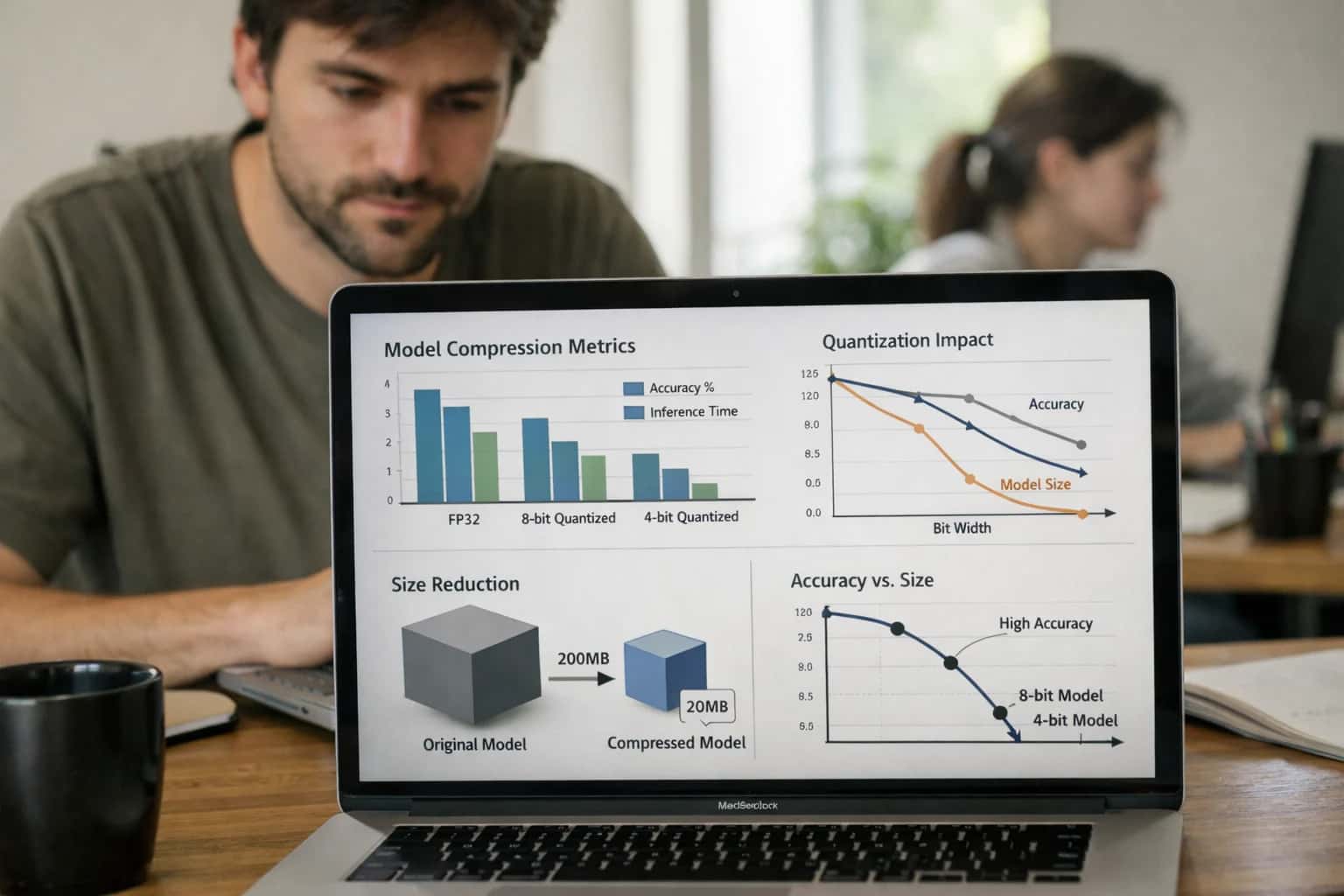
- Reduces model size by 4x for INT8 versus FP32.
- Enables the use of efficient, low-power integer arithmetic logic units (ALUs) ubiquitous in microcontrollers.
- Involves mapping a continuous range of floating-point values to a finite set of integers via a quantization function.
02
Symmetric vs. Asymmetric Schemes
Quantization is defined by how the floating-point range is mapped to the integer range.
- Symmetric Quantization: The quantization range is symmetric around zero. It uses a single scale factor and typically a zero-point of 0. This simplifies computation and is often used for weight tensors.
- Asymmetric Quantization: The range is defined by separate minimum and maximum values, resulting in a non-zero zero-point. This better captures skewed data distributions (e.g., ReLU activations) but adds a slight computational overhead for zero-point correction.
03
Scale and Zero-Point Parameters
The mapping between floating-point and integer domains is governed by two critical parameters derived during calibration.
- Scale (S): A floating-point value calculated as
(float_max - float_min) / (quant_max - quant_min). It defines the resolution of the quantized representation. - Zero-Point (Z): An integer value representing the quantized equivalent of the real number zero. It ensures that real zero can be exactly represented, which is crucial for operations like padding. The quantization formula is:
Q = round(R / S) + Z, where R is the real value and Q is the quantized integer.
04
Integer-Only Arithmetic
A core goal is to eliminate floating-point operations during inference. This is achieved by refactoring layer computations. For a matrix multiplication followed by bias addition:
- Weights (W) and activations (A) are pre-quantized to integers (
W_q,A_q). - The integer matrix multiplication
W_q * A_qis performed. - The result is rescaled using integer arithmetic on the pre-computed scale and zero-point values, yielding an integer output. This allows the entire inference graph to run using only integer addition and multiplication.
05
Calibration Requirement
Determining optimal scale and zero-point parameters requires a calibration step. A small, representative dataset is passed through the pre-trained FP32 model to collect statistics:
- Dynamic ranges (min/max) of activation tensors for each layer.
- These ranges are used to calculate the layer-specific quantization parameters. Calibration is critical for accuracy; poor range estimation leads to clipping (values outside the range are lost) or excessive quantization noise.
06
Hardware Acceleration Alignment
Integer quantization directly enables the use of specialized microcontroller and NPU features:
- SIMD (Single Instruction, Multiple Data) Units: Process multiple INT8 operands in a single instruction cycle.
- Dedicated INT8 MAC (Multiply-Accumulate) Pipelines: Found in modern microcontrollers and NPUs for extreme efficiency.
- Optimized Kernels: Libraries like CMSIS-NN provide hand-tuned, assembly-optimized INT8 convolution and fully connected layer implementations for Arm Cortex-M processors, maximizing throughput.
COMPARISON
Integer Quantization vs. Other Techniques
A feature and performance comparison of Integer Quantization against other common model compression and optimization techniques for microcontroller deployment.
| Feature / Metric | Integer Quantization (INT8) | Floating-Point (FP32) | Weight Pruning | Knowledge Distillation |
|---|---|---|---|---|
Primary Data Type | 8-bit integer | 32-bit floating-point | 32-bit floating-point (sparse) | 32-bit floating-point |
Arithmetic Hardware | Integer ALU (ubiquitous) | FPU (often absent on MCUs) | FPU or sparse-specific kernels | FPU |
Model Size Reduction | ~75% (vs. FP32) | 0% (baseline) | 20-90% (varies by sparsity) | 0% (teacher model size) |
Inference Speedup (Typical) | 2x - 4x | 1x (baseline) | 0.5x - 2x (depends on sparsity support) | 1x - 1.5x (student vs. teacher) |
Accuracy Loss (Typical) | 0.5% - 3% | 0% (baseline) | 1% - 5% | Often minimal (student vs. teacher) |
Requires Retraining | ||||
Requires Calibration Dataset | ||||
Compiler/OS Support | Widespread (TFLM, CMSIS-NN) | Universal | Limited (requires sparse kernels) | Universal |
Peak RAM Reduction | ~75% (activations) | 0% (baseline) | 0% (weights only) | 0% (model size unchanged) |
Deterministic Execution | ||||
Primary Use Case | General-purpose latency & size reduction | Maximum accuracy, development baseline | Extreme model size reduction | Transferring knowledge to a smaller architecture |
IMPLEMENTATION
Frameworks and Tools for Integer Quantization
Specialized software libraries and toolchains that enable the conversion, optimization, and deployment of integer-quantized neural networks onto microcontroller hardware.
INTEGER QUANTIZATION
Frequently Asked Questions
Integer quantization is a foundational technique for deploying neural networks on microcontrollers. These questions address its core mechanisms, trade-offs, and implementation details for performance engineers.
Integer quantization is a model compression technique that constrains a neural network's parameters (weights) and activations to integer values, enabling execution using efficient integer-only arithmetic. It works by mapping the continuous range of 32-bit floating-point values to a discrete set of lower-bit integers (e.g., INT8). This mapping is defined by a scaling factor (which converts between integer and floating-point ranges) and a zero-point (the integer representing the real value zero in asymmetric schemes). The process drastically reduces model memory footprint and accelerates inference on hardware lacking floating-point units.
Enabling Efficiency, Speed & Accuracy
Intelligent Analysis, Decision & Execution
We build AI systems for teams that need search across company data, workflow automation across tools, or AI features inside products and internal software.
Talk to Us
Search across company data
Give teams answers from docs, tickets, runbooks, and product data with sources and permissions.
Useful when people spend too long searching or get different answers from different systems.
Enterprise searchRAGPermissions
Read more
Automate internal workflows
Use AI to route work, draft outputs, trigger actions, and keep approvals and logs in place.
Useful when repetitive work moves across multiple tools and teams.
AI agentsWorkflow automationGovernance
Read more
Add AI to products and internal tools
Build assistants, guided actions, or decision support into the software your team or customers already use.
Useful when AI needs to be part of the product, not a separate tool.
AI integrationDecision supportModel routing
Read more
About the author
Prasad Kumkar
CEO & MD, Inference Systems
Prasad Kumkar is the CEO & MD of Inference Systems and writes about AI systems architecture, LLM infrastructure, model serving, evaluation, and production deployment. Over 5+ years, he has worked across computer vision models, L5 autonomous vehicle systems, and LLM research, with a focus on taking complex AI ideas into real-world engineering systems.
His work and writing cover AI systems, large language models, AI agents, multimodal systems, autonomous systems, inference optimization, RAG, evaluation, and production AI engineering.
LinkedIn
Limited slotsGet a Free AI Consultation
Partnered with leading AI, data, and software stack.





How We Work
Custom AI workflows for your Business
One-fit-all AI don't work for modern businesses. At Inferensys, we aim to understand your business & custom requirements; which we use to define most efficient agentic workflows, the data, and the tools for your business.
01
Review the use case
We understand the task, the users, and where AI can actually help.
Read more02
Pick the right approach
We define what needs search, automation, or product integration.
Read more03
Build the first useful version
We implement the part that proves the value first.
Read more04
Improve from there
We add the checks and visibility needed to keep it useful.
Read moreThe first call is a practical review of your use case and the right next step.
Talk to Us