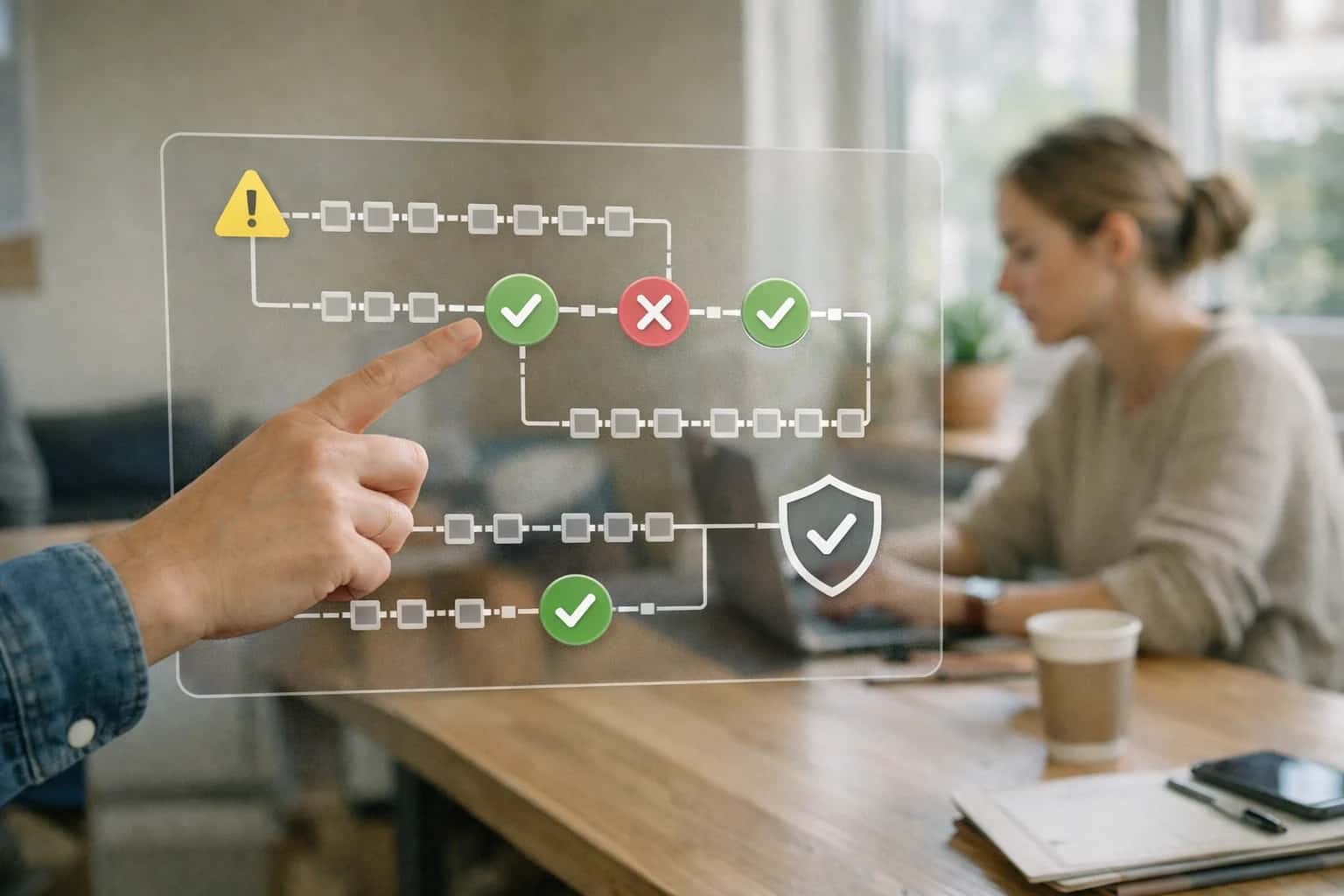
Data lineage is the end-to-end documentation of a data record's journey from its source system through every extract, transform, and load (ETL) process, aggregation, and consumption point. It creates a directed acyclic graph (DAG) that maps column-level dependencies, capturing how specific fields are derived, filtered, or joined, enabling engineers to perform precise root cause analysis and impact assessments before modifying production pipelines.

Glossary
Data Lineage
Data lineage is the process of tracking the origin, movement, transformation, and quality of data over its entire lifecycle, providing a complete audit trail for compliance and governance.
DATA GOVERNANCE
What is Data Lineage?
Data lineage is the lifecycle-spanning process of tracking data's origin, movement, transformation, and quality, providing a complete audit trail essential for compliance and debugging.
In sovereign cloud architectures, lineage metadata is critical for proving jurisdictional data residency to auditors. By cryptographically signing each transformation step and logging the geographic location of processing nodes, lineage tools provide immutable proof that data never crossed a forbidden border, satisfying the technical controls required by regulations like GDPR and the CLOUD Act.
FOUNDATIONAL CAPABILITIES
Core Characteristics of Data Lineage
Data lineage provides a complete, end-to-end map of data's journey from origin to consumption. It captures transformations, system hops, and ownership changes to create an irrefutable audit trail for compliance and operational debugging.
01
Backward Lineage
Traces data from its final output back to its raw source systems. This is critical for root cause analysis when a report or model output is incorrect.
- Answers: 'Where did this number come from?'
- Maps the full dependency chain of a dataset
- Essential for debugging data quality issues in production dashboards
02
Forward Lineage
Tracks data from its origin to all downstream consumers and transformations. This enables proactive impact analysis before making schema changes.
- Answers: 'What breaks if I change this column?'
- Identifies all downstream dependencies including models, reports, and APIs
- Prevents cascading failures in complex data pipelines
03
Column-Level Granularity
Captures transformations at the most atomic level—individual columns and fields—rather than just table-level movements. This precision is mandatory for regulatory compliance.
- Tracks how a specific PII field is masked or tokenized
- Validates that sensitive columns are handled per data residency rules
- Provides granular audit trails for GDPR and CCPA compliance
04
Automated Parsing
Uses static code analysis to automatically extract lineage from SQL queries, Python scripts, and ETL jobs without manual tagging. This eliminates documentation drift.
- Parses SQL dialects (SparkSQL, T-SQL, PL/SQL) natively
- Integrates with dbt, Airflow, and Databricks workflows
- Ensures lineage stays synchronized with actual code execution
05
Horizontal Lineage
Maps data movement across different systems, databases, and organizational boundaries. This is crucial for understanding cross-platform data flows in hybrid architectures.
- Tracks data from on-premises databases to cloud warehouses
- Visualizes handoffs between microservices via Kafka or APIs
- Identifies unauthorized data replication across environments
06
Temporal Versioning
Preserves a historical record of how data definitions and transformations have changed over time. This enables point-in-time audits and reproducibility.
- Reconstructs the exact logic used for a quarterly financial report from 18 months ago
- Compares current vs. historical transformation logic
- Supports regulatory inquiries that require historical data context
DATA LINEAGE EXPLAINED
Frequently Asked Questions
Clear, technical answers to the most common questions about tracking data origin, movement, and transformation across sovereign infrastructure.
Data lineage is the lifecycle-spanning process of tracking data's origin, movement, transformation, and quality from source to destination. It provides a complete, auditable map of how data flows through systems. The mechanism works by instrumenting data pipelines to capture metadata at every hop—recording input sources, applied transformations, timestamps, and responsible processes. This metadata is then stored in a lineage graph, a directed acyclic graph (DAG) where nodes represent datasets and edges represent transformations. In sovereign cloud architectures, lineage tools must operate within jurisdictionally-bound environments, ensuring the audit trail itself never leaves the designated data residency zone. Modern implementations use OpenLineage standards to emit standardized events from orchestration frameworks like Apache Airflow or Spark jobs, building a real-time, queryable map of data provenance.
TRACKING DATA PROVENANCE
Data Lineage in Practice
Data lineage provides a complete audit trail of data's origin, movement, and transformation across systems. These cards illustrate the core mechanisms and practical applications that make lineage essential for sovereign AI compliance.
01
Automated Lineage Harvesting
Modern lineage tools automatically parse SQL query logs, ETL job metadata, and Spark execution plans to construct lineage graphs without manual tagging. This reverse-engineering approach captures column-level transformations by analyzing the actual code that moves data.
- Parses INSERT, CREATE TABLE AS, and MERGE statements
- Tracks transformations across dbt models, Airflow DAGs, and Kafka streams
- Builds a directed acyclic graph (DAG) of data dependencies
Column-level
Granularity
02
Jurisdictional Boundary Enforcement
Lineage metadata tags each dataset with its legal jurisdiction of origin. When a downstream model or dashboard attempts to access data, the lineage graph is checked against geofencing policies to prevent cross-border data leakage.
- Tags data with ISO 3166 country codes at ingestion
- Prevents joins that would violate Schrems II or GDPR Chapter V transfer restrictions
- Generates real-time alerts when a pipeline attempts to move data across a jurisdictional boundary
03
Impact Analysis and Root Cause
When a source table schema changes or a data quality incident occurs, lineage graphs enable teams to instantly identify all downstream consumers—dashboards, ML models, and reverse ETL syncs—that will be affected.
- Traces a NULL value anomaly back to the specific ingestion batch and source system
- Calculates the blast radius of a breaking schema change before deployment
- Reduces incident triage time from hours to minutes
04
Immutable Lineage Audit Trails
For regulated industries, lineage records must be tamper-proof. Each lineage event is cryptographically hashed and stored in an append-only ledger, providing non-repudiable proof of data's chain of custody for auditors.
- Integrates with WORM (Write Once, Read Many) compliant storage
- Each transformation step receives a SHA-256 content hash
- Supports eDiscovery and regulatory examination without manual reconstruction
06
Fine-Grained Column-Level Lineage
Beyond table-level tracking, column-level lineage maps exactly how a specific field—such as customer_risk_score—is derived. This is critical for algorithmic explainability under regulations like the EU AI Act.
- Traces a model feature back through SQL window functions, UDFs, and feature stores
- Identifies which source columns contributed to a specific prediction
- Supports data subject access requests (DSARs) by pinpointing all personal data usage
Enabling Efficiency, Speed & Accuracy
Intelligent Analysis, Decision & Execution
We build AI systems for teams that need search across company data, workflow automation across tools, or AI features inside products and internal software.
Talk to Us
Search across company data
Give teams answers from docs, tickets, runbooks, and product data with sources and permissions.
Useful when people spend too long searching or get different answers from different systems.
Enterprise searchRAGPermissions
Read more
Automate internal workflows
Use AI to route work, draft outputs, trigger actions, and keep approvals and logs in place.
Useful when repetitive work moves across multiple tools and teams.
AI agentsWorkflow automationGovernance
Read more
Add AI to products and internal tools
Build assistants, guided actions, or decision support into the software your team or customers already use.
Useful when AI needs to be part of the product, not a separate tool.
AI integrationDecision supportModel routing
Read moreSOVEREIGN DATA GOVERNANCE
Data Lineage vs. Related Concepts
Distinguishing the audit-focused tracking of data provenance from related but distinct data management disciplines.
| Feature | Data Lineage | Data Provenance | Data Observability | Data Catalog |
|---|---|---|---|---|
Primary Purpose | Audit trail of data movement and transformation | Documentation of data origin and ownership | Monitoring data health and pipeline reliability | Inventory and discovery of data assets |
Core Question Answered | How was this data created and where did it go? | Where did this data come from and who created it? | Is the data fresh, complete, and reliable right now? | What data exists and where is it located? |
Temporal Focus | Historical and forward-looking | Historical (point of origin) | Real-time and current state | Current snapshot |
Granularity | Column-level and transformation-level | Dataset-level and system-level | Pipeline-level and metric-level | Dataset-level and schema-level |
Key Metadata Tracked | Inputs, outputs, transformation logic, job IDs | Creator, creation date, source system, digital signatures | Freshness, volume, schema changes, null counts | Schema, tags, owners, descriptions, classifications |
Primary Compliance Use | Article 30 RoPA, GDPR Art. 5 accuracy | GDPR Art. 5 transparency, consent attribution | SLAs, incident response, data contract enforcement | Data subject access requests, asset inventory |
Automated Enforcement | ||||
Typical Latency | < 1 sec to minutes | Static metadata | < 1 sec to seconds | Batch updated |

About the author
Prasad Kumkar
CEO & MD, Inference Systems
Prasad Kumkar is the CEO & MD of Inference Systems and writes about AI systems architecture, LLM infrastructure, model serving, evaluation, and production deployment. Over 5+ years, he has worked across computer vision models, L5 autonomous vehicle systems, and LLM research, with a focus on taking complex AI ideas into real-world engineering systems.
His work and writing cover AI systems, large language models, AI agents, multimodal systems, autonomous systems, inference optimization, RAG, evaluation, and production AI engineering.
LinkedIn
Limited slotsGet a Free AI Consultation
Partnered with leading AI, data, and software stack.





How We Work
Custom AI workflows for your Business
One-fit-all AI don't work for modern businesses. At Inferensys, we aim to understand your business & custom requirements; which we use to define most efficient agentic workflows, the data, and the tools for your business.
01
Review the use case
We understand the task, the users, and where AI can actually help.
Read more02
Pick the right approach
We define what needs search, automation, or product integration.
Read more03
Build the first useful version
We implement the part that proves the value first.
Read more04
Improve from there
We add the checks and visibility needed to keep it useful.
Read moreThe first call is a practical review of your use case and the right next step.
Talk to Us