Compliance as Code translates human-readable policy documents and regulatory frameworks into executable code. By codifying rules from standards like NIST 800-53 or CIS Benchmarks, organizations replace manual, point-in-time audits with continuous, automated validation. This ensures that every infrastructure change or application deployment is programmatically assessed against the required security posture before reaching production, eliminating configuration drift.

Glossary
Compliance as Code
The practice of defining regulatory and security compliance rules in a machine-readable, programmable format that can be automatically tested and enforced within a CI/CD pipeline.
AUTOMATED GOVERNANCE
What is Compliance as Code?
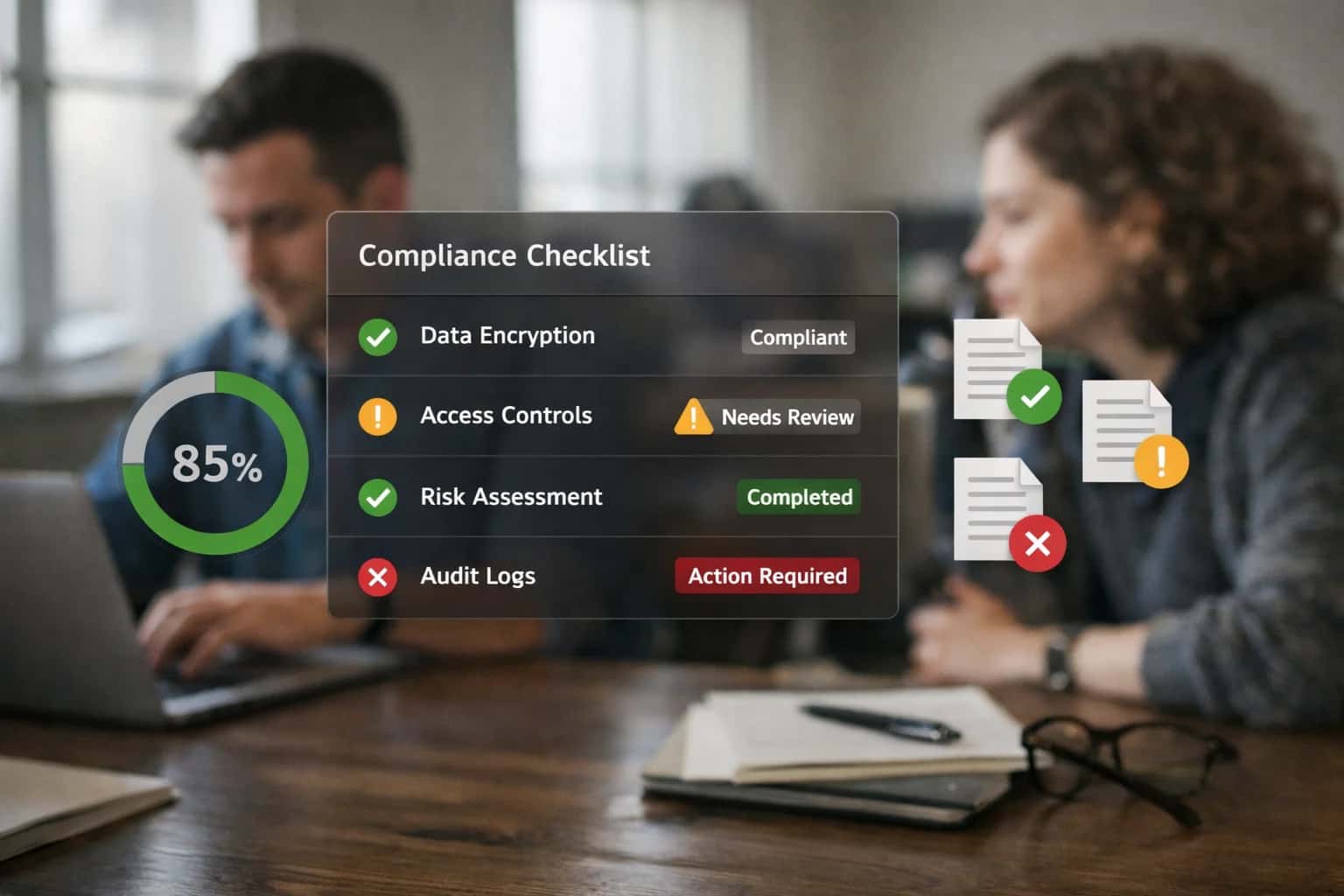
Compliance as Code (CaC) is the methodology of defining regulatory, security, and organizational policy requirements in a machine-readable, programmable format that can be automatically tested, validated, and enforced within a software delivery pipeline.
In a CI/CD pipeline, CaC tools integrate directly with Infrastructure as Code (IaC) templates and container registries to perform automated checks. A misconfigured storage bucket or an open network port triggers an immediate policy violation, blocking the deployment. This shift-left approach embeds governance into the engineering workflow, providing an immutable audit trail and enabling continuous authority to operate (cATO) in highly regulated sovereign cloud environments.
AUTOMATED GOVERNANCE
Key Features of Compliance as Code
Compliance as Code transforms manual audit processes into automated, verifiable pipelines. These core features define a mature implementation.
02
Automated Evidence Collection
The continuous, agentless harvesting of telemetry from infrastructure, applications, and APIs to prove control effectiveness. This eliminates manual screenshot-based audits.
- Immutable Logs: Evidence is cryptographically hashed and stored in append-only storage.
- Continuous Monitoring: Shifts from point-in-time audits to near-real-time compliance posture.
- API-First Collection: Integrates directly with cloud provider APIs (AWS CloudTrail, Azure Activity Log) to gather raw configuration data.
03
Pipeline-Driven Remediation
The integration of compliance checks directly into the CI/CD pipeline, preventing non-compliant infrastructure from being deployed. This acts as a hard gate, not a passive warning.
- Shift-Left Security: Misconfigurations are caught during
terraform plan, not after production deployment. - Auto-Remediation: Simple drift violations can trigger automated pull requests or rollback jobs.
- Terraform Sentinel/OPA Conftest: Common tools that enforce policies during the build phase.
04
Drift Detection & Reconciliation
The mechanism that identifies when the live state of a system has deviated from the desired state defined in code. This detects 'click-ops' manual changes that bypass the pipeline.
- State Reconciliation: Tools continuously compare the declared policy state against the actual resource state.
- Alerting on Deviation: Immediate notifications are triggered when a resource becomes non-compliant.
- Immutable Infrastructure: Drift is often resolved by destroying the non-compliant resource and redeploying a compliant one, rather than patching in place.
05
Compliance as a Data Model
The abstraction of complex regulatory frameworks (e.g., SOC 2, HIPAA, GDPR) into structured JSON or YAML control mappings. This separates the 'what' (the regulation) from the 'how' (the technical implementation).
- Control Inheritance: A single technical control (e.g., 'Encrypt data at rest') can map to multiple regulatory requirements.
- Standardized Schemas: Frameworks like OSCAL (Open Security Controls Assessment Language) provide a standardized XML/JSON schema for representing controls.
- Automated Reporting: Dashboards are generated directly from the data model, providing real-time audit readiness.
06
Immutable Audit Trails
A cryptographically verifiable, tamper-proof record of every compliance decision, policy change, and remediation action. This serves as the primary artifact for external auditors.
- Non-Repudiation: Every action is signed and attributed to a specific identity or service account.
- WORM Storage: Write-Once-Read-Many storage prevents alteration of historical compliance records.
- Provenance Tracking: Tracks the full lineage of a policy from its Git commit hash to its enforcement point.
COMPLIANCE AS CODE
Frequently Asked Questions
Clear, technically precise answers to the most common questions about defining, testing, and enforcing regulatory and security rules programmatically within automated software delivery pipelines.
Compliance as Code (CaC) is the practice of defining regulatory, security, and organizational policy requirements in a machine-readable, executable format that can be automatically validated, tested, and enforced within a CI/CD pipeline. It transforms static, human-readable policy documents into programmatic assertions that run against infrastructure and application configurations. The mechanism works by codifying rules—such as 'encryption must be AES-256' or 'storage buckets must not be publicly readable'—using policy-as-code languages like Open Policy Agent's Rego, HashiCorp Sentinel, or cloud-native tools like AWS Config Rules. These rules are stored in a version-controlled repository, integrated into the build and deployment pipeline, and executed automatically. When a deployment artifact or an Infrastructure as Code template (e.g., a Terraform plan) is generated, the CaC engine evaluates it against the defined policies. A non-compliant result triggers a hard failure, blocking the deployment and notifying the developer, creating a closed-loop, preventative control rather than a reactive audit.
Enabling Efficiency, Speed & Accuracy
Intelligent Analysis, Decision & Execution
We build AI systems for teams that need search across company data, workflow automation across tools, or AI features inside products and internal software.
Talk to Us
Search across company data
Give teams answers from docs, tickets, runbooks, and product data with sources and permissions.
Useful when people spend too long searching or get different answers from different systems.
Enterprise searchRAGPermissions
Read more
Automate internal workflows
Use AI to route work, draft outputs, trigger actions, and keep approvals and logs in place.
Useful when repetitive work moves across multiple tools and teams.
AI agentsWorkflow automationGovernance
Read more
Add AI to products and internal tools
Build assistants, guided actions, or decision support into the software your team or customers already use.
Useful when AI needs to be part of the product, not a separate tool.
AI integrationDecision supportModel routing
Read more
About the author
Prasad Kumkar
CEO & MD, Inference Systems
Prasad Kumkar is the CEO & MD of Inference Systems and writes about AI systems architecture, LLM infrastructure, model serving, evaluation, and production deployment. Over 5+ years, he has worked across computer vision models, L5 autonomous vehicle systems, and LLM research, with a focus on taking complex AI ideas into real-world engineering systems.
His work and writing cover AI systems, large language models, AI agents, multimodal systems, autonomous systems, inference optimization, RAG, evaluation, and production AI engineering.
LinkedIn
Limited slotsGet a Free AI Consultation
Partnered with leading AI, data, and software stack.





How We Work
Custom AI workflows for your Business
One-fit-all AI don't work for modern businesses. At Inferensys, we aim to understand your business & custom requirements; which we use to define most efficient agentic workflows, the data, and the tools for your business.
01
Review the use case
We understand the task, the users, and where AI can actually help.
Read more02
Pick the right approach
We define what needs search, automation, or product integration.
Read more03
Build the first useful version
We implement the part that proves the value first.
Read more04
Improve from there
We add the checks and visibility needed to keep it useful.
Read moreThe first call is a practical review of your use case and the right next step.
Talk to Us