Bare-metal orchestration is the programmatic control layer that automates the entire lifecycle of physical servers—from initial power-on and firmware configuration to operating system imaging and workload scheduling—without any virtualization abstraction. Unlike cloud orchestration tools that manage virtual machines, bare-metal orchestrators interact directly with server Baseboard Management Controllers (BMCs) via protocols like Redfish API and IPMI to execute out-of-band provisioning. This eliminates the performance overhead of hypervisors, granting AI workloads direct, uncontested access to GPUs, NVLink interconnects, and RDMA-capable network fabrics for maximum computational throughput.

Glossary
Bare-Metal Orchestration
The automated provisioning, configuration, and lifecycle management of physical servers without a hypervisor layer, providing direct hardware access for maximum GPU performance in dedicated AI clusters.
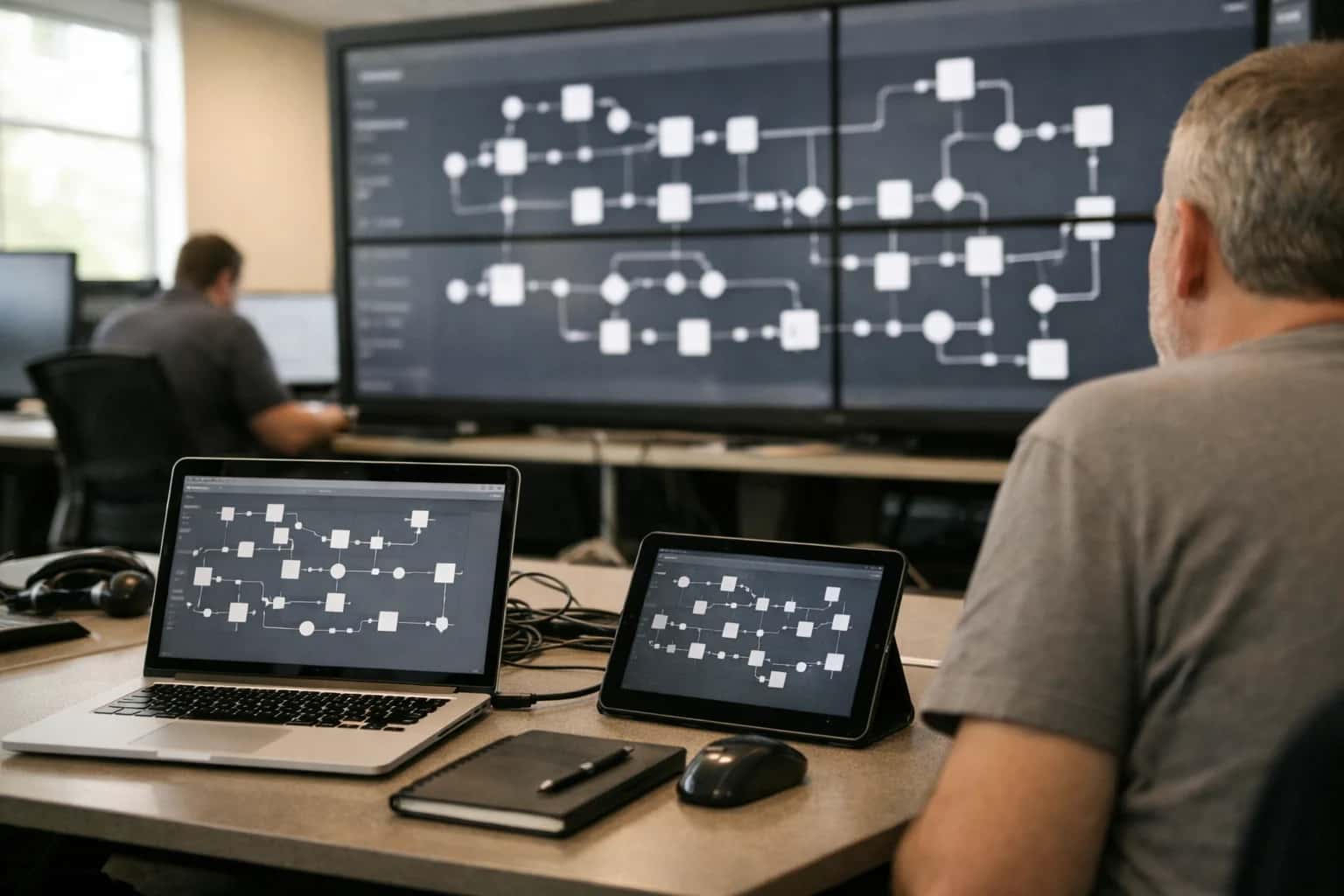
PHYSICAL SERVER AUTOMATION
What is Bare-Metal Orchestration?
Bare-metal orchestration is the automated provisioning, configuration, and lifecycle management of physical servers without a hypervisor layer, providing direct hardware access for maximum performance in dedicated AI clusters.
In sovereign AI infrastructure, bare-metal orchestration is critical for enforcing hardware-level security and deterministic performance. Platforms like MAAS (Metal as a Service) and Canonical's Juju integrate with Slurm workload managers and GPU Operators to dynamically allocate entire physical nodes to training jobs, ensuring strict NUMA alignment and direct GPUDirect data paths. This orchestration layer manages the full state machine of a server—commissioning, testing via GPU burn-in, deploying immutable OS images, and securely decommissioning—while maintaining a hardware root of trust through firmware attestation, ensuring no unauthorized software compromises the physical compute substrate.
CORE CAPABILITIES
Key Features of Bare-Metal Orchestration
Bare-metal orchestration automates the provisioning and lifecycle management of physical servers, providing direct hardware access without a hypervisor layer for maximum GPU performance in dedicated AI clusters.
01
Declarative Infrastructure Provisioning
Administrators define the desired physical server state—including firmware versions, BIOS settings, and disk partitioning—in code. The orchestration platform automatically reconciles the actual hardware state with this declaration, enabling immutable infrastructure patterns for physical nodes. This eliminates manual racking errors and ensures every GPU node is provisioned identically.
- Uses YAML or JSON-based configuration files
- Integrates with Redfish API for out-of-band management
- Supports PXE boot and iPXE for network-based OS installation
< 15 min
Node Provisioning Time
02
Hypervisor-Free GPU Access
By eliminating the virtualization layer, bare-metal orchestration grants workloads direct, unmediated access to GPU accelerators. This avoids the I/O overhead and PCIe passthrough complexity associated with hypervisors, ensuring that NCCL collective operations and GPUDirect RDMA data paths operate at full line rate without translation penalties.
- No virtual GPU (vGPU) licensing costs
- Full Multi-Instance GPU (MIG) partitioning control
- Eliminates the 'noisy neighbor' problem of shared virtualized hosts
~0%
Virtualization Overhead
03
Automated Firmware & Driver Lifecycle
The orchestrator manages the entire firmware stack, including GPU vBIOS, NIC firmware, and storage controller firmware, ensuring version consistency across the cluster. It automates the rollout of CUDA drivers and GPU Operator components, performing rolling updates that cordon and drain workloads before re-provisioning nodes to prevent training job interruptions.
- Integrates with DCGM for health validation post-update
- Maintains a cryptographically signed firmware manifest
- Supports canary deployment strategies for driver rollouts
04
Hardware-Aware Workload Scheduling
The orchestration layer exposes detailed hardware topology metadata—including NUMA node layout, GPU-to-GPU NVLink connectivity, and network fabric locality—to the scheduler. This enables intelligent placement of distributed training jobs that minimizes inter-node latency and maximizes intra-node bandwidth by aligning pod placement with the underlying physical spine-leaf architecture.
- Considers HBM3e memory capacity per accelerator
- Aligns NCCL ring formation with physical topology
- Prevents cross-NUMA memory access penalties
05
Out-of-Band Power & Thermal Control
Orchestration platforms interface with Baseboard Management Controllers (BMCs) via the Redfish API to enforce power capping policies and monitor thermal thresholds. This is critical for direct liquid cooling environments where coolant flow rates and inlet temperatures must be coordinated with compute load to prevent thermal throttling of high-TDP GPUs during sustained training runs.
- Dynamic power capping to stay within rack power budgets
- Automated emergency shutdown on thermal excursion
- Integration with facility-level DCIM systems
06
Immutable Image Provisioning
Nodes are provisioned from versioned, pre-built OS images containing the exact kernel version, CUDA toolkit, and container runtime required. This ensures bit-for-bit reproducibility across the cluster and eliminates configuration drift. Images are streamed via iSCSI or NVMe-oF from a central repository, allowing a node to transition from bare silicon to a fully operational Kubernetes worker in minutes.
- Supports Lustre client configuration in the image
- Integrates with private container registries for air-gapped sites
- Enables rapid rollback to known-good images
Enabling Efficiency, Speed & Accuracy
Intelligent Analysis, Decision & Execution
We build AI systems for teams that need search across company data, workflow automation across tools, or AI features inside products and internal software.
Talk to Us
Search across company data
Give teams answers from docs, tickets, runbooks, and product data with sources and permissions.
Useful when people spend too long searching or get different answers from different systems.
Enterprise searchRAGPermissions
Read more
Automate internal workflows
Use AI to route work, draft outputs, trigger actions, and keep approvals and logs in place.
Useful when repetitive work moves across multiple tools and teams.
AI agentsWorkflow automationGovernance
Read more
Add AI to products and internal tools
Build assistants, guided actions, or decision support into the software your team or customers already use.
Useful when AI needs to be part of the product, not a separate tool.
AI integrationDecision supportModel routing
Read moreBARE-METAL ORCHESTRATION
Frequently Asked Questions
Direct answers to the most common technical questions about provisioning and managing physical GPU servers without a hypervisor layer for maximum AI workload performance.
Bare-metal orchestration is the automated provisioning, configuration, and lifecycle management of physical servers without a hypervisor layer, granting workloads direct, unmediated access to CPU, memory, and accelerator hardware. Unlike virtualized environments where a hypervisor abstracts hardware and introduces overhead, bare-metal orchestration eliminates the performance tax of virtualization—typically 2-5% for CPU but significantly higher for GPU workloads due to PCIe passthrough complexity and memory translation. The orchestrator, such as MAAS (Metal as a Service) or Tinkerbell, uses IPMI and PXE boot to discover, image, and configure physical nodes declaratively. For AI clusters, this direct hardware access is critical: it enables GPUDirect RDMA across nodes, avoids NUMA misalignment penalties, and ensures consistent, reproducible benchmark performance for distributed training jobs using NCCL.

About the author
Prasad Kumkar
CEO & MD, Inference Systems
Prasad Kumkar is the CEO & MD of Inference Systems and writes about AI systems architecture, LLM infrastructure, model serving, evaluation, and production deployment. Over 5+ years, he has worked across computer vision models, L5 autonomous vehicle systems, and LLM research, with a focus on taking complex AI ideas into real-world engineering systems.
His work and writing cover AI systems, large language models, AI agents, multimodal systems, autonomous systems, inference optimization, RAG, evaluation, and production AI engineering.
LinkedIn
Limited slotsGet a Free AI Consultation
Partnered with leading AI, data, and software stack.





How We Work
Custom AI workflows for your Business
One-fit-all AI don't work for modern businesses. At Inferensys, we aim to understand your business & custom requirements; which we use to define most efficient agentic workflows, the data, and the tools for your business.
01
Review the use case
We understand the task, the users, and where AI can actually help.
Read more02
Pick the right approach
We define what needs search, automation, or product integration.
Read more03
Build the first useful version
We implement the part that proves the value first.
Read more04
Improve from there
We add the checks and visibility needed to keep it useful.
Read moreThe first call is a practical review of your use case and the right next step.
Talk to Us