Helm chart offline packaging is the technical procedure of resolving and bundling all external dependencies of a Kubernetes application definition into a self-contained artifact. This process involves executing helm dependency update to fetch and cache subcharts, then using helm package to create a compressed .tgz chart archive. The critical distinction from standard packaging is the parallel extraction of every container image referenced in the chart's templates and values files, which are then exported via tools like skopeo or docker save to create a co-located image tarball, ensuring no runtime pull from an external registry is required.

Glossary
Helm Chart Offline Packaging
The process of bundling a Helm chart and all its dependent container images into a single transportable archive for deployment into a disconnected Kubernetes cluster.
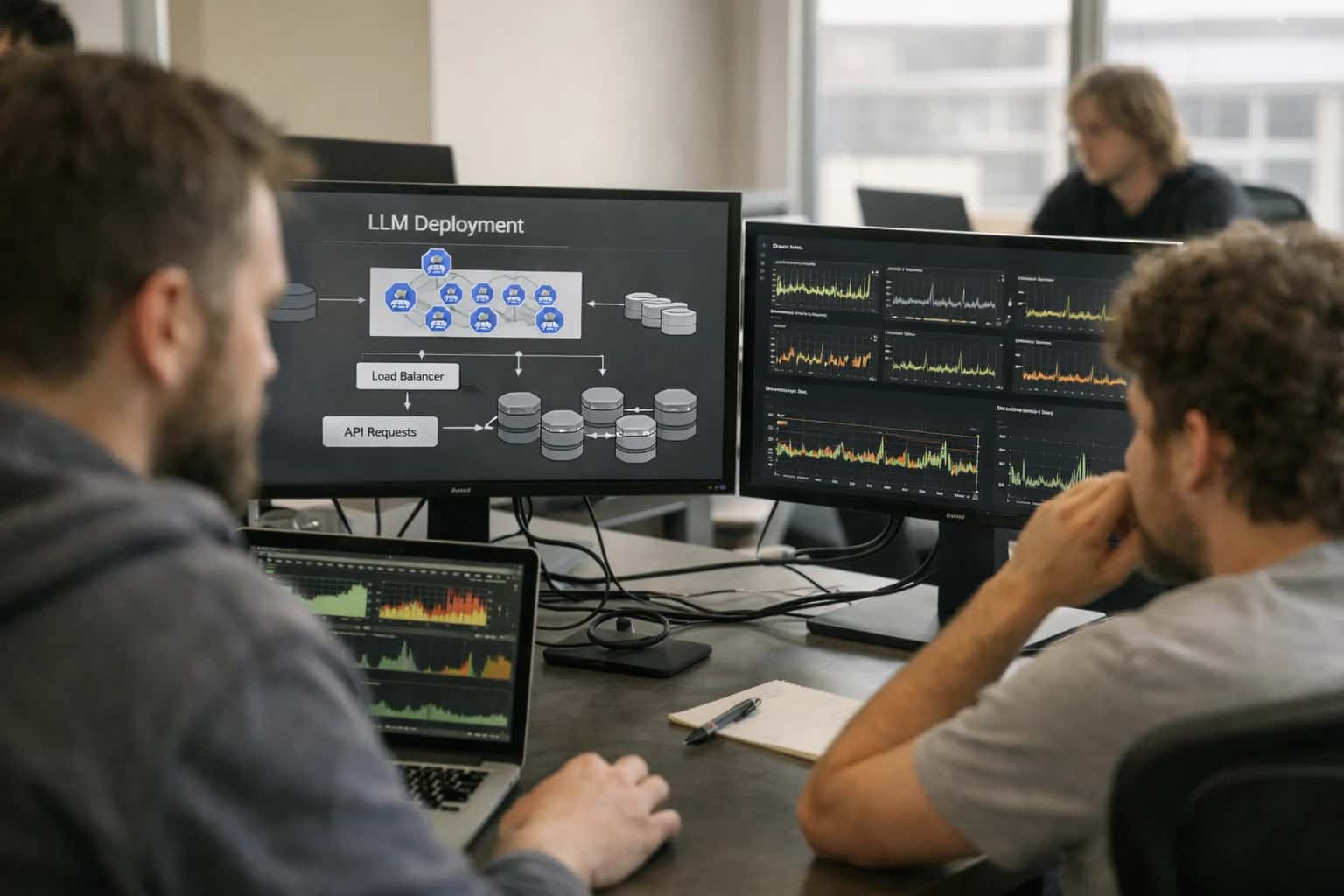
AIR-GAPPED DEPLOYMENT STRATEGY
What is Helm Chart Offline Packaging?
Helm chart offline packaging is the systematic process of bundling a Helm chart, its subchart dependencies, and all referenced container images into a single, transportable archive for deployment into a disconnected or air-gapped Kubernetes cluster.
The resulting offline bundle is physically transferred to the air-gapped environment using a data diode or removable media, where a private registry is primed with the container images and the chart is pushed to a local chart museum or OCI-compliant repository. This methodology eliminates the ImagePullBackOff errors that occur when a disconnected cluster attempts to contact public registries like Docker Hub or gcr.io. For sovereign AI infrastructure, this guarantees that the entire software supply chain for a model-serving stack—including the GPU Operator, inference server, and autoscaler—is verified, immutable, and deployable without any external network dependency.
OFFLINE PACKAGING
Key Characteristics
Helm chart offline packaging transforms a dynamic, network-dependent deployment artifact into a static, self-contained archive suitable for air-gapped environments. This process ensures that every dependency, from the chart metadata to the container images, is locally resolvable.
01
Complete Dependency Resolution
The packaging process recursively resolves and bundles all subcharts and their transitive dependencies into a single archive. This eliminates the need for the target cluster to reach out to external Helm repositories. The final package is a .tgz file containing the full chart tree, ensuring that a helm install command in a disconnected environment will not fail due to a missing requirements.yaml dependency.
02
Container Image Relocation
A critical companion step is the relocation of all referenced container images. Tools like helm chart save or skopeo are used to:
- Scan the rendered manifests for every image reference
- Pull images from external registries
- Re-tag them to point to a private registry accessible in the air gap
- Push them to that internal registry This ensures that when a pod is scheduled, the kubelet can pull the image without an internet connection.
03
Immutable Archive Creation
The output is a single, versioned, immutable .tgz artifact. This archive becomes the source of truth for that specific release in the disconnected environment. Its immutability guarantees that the exact same set of files and metadata tested in staging is what gets deployed to production, eliminating configuration drift caused by dynamic repository lookups. Verification is done via a sha256 checksum.
04
OCI-Compliant Storage
Modern Helm packaging leverages Open Container Initiative (OCI) registries as a universal storage layer. Instead of relying solely on legacy chart repositories, a chart and its associated images can be bundled and pushed as OCI artifacts to a single private registry. This unifies the storage and access control model for both application code and its runtime dependencies under one standard API.
05
Air-Gap Deployment Readiness
The packaged chart is explicitly designed for environments with a physical air gap. It assumes zero external network egress. All hooks, init containers, and custom resource definitions (CRDs) must be pre-cached. The packaging workflow often integrates with a private registry mirroring script to automate the entire bundling process, converting a dynamic Helm chart into a static, air-gap-compliant deployment unit.
HELM CHART OFFLINE PACKAGING
Frequently Asked Questions
Answers to the most common technical questions about bundling, transporting, and deploying Helm charts into air-gapped and disconnected Kubernetes environments.
Helm chart offline packaging is the process of bundling a Helm chart and every OCI-compliant container image it references into a single, transportable archive for deployment into a disconnected Kubernetes cluster with no internet access. The workflow begins by rendering the chart to identify all image: fields, then using a tool like helm chart save or skopeo to pull each image into a local cache. These images are exported as .tar files alongside the chart's .tgz package. The entire directory structure is then compressed into a monolithic archive, physically transferred via removable media, and loaded into a private container registry on the air-gapped side. This guarantees that a helm install command can succeed without any external pull requests, satisfying strict data residency enforcement and air-gapped model deployment requirements.
Enabling Efficiency, Speed & Accuracy
Intelligent Analysis, Decision & Execution
We build AI systems for teams that need search across company data, workflow automation across tools, or AI features inside products and internal software.
Talk to Us
Search across company data
Give teams answers from docs, tickets, runbooks, and product data with sources and permissions.
Useful when people spend too long searching or get different answers from different systems.
Enterprise searchRAGPermissions
Read more
Automate internal workflows
Use AI to route work, draft outputs, trigger actions, and keep approvals and logs in place.
Useful when repetitive work moves across multiple tools and teams.
AI agentsWorkflow automationGovernance
Read more
Add AI to products and internal tools
Build assistants, guided actions, or decision support into the software your team or customers already use.
Useful when AI needs to be part of the product, not a separate tool.
AI integrationDecision supportModel routing
Read more
About the author
Prasad Kumkar
CEO & MD, Inference Systems
Prasad Kumkar is the CEO & MD of Inference Systems and writes about AI systems architecture, LLM infrastructure, model serving, evaluation, and production deployment. Over 5+ years, he has worked across computer vision models, L5 autonomous vehicle systems, and LLM research, with a focus on taking complex AI ideas into real-world engineering systems.
His work and writing cover AI systems, large language models, AI agents, multimodal systems, autonomous systems, inference optimization, RAG, evaluation, and production AI engineering.
LinkedIn
Limited slotsGet a Free AI Consultation
Partnered with leading AI, data, and software stack.





How We Work
Custom AI workflows for your Business
One-fit-all AI don't work for modern businesses. At Inferensys, we aim to understand your business & custom requirements; which we use to define most efficient agentic workflows, the data, and the tools for your business.
01
Review the use case
We understand the task, the users, and where AI can actually help.
Read more02
Pick the right approach
We define what needs search, automation, or product integration.
Read more03
Build the first useful version
We implement the part that proves the value first.
Read more04
Improve from there
We add the checks and visibility needed to keep it useful.
Read moreThe first call is a practical review of your use case and the right next step.
Talk to Us