An offline vulnerability scan is a security assessment methodology designed for air-gapped environments where a scanner cannot reach the public internet to download the latest threat signatures. The process relies on a manually imported definition file—often transferred via a sneakernet protocol—to update a local mirror of a vulnerability database. The scanner then interrogates operating systems, applications, and configurations against this static snapshot to identify known Common Vulnerabilities and Exposures (CVEs) and security misconfigurations without ever establishing an outbound connection.

Glossary
Offline Vulnerability Scan
A security assessment process that identifies software flaws and misconfigurations within a physically disconnected network by using a locally hosted scanner and manually imported vulnerability definition files.
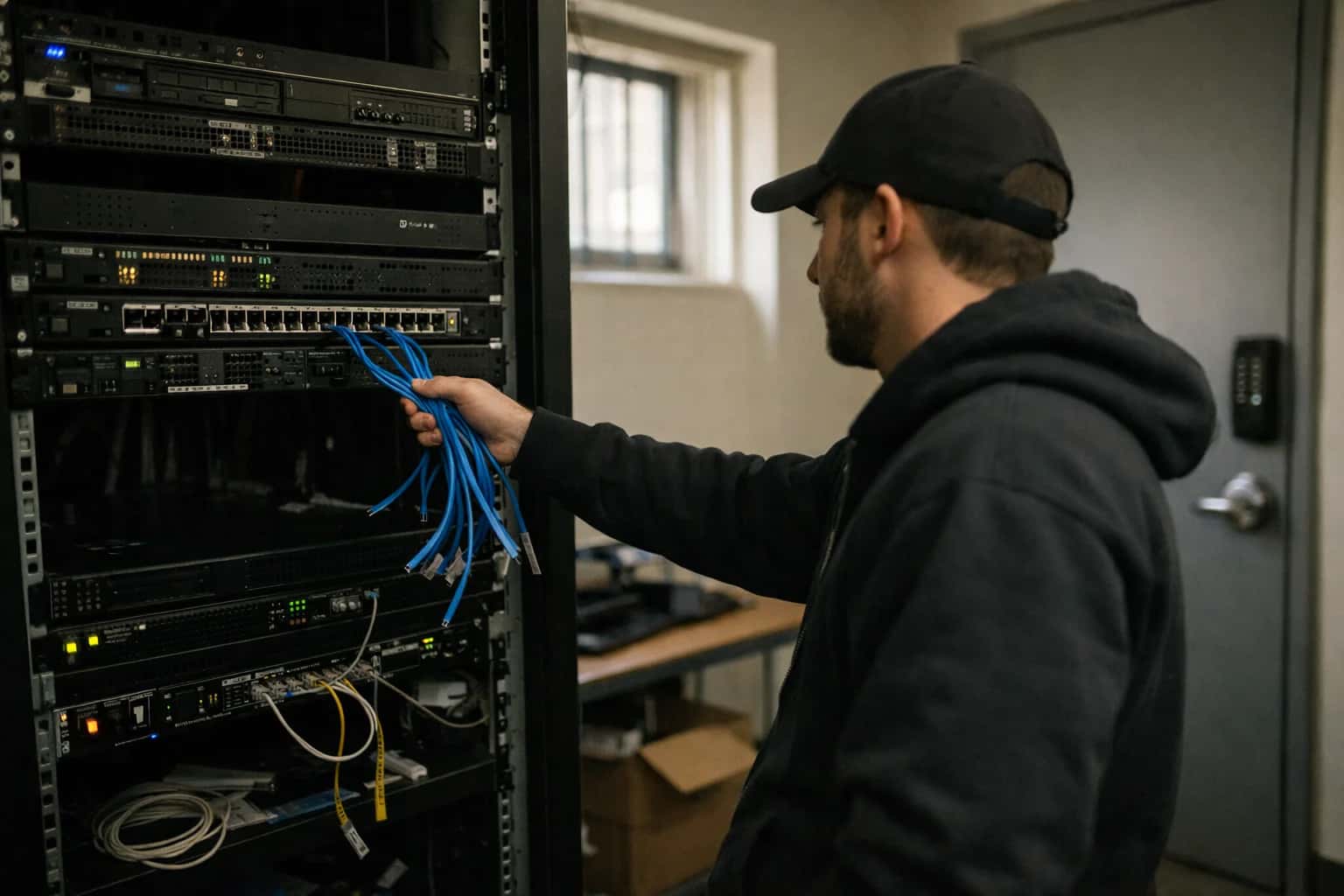
AIR-GAPPED SECURITY ASSESSMENT
What is Offline Vulnerability Scan?
An offline vulnerability scan is the process of executing a vulnerability assessment using a locally hosted scanner and a manually imported, static copy of a vulnerability database within a network that has no external connectivity.
This technique is critical for sovereign artificial intelligence infrastructure and defense systems, where the risk of network exfiltration outweighs the convenience of cloud-synced updates. The integrity of the scan depends on rigorous removable media validation and supply chain integrity checks to ensure the definition files themselves are not compromised. By comparing system fingerprints against a cryptographically verified, offline database, operators maintain a strict zero-trust architecture posture, proving compliance without violating the physical isolation of the secure enclave.
VULNERABILITY MANAGEMENT
Core Characteristics of Offline Scanning
Offline vulnerability scanning is the systematic process of identifying security flaws within an air-gapped network using a locally hosted scanner and manually imported threat intelligence, ensuring no external connectivity is required.
01
Manual Definition Import
The scanner relies on a sneakernet protocol to receive updates. Vulnerability definition files, often in SCAP or OVAL formats, are downloaded in a low-side environment, validated, and physically transferred via removable media validation to the high-side network. This breaks the kill chain by ensuring the scanner's intelligence is never exposed to a live network.
Air-Gapped
Update Mechanism
02
Localized Scan Engine
The scanning engine operates entirely within the disconnected container runtime. It requires no cloud lookups or external API calls. The engine parses the imported definitions and probes local assets using credentialed or agent-based methods. Key capabilities include:
- Authenticated scans for deep configuration assessment
- Agentless network scans for unmanaged devices
- Container image scanning against a local, air-gapped registry
03
Asset Discovery & Fingerprinting
Before scanning, the tool must map the air-gapped attack surface. It performs passive and active discovery to fingerprint operating systems, open ports, and installed software. This Bill of Materials (BOM) verification process correlates discovered components against the imported vulnerability database to identify missing patches and zero-day exposures without transmitting a single packet outside the enclave.
04
Compliance & Hardening Audits
Beyond CVE detection, offline scanners enforce Policy as Code (PaC) by checking configurations against CIS Benchmarks or DISA STIGs. The scanner generates a delta report showing deviations from the hardened kernel or immutable infrastructure baseline, providing auditors with cryptographic proof of the system's security posture without requiring network access to a central compliance dashboard.
05
Remediation & Reporting
The final output is a localized, human-readable report detailing risk scores and remediation steps. Because the system is air-gapped, automated patching is often replaced by a manual break-glass procedure or a scheduled maintenance window where signed patches are imported via data diode technologies. Reports are stored in a tamper-proof model registry equivalent to maintain an immutable audit trail.
OFFLINE VULNERABILITY SCANNING
Frequently Asked Questions
Addressing the most common technical questions regarding the execution of vulnerability scans within physically isolated, air-gapped networks where no external connectivity exists.
An offline vulnerability scan is a security assessment process that identifies software flaws, misconfigurations, and missing patches on systems within a network that has no external connectivity. Unlike cloud-based scanners, it operates by ingesting a manually imported, local copy of a vulnerability definition database—typically transferred via a sneakernet protocol using removable media. The scanner engine correlates this local database against the software inventory, open ports, and configuration states of target hosts. Because the scanner cannot reach the internet to fetch the latest Common Vulnerabilities and Exposures (CVE) data, the efficacy of the scan is entirely dependent on the freshness of the manually updated offline feed. This process ensures that highly sensitive air-gapped model deployment environments can maintain a robust security posture without violating data sovereignty or creating a bridge to external networks.
Enabling Efficiency, Speed & Accuracy
Intelligent Analysis, Decision & Execution
We build AI systems for teams that need search across company data, workflow automation across tools, or AI features inside products and internal software.
Talk to Us
Search across company data
Give teams answers from docs, tickets, runbooks, and product data with sources and permissions.
Useful when people spend too long searching or get different answers from different systems.
Enterprise searchRAGPermissions
Read more
Automate internal workflows
Use AI to route work, draft outputs, trigger actions, and keep approvals and logs in place.
Useful when repetitive work moves across multiple tools and teams.
AI agentsWorkflow automationGovernance
Read more
Add AI to products and internal tools
Build assistants, guided actions, or decision support into the software your team or customers already use.
Useful when AI needs to be part of the product, not a separate tool.
AI integrationDecision supportModel routing
Read moreSCANNING METHODOLOGY COMPARISON
Offline vs. Online Vulnerability Scanning
Comparing the operational characteristics, security properties, and infrastructure requirements of vulnerability scanning in air-gapped environments versus internet-connected deployments.
| Feature | Offline Scanning | Online Scanning | Hybrid Scanning |
|---|---|---|---|
Network connectivity required | One-way data diode only | ||
Definition update method | Manual sneakernet import | Automatic vendor feeds | Unidirectional push from low side |
External attack surface | None | Exposed to internet threats | Minimal (physical layer only) |
Scan initiation trigger | Scheduled or manual | Continuous or scheduled | Scheduled via air-gapped orchestrator |
Definition freshness latency | Days to weeks | Real-time to hours | Hours to days |
Data exfiltration risk | Eliminated | Present | Physically impossible |
Compliance with air-gap mandates | |||
Infrastructure complexity | High (manual processes) | Low (automated) | Very high (CDS integration) |

About the author
Prasad Kumkar
CEO & MD, Inference Systems
Prasad Kumkar is the CEO & MD of Inference Systems and writes about AI systems architecture, LLM infrastructure, model serving, evaluation, and production deployment. Over 5+ years, he has worked across computer vision models, L5 autonomous vehicle systems, and LLM research, with a focus on taking complex AI ideas into real-world engineering systems.
His work and writing cover AI systems, large language models, AI agents, multimodal systems, autonomous systems, inference optimization, RAG, evaluation, and production AI engineering.
LinkedIn
Limited slotsGet a Free AI Consultation
Partnered with leading AI, data, and software stack.





How We Work
Custom AI workflows for your Business
One-fit-all AI don't work for modern businesses. At Inferensys, we aim to understand your business & custom requirements; which we use to define most efficient agentic workflows, the data, and the tools for your business.
01
Review the use case
We understand the task, the users, and where AI can actually help.
Read more02
Pick the right approach
We define what needs search, automation, or product integration.
Read more03
Build the first useful version
We implement the part that proves the value first.
Read more04
Improve from there
We add the checks and visibility needed to keep it useful.
Read moreThe first call is a practical review of your use case and the right next step.
Talk to Us