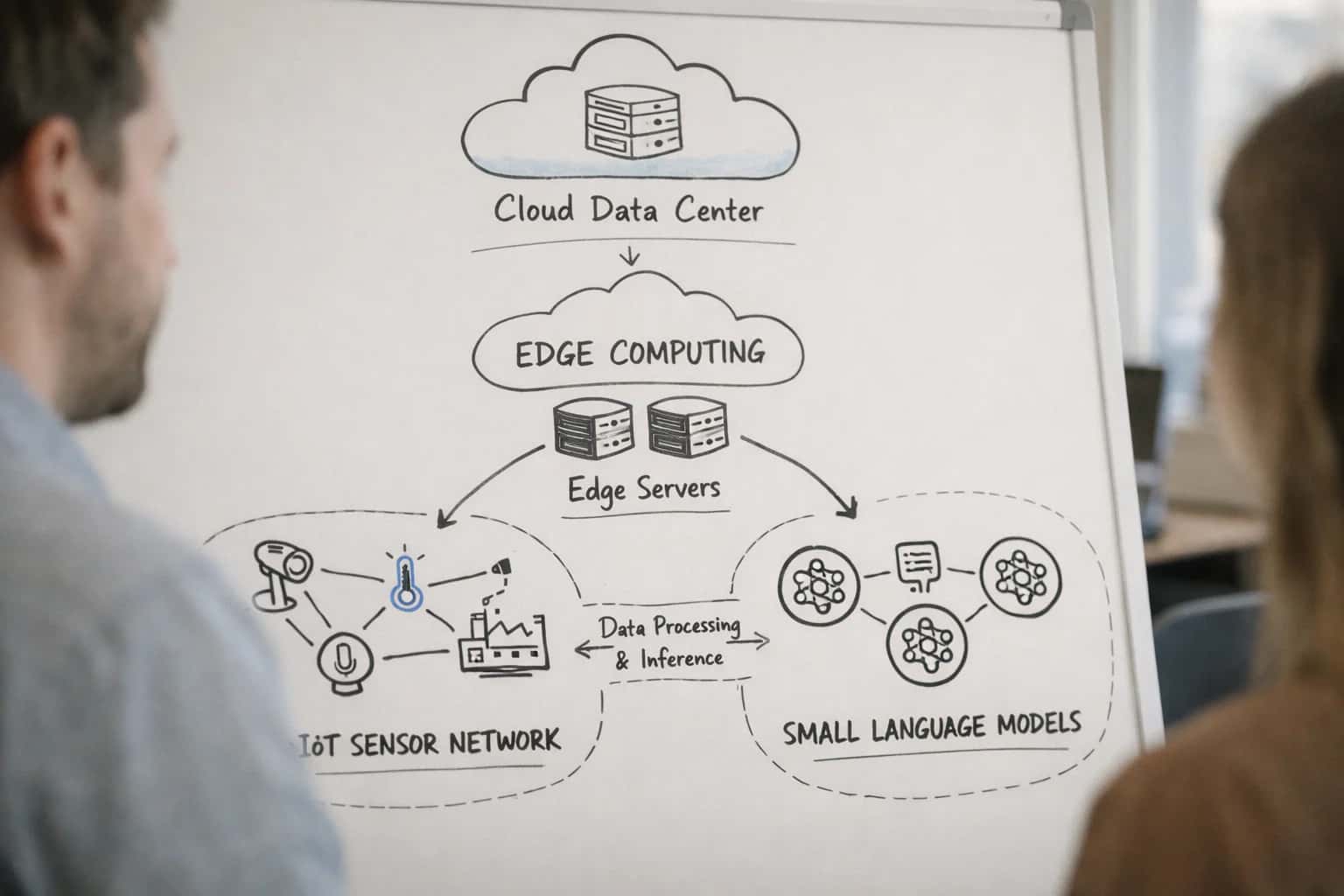
A Small Language Model (SLM) is a language model engineered for efficiency, typically possessing fewer than 10 billion parameters, in contrast to the hundreds of billions found in large foundation models. Through techniques like knowledge distillation, quantization, and weight pruning, an SLM retains core linguistic reasoning and instruction-following capabilities while drastically reducing its memory footprint and computational latency. This makes it suitable for execution on resource-constrained edge hardware, such as factory-floor gateways or mobile devices, without a persistent cloud connection.

Glossary
Small Language Model (SLM)
A highly optimized, compact language model that delivers robust reasoning capabilities with a fraction of the parameters of a large model, making it suitable for private, cost-effective deployment on edge hardware for shop-floor interfaces.
EDGE-OPTIMIZED AI
What is a Small Language Model (SLM)?
A small language model (SLM) is a highly optimized, compact neural network for natural language processing that delivers robust reasoning capabilities with a fraction of the parameters of a large language model, enabling private, cost-effective deployment on edge hardware.
The primary advantage of an SLM in industrial contexts is data sovereignty and operational autonomy. By running locally, an SLM powers natural language shop-floor interfaces and agentic reasoning loops without transmitting proprietary production data to external servers. This architecture eliminates network latency for real-time control, ensures offline resilience, and provides a cost-effective path to deploying private AI copilots for maintenance technicians and process engineers.
ARCHITECTURAL DISTINCTIONS
Key Characteristics of SLMs
Small Language Models (SLMs) are not merely scaled-down LLMs; they represent a distinct engineering philosophy prioritizing inference efficiency, domain specificity, and private deployment over general-purpose breadth.
01
Parameter Efficiency
SLMs operate with a fraction of the parameters of frontier models—typically between 100 million and 10 billion parameters. This compact architecture is achieved through techniques like knowledge distillation, where a smaller student model learns to replicate the behavior of a larger teacher model, and pruning, which removes redundant weights. The result is a model that retains robust reasoning and language understanding capabilities while drastically reducing the memory footprint and computational demand required for inference.
02
Edge-Native Deployment
A defining characteristic of SLMs is their ability to run entirely on resource-constrained edge hardware, such as industrial PCs, embedded systems, or even microcontrollers. By eliminating the need for a round-trip to a cloud API, SLMs enable ultra-low-latency inference (often < 10ms) and guarantee operational continuity during network outages. This is critical for shop-floor interfaces and real-time control systems where a disconnected cloud dependency is a safety and productivity risk.
03
Domain-Specific Specialization
Unlike general-purpose LLMs, SLMs are engineered for deep expertise in a narrow domain. Through Parameter-Efficient Fine-Tuning (PEFT) methods like Low-Rank Adaptation (LoRA), a pre-trained SLM can be cost-effectively adapted to master a specific manufacturing lexicon, interpret proprietary maintenance logs, or understand unique equipment schemas. This specialization yields higher accuracy on targeted tasks than a massive, generalist model that lacks deep contextual knowledge of the factory floor.
04
Data Privacy and Sovereignty
SLMs are the cornerstone of a sovereign AI strategy. Because all computation occurs locally, proprietary manufacturing data—such as production recipes, quality control findings, and equipment telemetry—never leaves the facility. This architecture inherently complies with stringent data governance requirements and eliminates the risk of exposing sensitive intellectual property to third-party cloud providers. The model processes the data in-place, ensuring absolute confidentiality.
05
Cost-Effective Inference
The computational frugality of SLMs translates directly to a dramatically lower total cost of ownership. They require no expensive, power-hungry data center GPUs for inference. A quantized SLM can run on a Neural Processing Unit (NPU) or a standard CPU, consuming only a few watts of power. This makes it economically viable to deploy intelligent language interfaces pervasively across hundreds of workstations and machines, a scale that would be cost-prohibitive with a large, cloud-dependent model.
06
Rapid, Low-Resource Fine-Tuning
Adapting an SLM to a new task is an agile process. Full fine-tuning of a model with a few billion parameters is feasible on a single enterprise-grade GPU in hours, not days. More commonly, PEFT techniques allow for adaptation in minutes by training only a tiny adapter module. This enables a continuous improvement loop where a model can be quickly retrained on new failure modes or updated procedures and redeployed to the factory floor with minimal operational disruption.
ARCHITECTURAL COMPARISON
SLM vs. Large Language Model (LLM)
A technical comparison of Small Language Models and Large Language Models across key deployment and performance dimensions for industrial applications.
| Feature | Small Language Model (SLM) | Large Language Model (LLM) |
|---|---|---|
Parameter Count | 100M – 10B | 100B – 1T+ |
Memory Footprint (FP16) | 0.2 – 20 GB | 200 GB – 2 TB+ |
Inference Latency (Edge GPU) | < 50 ms per token |
|
On-Device Deployment | ||
Offline Operation | ||
Multi-Turn Reasoning Depth | ||
Zero-Shot Generalization Breadth | ||
Domain-Specific Fine-Tuning Cost | $100 – $5,000 | $10,000 – $500,000+ |
Data Privacy (Local Inference) | ||
Energy per Inference | < 0.1 Wh |
|
SMALL LANGUAGE MODELS
Frequently Asked Questions
Concise answers to the most common technical and strategic questions about Small Language Models (SLMs) for industrial deployment.
A Small Language Model (SLM) is a highly optimized, compact neural network designed for natural language processing that delivers robust reasoning capabilities with a fraction of the parameters—typically ranging from a few hundred million to a few billion—compared to a Large Language Model (LLM) which may contain hundreds of billions or trillions of parameters. The fundamental difference lies in the parameter count and the resulting computational footprint. While an LLM like GPT-4 requires massive data center GPU clusters for inference, an SLM is engineered to run efficiently on resource-constrained hardware such as a single GPU, an edge server, or even a local CPU. This compactness is achieved through techniques like knowledge distillation, where a smaller 'student' model is trained to replicate the behavior of a larger 'teacher' model, and aggressive quantization, which reduces the numerical precision of the model's weights. For manufacturing, this means the difference between a cloud-dependent, high-latency query and a private, real-time shop-floor interface.
Enabling Efficiency, Speed & Accuracy
Intelligent Analysis, Decision & Execution
We build AI systems for teams that need search across company data, workflow automation across tools, or AI features inside products and internal software.
Talk to Us
Search across company data
Give teams answers from docs, tickets, runbooks, and product data with sources and permissions.
Useful when people spend too long searching or get different answers from different systems.
Enterprise searchRAGPermissions
Read more
Automate internal workflows
Use AI to route work, draft outputs, trigger actions, and keep approvals and logs in place.
Useful when repetitive work moves across multiple tools and teams.
AI agentsWorkflow automationGovernance
Read more
Add AI to products and internal tools
Build assistants, guided actions, or decision support into the software your team or customers already use.
Useful when AI needs to be part of the product, not a separate tool.
AI integrationDecision supportModel routing
Read more
About the author
Prasad Kumkar
CEO & MD, Inference Systems
Prasad Kumkar is the CEO & MD of Inference Systems and writes about AI systems architecture, LLM infrastructure, model serving, evaluation, and production deployment. Over 5+ years, he has worked across computer vision models, L5 autonomous vehicle systems, and LLM research, with a focus on taking complex AI ideas into real-world engineering systems.
His work and writing cover AI systems, large language models, AI agents, multimodal systems, autonomous systems, inference optimization, RAG, evaluation, and production AI engineering.
LinkedIn
Limited slotsGet a Free AI Consultation
Partnered with leading AI, data, and software stack.





How We Work
Custom AI workflows for your Business
One-fit-all AI don't work for modern businesses. At Inferensys, we aim to understand your business & custom requirements; which we use to define most efficient agentic workflows, the data, and the tools for your business.
01
Review the use case
We understand the task, the users, and where AI can actually help.
Read more02
Pick the right approach
We define what needs search, automation, or product integration.
Read more03
Build the first useful version
We implement the part that proves the value first.
Read more04
Improve from there
We add the checks and visibility needed to keep it useful.
Read moreThe first call is a practical review of your use case and the right next step.
Talk to Us