Knowledge distillation is a model compression technique where a compact 'student' network is trained to mimic the output distribution—not just the final prediction—of a larger, high-capacity 'teacher' model. By learning from the teacher's softened probability scores, the student internalizes the nuanced, dark knowledge of inter-class similarities that the teacher discovered during its pre-training on massive industrial datasets.

Glossary
Knowledge Distillation
A compression technique where a smaller 'student' model is trained to replicate the behavior of a larger, more complex 'teacher' foundation model, transferring its generalization capabilities to a deployable edge form factor.
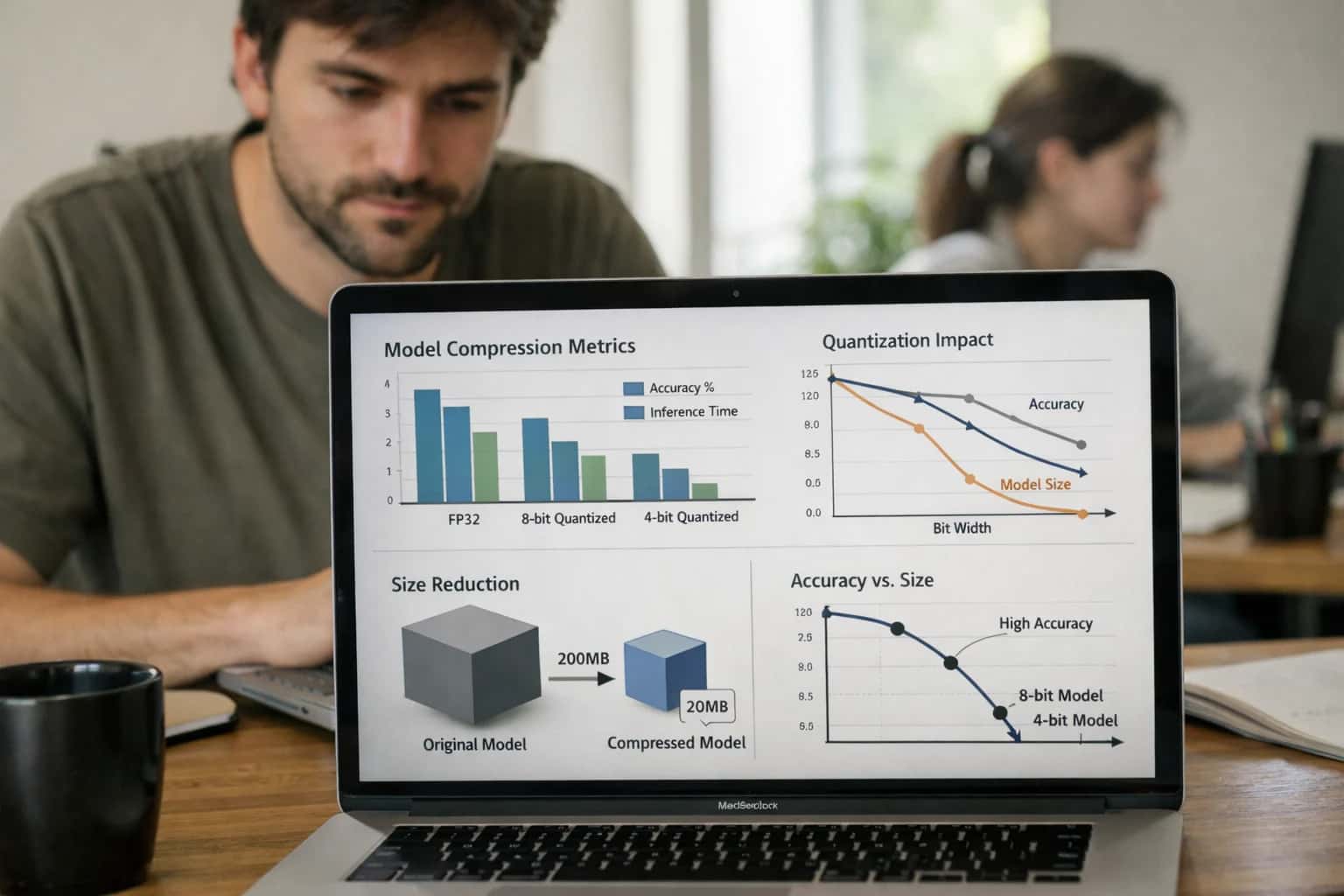
MODEL COMPRESSION
What is Knowledge Distillation?
A compression technique where a smaller 'student' model is trained to replicate the behavior of a larger, more complex 'teacher' foundation model, transferring its generalization capabilities to a deployable edge form factor.
This process transfers the teacher's generalization capabilities into a lightweight architecture suitable for deployment on resource-constrained factory-floor hardware. The student model achieves inference latency and memory footprints compatible with edge devices while preserving much of the teacher's accuracy on specialized tasks like anomaly detection, making it a critical enabler for private, low-latency industrial AI.
MODEL COMPRESSION
Key Distillation Techniques
Knowledge distillation transfers the generalization capabilities of a large, cumbersome teacher model to a compact, deployable student model. The following techniques define how this transfer is achieved.
01
Response-Based Distillation
The most straightforward form of knowledge transfer, where the student model is trained to mimic the final output distribution of the teacher model.
- Soft Targets: Instead of training only on hard labels, the student learns from the teacher's output probabilities, which contain rich information about inter-class similarities.
- Temperature Scaling: A hyperparameter (T) is applied to the softmax function to soften the probability distribution, revealing the 'dark knowledge' the teacher has learned about which classes are similar.
- Loss Function: Typically uses Kullback-Leibler (KL) divergence to minimize the difference between the student's and teacher's softened output distributions.
02
Feature-Based Distillation
Instead of only matching final outputs, the student learns to replicate the internal representations of the teacher's intermediate layers.
- Hint Layers: Specific intermediate layers in the teacher model are selected to guide the training of corresponding guided layers in the student.
- Representation Matching: A loss function minimizes the distance between the feature maps of the teacher and student, often using L2 loss or maximum mean discrepancy.
- Benefit: Transfers richer structural knowledge, teaching the student how to think, not just what to output. This is critical for complex industrial vision tasks.
03
Relation-Based Distillation
This technique captures the relationships between data samples learned by the teacher, transferring structural knowledge beyond individual instances.
- Instance Relationship Graph: The student learns to preserve the mutual relationships of data samples in the teacher's embedding space.
- Distance-Wise Loss: Penalizes the student if the Euclidean distance between a pair of its embeddings differs from the distance between the same pair in the teacher's space.
- Angle-Wise Loss: Ensures the angular structure formed by triplets of samples is preserved, maintaining the geometric topology of the teacher's manifold.
04
Online Distillation
A dynamic paradigm where the teacher and student models are trained simultaneously in a single end-to-end process, rather than using a pre-trained, static teacher.
- Peer Collaboration: Multiple student models can act as peers, learning from each other's collective knowledge without a single dominant teacher.
- Co-Distillation: The cohort of models trains concurrently, with each model's predictions serving as soft targets for the others.
- Advantage: Eliminates the need to pre-train and store a massive teacher model, reducing the overall computational pipeline for domain-specific industrial adaptation.
05
Self-Distillation
A counter-intuitive but powerful technique where a model acts as its own teacher, transferring knowledge from its deeper layers to its shallower ones.
- Deep Supervision: The deepest classifier in a network provides soft targets to earlier, shallower classifiers within the same architecture.
- Label Refinement: The model's own predictions on a clean dataset are used as soft labels to re-train itself, often improving generalization beyond the original training.
- Benefit: Requires no external teacher model and can be applied post-hoc to boost the accuracy of a deployed edge model without architectural changes.
06
Data-Free Distillation
A method for transferring knowledge when the original training data is unavailable due to privacy, security, or bandwidth constraints—a common scenario in federated industrial settings.
- Synthetic Inversion: The teacher model's weights are used to generate synthetic training samples that maximize the teacher's output confidence for a specific class.
- Generative Prior: A pre-trained generator is optimized to produce images or data points that elicit the desired soft targets from the teacher.
- Application: Enables model compression for factory-floor deployment without requiring access to sensitive, proprietary production datasets stored at a central location.
KNOWLEDGE DISTILLATION
Frequently Asked Questions
Clear answers to the most common questions about compressing large industrial foundation models into efficient, deployable student models for the factory floor.
Knowledge distillation is a model compression technique where a smaller 'student' model is trained to replicate the behavior of a larger, more complex 'teacher' foundation model. Instead of learning directly from ground-truth labels, the student learns from the teacher's output probability distribution—often called 'soft targets' or 'dark knowledge.' These soft targets contain richer information than hard labels, revealing the inter-class similarities the teacher has learned. For example, a teacher classifying manufacturing defects might assign a 90% probability to 'scratch' but also a 7% probability to 'abrasion,' teaching the student that these classes are semantically related. The student is trained using a combined loss function that balances matching the teacher's soft outputs with matching the ground-truth labels, effectively transferring the teacher's generalization capabilities into a compact, deployable form factor suitable for edge inference on the factory floor.
MODEL COMPRESSION COMPARISON
Knowledge Distillation vs. Other Compression Techniques
A technical comparison of knowledge distillation against alternative methods for reducing model size and computational footprint for edge deployment.
| Feature | Knowledge Distillation | Quantization | Weight Pruning |
|---|---|---|---|
Core Mechanism | Trains a smaller student model to mimic the softened output distribution of a larger teacher model | Reduces numerical precision of weights and activations from FP32 to INT8 or INT4 | Removes individual weights or entire neurons with near-zero magnitude from a trained network |
Preserves Generalization | |||
Requires Original Training Data | |||
Architecture Flexibility | Student can use a completely different architecture from the teacher | Architecture remains unchanged; only precision changes | Architecture remains unchanged; only sparsity increases |
Typical Compression Ratio | 5x–50x parameter reduction | 2x–4x memory reduction | 5x–20x parameter reduction |
Inference Hardware Benefit | Runs efficiently on general-purpose edge hardware | Requires hardware with native INT8/INT4 support for full speedup | Requires sparse matrix computation support for full speedup |
Training Overhead | High: requires full teacher inference and student training | Low: post-training quantization is fast; quantization-aware training adds moderate cost | Moderate: iterative pruning and fine-tuning cycles |
Risk of Catastrophic Accuracy Loss | Low: student learns the teacher's decision boundary, not just its weights | Moderate: aggressive INT4 quantization can cause significant drift | High: unstructured pruning above 80% sparsity often collapses accuracy |
Enabling Efficiency, Speed & Accuracy
Intelligent Analysis, Decision & Execution
We build AI systems for teams that need search across company data, workflow automation across tools, or AI features inside products and internal software.
Talk to Us
Search across company data
Give teams answers from docs, tickets, runbooks, and product data with sources and permissions.
Useful when people spend too long searching or get different answers from different systems.
Enterprise searchRAGPermissions
Read more
Automate internal workflows
Use AI to route work, draft outputs, trigger actions, and keep approvals and logs in place.
Useful when repetitive work moves across multiple tools and teams.
AI agentsWorkflow automationGovernance
Read more
Add AI to products and internal tools
Build assistants, guided actions, or decision support into the software your team or customers already use.
Useful when AI needs to be part of the product, not a separate tool.
AI integrationDecision supportModel routing
Read more
About the author
Prasad Kumkar
CEO & MD, Inference Systems
Prasad Kumkar is the CEO & MD of Inference Systems and writes about AI systems architecture, LLM infrastructure, model serving, evaluation, and production deployment. Over 5+ years, he has worked across computer vision models, L5 autonomous vehicle systems, and LLM research, with a focus on taking complex AI ideas into real-world engineering systems.
His work and writing cover AI systems, large language models, AI agents, multimodal systems, autonomous systems, inference optimization, RAG, evaluation, and production AI engineering.
LinkedIn
Limited slotsGet a Free AI Consultation
Partnered with leading AI, data, and software stack.





How We Work
Custom AI workflows for your Business
One-fit-all AI don't work for modern businesses. At Inferensys, we aim to understand your business & custom requirements; which we use to define most efficient agentic workflows, the data, and the tools for your business.
01
Review the use case
We understand the task, the users, and where AI can actually help.
Read more02
Pick the right approach
We define what needs search, automation, or product integration.
Read more03
Build the first useful version
We implement the part that proves the value first.
Read more04
Improve from there
We add the checks and visibility needed to keep it useful.
Read moreThe first call is a practical review of your use case and the right next step.
Talk to Us