Edge-CL addresses the core challenge of enabling a model to learn sequentially from new, non-stationary data streams on the device itself, a process known as on-device training, without suffering from catastrophic forgetting of previous knowledge. This requires novel algorithms that are co-designed with hardware constraints, prioritizing extreme efficiency in memory footprint, computational cost, and energy consumption to be viable on limited edge hardware.

Glossary
Edge-CL
Edge-CL (Edge Continual Learning) is the specialized practice of deploying and executing continual learning algorithms directly on resource-constrained edge devices, focusing on memory, compute, and energy efficiency.
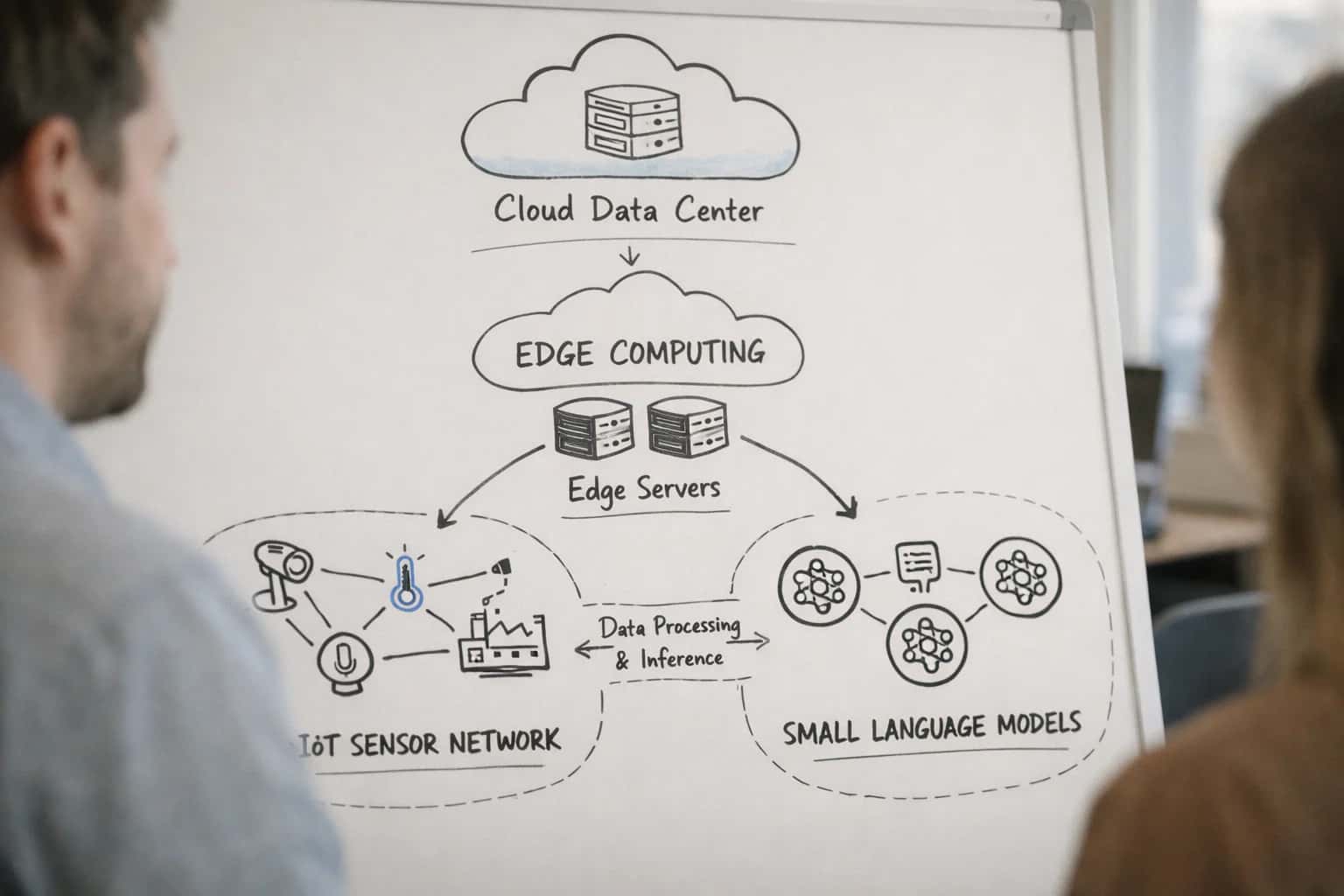
CONTINUAL LEARNING ON EDGE
What is Edge-CL?
Edge-CL (Edge Continual Learning) is the specialized subfield of machine learning focused on deploying and executing continual learning algorithms directly on resource-constrained edge devices, such as smartphones, IoT sensors, and embedded systems.
Techniques in Edge-CL are adaptations of core continual learning methods—including regularization-based, rehearsal-based, and architectural approaches—but are rigorously optimized for the edge. This involves strategies like highly efficient replay buffer management, micro-sized generative replay, and parameter-efficient fine-tuning. The goal is to create intelligent systems that can adapt locally to user behavior or environmental changes while operating within strict privacy, latency, and connectivity boundaries inherent to edge artificial intelligence architectures.
EDGE-CL
Core Challenges of Edge-CL
Deploying continual learning algorithms on resource-constrained edge devices introduces a unique set of engineering constraints beyond the fundamental stability-plasticity dilemma. These challenges center on the severe limitations of memory, compute, energy, and connectivity inherent to the edge environment.
01
Memory and Storage Constraints
Edge devices have orders of magnitude less RAM and persistent storage than cloud servers. This creates a fundamental bottleneck for continual learning, which often requires storing past data or model states to prevent forgetting.
- Replay Buffers must be extremely small, forcing sophisticated buffer management strategies like core-set selection to maximize the representational power of a few hundred samples.
- Architectural expansion methods like Progressive Neural Networks are often infeasible due to linear parameter growth.
- Model checkpoints, optimizer states, and auxiliary networks for methods like Generative Replay must fit within tight kilobyte-to-megabyte budgets.
02
Computational and Energy Limits
The inference of a trained model is computationally expensive on edge hardware; on-device training for continual learning is vastly more demanding. The available compute (in FLOPS) and energy budget (often battery-powered) are severely constrained.
- Full backward passes for gradient computation during training consume significant power and generate heat.
- Complex regularization terms, like those in Elastic Weight Consolidation (EWC), add computational overhead for importance weight calculation and application.
- The device must balance learning new tasks with its primary operational function, making efficient, sparse, or approximate updates critical.
03
Intermittent and Limited Connectivity
Edge devices often operate with unreliable, low-bandwidth, or metered network connections. This disrupts cloud-centric assumptions of continuous data streams and centralized orchestration.
- Federated Continual Learning must handle devices that drop in and out of the federation, leading to severe client drift.
- Syncing large model updates or memory buffers to a central server may be impossible, forcing fully decentralized, peer-to-peer, or isolated learning paradigms.
- The inability to fetch large, curated datasets or pre-trained models on-demand requires greater on-device autonomy and robustness.
04
Data Heterogeneity and Stream Characteristics
Data on the edge is non-IID (not Independent and Identically Distributed), arrives in a streaming or online fashion, and is often unlabeled or weakly supervised.
- Online Continual Learning is the default scenario, where the model sees each data point only once in a non-stationary stream.
- Data distribution shifts (Domain-Incremental Learning) are frequent due to environmental changes (e.g., weather, sensor degradation).
- Class-Incremental Learning must occur from a trickle of new examples, without the large, balanced batches typical of cloud training. Label scarcity necessitates self-supervised or unsupervised adaptation techniques.
05
Hardware Heterogeneity and Compilation
The "edge" encompasses a vast spectrum of hardware: microcontrollers (MCUs), mobile SoCs, and specialized Neural Processing Units (NPUs). Each has unique instruction sets, memory hierarchies, and acceleration primitives.
- A single Edge-CL algorithm must be compilable and efficient across diverse targets (ARM Cortex-M, Apple Neural Engine, Google Edge TPU).
- Hardware-aware model design is essential; operations not optimized for the target accelerator (e.g., certain sparse patterns or custom regularization layers) can nullify theoretical benefits.
- The deployment and management lifecycle is complex, requiring robust versioning and update mechanisms for models that are continually evolving on thousands of disparate devices.
06
Privacy, Security, and Robustness
Learning directly on devices containing sensitive data (e.g., cameras, health sensors) amplifies privacy and security requirements. The model itself becomes a high-value attack surface.
- Privacy-preserving machine learning techniques like differential privacy must be integrated into the local update process, often adding noise that can exacerbate forgetting.
- The model is vulnerable to adversarial attacks and data poisoning via the local data stream, requiring robust training and anomaly detection on-device.
- Catastrophic forgetting induced by a malicious or anomalous data sequence could permanently degrade system performance, necessitating rollback and recovery mechanisms.
METHODOLOGIES
Technical Approaches for Edge-CL
Edge-CL (Continual Learning on Edge) deploys algorithms that enable models to learn sequentially from new data on resource-constrained devices. The core challenge is balancing the acquisition of new knowledge with the retention of old, all within strict memory, compute, and energy budgets. Technical approaches are broadly categorized by how they manage this stability-plasticity dilemma.
Regularization-based methods mitigate catastrophic forgetting by adding a penalty term to the loss function that discourages significant changes to network parameters deemed important for previous tasks. Techniques like Elastic Weight Consolidation (EWC) and Synaptic Intelligence (SI) estimate parameter importance using the Fisher information matrix or online accumulation of weight updates, applying a quadratic constraint. This approach is memory-efficient, storing only importance scores, but can struggle with long task sequences due to accumulating constraints.
Rehearsal-based methods retain a subset of past data in a fixed-size replay buffer and interleave these 'experiences' with new data during training. Strategies like Experience Replay and Gradient Episodic Memory (GEM) directly rehearse old tasks. Generative Replay uses a separate generative model to produce synthetic past data. While highly effective, these methods face the critical edge challenge of buffer management—selecting representative samples under strict memory limits—and the compute overhead of training on mixed data streams.
PRACTICAL DEPLOYMENT
Edge-CL Use Cases and Applications
Edge-CL enables models to adapt to new data directly on resource-constrained devices. These applications highlight its role in creating autonomous, private, and responsive intelligent systems.
01
Autonomous Vehicle Adaptation
Enables self-driving cars to learn from rare road events (e.g., novel obstacle types, unusual weather) on-vehicle without catastrophic forgetting of core driving skills. This supports lifelong learning from a non-stationary environment.
- Key Challenge: Must operate with strict memory and energy constraints.
- Technique: Often uses rehearsal-based methods with a small replay buffer of critical past scenarios.
- Benefit: Eliminates the need for frequent, massive cloud retraining, allowing for rapid local adaptation.
02
Personalized On-Device Assistants
Allows smartphone or smart speaker language models to learn user-specific vocabulary, preferences, and routines locally, ensuring absolute privacy. The model evolves with the user without leaking personal data.
- Key Challenge: Limited compute for large model updates and battery life preservation.
- Technique: Employs parameter-efficient fine-tuning (e.g., LoRA) combined with regularization-based methods like Elastic Weight Consolidation.
- Benefit: Creates a truly personalized AI that improves over time without compromising user data sovereignty.
03
Industrial Predictive Maintenance
Deployed on factory-floor sensors or robots, Edge-CL models learn from evolving machine vibration, thermal, and acoustic signatures to predict failures. They adapt to machine wear and new failure modes without being recalled.
- Key Challenge: Handling concept drift as machinery degrades and operating in connectivity-denied areas.
- Technique: Online continual learning with streaming data, often using experience replay of anomalous signatures.
- Benefit: Enables proactive maintenance, reduces downtime, and operates fully offline within secure industrial networks.
04
Medical Device Personalization
Allows wearable health monitors (e.g., glucose sensors, ECG patches) to adapt to an individual patient's unique physiological baselines and changing health conditions through on-device training.
- Key Challenge: Extreme privacy requirements (PHI) and ultra-low power consumption.
- Technique: Federated continual learning can aggregate anonymous updates from a population of devices while each device personalizes locally.
- Benefit: Improves diagnostic accuracy over time for the individual while keeping all sensitive health data on the device.
05
Smart Camera Surveillance
Enables security cameras to learn new objects of interest (e.g., a new vehicle model, a unique package) on the edge while retaining the ability to recognize all previously learned classes.
- Key Challenge: Class-incremental learning with no task ID at inference and limited device memory for storing past images.
- Technique: Uses algorithms like iCaRL or generative replay to maintain a stable representation for all seen classes.
- Benefit: Reduces bandwidth by processing and learning locally, and allows system behavior to be tailored to its specific deployment environment.
06
Agricultural IoT and Robotics
Deployed on drones or field sensors, models learn to identify new crop diseases, pest types, or growth stages across seasons. They adapt to local conditions and newly encountered threats.
- Key Challenge: Domain-incremental learning across changing seasons (lighting, plant growth stage) and harsh environmental conditions.
- Technique: Architectural methods like Progressive Neural Networks or regularization to isolate seasonal knowledge.
- Benefit: Enables autonomous, adaptive precision agriculture without reliance on cloud connectivity in remote areas.
EDGE CONTINUAL LEARNING
Frequently Asked Questions
Edge-CL refers to the specific challenges and techniques for deploying continual learning algorithms on resource-constrained edge devices, focusing on memory, compute, and energy efficiency. Below are key questions about its mechanisms, trade-offs, and implementation.
Edge-CL (Edge Continual Learning) is the paradigm of deploying and executing continual learning algorithms directly on resource-constrained devices like smartphones, IoT sensors, or embedded systems, enabling models to adapt to new data locally over time. It differs fundamentally from cloud-based continual learning in its constraints and objectives.
Key Differences:
- Resource Scarcity: Edge devices have severe limitations in memory (RAM/Flash), compute (CPU/GPU), and energy (battery). Algorithms must be extremely lightweight.
- Data Privacy & Latency: Learning occurs on-device, eliminating the need to transmit raw, potentially sensitive data to a central server, and enabling real-time adaptation without network latency.
- Decentralized Operation: Each device learns from its unique, non-IID (Independent and Identically Distributed) data stream, creating a personalized model. This contrasts with centralized cloud training on aggregated datasets.
- Objective: The primary goal is not just to avoid catastrophic forgetting, but to do so within a tight power envelope and memory budget, often requiring co-design with model compression techniques like quantization and pruning.
Enabling Efficiency, Speed & Accuracy
Intelligent Analysis, Decision & Execution
We build AI systems for teams that need search across company data, workflow automation across tools, or AI features inside products and internal software.
Talk to Us
Search across company data
Give teams answers from docs, tickets, runbooks, and product data with sources and permissions.
Useful when people spend too long searching or get different answers from different systems.
Enterprise searchRAGPermissions
Read more
Automate internal workflows
Use AI to route work, draft outputs, trigger actions, and keep approvals and logs in place.
Useful when repetitive work moves across multiple tools and teams.
AI agentsWorkflow automationGovernance
Read more
Add AI to products and internal tools
Build assistants, guided actions, or decision support into the software your team or customers already use.
Useful when AI needs to be part of the product, not a separate tool.
AI integrationDecision supportModel routing
Read more
About the author
Prasad Kumkar
CEO & MD, Inference Systems
Prasad Kumkar is the CEO & MD of Inference Systems and writes about AI systems architecture, LLM infrastructure, model serving, evaluation, and production deployment. Over 5+ years, he has worked across computer vision models, L5 autonomous vehicle systems, and LLM research, with a focus on taking complex AI ideas into real-world engineering systems.
His work and writing cover AI systems, large language models, AI agents, multimodal systems, autonomous systems, inference optimization, RAG, evaluation, and production AI engineering.
LinkedIn
Limited slotsGet a Free AI Consultation
Partnered with leading AI, data, and software stack.





How We Work
Custom AI workflows for your Business
One-fit-all AI don't work for modern businesses. At Inferensys, we aim to understand your business & custom requirements; which we use to define most efficient agentic workflows, the data, and the tools for your business.
01
Review the use case
We understand the task, the users, and where AI can actually help.
Read more02
Pick the right approach
We define what needs search, automation, or product integration.
Read more03
Build the first useful version
We implement the part that proves the value first.
Read more04
Improve from there
We add the checks and visibility needed to keep it useful.
Read moreThe first call is a practical review of your use case and the right next step.
Talk to Us