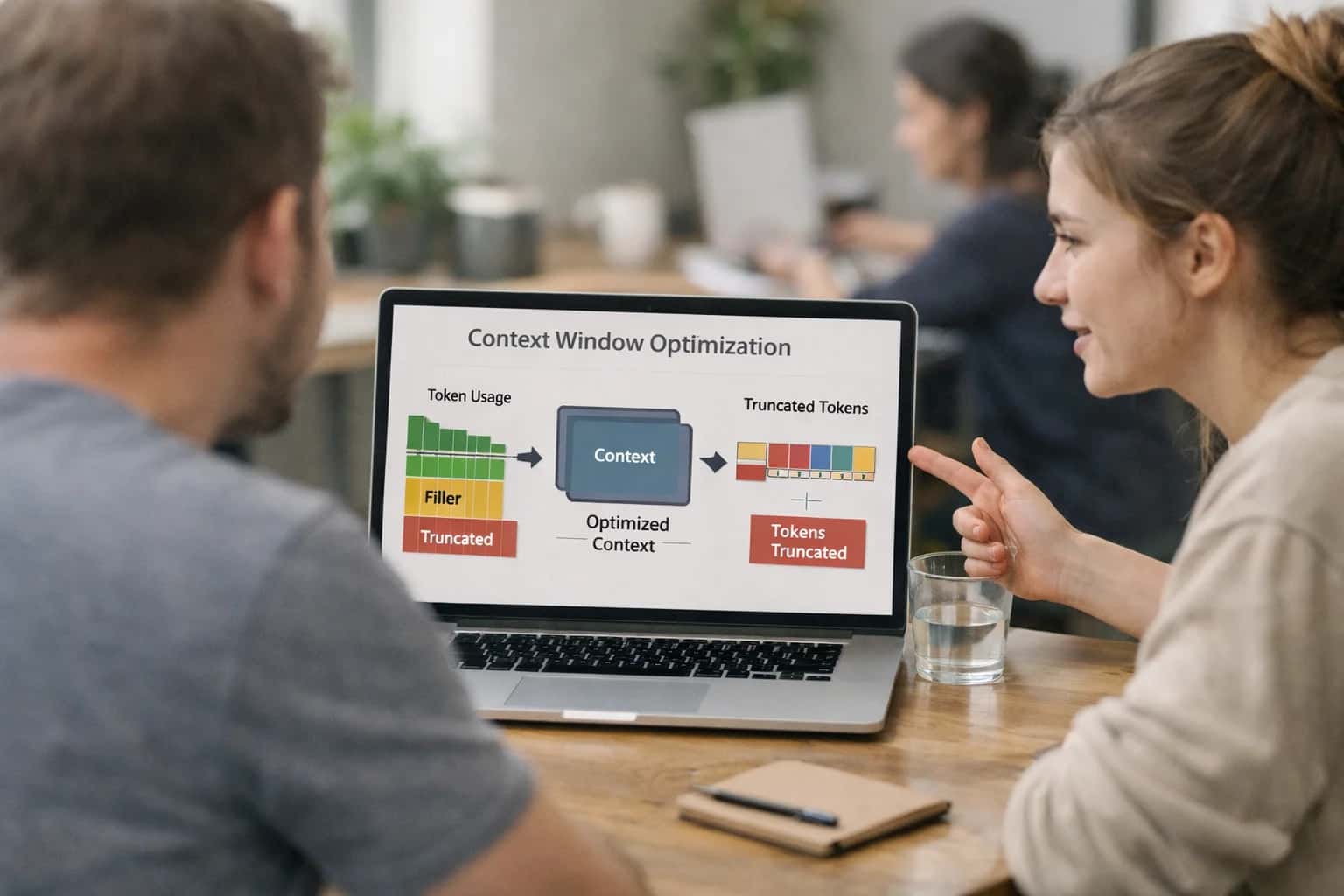
Maximum context length is the fixed, finite number of tokens—the fundamental units of text—that a language model can accept as input and generate as output in a single forward pass. This limit defines the model's context window, a critical architectural parameter determined during pre-training. It imposes a hard ceiling on the total combined length of the system prompt, user query, and any retrieved document chunks in a Retrieval-Augmented Generation (RAG) pipeline. Exceeding this limit typically forces truncation of the input sequence, which can discard crucial information.

Glossary
Maximum Context Length
Maximum context length is the fixed token limit defining a language model's context window, a critical constraint for input text and retrieved chunks in RAG systems.
GLOSSARY
What is Maximum Context Length?
The fundamental architectural constraint governing how much information a language model can process in a single interaction.
For system architects, the maximum context length is a primary driver for document chunking strategies. Effective chunk sizes must be calibrated to leave sufficient space within the window for the query, instructions, and the model's own generated response. Newer models with longer contexts (e.g., 128K or 1M tokens) enable larger chunks or more chunks per query, reducing the risk of context fragmentation. However, longer contexts increase computational cost quadratically in attention-based models, creating a trade-off between informational richness and inference latency or expense.
TECHNICAL FOUNDATION
Key Characteristics of Maximum Context Length
Maximum context length is a fixed architectural parameter of a transformer-based language model, defining the absolute limit of tokens it can process in a single forward pass. Its value is a primary constraint governing system design for retrieval-augmented generation.
01
Architectural Hard Limit
The maximum context length is a fixed, immutable parameter determined during a model's pre-training phase. It is dictated by the transformer architecture's attention mechanism, which has quadratic computational complexity (O(n²)) relative to sequence length. This hard limit cannot be exceeded without model retraining or architectural modifications like ALiBi or RoPE scaling. For example, GPT-4 Turbo has a 128k context window, while Llama 3.1 8B is 128k, and Claude 3.5 Sonnet supports 200k tokens.
02
Token-Based Measurement
Context length is measured in tokens, not characters or words. A token is a subword unit produced by the model's tokenizer (e.g., Byte-Pair Encoding). The relationship between raw text and tokens is non-linear:
- Common words may be a single token (e.g., 'the').
- Complex words or names can be multiple tokens (e.g., 'tokenization' -> ['token', 'ization']).
- This means a chunk sized to 500 characters could vary widely in token count, making token-level chunking critical for precise window management. Tools like the tiktoken library are used for accurate token counting.
03
Input Composition & Budgeting
The context window is a shared resource consumed by multiple input components. In a RAG pipeline, the total token count must fit within the limit:
- System Prompt: Instructions and few-shot examples.
- Retrieved Context: The concatenated text from retrieved document chunks.
- User Query: The current question or instruction.
- Model's Own Output: Generated tokens also consume the window in autoregressive models. Engineers must perform strict context budgeting, often reserving 20-30% of the window for the model's response, which directly constrains how many chunks can be retrieved.
04
Determinant of Chunking Strategy
The maximum context length is the primary variable for calculating optimal chunk size. The formula is:
Optimal Chunk Token Size = (Context Window - (Prompt Tokens + Output Token Budget)) / Number of Chunks to Retrieve
This calculation directly informs strategies like fixed-length chunking or semantic chunking. Exceeding the limit triggers truncation, typically from the middle of the sequence, which can discard critical retrieved information. Therefore, chunk size and chunk overlap are engineered as derivatives of this fundamental constraint.
05
Performance Trade-Offs
Longer context windows are not free and involve significant trade-offs:
- Computational Cost: Memory and inference time scale quadratically with sequence length.
- The 'Lost-in-the-Middle' Problem: Models often perform worse on information placed in the middle of very long contexts compared to the beginning and end.
- Retrieval Precision Impact: With a larger window, there is temptation to retrieve more, coarser chunks, which can dilute relevance. Techniques like reranking and sentence window retrieval are used to mitigate this. Efficient models use mechanisms like KV caching, but cache size is also bound by context length.
06
Model-Specific Variability
Context length is not standardized and varies significantly across model families and versions. Key considerations include:
- Base vs. Extended Context: Some models (e.g., via RoPE scaling) can have their effective context extended post-training, but this may degrade performance.
- Input vs. Total Context: Some architectures distinguish between input tokens and total generated tokens.
- Hardware Dependencies: The feasible context length in deployment can be limited by available GPU VRAM. This variability necessitates system configuration that is explicitly tied to the specific model version in use, making it a critical parameter in LLM ops and deployment manifests.
CONTEXT WINDOW CONSTRAINT
Implications for Retrieval-Augmented Generation (RAG)
The maximum context length of a language model is a primary architectural constraint that fundamentally shapes the design and performance of Retrieval-Augmented Generation (RAG) systems.
Maximum context length is the fixed token limit of a model's context window, dictating the total volume of text—including the user query, system instructions, and retrieved documents—that can be processed in a single inference call. In RAG, this hard limit necessitates strategic document chunking to ensure retrieved passages fit alongside the prompt, directly influencing chunk size, overlap, and the number of sources that can be included. Exceeding this limit triggers truncation, which can arbitrarily cut off critical context and degrade answer quality.
This constraint forces a critical engineering trade-off: larger chunks provide more comprehensive context but reduce the number of passages that can be retrieved, while smaller, more numerous chunks risk fragmenting information. Effective RAG design must therefore optimize chunk granularity and retrieval precision to surface the most relevant information within the available token budget. Techniques like hierarchical chunking and sentence window retrieval are employed to balance detail with coverage, ensuring the model receives sufficient grounding without wasteful token usage.
MODEL COMPARISON
Maximum Context Lengths of Common Models
The maximum token capacity for a single forward pass of widely used language models, a critical parameter for determining chunk size and managing input in retrieval-augmented generation systems.
| Model Family / Variant | Context Length (Tokens) | Primary Architecture | Typical Chunking Strategy |
|---|---|---|---|
GPT-4 Turbo / GPT-4o | 128000 | Transformer (Decoder) | Semantic or Hierarchical |
Claude 3 Opus | 200000 | Transformer (Decoder) | Semantic with overlap |
Gemini 1.5 Pro | 1000000 | Transformer (Mixture-of-Experts) | Large semantic segments |
Llama 3 70B | 8192 | Transformer (Decoder) | Fixed-length with overlap |
Llama 3 70B (extended) | 32768 | Transformer (Decoder) | Fixed-length with overlap |
Mixtral 8x7B | 32768 | Transformer (Mixture-of-Experts) | Fixed-length with overlap |
Command R | 128000 | Transformer (Decoder) | Semantic or Hierarchical |
GPT-3.5 Turbo | 16385 | Transformer (Decoder) | Fixed-length with overlap |
MAXIMUM CONTEXT LENGTH
Frequently Asked Questions
Maximum context length is a fundamental constraint in large language models and retrieval-augmented generation (RAG) systems. These questions address its technical definition, practical implications, and its critical role in designing document chunking strategies.
Maximum context length is the fixed, finite number of tokens—typically words or subword units—that a language model can accept as input and output in a single forward pass, defining its total working memory or context window. It is a hard architectural limit set during the model's pre-training, determined by factors like the Transformer architecture's attention mechanism and training compute. For example, GPT-4 Turbo has a 128k token context window, while many open-source models like Llama 3 have 8k or 128k variants. This limit constrains the total combined length of the system prompt, user query, and any retrieved document chunks in a RAG pipeline.
Enabling Efficiency, Speed & Accuracy
Intelligent Analysis, Decision & Execution
We build AI systems for teams that need search across company data, workflow automation across tools, or AI features inside products and internal software.
Talk to Us
Search across company data
Give teams answers from docs, tickets, runbooks, and product data with sources and permissions.
Useful when people spend too long searching or get different answers from different systems.
Enterprise searchRAGPermissions
Read more
Automate internal workflows
Use AI to route work, draft outputs, trigger actions, and keep approvals and logs in place.
Useful when repetitive work moves across multiple tools and teams.
AI agentsWorkflow automationGovernance
Read more
Add AI to products and internal tools
Build assistants, guided actions, or decision support into the software your team or customers already use.
Useful when AI needs to be part of the product, not a separate tool.
AI integrationDecision supportModel routing
Read more
About the author
Prasad Kumkar
CEO & MD, Inference Systems
Prasad Kumkar is the CEO & MD of Inference Systems and writes about AI systems architecture, LLM infrastructure, model serving, evaluation, and production deployment. Over 5+ years, he has worked across computer vision models, L5 autonomous vehicle systems, and LLM research, with a focus on taking complex AI ideas into real-world engineering systems.
His work and writing cover AI systems, large language models, AI agents, multimodal systems, autonomous systems, inference optimization, RAG, evaluation, and production AI engineering.
LinkedIn
Limited slotsGet a Free AI Consultation
Partnered with leading AI, data, and software stack.





How We Work
Custom AI workflows for your Business
One-fit-all AI don't work for modern businesses. At Inferensys, we aim to understand your business & custom requirements; which we use to define most efficient agentic workflows, the data, and the tools for your business.
01
Review the use case
We understand the task, the users, and where AI can actually help.
Read more02
Pick the right approach
We define what needs search, automation, or product integration.
Read more03
Build the first useful version
We implement the part that proves the value first.
Read more04
Improve from there
We add the checks and visibility needed to keep it useful.
Read moreThe first call is a practical review of your use case and the right next step.
Talk to Us