A context window is the fixed maximum sequence length of tokens—words or subwords—that a transformer-based language model can process in a single forward pass. This architectural limit, defined by the model's pre-training, imposes a hard constraint on the total combined length of the input prompt, system instructions, and any retrieved document chunks. Exceeding this limit requires strategies like truncation or advanced context management techniques to maintain coherence.

Glossary
Context Window
A context window is the fixed maximum sequence length of tokens that a language model can process in a single forward pass, imposing a fundamental constraint on input text and retrieved chunks.
AI GLOSSARY
What is a Context Window?
A fundamental architectural constraint in transformer-based language models.
In Retrieval-Augmented Generation (RAG) systems, the context window directly governs chunking strategies. Engineers must size document segments so that multiple retrieved chunks, plus the user query and model instructions, fit within this budget. This constraint balances retrieval recall (more context) against computational cost and potential information dilution. Modern models use techniques like sliding window attention or hierarchical chunking to effectively process longer documents.
ARCHITECTURAL CONSTRAINT
Key Characteristics of a Context Window
A context window is a fundamental, fixed architectural parameter of a transformer-based language model that dictates its operational capacity for processing sequential data in a single pass.
01
Fixed Token Capacity
The context window defines a hard, immutable limit on the total number of tokens (words or subwords) a model can accept as input and generate as output in one forward pass. This limit is set during the model's pre-training and is defined by its positional embedding scheme and attention mechanism architecture. For example, GPT-4 Turbo has a 128k token context window, while many open-source models like Llama 3 operate with 8k or 128k limits. Exceeding this limit requires truncation or advanced techniques like sliding window attention.
02
Input-Output Shared Budget
The context window is a shared resource pool between the prompt (input) and the completion (output). Every token generated by the model consumes a slot from this budget. In a Retrieval-Augmented Generation (RAG) pipeline, this budget must be allocated across:
- The system instruction and user query.
- Retrieved document chunks (context).
- The model's generated answer. Effective context window management involves optimizing chunk sizes and the number of retrieved passages to maximize relevant context while reserving sufficient space for a coherent, complete response.
03
Attention Mechanism Foundation
The context window's limit is intrinsically linked to the transformer's self-attention mechanism. In standard attention, each token attends to every other token, resulting in computational complexity that scales quadratically (O(n²)) with sequence length. This makes arbitrarily large context windows computationally prohibitive. Innovations like FlashAttention, sliding window attention, and streaming LLMs aim to mitigate this cost, but the fundamental trade-off between context length, computational expense, and inference latency remains a core engineering challenge.
04
Impact on Retrieval Strategy
The context window size is the primary determinant for document chunking strategies. Key decisions include:
- Chunk Size: Chunks must be sized to allow for multiple passages to fit within the window alongside the query and answer.
- Chunk Granularity: Smaller, finer-grained chunks improve retrieval precision but may lose broader context; larger chunks preserve context but reduce the number that can be retrieved.
- Reranking & Fusion: When many relevant chunks are identified, the context window constraint forces a reranking step to select the most salient passages, making cross-encoder models critical for precision.
05
The 'Lost in the Middle' Problem
Models exhibit a positional bias where information at the very beginning and very end of the context window is attended to more effectively, while information in the middle can be overlooked. This has direct implications for RAG:
- Retrieved chunks placed in the middle of the context may be under-utilized.
- Mitigation strategies include reordering chunks (placing the most relevant last) or using architectures like contextual compression to distill key information from many chunks into a concise summary before injection into the window.
06
Extended Context Techniques
Several advanced methods exist to effectively work with or extend beyond the native context window:
- Sliding Window: Processing long documents in segments, often with overlap, for tasks like summarization.
- Hierarchical Summarization: Creating a summary of retrieved chunks first, then using that summary as context.
- Streaming LLMs & Stateful Models: Architectures that maintain a dynamic, external cache of previous tokens to simulate a longer context.
- Structured Prompting: Techniques like Chain-of-Thought (CoT) or ReAct that explicitly manage reasoning steps within the token budget.
CORE MECHANISM
How the Context Window Works Technically
The context window is not merely a length limit but a fixed architectural constraint of the transformer's attention mechanism, dictating how a language model processes sequential information.
A context window is the fixed maximum sequence length, measured in tokens, that a transformer-based language model can attend to in a single forward pass. This limit is defined by the model's pre-trained architecture and its positional encoding scheme, which assigns a unique representation to each token's order. The window encompasses all input tokens—the user's query, system instructions, and any retrieved document chunks—as well as the model's own generated output tokens during autoregressive decoding. Exceeding this hard limit requires truncation or advanced techniques like sliding window attention.
Technically, the constraint arises from the quadratic computational complexity of the transformer's self-attention mechanism relative to sequence length. Each token must compute an attention score with every other token in the window. Managing this window is fundamental to Retrieval-Augmented Generation (RAG), as it forces the strategic selection and compression of retrieved evidence. Engineers must balance chunk size and chunk overlap against this limit to preserve necessary context while avoiding information loss at boundaries.
MODEL SPECIFICATIONS
Context Window Comparison Across Major Models
A comparison of the maximum context window sizes (in tokens) for prominent proprietary and open-source language models, illustrating the evolution of sequence length capacity.
| Model | Provider / Origin | Context Window (Tokens) | Architecture Notes |
|---|---|---|---|
GPT-4 Turbo | OpenAI | 128000 | Supports 128K input; output limited separately. |
Claude 3 Opus | Anthropic | 200000 | 200K context standard across Claude 3 family. |
Gemini 1.5 Pro | 1000000 | Experimental 1M token context; standard is 128K. | |
Llama 3 70B | Meta | 8192 | Base model context. Can be extended via fine-tuning. |
Mixtral 8x22B | Mistral AI | 65536 | Native 64K context in MoE architecture. |
Command R | Cohere | 128000 | 128K context optimized for RAG workflows. |
GPT-4 | OpenAI | 8192 | Original GPT-4 base context length (8K). |
Claude 2 | Anthropic | 100000 | 100K context window for extended document processing. |
CONTEXT WINDOW
Implications for Retrieval-Augmented Generation (RAG)
A model's fixed context window imposes critical architectural constraints on RAG systems, dictating how retrieved information is selected, formatted, and presented to the language model for generation.
01
The Primary Bottleneck for Retrieved Context
The context window is the absolute upper limit on the total tokens a model can process in a single call. In RAG, this budget must be shared between:
- The user's original query
- The system prompt and instructions
- The retrieved document chunks (context)
- The model's own generated output
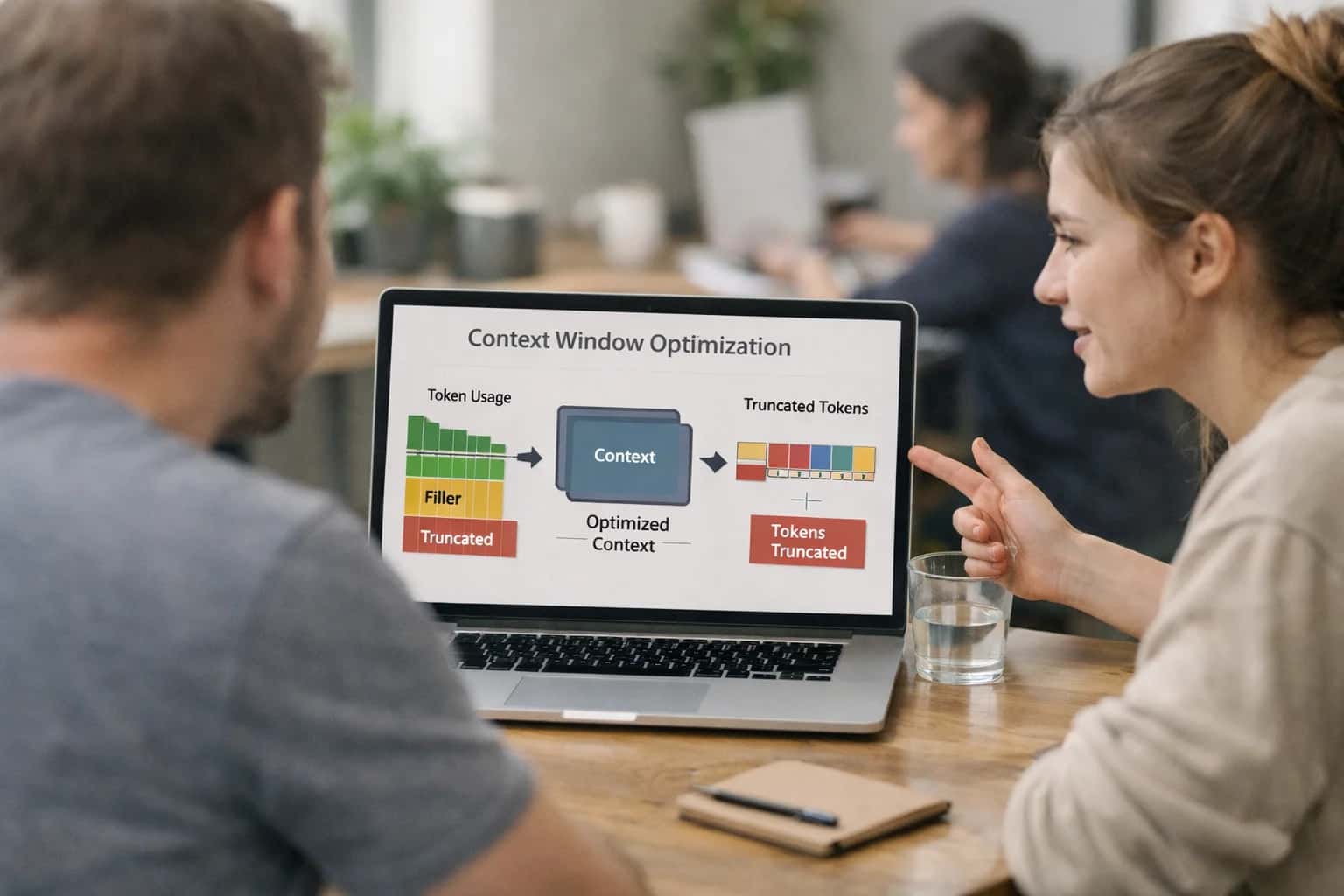
Exceeding this limit forces truncation, typically of the oldest or least relevant context, which can degrade answer quality. Effective RAG design requires precise budgeting for each component.
02
Dictating Optimal Chunk Size & Strategy
The context window size directly informs chunking strategy. For a model with a 4K-token window, using 500-token chunks allows for the retrieval of multiple chunks (e.g., 5-6) to provide comprehensive context. For an 8K model, larger 1000-token chunks might be used for deeper, self-contained context.
Key trade-offs include:
- Smaller Chunks: Higher retrieval precision, but risk missing broader context.
- Larger Chunks: Provide more in-context information, but may dilute relevance with extraneous details. The window size sets the practical bounds for this optimization.
03
Enabling Advanced RAG Patterns
Larger context windows (e.g., 128K+ tokens) enable sophisticated RAG architectures that are impractical with smaller limits:
- Multi-Hop / Iterative Retrieval: The model can process intermediate reasoning and multiple retrieved sets within a single window.
- Hybrid Retrieval Fusion: Results from both vector search and keyword search can be included and compared in-context.
- Sentence Window Retrieval: Retrieving a core sentence and its extensive surrounding context becomes feasible.
- Long-Form Synthesis: Generating comprehensive reports from dozens of retrieved document sections.
04
The Compression vs. Context Trade-Off
When the combined retrieved context threatens to exceed the window, systems must employ context management techniques:
- Summarization: Using a smaller model to condense retrieved chunks before insertion.
- Re-Ranking: Selecting only the top-N most relevant chunks via a cross-encoder.
- Intelligent Truncation: Prioritizing chunks with higher similarity scores.
Each technique adds latency and potential for information loss, making the native window size a key determinant of system simplicity and performance.
05
Impact on Prompt Engineering & System Instructions
The system prompt in a RAG pipeline—which defines the model's role, output format, and citation rules—consumes a fixed portion of the context window. With a smaller window (e.g., 2K tokens), verbose prompts severely limit space for retrieved context. This necessitates:
- Extremely concise prompting
- Moving instructions to fine-tuning where possible
- Using specialized, smaller models with tailored behavior to reduce in-context instruction need
Larger windows provide the luxury of more detailed, few-shot examples within the prompt to guide formatting and reasoning.
06
Cost and Latency Implications
Processing a full context window is computationally intensive. In RAG, filling a 128K-token window with retrieved documents significantly increases:
- Inference Cost: Most cloud APIs charge by total input + output tokens.
- Inference Latency: Model processing time scales with sequence length.
- Retrieval Cost: Fetching and tokenizing enough content to fill a large window requires more database operations.
Therefore, engineering best practice is to retrieve only as much context as is necessary for high-quality generation, not to maximize window usage. Efficient RAG systems are context-aware, not context-greedy.
CONTEXT WINDOW
Frequently Asked Questions
A context window is the fixed maximum sequence length of tokens a language model can process in a single forward pass. It is a fundamental architectural constraint that dictates how much information—including user prompts, system instructions, and retrieved document chunks—can be provided to the model at once.
A context window is the fixed maximum sequence length of tokens that a transformer-based language model can accept as input and attend to in a single forward pass. It defines the total amount of text—comprising the user's query, system instructions, conversation history, and any retrieved knowledge—that the model can consider when generating a response. This limit is a core architectural constraint determined by the model's pre-training and the quadratic computational complexity of the attention mechanism.
For example, models like GPT-4 Turbo have a 128K token context window, while many open-source models are commonly trained with 4K, 8K, or 32K limits. Exceeding this window requires strategies like truncation (removing tokens) or more advanced context management techniques.
Enabling Efficiency, Speed & Accuracy
Intelligent Analysis, Decision & Execution
We build AI systems for teams that need search across company data, workflow automation across tools, or AI features inside products and internal software.
Talk to Us
Search across company data
Give teams answers from docs, tickets, runbooks, and product data with sources and permissions.
Useful when people spend too long searching or get different answers from different systems.
Enterprise searchRAGPermissions
Read more
Automate internal workflows
Use AI to route work, draft outputs, trigger actions, and keep approvals and logs in place.
Useful when repetitive work moves across multiple tools and teams.
AI agentsWorkflow automationGovernance
Read more
Add AI to products and internal tools
Build assistants, guided actions, or decision support into the software your team or customers already use.
Useful when AI needs to be part of the product, not a separate tool.
AI integrationDecision supportModel routing
Read more
About the author
Prasad Kumkar
CEO & MD, Inference Systems
Prasad Kumkar is the CEO & MD of Inference Systems and writes about AI systems architecture, LLM infrastructure, model serving, evaluation, and production deployment. Over 5+ years, he has worked across computer vision models, L5 autonomous vehicle systems, and LLM research, with a focus on taking complex AI ideas into real-world engineering systems.
His work and writing cover AI systems, large language models, AI agents, multimodal systems, autonomous systems, inference optimization, RAG, evaluation, and production AI engineering.
LinkedIn
Limited slotsGet a Free AI Consultation
Partnered with leading AI, data, and software stack.





How We Work
Custom AI workflows for your Business
One-fit-all AI don't work for modern businesses. At Inferensys, we aim to understand your business & custom requirements; which we use to define most efficient agentic workflows, the data, and the tools for your business.
01
Review the use case
We understand the task, the users, and where AI can actually help.
Read more02
Pick the right approach
We define what needs search, automation, or product integration.
Read more03
Build the first useful version
We implement the part that proves the value first.
Read more04
Improve from there
We add the checks and visibility needed to keep it useful.
Read moreThe first call is a practical review of your use case and the right next step.
Talk to Us