Blue-green deployment is a release management strategy that maintains two identical, fully isolated production environments—designated Blue (active) and Green (idle)—where only one environment serves live user traffic at any time. The core mechanism involves deploying a new application version to the idle environment, performing validation, and then switching all incoming traffic from the active to the newly updated environment via a router or load balancer. This enables instantaneous rollback by simply re-routing traffic back to the previous environment if an issue is detected, eliminating downtime and reducing deployment risk.

Glossary
Blue-Green Deployment
A release management strategy that maintains two identical production environments (Blue and Green) to enable zero-downtime deployments and instantaneous rollback by switching traffic routing.
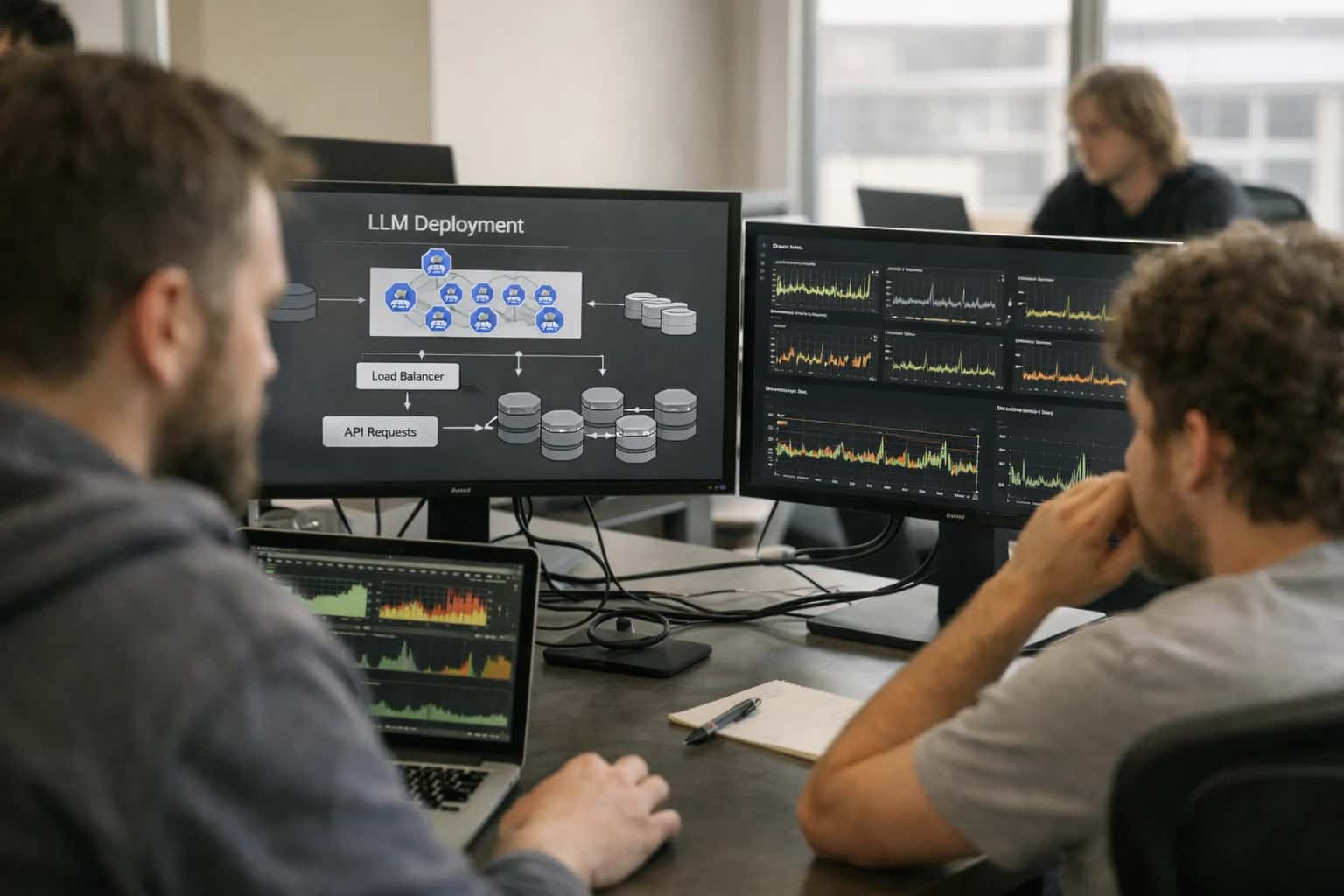
FAULT-TOLERANT AGENT DESIGN
What is Blue-Green Deployment?
A foundational release management strategy for achieving zero-downtime updates and instantaneous rollback in production systems.
This pattern is a cornerstone of fault-tolerant agent design and recursive error correction, as it provides the deterministic rollback capability essential for self-healing software systems. By decoupling deployment from release, it allows for rigorous pre-switch validation and supports canary deployments and feature flagging. The strategy requires significant infrastructure duplication and sophisticated traffic management, often implemented within a service mesh, but delivers unparalleled resilience for stateful services and autonomous agents where uninterrupted operation is critical.
FAULT-TOLERANT AGENT DESIGN
Key Features of Blue-Green Deployment
Blue-green deployment is a release management strategy that maintains two identical production environments, enabling instantaneous traffic switchover and rollback. This pattern is a cornerstone of resilient, self-healing software architectures.
01
Zero-Downtime Releases
The core feature of blue-green deployment is the ability to deploy a new version of an application to an idle environment (Green) while the current version continues to serve all live traffic from the active environment (Blue). Once the new version is fully deployed and validated, traffic is switched at the router or load balancer level, resulting in zero downtime for end-users. This is critical for services requiring continuous availability, such as financial trading platforms or global e-commerce sites.
02
Instantaneous Rollback Capability
If the new version (Green) exhibits critical errors post-switch, the system can be rolled back immediately by reverting traffic to the previous, stable version (Blue). This rollback is performed by simply updating the router configuration, a process that typically takes seconds. This feature provides a powerful safety net, allowing for rapid recovery from failed releases without complex database migrations or state reconciliation, making it a key component of agentic rollback strategies in autonomous systems.
03
Environment Isolation and Testing
The Green environment is a full, isolated copy of production. This allows for comprehensive integration testing, performance validation, and user acceptance testing (UAT) using real-world data and infrastructure before exposing the new version to any users. This isolation prevents configuration drift and ensures the deployment artifact is identical from staging to production, a principle aligned with deterministic execution for reliable agent behavior.
04
Traffic Routing as a Control Plane
The switch between Blue and Green is controlled by an external traffic router (e.g., a load balancer, API gateway, or service mesh). This decouples the deployment process from the application itself. Advanced routing rules enable sophisticated release strategies:
- Canary testing: Route a small percentage of traffic to Green.
- A/B testing: Route specific user segments based on headers or cookies.
- Instant cutover: Switch 100% of traffic at once. This makes the pattern a foundation for iterative refinement protocols and controlled experimentation.
05
Infrastructure as Code Prerequisite
Effective blue-green deployment requires the entire environment—servers, networking, databases, and configuration—to be provisioned declaratively using tools like Terraform, CloudFormation, or Kubernetes manifests. This ensures the Green environment is a true, automatable replica of Blue. This practice is essential for fault-tolerant agent design, as it guarantees consistent, recoverable runtime environments for autonomous systems and supports automated root cause analysis by providing known-good states.
06
Stateful Data Management Challenge
The primary complexity in blue-green deployments involves managing stateful data (e.g., databases, caches, file storage). Strategies must be employed to ensure both environments operate on consistent data:
- Shared database backend: Both Blue and Green connect to the same database cluster, but schema migrations must be backward-compatible.
- Database replication: Green uses a read-replica that is promoted post-switch, requiring careful cutover procedures.
- Event sourcing: Using an immutable log of events allows state to be rebuilt in either environment. This challenge directly relates to managing state in state machine replication for distributed agents.
FAULT-TOLERANT DEPLOYMENT COMPARISON
Blue-Green vs. Other Deployment Strategies
A comparison of deployment methodologies based on their impact on availability, rollback capability, and operational complexity, critical for designing self-healing systems.
| Feature / Metric | Blue-Green Deployment | Canary Deployment | Rolling Update | Recreate (Big Bang) |
|---|---|---|---|---|
Core Mechanism | Maintains two identical, full-scale environments (Blue & Green). Traffic is routed entirely to one at a time. | Releases new version to a small, controlled subset of users/servers first, then gradually expands. | Gradually replaces instances of the old version with the new version across the entire fleet. | Completely shuts down the old version before starting the new version across all instances. |
Switchover / Rollback Speed | < 1 sec (via DNS/LB config change) | Minutes to hours (requires gradual traffic re-routing) | Minutes (depends on batch size and health checks) | Downtime duration (typically minutes) |
Impact on Availability During Deployment | Zero downtime | Zero downtime (for unaffected users) | Potential for reduced capacity during transition | Full service outage |
Rollback Granularity & Speed | Instantaneous; revert traffic to previous environment. | Fast; revert traffic from canary pool to stable version. | Slow; requires rolling back updated instances sequentially. | Slow; requires full restart of previous version, causing another outage. |
Resource Overhead | High (100% duplicate infrastructure) | Low to Moderate (subset of infrastructure) | Low (in-place update, no extra capacity needed) | None (no parallel environments) |
Traffic Control Precision | All-or-nothing at the environment level. | Highly precise; can target specific user segments, regions, or percentages. | Coarse; controlled by instance count, not user traffic. | Not applicable during deployment. |
Risk Mitigation Profile | Isolates risk to the inactive environment; catastrophic failure in Green does not affect Blue. | Limits blast radius; failures affect only the canary group. | Risk is distributed; a bad version progressively affects the entire fleet. | Highest risk; a faulty version affects 100% of users immediately upon start. |
Testing & Validation in Production | Allows for full-scale, real-data testing on the idle environment before cutover. | Enables live A/B testing and performance comparison with real users. | Limited; new version runs concurrently with old but on different instances. | None; version is either fully off or fully on. |
Operational Complexity | Moderate (requires environment synchronization and traffic management tooling). | High (requires sophisticated traffic routing and monitoring for the canary group). | Low (handled natively by most orchestrators like Kubernetes). | Very Low (simple start/stop operation). |
Cost Implication | High (double infrastructure cost during deployment window). | Low (marginal extra cost for canary instances). | None (no extra infrastructure). | None (no extra infrastructure). |
Best Suited For | Mission-critical applications requiring instantaneous rollback and zero downtime, such as financial transaction systems. | Applications requiring gradual validation of new features, performance under real load, or user acceptance testing. | Stateless, non-critical services where brief periods of mixed versions are acceptable and simplicity is valued. | Non-production environments, scheduled maintenance windows, or applications where downtime is acceptable. |
FAULT-TOLERANT AGENT DESIGN
Platforms & Tools for Blue-Green Deployment
Blue-green deployment is a release management strategy that maintains two identical production environments, enabling instantaneous switchover and rollback. The following platforms and tools provide the orchestration, traffic routing, and automation required to implement this pattern effectively.
01
Kubernetes & Service Meshes
Kubernetes provides the foundational primitives for blue-green deployments through its Service and Deployment resources. A Deployment manages two identical ReplicaSets (Blue and Green), while a Service's selector field controls traffic routing. Advanced traffic shifting is achieved with service meshes like Istio or Linkerd, which use VirtualServices and DestinationRules to implement weighted canary routing and instant cutovers without modifying Kubernetes Services.
- Core Mechanism: A Service's label selector is updated to point from the old (Blue) Pods to the new (Green) Pods.
- Key Benefit: Native integration with cloud infrastructure, enabling declarative, GitOps-driven deployment pipelines.
02
Cloud Load Balancers & PaaS
Managed platform services abstract infrastructure complexity. Amazon Web Services Elastic Beanstalk, Google App Engine, and Azure App Service offer built-in blue-green swap capabilities. These platforms manage the underlying compute instances and integrate with their respective cloud load balancers (ELB/ALB, Cloud Load Balancing, Azure Front Door/Application Gateway). The swap is executed via API or console, which updates the load balancer's target group or backend set.
- Core Mechanism: Platform API swaps the active environment's association with the production DNS endpoint or load balancer.
- Key Benefit: Reduced operational overhead; the cloud provider manages health checks, scaling, and the actual traffic cutover.
03
CI/CD Pipeline Orchestrators
Tools like Spinnaker, ArgoCD, and GitLab CI/CD provide first-class support for blue-green workflows. They automate the entire lifecycle: provisioning the green environment, deploying the new version, running integration tests, shifting traffic, and terminating the old environment.
- Spinnaker: Uses the concept of Server Groups and Load Balancers in its deployment strategies. It provides a visual pipeline for managing the cutover and rollback.
- ArgoCD: A GitOps tool that can sync Kubernetes manifests to manage two deployments, often used with Argo Rollouts for advanced progressive delivery.
- Key Benefit: Automated, auditable pipelines that integrate testing and approval gates, reducing human error.
04
Infrastructure as Code (IaC) Tools
Terraform, Pulumi, and AWS CloudFormation are used to define the blue and green environments as immutable, version-controlled code. They enable the creation of a complete parallel stack (networking, compute, databases) for the green deployment. Traffic switchover is then achieved by updating a load balancer reference or DNS record within the IaC configuration and reapplying it.
- Core Mechanism: IaC state manages the mapping between a logical "production" endpoint and a physical environment resource (e.g., an Auto Scaling Group ARN).
- Key Benefit: Ensures environment parity and allows for the entire deployment topology to be versioned and reproduced exactly.
05
Database & State Migration Strategies
A critical challenge for blue-green deployments is managing database schema migrations and application state. Tools and patterns are essential to ensure both environments remain compatible during the transition.
- Forward-Compatible Migrations: Schema changes must be backwards-compatible (e.g., adding nullable columns) so the old (Blue) application continues to function.
- Feature Toggling: Application logic for new database fields is controlled by feature flags, activated after the green cutover.
- Dual-Write & Shadowing: Advanced patterns involve writing to both old and new data stores temporarily, or shadowing traffic to test new database interactions.
- Tools: Liquibase and Flyway help manage incremental, versioned schema scripts that can be applied safely.
06
Monitoring & Automated Rollback
Successful blue-green deployment requires real-time observability to validate the green environment's health post-cutover. This enables automated rollback—a core tenet of fault-tolerant design.
- Key Metrics: Monitor error rates (4xx/5xx), latency (p95, p99), and business metrics (transaction success rate) from the green environment.
- Automation Tools: Prometheus and Grafana for metric collection/alerting. CI/CD pipelines (e.g., Spinnaker) can be configured with automated rollback triggers based on these alerts.
- Smoke Tests: Automated post-deployment validation suites run against the green environment before and after receiving live traffic.
- Result: If key thresholds are breached, traffic is automatically routed back to the stable blue environment, minimizing user impact.
FAULT-TOLERANT AGENT DESIGN
Frequently Asked Questions
Essential questions about Blue-Green Deployment, a core strategy for achieving zero-downtime releases and enabling robust, self-healing software systems.
Blue-Green Deployment is a release management strategy that maintains two identical, fully provisioned production environments (labeled 'Blue' and 'Green'), where only one environment serves live user traffic at any given time, allowing for instantaneous switchover and rollback by changing traffic routing.
This technique is a cornerstone of fault-tolerant agent design, as it provides a deterministic mechanism for deploying new versions of autonomous systems—including agents, models, and their supporting services—with minimal risk. The inactive environment serves as a hot standby, enabling immediate rollback to the last known-good state if the new deployment exhibits errors, supporting agentic rollback strategies and self-healing software systems. It eliminates the 'big bang' cutover of traditional deployments, decoupling deployment from release.
Enabling Efficiency, Speed & Accuracy
Intelligent Analysis, Decision & Execution
We build AI systems for teams that need search across company data, workflow automation across tools, or AI features inside products and internal software.
Talk to Us
Search across company data
Give teams answers from docs, tickets, runbooks, and product data with sources and permissions.
Useful when people spend too long searching or get different answers from different systems.
Enterprise searchRAGPermissions
Read more
Automate internal workflows
Use AI to route work, draft outputs, trigger actions, and keep approvals and logs in place.
Useful when repetitive work moves across multiple tools and teams.
AI agentsWorkflow automationGovernance
Read more
Add AI to products and internal tools
Build assistants, guided actions, or decision support into the software your team or customers already use.
Useful when AI needs to be part of the product, not a separate tool.
AI integrationDecision supportModel routing
Read more
About the author
Prasad Kumkar
CEO & MD, Inference Systems
Prasad Kumkar is the CEO & MD of Inference Systems and writes about AI systems architecture, LLM infrastructure, model serving, evaluation, and production deployment. Over 5+ years, he has worked across computer vision models, L5 autonomous vehicle systems, and LLM research, with a focus on taking complex AI ideas into real-world engineering systems.
His work and writing cover AI systems, large language models, AI agents, multimodal systems, autonomous systems, inference optimization, RAG, evaluation, and production AI engineering.
LinkedIn
Limited slotsGet a Free AI Consultation
Partnered with leading AI, data, and software stack.





How We Work
Custom AI workflows for your Business
One-fit-all AI don't work for modern businesses. At Inferensys, we aim to understand your business & custom requirements; which we use to define most efficient agentic workflows, the data, and the tools for your business.
01
Review the use case
We understand the task, the users, and where AI can actually help.
Read more02
Pick the right approach
We define what needs search, automation, or product integration.
Read more03
Build the first useful version
We implement the part that proves the value first.
Read more04
Improve from there
We add the checks and visibility needed to keep it useful.
Read moreThe first call is a practical review of your use case and the right next step.
Talk to Us