Prompt compression is a set of techniques aimed at reducing the token length of an input prompt to lower computational cost, decrease latency, and fit within a model's finite context window while preserving essential task performance. It operates as a form of dynamic prompt correction, often using methods like selective inclusion, summarization, or learned encoding to distill verbose instructions or lengthy contextual documents into a more compact, information-dense form. This is distinct from prompt tuning, which modifies prompt embeddings for better performance.

Glossary
Prompt Compression
Prompt compression is a set of techniques that reduce the token length of a prompt to lower computational cost and fit within context window limits while preserving task performance.
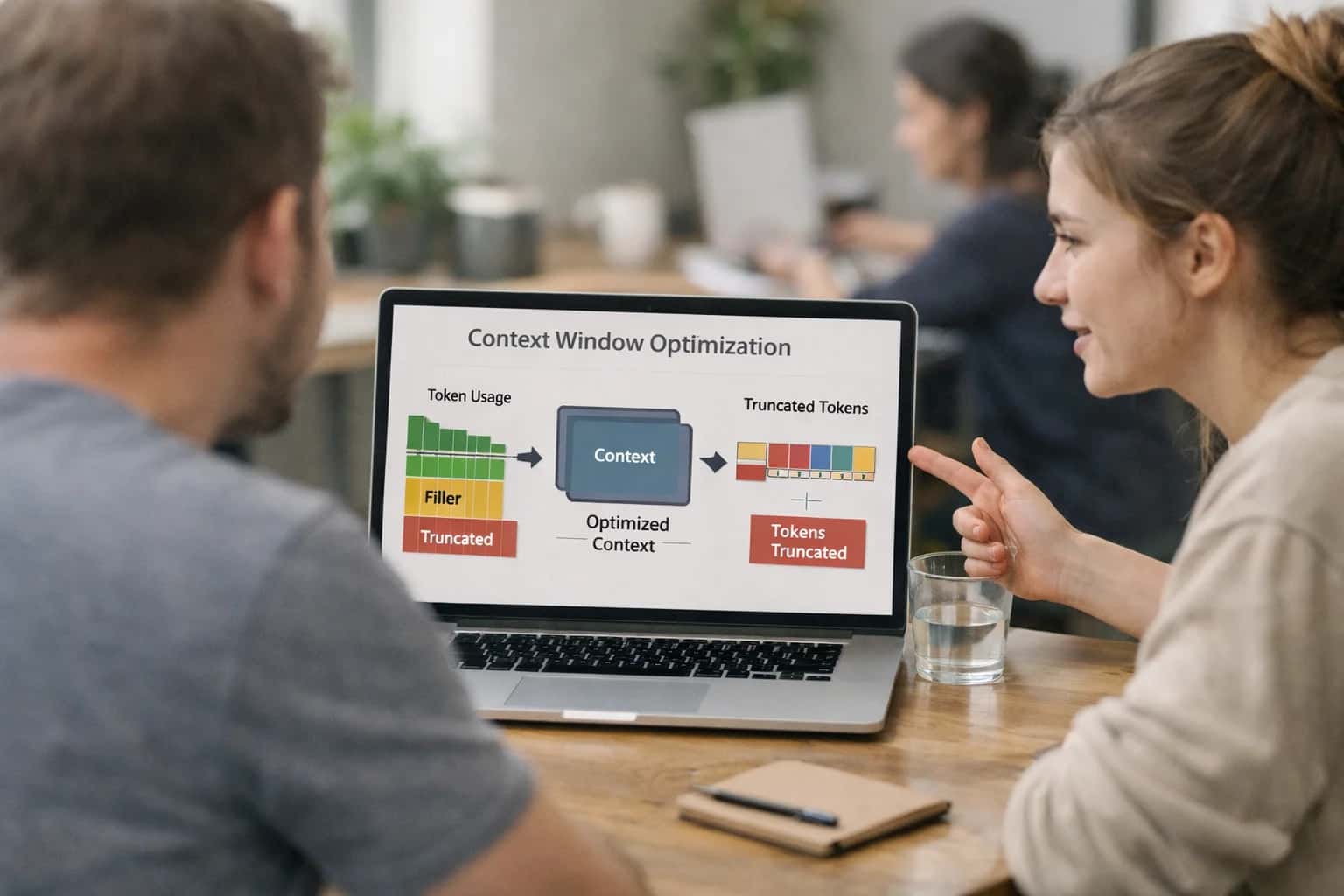
DYNAMIC PROMPT CORRECTION
What is Prompt Compression?
A core technique for optimizing LLM interactions by reducing token count while preserving task intent.
Common technical approaches include training a small auxiliary model to identify and retain critical tokens, using the LLM itself to summarize its own context, or applying lossless compression algorithms on the embedding space. The goal is to maintain high task fidelity—ensuring accuracy and reasoning capability do not degrade—while achieving significant reductions in inference cost and prompt engineering overhead. It is a key enabler for complex multi-step agentic workflows and Retrieval-Augmented Generation (RAG) systems that must manage large volumes of reference text.
DYNAMIC PROMPT CORRECTION
Key Prompt Compression Techniques
Prompt compression reduces the token count of instructions to lower computational cost and fit context windows, using methods from summarization to learned encoding.
01
Selective Context Pruning
This technique involves removing tokens deemed less relevant to the current task from the prompt or context window. It operates by scoring the importance of context segments (e.g., via attention scores or relevance heuristics) and pruning the lowest-scoring parts.
- Methods: Can use simple heuristics (e.g., recency), learned classifiers, or gradient-based saliency maps.
- Goal: Maximally preserve task-critical information while discarding filler, redundant examples, or outdated conversational turns.
- Trade-off: Aggressive pruning risks losing subtle contextual cues necessary for complex reasoning.
02
Prompt Summarization & Distillation
This approach uses a secondary, often smaller, model to summarize a long prompt into a concise version before feeding it to the primary LLM. The summary acts as a compressed representation of the original instructions and context.
- Process: A 'compressor' LLM generates a short summary; the 'target' LLM receives the summary to perform the task.
- Example: Converting a multi-paragraph system prompt and conversation history into a few bullet points of key constraints and intents.
- Consideration: Requires careful tuning of the summarization instruction to avoid losing procedural details or specific formatting requirements.
03
Token-Level Compression (Learned Encoders)
This advanced method trains a model to map long prompt sequences into a smaller set of continuous latent vectors or 'soft prompts'. The decoder (the main LLM) is then conditioned on these compressed vectors.
- Mechanism: Similar to how an autoencoder learns a bottleneck representation. The compressor and main model may be trained jointly or separately.
- Efficiency: Achieves high compression ratios by moving from discrete token space to a dense, information-rich continuous space.
- Use Case: Particularly valuable for recurring, structured prompts where the compression model can learn an optimal encoding.
04
Dynamic Token Streaming
Instead of sending the entire prompt at once, this technique streams tokens to the model incrementally, based on immediate need, and can evict tokens from the context window after they are processed.
- How it works: The system manages a sliding window of active context, adding new tokens (from user input or tool outputs) and dropping the oldest or least relevant ones to stay under a limit.
- Benefit: Enables handling of theoretically infinite-length interactions by maintaining only a working memory buffer.
- Challenge: Requires sophisticated logic to decide what to keep, often integrating with retrieval-augmented generation (RAG) to re-inject critical past information when needed.
05
Instruction-Tuned Compression
This method fine-tunes the primary LLM itself to follow instructions from compressed or abbreviated prompts. The model learns to infer the full intent from terse, shorthand, or template-based prompts.
- Training: The model is trained on pairs of (full detailed prompt, compressed prompt, correct output).
- Outcome: The deployed model becomes adept at understanding prompts where verbs, key nouns, and format specifiers are prioritized, and verbose explanations are omitted.
- Advantage: Reduces prompt engineering overhead and token cost in production, as engineers can write shorter prompts.
06
Caching & Pre-Computation
For static or reusable components of a prompt (e.g., system instructions, few-shot examples, API schemas), this technique involves pre-computing and caching their intermediate representations (like key-value caches in transformer attention).
- Performance Gain: The cached representations are loaded directly, bypassing the computation needed to process those tokens repeatedly.
- Implementation: Leverages transformer inference optimizations like continuous batching and prefix caching where identical prompt prefixes across requests share computation.
- Limitation: Only applicable to the invariant portions of a prompt, not dynamic user input.
TECHNIQUE
How Prompt Compression Works
Prompt compression is a set of techniques aimed at reducing the token length of a prompt to lower computational cost and fit within context window limits while preserving task performance.
Prompt compression is a technique for reducing the token count of an input prompt to a large language model (LLM). The primary goals are to decrease computational cost and latency during inference and to fit more relevant context within a model's fixed context window. This is achieved through methods like selective inclusion, where only the most salient parts of a long prompt are retained, or summarization, where verbose instructions are condensed into a concise form. The core challenge is maintaining the original prompt's semantic intent and instructional fidelity to avoid degrading the model's output quality.
Advanced compression techniques move beyond simple text truncation. Methods include lossless encoding, where prompts are transformed into a more token-efficient representation that the model can decode, and learned compression, where a small auxiliary model is trained to predict which prompt components are essential for a given task. These techniques are critical for dynamic prompt correction systems and agentic workflows, where iterative reasoning and tool-calling can rapidly inflate context length. Effective compression enables more complex, multi-step operations within practical resource constraints.
METHODOLOGY COMPARISON
Comparing Prompt Compression Techniques
A technical comparison of core approaches to reducing prompt token length while preserving task performance, critical for cost management and context window limits.
| Technique / Metric | Selective Context Pruning | Summarization-Based Compression | Token-Level Encoding (e.g., LLMLingua) | Learned Latent Compression |
|---|---|---|---|---|
Core Mechanism | Heuristic or scoring-based removal of less relevant context chunks (sentences, paragraphs). | Abstractive or extractive summarization of long context into a concise version. | Fine-tuned small model identifies and removes 'non-essential' tokens at the sub-sentence level. | End-to-end training of an encoder to map prompts to a compressed latent representation; a decoder reconstructs context for the LLM. |
Preservation Fidelity | Moderate to High (for relevant tasks). Risk of deleting critical information if scoring fails. | Variable. High risk of factual hallucination or loss of nuanced detail in abstractive methods. | High for general tasks. Performance depends on the training data/tasks of the compression model. | Potentially Very High. Fidelity is explicitly optimized for during the encoder-decoder training. |
Compression Ratio | 10-50% reduction | 70-90% reduction | 20-60% reduction | Configurable, often 50-90% reduction |
Computational Overhead | Low (requires scoring pass, often with a lightweight model). | High (requires a full inference pass with a summarization model). | Moderate (requires inference with the small compression model). | High (requires training the compression system). Inference overhead is moderate (encoder + decoder). |
Task Agnostic | ||||
Requires Training | ||||
Explainability / Debugging | High. Deleted chunks are identifiable. | Low. Original context is transformed, hard to trace output to source. | Moderate. Can inspect which tokens were removed. | Very Low. Compression is a black-box latent operation. |
Best For | RAG systems where relevance scores are available; removing stale chat history. | Reducing verbose instructions or long documents for high-level understanding tasks. | General-purpose prompt optimization where a pre-trained compressor is available. | Specialized, high-stakes deployments where compression can be extensively tailored and validated. |
APPLICATION DOMAINS
Primary Use Cases for Prompt Compression
Prompt compression is not just an academic exercise; it's a critical engineering technique for production AI systems. These are the core scenarios where reducing prompt token count delivers tangible operational benefits.
01
Reducing Inference Cost & Latency
This is the most direct financial and performance driver. Inference cost scales linearly with the number of tokens processed (input + output). By compressing lengthy prompts—such as detailed system instructions, few-shot examples, or retrieved context—you directly lower compute expense per query. Latency is also reduced, as the model processes fewer tokens, leading to faster time-to-first-token (TTFT). This is critical for high-throughput applications like customer support chatbots or real-time analytics.
- Example: Compressing a 2000-token system prompt and retrieved context down to 800 tokens can reduce inference cost and latency by over 50% for that input portion.
02
Extending Effective Context Window
While models have fixed context window limits (e.g., 128K tokens), compression allows you to functionally work with more information. By summarizing or selectively including content from long documents, chat histories, or codebases, you can fit a higher density of relevant information within the window. This prevents the need for aggressive truncation, which can discard critical details.
- Key Technique: Selective Context Inclusion algorithms, rather than naive truncation, identify and retain the most salient sentences or facts for the task at hand, preserving performance while staying within limits.
03
Enabling Complex Multi-Turn Dialogues
Maintaining a coherent, long-running conversation requires keeping the entire history within the context window. Uncompressed, this history quickly consumes available tokens. Prompt compression applied to past dialogue turns allows the agent to retain the semantic gist of the conversation without verbatim repetition. This enables multi-agent system orchestration and extended user sessions where memory of early interactions is crucial.
- Application: An autonomous customer service agent can summarize the key points and resolution status of a 50-message thread into a concise context block, freeing up tokens for resolving the current user issue.
04
Optimizing Retrieval-Augmented Generation (RAG)
RAG architectures often retrieve multiple relevant document chunks, which can collectively exceed context limits. Prompt compression is used to distill these chunks into a concise, unified context. Techniques include:
- Extractive Summarization: Selecting the most relevant sentences from each chunk.
- Abstractive Summarization: Generating a new, shorter summary that captures the core information. This ensures the LLM receives the maximum signal from retrieved data without being overwhelmed or hitting token ceilings, directly improving answer quality and factuality.
05
Facilitating Tool & API Call Descriptions
Agents that perform tool calling require detailed descriptions of available functions, their parameters, and examples. In complex systems with dozens of tools, these descriptions can be verbose. Compression techniques can generate abbreviated, task-specific tool documentation that preserves essential usage logic while saving tokens. This allows more tool definitions to fit alongside the user query and reasoning steps within a single prompt, enabling more sophisticated agentic cognitive architectures.
- Benefit: An agent can access a compressed 'cheat sheet' for 20 API tools instead of being limited to the full descriptions for only 5.
06
Improving Reliability for Edge & Constrained Deployments
Deploying LLMs on edge devices or within cost-sensitive environments imposes strict constraints on memory and compute. Small Language Model (SLM) engineering often pairs with prompt compression to maximize capability within these limits. By using highly compressed, efficient prompts, these smaller models can perform complex tasks typically requiring larger context windows, enabling private, cost-effective AI on local hardware. This is essential for sovereign AI infrastructure and applications requiring low-latency, offline operation.
PROMPT COMPRESSION
Frequently Asked Questions
Prompt compression is a set of techniques aimed at reducing the token length of a prompt—through summarization, selective inclusion, or encoding—to lower computational cost and fit within context window limits while preserving task performance.
Prompt compression is a set of techniques that reduce the token count of a prompt to lower computational cost and fit within context window limits while preserving task performance. It works by applying algorithms to the original prompt text to generate a shorter, semantically equivalent version. Common methods include extractive summarization, which selects and concatenates key sentences or phrases, and abstractive summarization, where a model paraphrases the original instructions. More advanced techniques involve selective context caching, where only the most relevant parts of a long conversation history are retained, and token pruning within the model's attention mechanism. The core challenge is maintaining the instructional fidelity and contextual grounding of the original prompt after compression.
Enabling Efficiency, Speed & Accuracy
Intelligent Analysis, Decision & Execution
We build AI systems for teams that need search across company data, workflow automation across tools, or AI features inside products and internal software.
Talk to Us
Search across company data
Give teams answers from docs, tickets, runbooks, and product data with sources and permissions.
Useful when people spend too long searching or get different answers from different systems.
Enterprise searchRAGPermissions
Read more
Automate internal workflows
Use AI to route work, draft outputs, trigger actions, and keep approvals and logs in place.
Useful when repetitive work moves across multiple tools and teams.
AI agentsWorkflow automationGovernance
Read more
Add AI to products and internal tools
Build assistants, guided actions, or decision support into the software your team or customers already use.
Useful when AI needs to be part of the product, not a separate tool.
AI integrationDecision supportModel routing
Read more
About the author
Prasad Kumkar
CEO & MD, Inference Systems
Prasad Kumkar is the CEO & MD of Inference Systems and writes about AI systems architecture, LLM infrastructure, model serving, evaluation, and production deployment. Over 5+ years, he has worked across computer vision models, L5 autonomous vehicle systems, and LLM research, with a focus on taking complex AI ideas into real-world engineering systems.
His work and writing cover AI systems, large language models, AI agents, multimodal systems, autonomous systems, inference optimization, RAG, evaluation, and production AI engineering.
LinkedIn
Limited slotsGet a Free AI Consultation
Partnered with leading AI, data, and software stack.





How We Work
Custom AI workflows for your Business
One-fit-all AI don't work for modern businesses. At Inferensys, we aim to understand your business & custom requirements; which we use to define most efficient agentic workflows, the data, and the tools for your business.
01
Review the use case
We understand the task, the users, and where AI can actually help.
Read more02
Pick the right approach
We define what needs search, automation, or product integration.
Read more03
Build the first useful version
We implement the part that proves the value first.
Read more04
Improve from there
We add the checks and visibility needed to keep it useful.
Read moreThe first call is a practical review of your use case and the right next step.
Talk to Us