Dynamic context management is a set of techniques for intelligently selecting, summarizing, or swapping information within a large language model's finite context window during a multi-turn interaction to maintain relevant conversational history and factual grounding. It is a critical engineering challenge for autonomous agents and Retrieval-Augmented Generation (RAG) systems, ensuring that the most pertinent information is retained for coherent reasoning without exceeding token limits, which would cause earlier parts of the dialogue to be forgotten.

Glossary
Dynamic Context Management
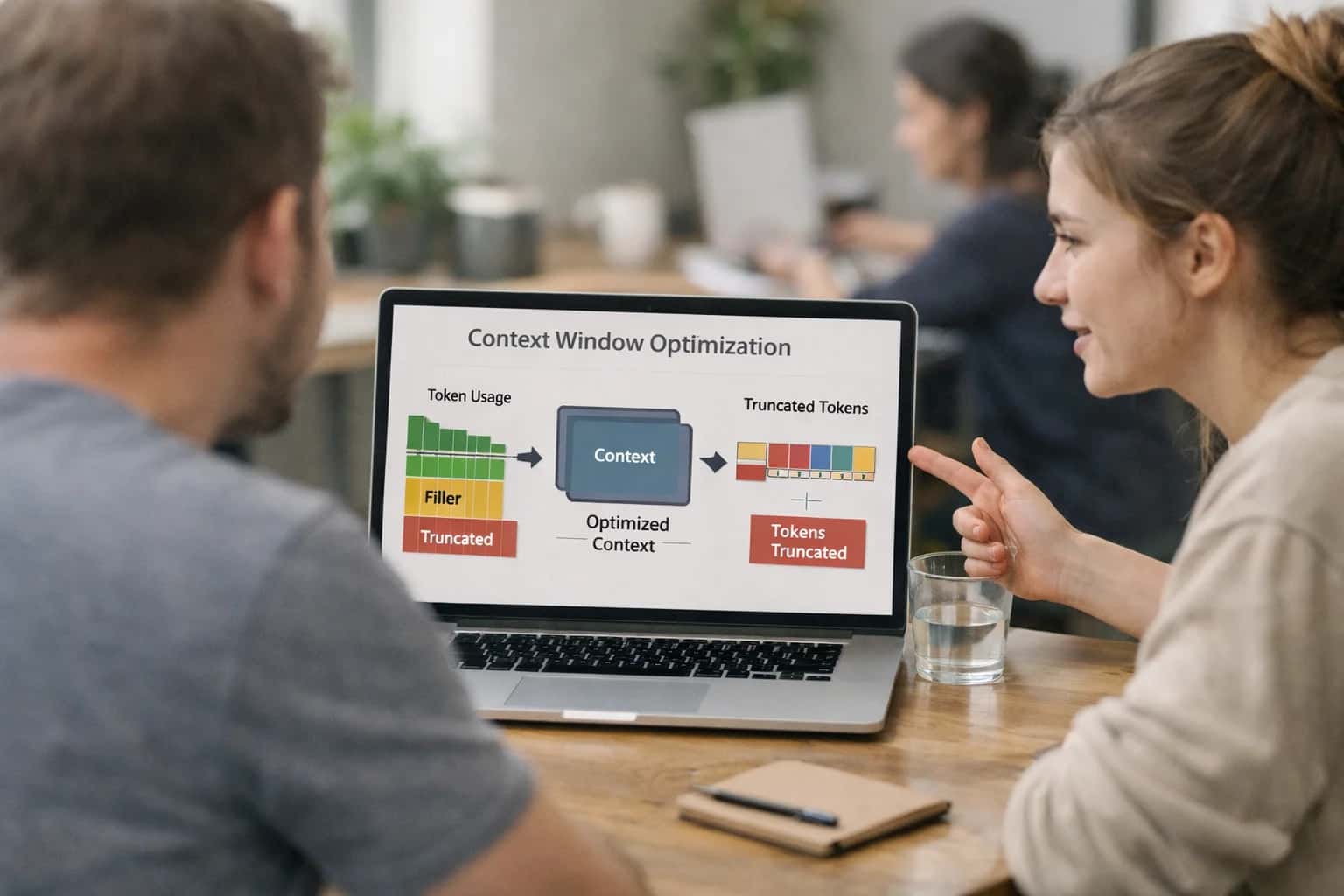
Dynamic context management refers to techniques for intelligently selecting, summarizing, or swapping information within a model's finite context window during a multi-turn interaction to maintain relevant conversational history and facts.
RECURSIVE ERROR CORRECTION
What is Dynamic Context Management?
A core technique within autonomous agent systems for intelligently managing the limited context window of a large language model during extended, multi-turn interactions.
Core methods include context summarization, where prior conversation is condensed; relevance-based pruning, which removes less critical tokens; and strategic context swapping, which dynamically loads relevant external knowledge from a vector database or agentic memory system. This enables long-horizon tasks by simulating an extended memory, directly supporting recursive reasoning loops and self-healing software systems where an agent must reference its own prior steps and errors to iteratively improve.
DYNAMIC CONTEXT MANAGEMENT
Key Techniques and Strategies
These are the core methodologies for intelligently managing the finite context window of a language model during a multi-turn interaction, ensuring relevant history and facts are maintained to optimize performance.
01
Context Summarization
This technique involves periodically condensing the existing conversation history into a shorter, information-dense summary. The summary is then prepended to the model's context window, freeing up tokens for new interactions while preserving the core narrative and key facts.
- Methods: Can be performed by the primary LLM itself or a secondary, smaller model.
- Trigger: Often executed when the token count approaches the model's context limit.
- Benefit: Enables extremely long conversations without losing critical information or hitting hard token limits.
02
Sliding Window with Sticky Tokens
This strategy treats the context window as a fixed-size buffer. As new tokens are added, the oldest tokens are dropped to make room, maintaining a rolling window of the most recent conversation. Sticky tokens (like the system prompt, critical instructions, or a summary) are pinned and never evicted, ensuring foundational directives remain in context.
- Analogy: Functions like a cache with a least-recently-used (LRU) eviction policy for most content.
- Use Case: Ideal for real-time chat applications where only the immediate past is most relevant.
- Challenge: Can lead to context loss for facts mentioned earlier in a long dialogue.
03
Semantic Search & Selective Recall
Instead of storing the entire raw history, this approach maintains a vector database of past conversation snippets. When a new user query arrives, a semantic search retrieves the most relevant past exchanges based on meaning, not just recency. These retrieved snippets are dynamically injected into the prompt.
- Core Technology: Relies on embedding models to convert text into numerical vectors.
- Advantage: Provides associative memory, recalling relevant facts from anywhere in the history, not just the recent window.
- Foundation: The key mechanism behind Retrieval-Augmented Generation (RAG) for conversational agents.
04
Hierarchical Context Management
This architecture organizes context into multiple, distinct layers with different purposes and refresh rates.
- System Layer: Contains the core instructions, personality, and safety guidelines. Persists for the entire session.
- Episodic Layer: Contains a compressed summary of the entire conversation history. Updated periodically.
- Working Memory: Contains the raw tokens of the most recent turns (a sliding window). Changes every turn.
- Retrieved Context: Holds facts pulled from long-term memory (e.g., a knowledge base) relevant to the current query. Dynamic per turn.
This separation allows for precise control over what information influences the model at any given time.
05
Token Budgeting & Priority Scoring
This proactive strategy assigns a token budget to different parts of the context and uses a scoring function to determine what to include. Each potential context element (e.g., a past message, a retrieved document chunk) is given a priority score based on:
- Recency
- Relevance to the current query (via semantic similarity)
- Information density
- User-defined importance
The highest-scoring items are included until the token budget is filled. This moves beyond simple recency to an optimized, relevance-driven context.
06
Function/Tool Call History Management
In agentic systems that call external tools or APIs, managing the history of these calls is a critical sub-problem of dynamic context. Strategies include:
- Storing Results, Not Code: Keeping a concise log of tool names, parameters, and results, rather than the full syntax.
- Summarizing Multi-Step Executions: After a sequence of tool calls completes a sub-task, the system generates a natural language summary of what was accomplished and stores that instead of every intermediate step.
- Error Context Isolation: When a tool call fails, preserving the detailed error message and parameters in context is crucial for the agent's self-correction logic, even if other history is summarized.
This ensures the agent remains aware of its actions without the context being dominated by verbose JSON or code.
TECHNICAL OVERVIEW
How Dynamic Context Management Works
Dynamic context management is the systematic process of intelligently curating the information within a language model's finite context window during a multi-turn interaction.
Dynamic context management refers to the real-time techniques for selecting, summarizing, or swapping information within a model's finite context window to maintain relevant conversational history and factual grounding. It operates as a critical subsystem within autonomous agents and Retrieval-Augmented Generation (RAG) pipelines, ensuring the most pertinent data is available for each reasoning step without exceeding token limits. Core mechanisms include context pruning, summarization of prior turns, and priority-based retrieval from external knowledge stores.
The process is governed by heuristic rules or a learned policy that evaluates the relevance of each piece of contextual information—such as past dialogue, tool outputs, or retrieved documents—to the current query. High-relevance items are retained or fetched; low-relevance items are summarized or evicted. This enables extended, coherent multi-step tasks like autonomous debugging or complex planning by preventing context dilution, managing attention steering, and mitigating performance degradation from lost-in-the-middle effects where key information is positioned poorly within the window.
DYNAMIC CONTEXT MANAGEMENT
Practical Examples and Use Cases
Dynamic context management is a critical engineering technique for overcoming the fixed-length context window of large language models. These examples illustrate how it is applied to maintain relevant conversational state and factual grounding in production systems.
01
Long-Form Conversational Agents
In extended customer support or technical chat sessions, a naive approach of appending the entire history quickly exhausts the context window. Dynamic context management solves this by:
- Automated Summarization: Periodically condensing past dialogue turns into a concise summary that preserves key facts, user intent, and unresolved issues.
- Selective Recall: Using a vector similarity search against a running log of the conversation to retrieve only the most relevant past exchanges when a user references a prior topic.
- Example: A support agent handling a complex software bug over 50 messages. The system maintains a rolling summary of the problem description, steps attempted, and current error state, ensuring the LLM always has the crucial context without the token overhead of the full transcript.
02
Multi-Document Analysis & Synthesis
When an agent must answer questions or write reports based on many source documents (e.g., legal case files, research papers), it cannot fit all text simultaneously. Dynamic context implements a two-stage retrieval process:
- First-Stage Retrieval: A query identifies the most relevant full documents from a corpus using a sparse or dense retriever.
- Second-Stage Chunking: For each relevant document, a more granular search extracts only the specific paragraphs or sections pertinent to the immediate query using semantic search over chunks.
- This hierarchical retrieval dynamically loads a minimal, high-signal context. For instance, a financial analyst agent querying "risks in Q3" would not load entire 10-K filings, but only the 'Risk Factors' sections from the most recent relevant reports.
03
Code Generation & Iterative Debugging
Programming assistants must manage extensive context including codebases, error traces, and user feedback. Dynamic techniques include:
- Relevant File Selection: Using the user's natural language request and the currently open file to retrieve only related functions or classes from a codebase index, rather than the whole repository.
- Error-Aware Context Switching: When a compiler error is returned, the system automatically swaps the context from the generation prompt to focus on the erroneous code block and the exact error message for the debug cycle.
- Example: A developer asks, "Add authentication to the API endpoint." The system retrieves the relevant
api_router.pyfile and the existingauth.pyutility module. After a failed test, the context is dynamically updated to include the test failure log and the specific function signature in focus.
04
Autonomous Research & Writing Agents
Agents that autonomously research a topic and draft content must navigate vast information. They use dynamic context to operate a read-think-write loop:
- The agent starts with a high-level directive (e.g., "Write a briefing on quantum encryption").
- It formulates search queries, and for each search result, dynamically loads the article's summary or key excerpts into its context for analysis.
- As it writes sections, it swaps the research context in and out, keeping only the citations and facts relevant to the current paragraph.
- This prevents the context dilution problem, where early, less relevant search results consume the window needed for later, more critical details. The context is a sliding viewport over a large research corpus.
05
Contextual Task Memory for Personal Assistants
A personal AI assistant that manages calendars, emails, and tasks over weeks needs to remember past interactions without retokenizing them every time. This is achieved via:
- Episodic Memory Compression: After each interaction, key entities (meeting requests, task assignments, decisions) are extracted and stored in a structured knowledge graph or database.
- On-Demand Context Hydration: When a user says, "Reschedule that meeting we discussed Tuesday," the system queries its memory store for "meeting" entities from the approximate date, retrieves the specific record, and injects only that structured data (title, participants, proposed time) into the current prompt.
- The LLM's context contains the present conversation plus a minimal, highly relevant memory payload, not the raw history of every prior chat.
06
Mitigating Context Window Limitations in RAG
In a standard Retrieval-Augmented Generation (RAG) system, even retrieved documents can be too long. Dynamic context management applies post-retrieval processing:
- Re-Ranking & Filtering: Retrieved chunks are scored for relevance a second time, and only the top-k are included.
- Intelligent Chunking: Using models trained to find self-contained semantic units (like paragraphs ending in a conclusion) rather than arbitrary text splits.
- Iterative Retrieval: If the initial answer is insufficient, the agent formulates a new, more precise query based on gaps in its current context, triggering a fresh retrieval round.
- Example: A RAG system for a product manual. A query about "error code 500" retrieves 10 potential sections. A cross-encoder re-ranks them, and the system includes only the top 2 most relevant sections in the final prompt to the LLM, ensuring space for the model's own reasoning.
COMPARISON
Dynamic vs. Static Context Management
A technical comparison of two core approaches for managing the finite context window in LLM-based agentic systems.
| Feature / Metric | Dynamic Context Management | Static Context Management |
|---|---|---|
Context Window Utilization | Selective, prioritized inclusion based on relevance | Sequential, first-in-first-out (FIFO) inclusion |
Core Mechanism | Intelligent summarization, selective recall, and relevance scoring | Fixed-window truncation (e.g., last N tokens) |
Memory Persistence | Long-term facts can be compressed and retained across many turns | Information is completely discarded once pushed out of the fixed window |
Operational Overhead | Higher; requires compute for scoring, summarization, and retrieval logic | Lower; simple append and truncate operations |
Latency Impact | Adds 50-200ms per turn for context scoring/compression | Negligible (< 5ms per turn) |
Ideal Use Case | Long-running, multi-turn agentic workflows requiring factual consistency | Short, stateless conversations or single-turn inference tasks |
Resilience to Context Distraction | High; can deprioritize irrelevant conversational tangents | Low; irrelevant tokens consume fixed window space |
Integration Complexity | High; requires orchestration with vector stores and scoring models | Low; native to most LLM API chat completion interfaces |
DYNAMIC CONTEXT MANAGEMENT
Frequently Asked Questions
Dynamic context management encompasses the techniques for intelligently managing the finite context window of a language model during a multi-turn conversation. This FAQ addresses core concepts, implementation strategies, and related technologies.
Dynamic context management is the set of techniques used to intelligently select, summarize, or swap information within a language model's finite context window during a multi-turn interaction to maintain relevant conversational history and factual grounding. It is critically important because models have strict token limits; without it, essential context is lost (a problem known as context window overflow), leading to degraded performance, factual inconsistencies, and the inability to maintain long-term coherence in extended dialogues or complex tasks. Effective management ensures the model always has access to the most pertinent information, balancing detail with efficiency.
Enabling Efficiency, Speed & Accuracy
Intelligent Analysis, Decision & Execution
We build AI systems for teams that need search across company data, workflow automation across tools, or AI features inside products and internal software.
Talk to Us
Search across company data
Give teams answers from docs, tickets, runbooks, and product data with sources and permissions.
Useful when people spend too long searching or get different answers from different systems.
Enterprise searchRAGPermissions
Read more
Automate internal workflows
Use AI to route work, draft outputs, trigger actions, and keep approvals and logs in place.
Useful when repetitive work moves across multiple tools and teams.
AI agentsWorkflow automationGovernance
Read more
Add AI to products and internal tools
Build assistants, guided actions, or decision support into the software your team or customers already use.
Useful when AI needs to be part of the product, not a separate tool.
AI integrationDecision supportModel routing
Read more
About the author
Prasad Kumkar
CEO & MD, Inference Systems
Prasad Kumkar is the CEO & MD of Inference Systems and writes about AI systems architecture, LLM infrastructure, model serving, evaluation, and production deployment. Over 5+ years, he has worked across computer vision models, L5 autonomous vehicle systems, and LLM research, with a focus on taking complex AI ideas into real-world engineering systems.
His work and writing cover AI systems, large language models, AI agents, multimodal systems, autonomous systems, inference optimization, RAG, evaluation, and production AI engineering.
LinkedIn
Limited slotsGet a Free AI Consultation
Partnered with leading AI, data, and software stack.





How We Work
Custom AI workflows for your Business
One-fit-all AI don't work for modern businesses. At Inferensys, we aim to understand your business & custom requirements; which we use to define most efficient agentic workflows, the data, and the tools for your business.
01
Review the use case
We understand the task, the users, and where AI can actually help.
Read more02
Pick the right approach
We define what needs search, automation, or product integration.
Read more03
Build the first useful version
We implement the part that proves the value first.
Read more04
Improve from there
We add the checks and visibility needed to keep it useful.
Read moreThe first call is a practical review of your use case and the right next step.
Talk to Us