This technique enables domain adaptation and personalization using local data without the prohibitive memory, compute, and energy costs of full model retraining. By training only compact adapter modules like LoRA or prefix embeddings, the base model's vast majority of weights remain frozen. This makes adaptation feasible on resource-constrained hardware such as smartphones, IoT sensors, and microcontrollers, where cloud connectivity or data transfer is impractical or privacy-sensitive.

Glossary
On-Device PEFT
On-Device PEFT is the process of adapting a pre-trained model directly on an edge device by training only a small subset of parameters, enabling efficient personalization and domain adaptation without cloud compute.
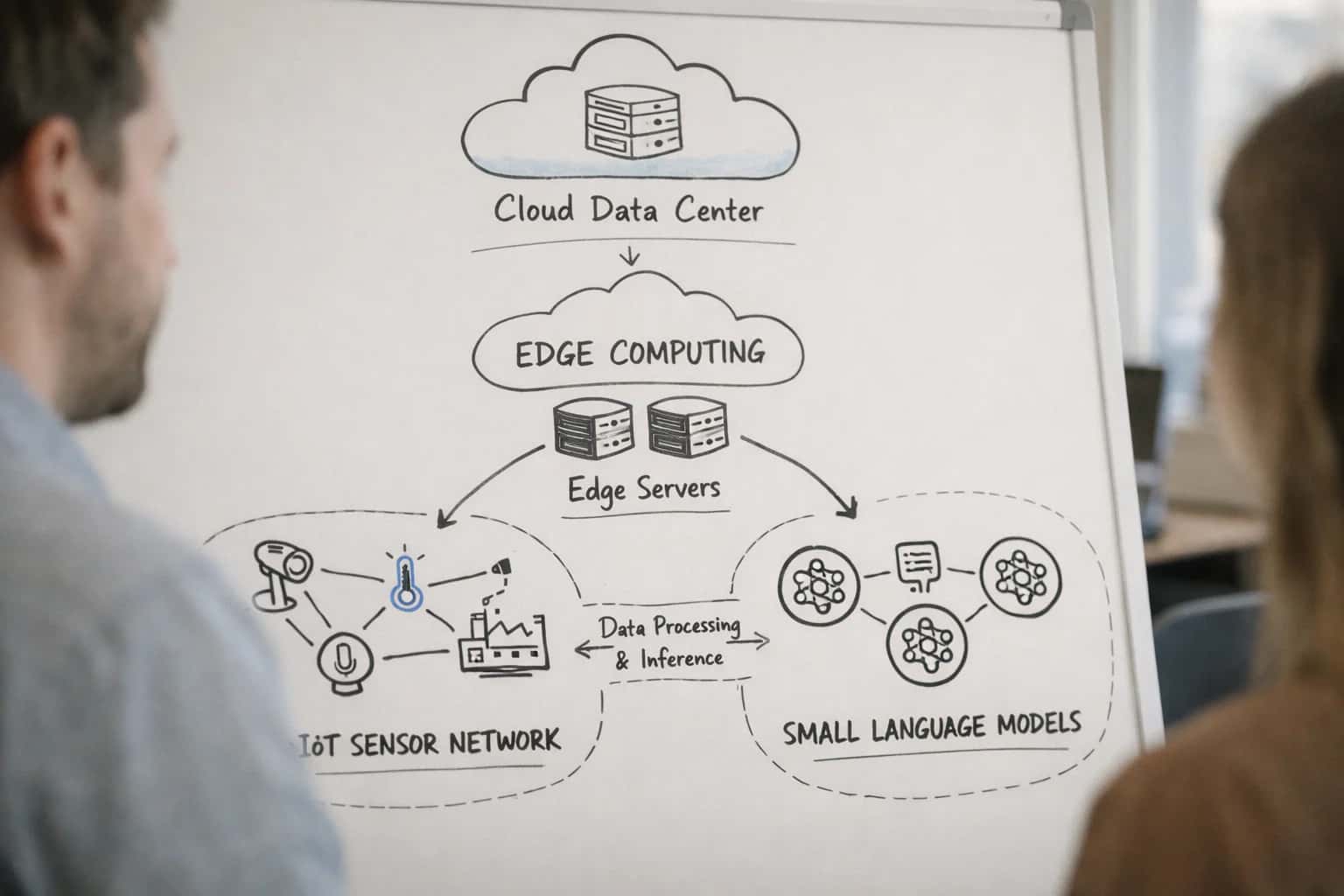
DEFINITION
What is On-Device PEFT?
On-Device PEFT (Parameter-Efficient Fine-Tuning) is the process of adapting a pre-trained machine learning model directly on an edge device by updating only a small, strategically selected subset of its parameters.
The core technical challenge involves executing a constrained edge training loop within strict memory and power budgets. Successful implementations leverage hardware-aware PEFT designs, quantization-aware training, and efficient delta deployment strategies. This paradigm is foundational for applications like user-specific adapters, federated PEFT, and continual edge learning, allowing models to evolve locally while preserving data privacy and operational autonomy.
ON-DEVICE PEFT
Key Technical Characteristics
On-Device PEFT is defined by a set of core technical constraints and design principles that differentiate it from cloud-based fine-tuning. These characteristics focus on extreme resource efficiency, hardware compatibility, and operational autonomy.
01
Extreme Memory Efficiency
The primary constraint for on-device PEFT is peak RAM usage. Techniques must minimize the memory footprint of:
- Gradient Computation: Storing gradients for only the trainable adapter parameters (e.g., LoRA matrices) instead of the full model.
- Optimizer States: Using memory-efficient optimizers like 8-bit Adam or SGD that avoid storing large momentum buffers.
- Activation Memory: Employing gradient checkpointing to trade compute for memory by recomputing activations during the backward pass. Successful implementations keep the total training memory overhead to a small fraction of the base model's size, often targeting kilobyte-scale increases on MCUs.
02
Hardware-Aware Algorithm Design
On-device PEFT algorithms are co-designed with target silicon. Key considerations include:
- Numerical Precision: Supporting mixed-precision training (FP16/FP32) on GPUs or quantization-aware training (INT8) for NPUs and MCUs to match hardware capabilities.
- Operator Support: Ensuring adapter operations (e.g., low-rank matrix additions) map efficiently to available hardware accelerators (DSP, NPU) or CPU instruction sets.
- Energy Profile: Minimizing the number of floating-point operations (FLOPs) and memory accesses to reduce power consumption, a critical metric for battery-powered devices. This alignment ensures the fine-tuning loop can execute within the thermal and power budgets of the edge device.
03
Static Computation Graphs & Determinism
To run reliably on constrained, real-time operating systems (RTOS), on-device PEFT workflows often require:
- Ahead-of-Time Compilation: The entire training loop (forward pass, loss calculation, backward pass, optimizer step) is compiled into a static, executable binary using frameworks like TensorFlow Lite for Microcontrollers or Apache TVM.
- Fixed Memory Allocation: All buffers for parameters, gradients, and optimizer states are statically allocated at compile time to avoid heap fragmentation and guarantee operation.
- Deterministic Execution: Avoiding non-deterministic operations to ensure identical model updates given the same data, which is crucial for debugging and reproducibility in the field.
04
Federated & Privacy-Preserving Formulations
On-device PEFT is a natural fit for privacy-centric learning paradigms:
- Federated PEFT: Devices train local adapter weights and transmit only these small deltas (e.g., a few kilobytes) to a central server for secure aggregation, drastically reducing communication costs versus sending full gradients or data.
- Differential Privacy (DP): DP-SGD can be applied efficiently by adding calibrated noise only to the gradients of the small set of adapter parameters, providing a rigorous privacy guarantee without the prohibitive overhead of applying DP to a full model.
- Secure Enclave Execution: The PEFT training loop can be isolated within a hardware Trusted Execution Environment (TEE), protecting both the base model weights and the sensitive training data from the host OS.
05
Delta Deployment & Runtime Modularity
The small size of PEFT adapters enables novel deployment strategies:
- Over-the-Air (OTA) Updates: Only the adapter weights (the 'delta') need to be distributed for model updates, reducing bandwidth from gigabytes to megabytes or kilobytes.
- Runtime Adapter Loading: Inference engines can dynamically load different adapter modules (e.g., for different users, tasks, or languages) from storage into RAM without reloading the base model.
- Hot-Swappable Adapters: Systems can support contextual switching between adapters within a single inference session, enabling instant personalization or task switching (e.g., from a general language model to a device-specific command recogniter).
06
Data-Efficient & Continual Learning
On-device adaptation must work with small, locally generated datasets and adapt over time:
- Few-Shot Learning: PEFT methods like Prompt Tuning or LoRA are designed to achieve high performance with only a handful of examples per class, which is typical for on-device personalization.
- Online Learning: The training loop processes data in small, sequential batches (or even single examples), updating the adapter incrementally without storing large datasets.
- Catastrophic Forgetting Mitigation: Techniques like Experience Replay (storing a small buffer of past data) or Elastic Weight Consolidation applied to adapter parameters help the model retain previous knowledge while learning new tasks sequentially on the device.
TECHNICAL DEEP DIVE
How On-Device PEFT Works: The Technical Mechanism
On-Device PEFT enables a pre-trained model to adapt locally by updating only a minimal, strategically selected subset of its parameters, bypassing the need for cloud compute.
On-Device Parameter-Efficient Fine-Tuning (PEFT) works by freezing the vast majority of a pre-trained model's base parameters and introducing a small set of trainable parameters—such as LoRA matrices or adapter modules—that are optimized using local device data. A constrained edge training loop executes forward and backward passes, calculating gradients and applying updates exclusively to these introduced parameters via an on-device optimizer like SGD, all within strict memory and power budgets. The core model's knowledge remains intact while the new parameters learn task- or user-specific patterns.
The technical mechanism hinges on efficient computation graphs and hardware-aware operations that minimize peak RAM usage and leverage available accelerators (e.g., NPUs). Post-training, only the tiny adapter weights (the 'delta') are stored. During inference, the system performs a parameter composition, merging the frozen base weights with the active adapter's weights to produce adapted outputs. This enables runtime adapter loading for context-specific behavior without retransmitting the entire model.
ON-DEVICE PEFT
Common Use Cases & Applications
On-Device PEFT enables efficient model adaptation directly on edge hardware. Its primary applications center on privacy, personalization, and operational efficiency in resource-constrained environments.
01
User & Device Personalization
On-Device PEFT is the core technology for privacy-preserving personalization. A shared base model (e.g., for speech recognition or recommendation) is deployed to all devices. Each device then fine-tunes a small, unique user-specific adapter (like a LoRA module) using only local interaction data. This adapter customizes the model's behavior for individual accents, preferences, or usage patterns without any personal data leaving the device. The result is a tailored AI experience that maintains user privacy and reduces cloud dependency.
02
Domain-Specific Adaptation at the Edge
This use case involves adapting a general-purpose model to a specific physical environment or operational domain directly on the deployed hardware. For example:
- A visual inspection model is fine-tuned on-device to recognize unique defects on a particular factory's production line.
- A keyword spotting model is adapted to the specific acoustic profile of a noisy kitchen or car interior.
- A time-series model learns the normal vibration signature of a specific turbine for predictive maintenance. By performing PEFT for domain adaptation locally, the model achieves higher accuracy for its immediate context without the cost and latency of cloud retraining or the security risk of transmitting sensitive operational data.
03
Federated Learning with PEFT
Federated PEFT dramatically improves the efficiency and privacy of decentralized learning. Instead of devices sharing full model gradients, they locally train only a small PEFT adapter (e.g., a LoRA matrix). Only these compact adapter updates are sent to a central server for secure aggregation (e.g., via averaging). The aggregated adapter is then redistributed. This approach:
- Reduces communication costs by orders of magnitude compared to full-model federated learning.
- Enhances privacy as the small adapter update reveals less about the raw local data.
- Enables practical collaboration across a fleet of phones, sensors, or vehicles to improve a global model while keeping all training data on-device.
04
Over-the-Air (OTA) Model Updates
On-Device PEFT enables efficient and secure delta deployment for model updates. When a model needs improvement or a bug fix, only the small, newly trained PEFT adapter weights (the 'delta') are distributed over-the-air (OTA) to devices. The device then merges this adapter with its pre-existing base model. This strategy offers critical advantages for managing large fleets:
- Minimizes bandwidth usage, as updates are often <1% the size of the full model.
- Reduces update time and cost, enabling rapid iteration and patching.
- Allows for A/B testing of different adapter versions on subsets of devices.
- Maintains operational continuity as the base model remains stable.
05
Continual & Lifelong Learning on Devices
Continual edge learning systems use On-Device PEFT to allow a model to learn sequentially from new data encountered during operation. For instance, a robot vacuum learns the layout of new furniture, or a smart camera learns to recognize new faces. PEFT is ideal for this because:
- Training only a small adapter minimizes computational and memory overhead, fitting within tight edge training loop budgets.
- Techniques like adapter composition or sparse activation can help mitigate catastrophic forgetting by isolating knowledge for different tasks into separate, modular adapters.
- This enables devices to improve autonomously over time while operating fully offline, adapting to changing environments without developer intervention.
06
Privacy-Enhanced Model Training
On-Device PEFT is a foundational component for building privacy-preserving machine learning systems. By keeping all sensitive data local, it eliminates the primary data leakage vector. This can be combined with advanced cryptographic techniques for stronger guarantees:
- PEFT with Differential Privacy (DP): During on-device adapter training, calibrated noise is added to the gradients. This provides a mathematical guarantee that the final adapter cannot reveal whether any specific individual's data was in the training set.
- Private PEFT frameworks may also use secure aggregation in federated settings or homomorphic encryption for computations on encrypted data.
- This is critical for applications in healthcare (clinical workflow automation), finance, and any domain handling regulated personal information, enabling model adaptation in compliance with strict data sovereignty laws.
KEY CHARACTERISTICS
Comparison of PEFT Methods for On-Device Use
A technical comparison of popular Parameter-Efficient Fine-Tuning (PEFT) methods based on their suitability for deployment and execution on resource-constrained edge devices.
| Feature / Metric | Low-Rank Adaptation (LoRA) | Adapter Layers | Prompt Tuning |
|---|---|---|---|
Peak Training Memory | Low (adds ~0.1-1% of base model) | Low (adds ~0.5-3% of base model) | Very Low (adds <0.01% of base model) |
Inference Overhead | Low (requires merging) | Medium (extra forward pass per layer) | Very Low (prepended to input) |
Hardware Compatibility | |||
Supports Dynamic Switching | |||
Update Size (OTA) | Small (two low-rank matrices) | Small (per-layer modules) | Minimal (prompt embeddings) |
Quantization-Friendly | |||
Native TFLite Support | Partial (via custom ops) | Limited | |
Typical Accuracy Retention | 95-99% of full fine-tune | 94-98% of full fine-tune | 85-95% of full fine-tune |
ON-DEVICE PEFT
Frequently Asked Questions
On-Device PEFT enables efficient, private model adaptation directly on edge hardware. These FAQs address the core technical questions for engineers deploying AI to resource-constrained environments.
On-Device PEFT (Parameter-Efficient Fine-Tuning) is the process of adapting a pre-trained model directly on an edge device by training only a small subset of its parameters, such as adapter modules or LoRA matrices, while keeping the vast majority of the base model frozen. It works by executing a constrained edge training loop locally: the device performs forward and backward passes on its own data, computes gradients only for the small set of trainable PEFT parameters, and applies updates via an optimizer like SGD, all within strict memory, compute, and power budgets. This enables domain adaptation and personalization without transferring sensitive data to the cloud.
Enabling Efficiency, Speed & Accuracy
Intelligent Analysis, Decision & Execution
We build AI systems for teams that need search across company data, workflow automation across tools, or AI features inside products and internal software.
Talk to Us
Search across company data
Give teams answers from docs, tickets, runbooks, and product data with sources and permissions.
Useful when people spend too long searching or get different answers from different systems.
Enterprise searchRAGPermissions
Read more
Automate internal workflows
Use AI to route work, draft outputs, trigger actions, and keep approvals and logs in place.
Useful when repetitive work moves across multiple tools and teams.
AI agentsWorkflow automationGovernance
Read more
Add AI to products and internal tools
Build assistants, guided actions, or decision support into the software your team or customers already use.
Useful when AI needs to be part of the product, not a separate tool.
AI integrationDecision supportModel routing
Read more
About the author
Prasad Kumkar
CEO & MD, Inference Systems
Prasad Kumkar is the CEO & MD of Inference Systems and writes about AI systems architecture, LLM infrastructure, model serving, evaluation, and production deployment. Over 5+ years, he has worked across computer vision models, L5 autonomous vehicle systems, and LLM research, with a focus on taking complex AI ideas into real-world engineering systems.
His work and writing cover AI systems, large language models, AI agents, multimodal systems, autonomous systems, inference optimization, RAG, evaluation, and production AI engineering.
LinkedIn
Limited slotsGet a Free AI Consultation
Partnered with leading AI, data, and software stack.





How We Work
Custom AI workflows for your Business
One-fit-all AI don't work for modern businesses. At Inferensys, we aim to understand your business & custom requirements; which we use to define most efficient agentic workflows, the data, and the tools for your business.
01
Review the use case
We understand the task, the users, and where AI can actually help.
Read more02
Pick the right approach
We define what needs search, automation, or product integration.
Read more03
Build the first useful version
We implement the part that proves the value first.
Read more04
Improve from there
We add the checks and visibility needed to keep it useful.
Read moreThe first call is a practical review of your use case and the right next step.
Talk to Us