Edge-LoRA is a hardware-aware implementation of Low-Rank Adaptation (LoRA) optimized for deployment on resource-constrained edge devices, focusing on minimizing memory footprint, computational overhead, and energy consumption during both adaptation and inference. It extends the core LoRA principle—freezing a pre-trained model and injecting trainable low-rank matrices—with system-level optimizations for microcontrollers (MCUs), neural processing units (NPUs), and other edge silicon. This enables efficient on-device fine-tuning and personalization without cloud dependency.

Glossary
Edge-LoRA
Edge-LoRA is a hardware-aware implementation of Low-Rank Adaptation (LoRA) optimized for deployment on resource-constrained edge devices, focusing on minimizing memory footprint, computational overhead, and energy consumption during both adaptation and inference.
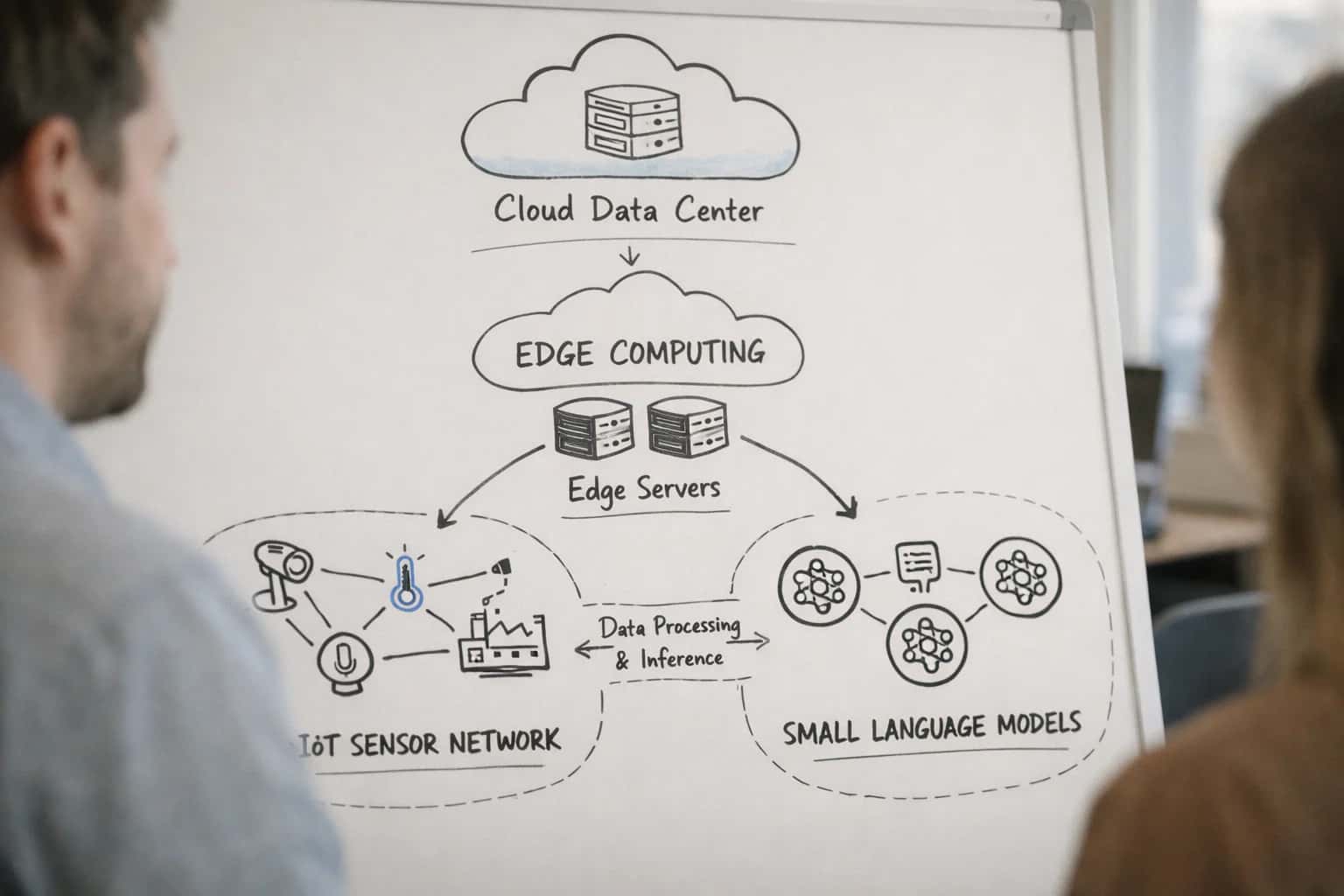
PEFT FOR EDGE AND ON-DEVICE AI
What is Edge-LoRA?
Edge-LoRA is a hardware-optimized implementation of the Low-Rank Adaptation (LoRA) technique, specifically engineered for deployment on resource-constrained edge devices.
Key optimizations include quantization-aware training for INT8/FP16 support, static memory allocation to avoid runtime overhead, and compiler-level fusion of adapter operations. These make Edge-LoRA integral to TinyML and edge AI workflows, allowing a single base model to serve multiple specialized tasks via hot-swappable adapters. It directly addresses constraints in power, memory, and compute that are critical for applications like sensor data analysis, predictive maintenance, and keyword spotting on devices.
HARDWARE-AWARE ADAPTATION
Key Characteristics of Edge-LoRA
Edge-LoRA is a specialized implementation of Low-Rank Adaptation (LoRA) engineered for the stringent constraints of edge devices. Its design principles prioritize minimizing memory footprint, computational overhead, and energy consumption during both adaptation and inference phases.
01
Memory-Constrained Rank Selection
Unlike standard LoRA, which may use a fixed rank (r) for all layers, Edge-LoRA employs adaptive rank selection based on layer sensitivity and available device memory. Critical layers may receive a higher rank for better adaptation, while less sensitive layers use a lower rank or are frozen entirely.
- Static Memory Budgeting: The total size of all LoRA matrices is pre-calculated to fit within a device's SRAM, avoiding costly DRAM swaps.
- Example: A model with 7B parameters might use an aggregate rank sum of 256, resulting in adapter weights under 10MB, suitable for microcontrollers.
02
Quantization-Aware Adapter Training
Edge-LoRA adapters are trained with simulated quantization to ensure stability when deployed with low-precision (INT8/FP16) base models. The gradient updates for the low-rank matrices account for quantization noise, preventing accuracy collapse.
- Post-Training Quantization (PTQ) Compatibility: The trained LoRA deltas are designed to be fused with a pre-quantized base model without requiring QAT (Quantization-Aware Training) for the entire network.
- Hardware Alignment: Adapter weights are structured to leverage NEON SIMD instructions on ARM CPUs or tensor cores on edge NPUs for efficient low-rank matrix operations.
03
Sparse Gradient Updates & Checkpointing
To reduce peak RAM during on-device training, Edge-LoRA implements selective gradient computation and micro-checkpointing.
- Gradient Sparsity: Only a subset of the LoRA parameters are updated per batch, controlled by a magnitude threshold, reducing the size of the gradient tensor held in memory.
- Recomputation Strategy: Intermediate activations are recomputed during the backward pass instead of stored, trading compute cycles for memory—a viable trade-off on edge devices where memory is the primary bottleneck.
- This allows training loops to run on devices with < 512KB of RAM.
04
Runtime-Efficient Inference Merging
Edge-LoRA supports dynamic adapter merging at inference time without performance degradation. The low-rank matrices (A and B) are fused with the base model weights on-the-fly using efficient kernel fusion techniques.
- Just-In-Time (JIT) Compilation: The merge operation (W + BA) is compiled into a single kernel for the target accelerator (e.g., GPU, NPU).
- Hot-Swapping: Multiple adapters can be stored in flash memory and loaded into RAM as needed, enabling context-specific model behavior (e.g., user personalization, task switching) with sub-millisecond latency overhead.
- This is critical for applications like keyword spotting where different wake-word adapters must be switched rapidly.
05
Energy-Proportional Training Loops
The Edge-LoRA training process is designed for energy proportionality, minimizing Joule-per-update. Techniques include:
- Gradient Accumulation with Low Frequency: Batches are processed at a lower clock frequency, and gradients are accumulated over multiple micro-batches before an update, reducing dynamic power consumption.
- Sleep-State Awareness: The training scheduler is integrated with the device's power management unit (PMU), pausing updates during sleep cycles and resuming from a tiny checkpoint (< 1KB).
- This enables continual edge learning on battery-powered sensors for applications like predictive maintenance.
06
Federated & Privacy-Preserving Workflows
Edge-LoRA is a foundational primitive for Federated Learning (FL) and Differential Privacy (DP) on edge networks.
- Communication Efficiency: Only the small LoRA delta (e.g., a few megabytes) is transmitted to the aggregation server, not the full model weights (gigabytes).
- Differential Privacy Integration: Gaussian noise can be added directly to the LoRA gradient updates before transmission, providing a strong privacy guarantee. The small parameter count makes the privacy-utility trade-off more favorable.
- This architecture is essential for private personalization in healthcare or finance, where user data must never leave the device.
TECHNICAL DEEP DIVE
How Edge-LoRA Works: The Technical Mechanism
Edge-LoRA is a hardware-optimized variant of Low-Rank Adaptation (LoRA) engineered for resource-constrained devices. It modifies the core LoRA algorithm to minimize memory, compute, and energy overhead during both fine-tuning and inference at the edge.
Edge-LoRA implements the Low-Rank Adaptation principle by freezing a pre-trained base model and injecting trainable low-rank matrices into its attention or feed-forward layers. The key innovation is its hardware-aware design, which constrains the rank (r) of these adapter matrices to an extreme degree—often single digits—to drastically reduce the parameter count. This minimizes the peak RAM required to store gradients and optimizer states during on-device training and shrinks the adapter footprint for inference.
The mechanism optimizes for fixed-point arithmetic and static memory allocation common in microcontrollers. It often employs quantization-aware training for the LoRA matrices, ensuring stability when weights are converted to INT8. During inference, the system performs a one-time merge of the low-rank matrices with the frozen base weights, or uses runtime adapter loading to switch contexts without recomputation. This fusion creates a single, efficient model executable on NPUs or DSPs, eliminating the overhead of separate adapter modules during live prediction.
DEPLOYMENT SCENARIOS
Common Use Cases for Edge-LoRA
Edge-LoRA enables efficient model adaptation directly on resource-constrained hardware. These are the primary scenarios where its memory and compute optimizations deliver critical value.
01
On-Device Personalization
Edge-LoRA enables user-specific adaptation of a shared base model directly on a smartphone, wearable, or smart home device. By training a compact LoRA adapter on local user interactions, the device can personalize responses, recommendations, or behavior without sending private data to the cloud. This is foundational for privacy-preserving features like personalized keyboard predictions, fitness coaching, or content curation.
< 100MB
Typical Adapter Size
02
Sensor-Specific Domain Adaptation
Pre-trained models for time-series analysis or anomaly detection are adapted to the unique noise profile and statistical characteristics of individual sensors in the field. Edge-LoRA fine-tunes the model on normal operational data from a specific machine (e.g., a turbine or pump) to create a device-specific adapter. This allows for highly accurate, on-device fault detection and predictive maintenance without the cost of training a unique model per asset.
- Key Application: Vibration analysis for industrial equipment.
- Benefit: Catches subtle, asset-specific failure signatures.
03
Keyword Spotting & Audio Command Customization
Edge-LoRA efficiently adapts acoustic models for wake-word detection and command recognition to new accents, languages, or noisy acoustic environments. Instead of retraining the entire model in the cloud, a small LoRA adapter is trained on-device with a few user samples. This enables rapid customization for global product deployments and improves accuracy in challenging real-world settings like cars or kitchens.
~10-50
Customization Samples Needed
04
Federated Learning with Reduced Overhead
In a federated learning setup, Edge-LoRA drastically reduces communication and compute costs. Instead of sending full model updates, each edge device trains only its local LoRA adapter and transmits these small matrices (the delta) to a central server for secure aggregation. This preserves data privacy, minimizes bandwidth use, and allows personalization across a device fleet. It's essential for applications in healthcare (medical device adaptation) and finance (fraud pattern learning).
> 90%
Reduced Communication
05
Over-the-Air (OTA) Model Updates
Edge-LoRA enables efficient delta deployment for remote model improvements. When a base model needs a bug fix, a security patch, or a new capability, only a tiny LoRA adapter (often kilobytes in size) is wirelessly transmitted to the edge device fleet. This OTA update integrates with the pre-deployed base model, enabling rapid, low-bandwidth model evolution without full model replacement—critical for maintaining large-scale IoT deployments.
KB vs. GB
Update Size Comparison
ARCHITECTURAL COMPARISON
Edge-LoRA vs. Standard Cloud LoRA
A technical comparison of LoRA implementations optimized for resource-constrained edge environments versus standard cloud-based deployments.
| Feature / Metric | Edge-LoRA | Standard Cloud LoRA |
|---|---|---|
Primary Deployment Target | Microcontrollers (MCUs), Edge SoCs, Mobile Phones | Cloud VMs, High-Performance GPU Clusters |
Memory Footprint (Adapter) | < 100 KB | 10-100 MB |
Numerical Precision (Training) | INT8, FP16 (Quantization-Aware) | BF16, FP32 |
Numerical Precision (Inference) | INT8, FP16 | FP16, FP32 |
Training Compute Budget | Milliwatt-hours (mWh) | Kilowatt-hours (kWh) |
Update Distribution Mechanism | Over-the-Air (OTA) Delta Deployment | Full Model Container/Image Update |
Adapter Switching at Runtime | Hot-Swappable Adapters | |
Integration with On-Device Data | ||
Inherent Data Privacy (Training) | ||
Typical Use Case | Sensor Anomaly Detection, User Personalization | Instruction Tuning, Large-Scale Domain Adaptation |
Supported Hardware Accelerators | MicroNPUs, DSPs, ARM Cortex-M | NVIDIA GPUs, Google TPUs, AMD Instinct |
Toolchain & Framework | TFLite Micro, Edge Impulse, MCU-Optimized Runtimes | PyTorch, Hugging Face PEFT, TensorFlow |
Peak RAM During Training | Static Allocation, < 512 KB | Dynamic Allocation, > 16 GB |
Communication Cost for Update | < 1 MB | 1-10 GB |
Continuous/Continual Learning Support |
EDGE-LORA
Frequently Asked Questions
Edge-LoRA is a hardware-optimized implementation of Low-Rank Adaptation designed for resource-constrained edge devices. These questions address its core mechanisms, benefits, and practical deployment considerations.
Edge-LoRA is a hardware-aware implementation of the Low-Rank Adaptation (LoRA) fine-tuning technique, specifically optimized for deployment on resource-constrained edge devices like microcontrollers, smartphones, and IoT sensors. It works by decomposing the weight update matrix (ΔW) for a pre-trained neural network layer into the product of two low-rank matrices, A and B, where ΔW = BA. During fine-tuning, only these small, low-rank matrices are trained and updated, while the original, much larger base model weights remain frozen. The key innovation of Edge-LoRA is its co-design with edge hardware constraints, incorporating optimizations such as static memory allocation for adapter weights, quantization-aware training for the low-rank matrices, and compiler-level passes to fuse adapter operations, all to minimize memory footprint, computational latency, and energy consumption during both the adaptation and inference phases.
Enabling Efficiency, Speed & Accuracy
Intelligent Analysis, Decision & Execution
We build AI systems for teams that need search across company data, workflow automation across tools, or AI features inside products and internal software.
Talk to Us
Search across company data
Give teams answers from docs, tickets, runbooks, and product data with sources and permissions.
Useful when people spend too long searching or get different answers from different systems.
Enterprise searchRAGPermissions
Read more
Automate internal workflows
Use AI to route work, draft outputs, trigger actions, and keep approvals and logs in place.
Useful when repetitive work moves across multiple tools and teams.
AI agentsWorkflow automationGovernance
Read more
Add AI to products and internal tools
Build assistants, guided actions, or decision support into the software your team or customers already use.
Useful when AI needs to be part of the product, not a separate tool.
AI integrationDecision supportModel routing
Read more
About the author
Prasad Kumkar
CEO & MD, Inference Systems
Prasad Kumkar is the CEO & MD of Inference Systems and writes about AI systems architecture, LLM infrastructure, model serving, evaluation, and production deployment. Over 5+ years, he has worked across computer vision models, L5 autonomous vehicle systems, and LLM research, with a focus on taking complex AI ideas into real-world engineering systems.
His work and writing cover AI systems, large language models, AI agents, multimodal systems, autonomous systems, inference optimization, RAG, evaluation, and production AI engineering.
LinkedIn
Limited slotsGet a Free AI Consultation
Partnered with leading AI, data, and software stack.





How We Work
Custom AI workflows for your Business
One-fit-all AI don't work for modern businesses. At Inferensys, we aim to understand your business & custom requirements; which we use to define most efficient agentic workflows, the data, and the tools for your business.
01
Review the use case
We understand the task, the users, and where AI can actually help.
Read more02
Pick the right approach
We define what needs search, automation, or product integration.
Read more03
Build the first useful version
We implement the part that proves the value first.
Read more04
Improve from there
We add the checks and visibility needed to keep it useful.
Read moreThe first call is a practical review of your use case and the right next step.
Talk to Us