The Android Neural Networks API (NNAPI) is a low-level C API that provides a hardware abstraction layer for executing computationally intensive machine learning operations on Android devices. It allows inference frameworks like TensorFlow Lite and PyTorch Mobile to delegate model execution to available hardware accelerators—such as NPUs, GPUs, and DSPs—while providing a consistent interface for CPU fallback. By abstracting the underlying silicon, NNAPI enables developers to write hardware-agnostic code that automatically leverages the most efficient processor for a given neural network operation.

Glossary
Android NNAPI
Android NNAPI is a C API that provides a hardware abstraction layer for running computationally intensive machine learning operations on Android devices, enabling acceleration across CPUs, GPUs, DSPs, and NPUs.
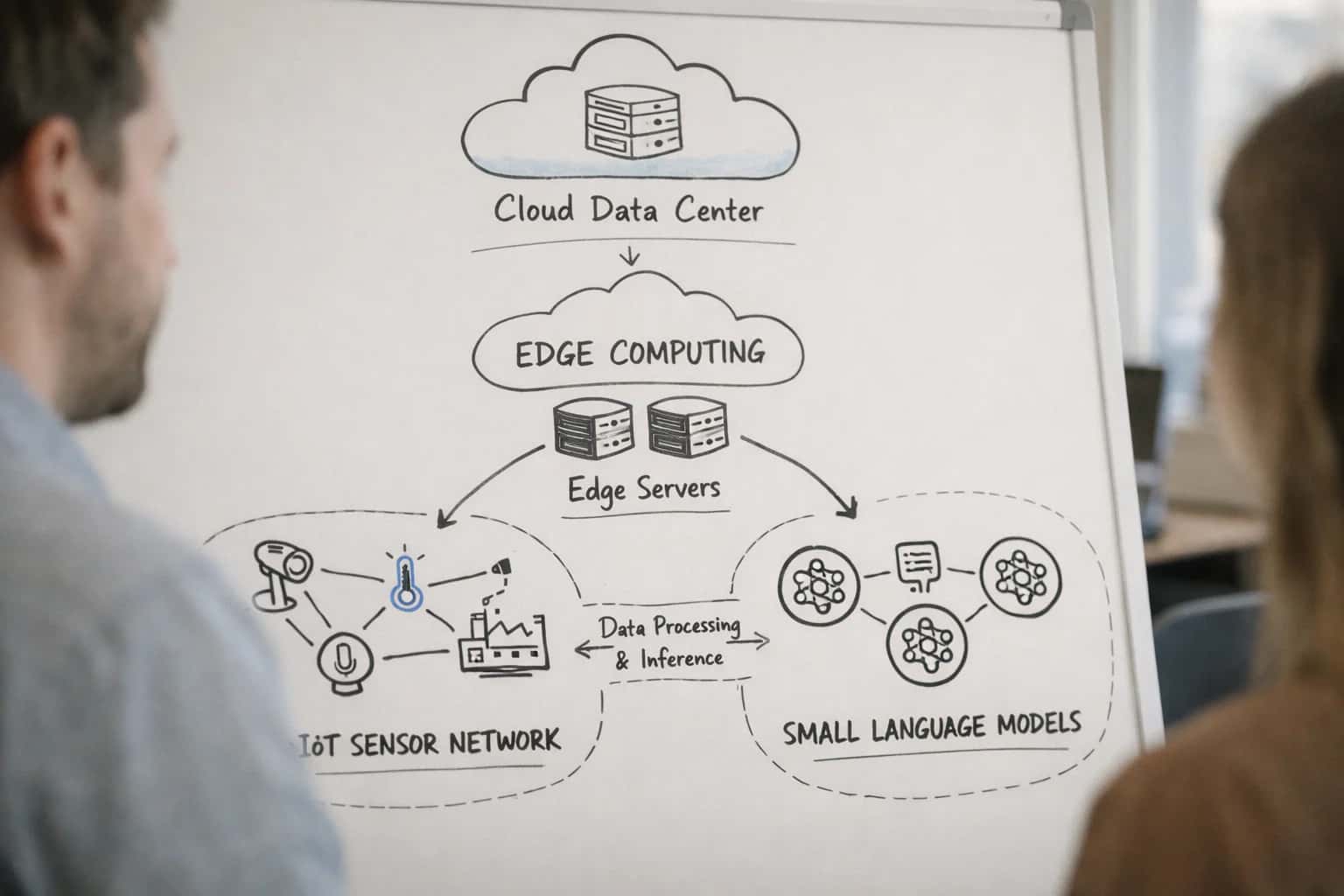
ON-DEVICE MODEL FORMATS
What is Android NNAPI?
A technical definition of the Android Neural Networks API, the foundational C API for on-device machine learning acceleration on Android.
NNAPI operates by accepting a computational graph definition of a model, typically converted from a higher-level framework. It then compiles and executes this graph via a system-level driver model, where vendors implement NNAPI drivers for their specific hardware. This architecture is central to on-device model compression strategies, as it efficiently executes models optimized via post-training quantization and weight pruning. For developers, using NNAPI through a supported framework delegate is the standard path to achieving optimal energy-efficient inference on the heterogeneous compute elements within a modern mobile System-on-a-Chip (SoC).
ON-DEVICE INFRASTRUCTURE
Key Features of Android NNAPI
The Android Neural Networks API (NNAPI) is a C-level API that provides a hardware abstraction layer for running machine learning models on Android devices. It allows developers to leverage dedicated accelerators like NPUs, GPUs, and DSPs for efficient on-device inference.
01
Hardware Abstraction Layer
NNAPI's core function is to abstract the underlying hardware accelerators. It provides a unified interface for common neural network operations, allowing the Android runtime to dispatch computations to the most suitable processor available on the device—be it a CPU, GPU, DSP, or a dedicated Neural Processing Unit (NPU). This shields developers from the complexity of writing vendor-specific code for each chipset.
02
Model Support & Interoperability
NNAPI is designed to work with models trained in mainstream frameworks. Developers typically convert models from TensorFlow or PyTorch into a compatible format. Common supported formats include:
- TensorFlow Lite (via the TFLite interpreter using NNAPI delegate)
- Models converted via Android's own conversion tools NNAPI defines a computational graph of operations (ops) that the model must be decomposed into for execution.
03
Delegation for Acceleration
NNAPI uses a delegate system to offload work. The API runtime examines the model's computational graph and can delegate supported subgraphs or operations to a hardware-specific driver. For example:
- A subgraph of quantized INT8 operations might be sent to a Qualcomm Hexagon DSP.
- Convolution layers could be offloaded to a Mali GPU or a Google Edge TPU. Operations not supported by an accelerator fall back to optimized CPU execution.
04
Quantization & Low-Precision Support
A key feature for on-device efficiency is native support for quantized data types. NNAPI provides robust support for:
- 8-bit and 16-bit integer (INT8, INT16) computations, which are essential for running models compressed via post-training quantization or quantization-aware training.
- Brain floating-point (bfloat16) and float16 for reduced precision floating-point. This allows compressed models to run efficiently on accelerators designed for low-precision math, drastically reducing power consumption and latency.
05
Dynamic Execution & Memory Management
NNAPI manages the lifecycle of an inference session. Key steps include:
- Model Compilation: The model is compiled for the available accelerators, which may involve hardware-specific kernel selection and memory planning.
- Memory Allocation: Input, output, and intermediate tensors are allocated. NNAPI can use shared memory buffers for zero-copy data passing.
- Execution Scheduling: The runtime schedules operations across available processors asynchronously, managing dependencies within the computational graph.
06
System-Level Integration & Constraints
As a system API, NNAPI is tightly integrated with Android's power and thermal management. It must operate within strict constraints:
- Power Budgets: Heavy inference workloads are managed to prevent excessive battery drain.
- Thermal Limits: Sustained operations may be throttled to avoid device overheating.
- Android Version Fragmentation: Feature availability and driver quality depend on the device manufacturer's implementation and the Android OS version, leading to variability in supported operations and performance.
ON-DEVICE MODEL FORMATS
How Android NNAPI Works
The Android Neural Networks API (NNAPI) is a hardware abstraction layer that enables efficient execution of machine learning models on Android devices.
Android NNAPI is a C-level API that provides a runtime for executing pre-trained, serialized models on Android devices. It acts as a hardware abstraction layer, allowing frameworks like TensorFlow Lite to delegate computationally intensive operations to available hardware accelerators such as NPUs, GPUs, or DSPs. The API defines a model as a computational graph of operations and tensors, which the NNAPI runtime maps to optimized drivers provided by silicon vendors. This architecture ensures consistent performance across diverse hardware while abstracting the underlying complexity from application developers.
Execution begins when a client, typically an inference framework, submits a model and inputs. The NNAPI runtime performs graph compilation, partitioning the model's operations between the device's CPU and any available accelerators via delegates. It manages memory allocation for input, output, and intermediate tensors across these heterogeneous processors. For optimal performance, models are often quantized and optimized for mobile deployment using tools like the TFLite Converter, which can generate NNAPI-compatible graphs. This system enables low-latency, energy-efficient inference directly on the device without requiring a cloud connection.
FRAMEWORK COMPARISON
Android NNAPI vs. Other On-Device Frameworks
A technical comparison of Android's Neural Networks API against other major on-device inference frameworks, focusing on deployment characteristics, hardware support, and integration models.
| Feature / Metric | Android NNAPI | TensorFlow Lite | Core ML | ONNX Runtime |
|---|---|---|---|---|
Primary Role | Hardware abstraction layer for Android accelerators | End-to-end mobile/edge inference framework | Apple ecosystem inference framework | Cross-platform, high-performance inference engine |
Platform Target | Android only (C/C++ API) | Multi-platform (Android, iOS, Linux, MCUs) | Apple platforms only (iOS, macOS, etc.) | Multi-platform (Windows, Linux, Android, iOS, Web) |
Model Format | Supports TFLite, but defines its own graph representation internally | TFLite FlatBuffer (.tflite) | Core ML model (.mlmodel) | ONNX format (.onnx) |
Hardware Delegation | Yes, via NNAPI drivers (NPU, GPU, DSP) | Yes, via Delegate API (GPU, Hexagon, EdgeTPU) | Yes, via Apple Neural Engine (ANE), GPU | Yes, via Execution Providers (CPU, CUDA, TensorRT, OpenVINO) |
Quantization Support | INT8, UINT8, INT16, FLOAT16, FLOAT32 | INT8, FLOAT16, FLOAT32 (via converter) | INT8, FLOAT16, FLOAT32 (via coremltools) | INT8, UINT8, FLOAT16, FLOAT32 (varies by EP) |
Direct Developer Use | Typically used indirectly via higher-level frameworks (TFLite) | Direct use via Interpreter API | Direct use via Core ML APIs | Direct use via C, C++, C#, Python, Java APIs |
Pre/Post-Processing | No, focuses only on core neural network operations | Limited, often requires custom code | Integrated via Vision framework or custom code | Can be part of the ONNX graph; otherwise custom |
Memory-Mapped Model Execution | Yes, for efficient zero-copy loading | Yes, via | Managed by the OS and framework | Yes, supported on certain platforms |
Dynamic Shape Support | Limited, depends on driver implementation | Limited, primarily for fixed graphs | Good, with flexible shapes | Good, a core feature of the ONNX standard |
Vendor-Neutral Abstraction | Yes, primary design goal for Android silicon | No, Google-led but supports many delegates | No, Apple-proprietary for Apple hardware | Yes, via open standard and multiple EPs |
ANDROID NNAPI
Frequently Asked Questions
The Android Neural Networks API (NNAPI) is a foundational C/C++ API for on-device machine learning on Android. It provides a hardware abstraction layer, allowing developers to run trained models efficiently across diverse mobile processors. These FAQs address its core purpose, operation, and integration within the on-device AI ecosystem.
Android NNAPI (Neural Networks API) is a low-level C API that provides a hardware abstraction layer for running machine learning inference on Android devices. It works by allowing an application to define a computational graph of operations (a model), which the NNAPI runtime then schedules for execution on the most suitable available processor—such as the CPU, GPU, or a dedicated Neural Processing Unit (NPU)—via hardware-specific drivers.
Key Mechanism:
- Model Definition: An app provides a model, typically converted to a supported format, and defines the input/output tensors.
- Compilation: The NNAPI runtime compiles the model for the target device, performing optimizations and partitioning the graph.
- Execution: The runtime executes the compiled model, managing memory and delegating operations to accelerator drivers via its Delegate API architecture. It handles synchronization and returns results to the application.
Enabling Efficiency, Speed & Accuracy
Intelligent Analysis, Decision & Execution
We build AI systems for teams that need search across company data, workflow automation across tools, or AI features inside products and internal software.
Talk to Us
Search across company data
Give teams answers from docs, tickets, runbooks, and product data with sources and permissions.
Useful when people spend too long searching or get different answers from different systems.
Enterprise searchRAGPermissions
Read more
Automate internal workflows
Use AI to route work, draft outputs, trigger actions, and keep approvals and logs in place.
Useful when repetitive work moves across multiple tools and teams.
AI agentsWorkflow automationGovernance
Read more
Add AI to products and internal tools
Build assistants, guided actions, or decision support into the software your team or customers already use.
Useful when AI needs to be part of the product, not a separate tool.
AI integrationDecision supportModel routing
Read more
About the author
Prasad Kumkar
CEO & MD, Inference Systems
Prasad Kumkar is the CEO & MD of Inference Systems and writes about AI systems architecture, LLM infrastructure, model serving, evaluation, and production deployment. Over 5+ years, he has worked across computer vision models, L5 autonomous vehicle systems, and LLM research, with a focus on taking complex AI ideas into real-world engineering systems.
His work and writing cover AI systems, large language models, AI agents, multimodal systems, autonomous systems, inference optimization, RAG, evaluation, and production AI engineering.
LinkedIn
Limited slotsGet a Free AI Consultation
Partnered with leading AI, data, and software stack.





How We Work
Custom AI workflows for your Business
One-fit-all AI don't work for modern businesses. At Inferensys, we aim to understand your business & custom requirements; which we use to define most efficient agentic workflows, the data, and the tools for your business.
01
Review the use case
We understand the task, the users, and where AI can actually help.
Read more02
Pick the right approach
We define what needs search, automation, or product integration.
Read more03
Build the first useful version
We implement the part that proves the value first.
Read more04
Improve from there
We add the checks and visibility needed to keep it useful.
Read moreThe first call is a practical review of your use case and the right next step.
Talk to Us