TinyML is the extreme edge of edge AI, enabling machine learning inference on devices with severe constraints in memory (often kilobytes), compute (megahertz), and power (milliwatts). This involves specialized techniques like model quantization, pruning, and knowledge distillation to shrink neural networks for deployment on microcontrollers, enabling applications in embedded vision, sensor analytics, and on-device 3D reconstruction without cloud connectivity.

Glossary
TinyML
TinyML is a subfield of machine learning focused on designing and deploying ultra-low-power models capable of running on microcontrollers and other highly resource-constrained edge devices.
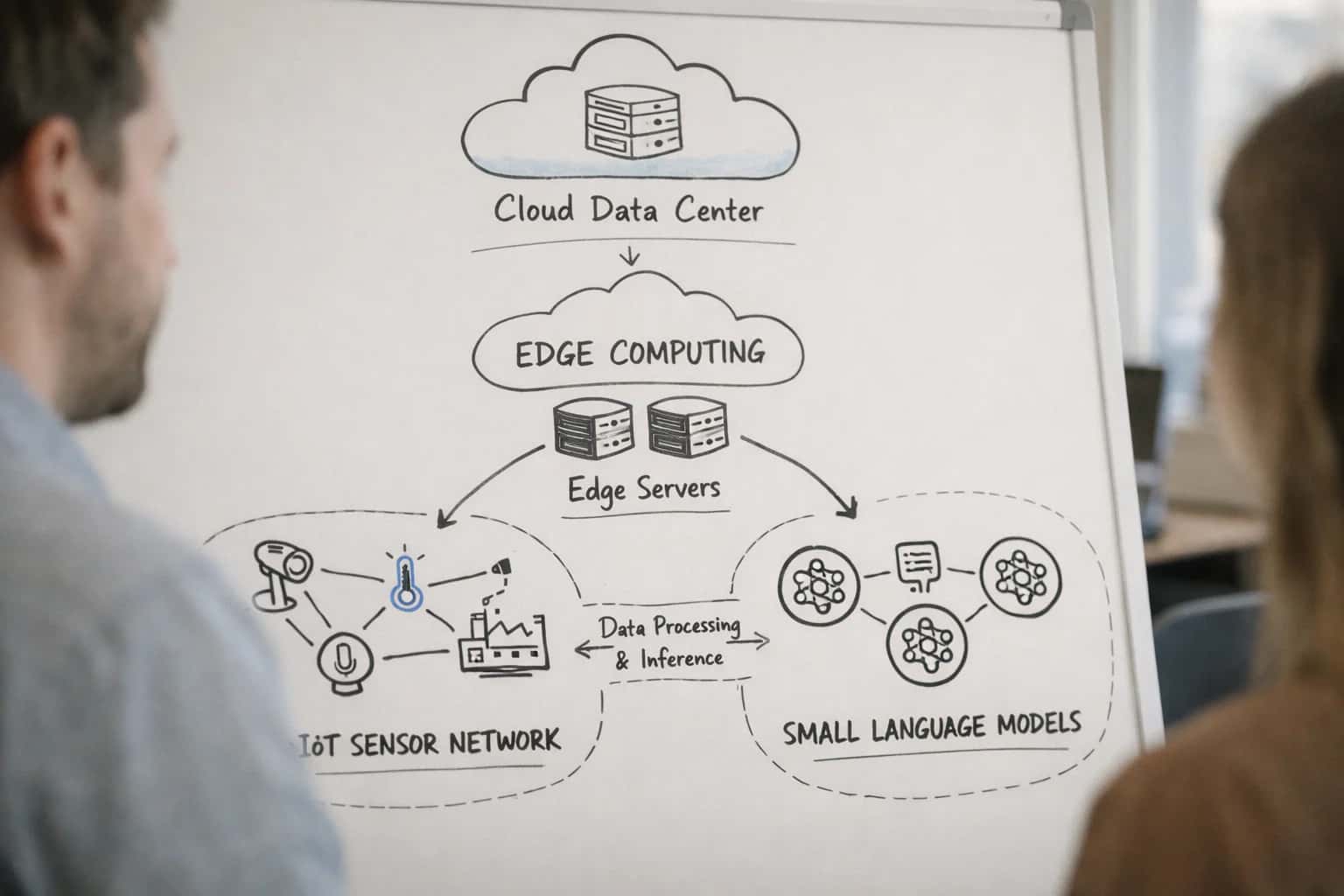
ON-DEVICE 3D RECONSTRUCTION
What is TinyML?
TinyML is a subfield of machine learning focused on designing and deploying ultra-low-power models capable of running directly on microcontrollers and other highly resource-constrained edge devices.
The field intersects with hardware acceleration via Neural Processing Units (NPUs) and frameworks like TensorFlow Lite Micro. It is foundational for spatial computing architectures, allowing real-time sensor fusion and environmental understanding in AR glasses and robots. By moving intelligence to the sensor, TinyML enables federated learning at the edge and addresses critical needs for low latency, data privacy, and operational resilience in autonomous systems.
TINYML
Key Constraints of TinyML Systems
TinyML systems operate under extreme hardware limitations, imposing fundamental trade-offs between model capability, power consumption, and inference speed. These constraints define the design space for on-device intelligence.
01
Memory Footprint
The total RAM and flash storage available for the model, its weights, and runtime data is severely limited, often to kilobytes (KB) or low megabytes (MB). This necessitates:
- Extreme model compression via pruning and quantization.
- Careful management of activation memory during inference.
- Storing models in read-only memory (ROM) or flash, not RAM.
02
Power Budget
TinyML devices are often battery-powered or energy-harvesting, requiring microwatt to milliwatt average power consumption. This demands:
- Ultra-low-power standby states with rapid wake-up.
- Inference-optimized hardware like always-on wake-word detectors.
- Duty cycling, where the main processor is active for only milliseconds per inference to minimize energy use.
03
Compute Throughput
Microcontroller clock speeds are orders of magnitude slower than cloud GPUs, often in the tens to hundreds of MHz. This limits model complexity and forces:
- Use of integer-only arithmetic (INT8) instead of floating-point.
- Operator-level optimizations for specific hardware (e.g., CMSIS-NN for ARM Cortex-M).
- Model architectures designed for few operations (e.g., depthwise separable convolutions).
04
Latency & Real-Time Requirements
For interactive applications (e.g., keyword spotting, gesture control), inference must complete within a strict deadline, often <100 milliseconds. This constraint:
- Eliminates complex, multi-stage models.
- Prioritizes deterministic execution with no cache misses or garbage collection pauses.
- Often requires fixed-point arithmetic for predictable timing.
05
Lack of Floating-Point Unit (FPU)
Most microcontrollers lack hardware for floating-point math, making FP32 operations prohibitively slow via software emulation. The solution is quantization:
- Converting weights and activations to integers (INT8, INT4).
- Using quantization-aware training to maintain accuracy.
- Employing per-channel or per-tensor scaling factors to preserve dynamic range.
06
Thermal & Physical Constraints
Embedded devices have no active cooling, limiting sustained compute. They also face environmental challenges:
- Wide temperature ranges (-40°C to +85°C) can affect silicon behavior and sensor data.
- Limited physical space for sensors and compute modules.
- Electromagnetic interference in industrial settings can corrupt memory and computations.
ON-DEVICE 3D RECONSTRUCTION
TinyML Framework Comparison
A feature and capability comparison of leading frameworks for deploying machine learning models on microcontrollers and resource-constrained edge devices, with a focus on 3D reconstruction and spatial computing tasks.
| Framework / Feature | TensorFlow Lite for Microcontrollers | Edge Impulse | OpenMV | CMSIS-NN (ARM) |
|---|---|---|---|---|
Primary Use Case | General-purpose model deployment on microcontrollers | End-to-end ML development & deployment pipeline | Computer vision on embedded microcontrollers | Optimized neural network kernels for ARM Cortex-M CPUs |
Model Format Support | TensorFlow Lite (.tflite) | TensorFlow Lite, ONNX (export) | TensorFlow Lite, custom OpenMV scripts | TensorFlow Lite for Microcontrollers |
3D Reconstruction Primitives | Custom operator support via MicroOps | Custom C++ block / EON Compiler for custom layers | Limited; focused on 2D vision pipelines | Kernels for Conv2D, DepthwiseConv2D, FullyConnected |
Hardware Abstraction Layer | Yes, via TFLM Porting API | Yes, via EIM and deployment blocks | Yes, for OpenMV Cam modules | No; low-level CMSIS-DSP compatible assembly/C kernels |
Memory Footprint (Typical Minimal) | < 20 KB RAM | Varies by model; ~50-100 KB RAM | ~32 KB RAM (OpenMV Cam H7) | Kernel-specific; adds ~5-15 KB to base TFLM |
Quantization Support | INT8, INT16, FP16, FP32 | INT8 (via EON Compiler), FP32 | INT8, FP32 | INT8, INT16 (optimized kernels) |
Real-Time Performance Profiling | Basic logging via debug output | Integrated studio profiling & timing blocks | Frame rate display in IDE | Cycle-accurate simulation via ARM MDK |
On-Device Training Support | No (inference only) | Yes, via Learning Blocks for continuous learning | No | No (inference kernels only) |
Sensor Fusion Pipeline Support | Custom C++ integration required | Native block for fusing multiple sensor data types | Native support for image sensor + GPIO/I2C | No; compute kernels only |
License | Apache 2.0 | Source-available (EIM), proprietary cloud services | MIT (OpenMV IDE & firmware) | Apache 2.0 (as part of CMSIS) |
TINYML
Frequently Asked Questions
TinyML is the field of machine learning focused on deploying ultra-low-power models on microcontrollers and other highly constrained edge devices. This FAQ addresses the core technical questions developers and engineers have about this critical technology for on-device intelligence.
TinyML is a subfield of machine learning that focuses on designing, optimizing, and deploying models capable of running on microcontrollers (MCUs) and other resource-constrained edge devices with severe limitations in memory (often <1MB), power (milliwatt range), and compute. It works by applying extreme model compression techniques—such as post-training quantization, pruning, and knowledge distillation—to shrink large neural networks into tiny, efficient executables. These models perform on-device inference, processing sensor data (e.g., audio, motion, images) locally without a cloud connection, enabling real-time, private, and ultra-low-power applications like keyword spotting, predictive maintenance, and gesture recognition.
Enabling Efficiency, Speed & Accuracy
Intelligent Analysis, Decision & Execution
We build AI systems for teams that need search across company data, workflow automation across tools, or AI features inside products and internal software.
Talk to Us
Search across company data
Give teams answers from docs, tickets, runbooks, and product data with sources and permissions.
Useful when people spend too long searching or get different answers from different systems.
Enterprise searchRAGPermissions
Read more
Automate internal workflows
Use AI to route work, draft outputs, trigger actions, and keep approvals and logs in place.
Useful when repetitive work moves across multiple tools and teams.
AI agentsWorkflow automationGovernance
Read more
Add AI to products and internal tools
Build assistants, guided actions, or decision support into the software your team or customers already use.
Useful when AI needs to be part of the product, not a separate tool.
AI integrationDecision supportModel routing
Read more
About the author
Prasad Kumkar
CEO & MD, Inference Systems
Prasad Kumkar is the CEO & MD of Inference Systems and writes about AI systems architecture, LLM infrastructure, model serving, evaluation, and production deployment. Over 5+ years, he has worked across computer vision models, L5 autonomous vehicle systems, and LLM research, with a focus on taking complex AI ideas into real-world engineering systems.
His work and writing cover AI systems, large language models, AI agents, multimodal systems, autonomous systems, inference optimization, RAG, evaluation, and production AI engineering.
LinkedIn
Limited slotsGet a Free AI Consultation
Partnered with leading AI, data, and software stack.





How We Work
Custom AI workflows for your Business
One-fit-all AI don't work for modern businesses. At Inferensys, we aim to understand your business & custom requirements; which we use to define most efficient agentic workflows, the data, and the tools for your business.
01
Review the use case
We understand the task, the users, and where AI can actually help.
Read more02
Pick the right approach
We define what needs search, automation, or product integration.
Read more03
Build the first useful version
We implement the part that proves the value first.
Read more04
Improve from there
We add the checks and visibility needed to keep it useful.
Read moreThe first call is a practical review of your use case and the right next step.
Talk to Us