On-device inference is the execution of a trained machine learning model directly on an end-user device, such as a smartphone, IoT sensor, or robot, without requiring a network connection to a cloud server. This paradigm shifts computation from centralized data centers to the edge, enabling low-latency responses, enhanced data privacy, and reliable operation in network-constrained environments. It is the fundamental runtime for applications like real-time augmented reality (AR), autonomous navigation, and always-on voice assistants.

Glossary
On-Device Inference
On-device inference is the execution of a trained machine learning model directly on an end-user device (e.g., smartphone, IoT sensor) without requiring a network connection to a cloud server.
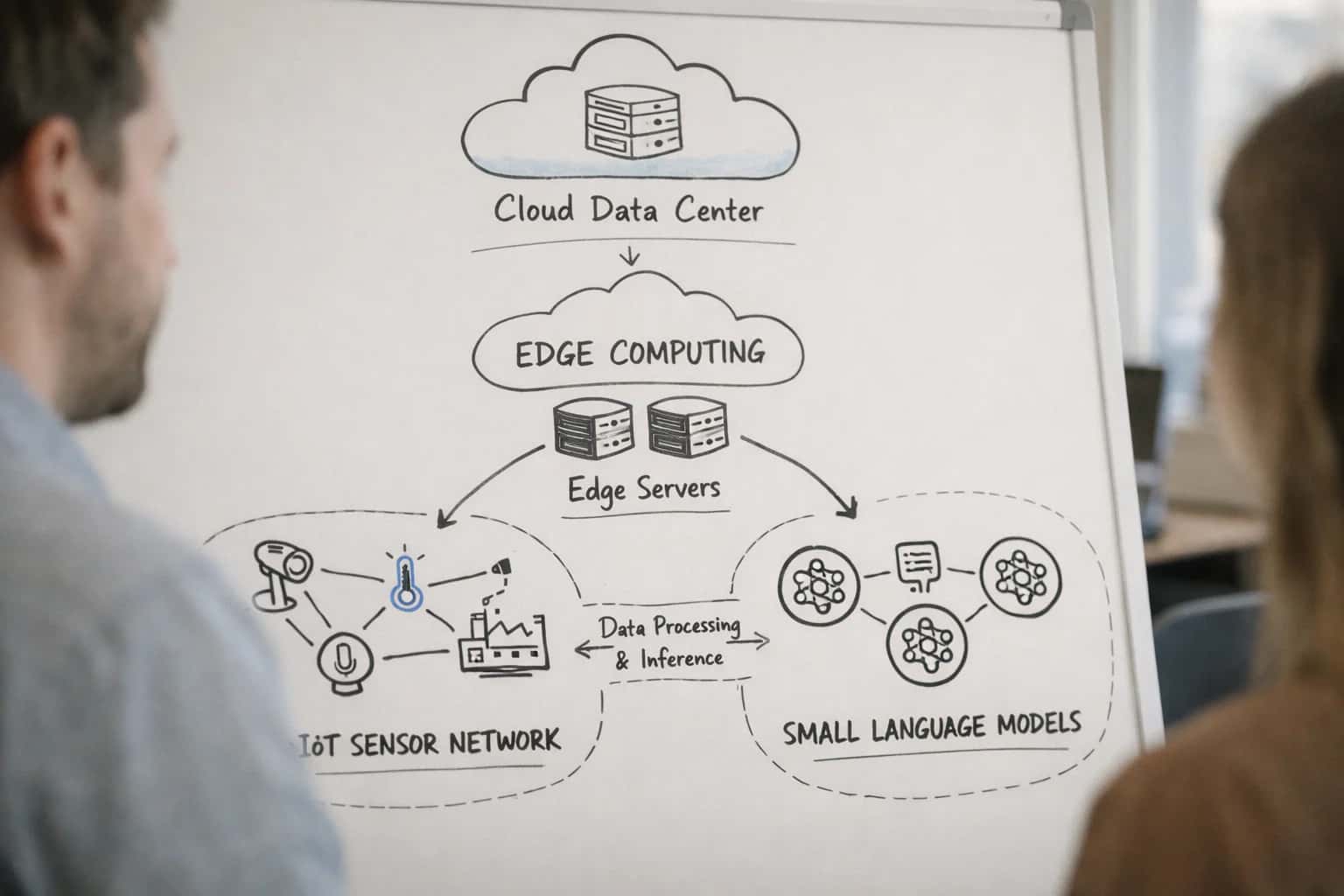
EDGE AI
What is On-Device Inference?
On-device inference is the execution of a trained machine learning model directly on an end-user device, such as a smartphone, IoT sensor, or robot, without requiring a network connection to a cloud server.
Deploying models on-device necessitates significant model compression through techniques like post-training quantization and pruning to meet stringent constraints on memory, power, and compute. Execution is often accelerated by dedicated Neural Processing Units (NPUs) or GPUs. This approach is critical for spatial computing tasks—such as Simultaneous Localization and Mapping (SLAM) and 3D scene reconstruction—where instantaneous processing of camera and sensor data is required for interactive experiences.
ON-DEVICE 3D RECONSTRUCTION
Key Characteristics of On-Device Inference
On-device inference executes a trained machine learning model directly on an end-user device. For spatial computing, this enables real-time 3D scene understanding without a cloud connection.
01
Latency & Real-Time Response
On-device inference eliminates network round-trip time, providing deterministic, sub-100 millisecond latency. This is non-negotiable for interactive applications like augmented reality (AR) and robotic navigation, where a delayed response breaks immersion or causes operational failure. Processing occurs in a single inference pass, enabling immediate action based on sensor input.
02
Privacy & Data Sovereignty
Sensitive data, such as camera feeds from a phone or LiDAR scans of a private facility, never leaves the physical device. This ensures compliance with strict regulations like GDPR and HIPAA by design. For enterprise applications in healthcare or defense, this characteristic provides a fundamental security guarantee, as raw data is not exposed to external servers or networks.
03
Operational Reliability & Offline Functionality
Systems remain fully functional without an internet connection or cloud service availability. This is critical for:
- Field robotics in remote environments.
- Industrial inspection in facilities with poor connectivity.
- Consumer AR applications used anywhere. Reliability is inherent, as performance is not subject to network bandwidth, latency spikes, or service outages.
04
Power & Thermal Constraints
Edge devices have strict power budgets and lack active cooling. Inference must be optimized for milliwatt to watt-level consumption to preserve battery life. Thermal throttling is a major concern; inefficient models can cause devices to overheat and forcibly reduce performance. This drives the need for highly optimized models and efficient use of hardware accelerators like NPUs.
05
Model Compression & Optimization
To run on resource-constrained hardware, large models undergo aggressive compression. Key techniques include:
- Quantization: Reducing numerical precision of weights (e.g., FP32 to INT8).
- Pruning: Removing redundant neurons or weights.
- Knowledge Distillation: Training a smaller 'student' model to mimic a larger 'teacher'. These techniques reduce model size and computational complexity (FLOPs) at a potential cost to accuracy, requiring careful trade-off analysis.
06
Hardware-Software Co-Design
Maximum efficiency requires tailoring the software stack to the underlying silicon. This involves:
- Using dedicated Neural Processing Units (NPUs) or GPU shaders for matrix operations.
- Leveraging frameworks like TensorFlow Lite or Core ML that provide hardware-aware kernels.
- Employing vendor-specific SDKs (e.g., for Qualcomm Hexagon, Apple Neural Engine) to access low-level acceleration. Performance is dictated by this tight integration.
TECHNICAL CONSIDERATIONS AND CHALLENGES
On-Device Inference
On-device inference refers to the execution of a trained machine learning model directly on an end-user device without requiring a network connection to a cloud server.
This paradigm shifts computation from data centers to the edge, enabling applications like real-time augmented reality and autonomous robotics to function with minimal latency and guaranteed availability offline. The primary technical challenge is adapting models designed for cloud-scale compute to run efficiently on hardware with severe constraints in memory footprint, power consumption, and thermal budget. This necessitates aggressive model compression techniques, including post-training quantization and pruning, alongside specialized compilation for neural processing units (NPUs).
Successful deployment requires a holistic system design balancing model accuracy against inference latency and energy efficiency. Engineers must profile workloads across the device's heterogeneous compute fabric (CPU, GPU, NPU) and manage memory bandwidth bottlenecks. Furthermore, the model must be robust to the variable sensor data and environmental conditions encountered in the wild, as continuous cloud-based model updates are not guaranteed. This makes on-device learning paradigms, such as federated learning, an important consideration for long-term system adaptation.
PRACTICAL APPLICATIONS
Common Use Cases for On-Device Inference
On-device inference enables real-time, private, and resilient machine learning applications by executing models directly on end-user hardware. Below are key domains where this capability is essential.
01
Augmented & Virtual Reality
On-device inference is foundational for interactive AR/VR, enabling real-time spatial understanding without network lag. Key tasks include:
- Camera pose estimation and SLAM for anchoring digital content.
- Semantic segmentation to understand surfaces and objects.
- Neural rendering for realistic avatars or effects.
Frameworks like ARKit and ARCore rely heavily on optimized on-device models for plane detection, face tracking, and occlusion.
< 16ms
Target Latency (60 FPS)
02
Autonomous Mobile Robots & Drones
Robots and drones require deterministic latency and operational continuity in GPS-denied or remote environments. On-device models handle:
- Visual odometry and path planning for navigation.
- Obstacle detection and semantic understanding of terrain.
- Real-time decision-making for safety.
This eliminates dependency on cloud connectivity, which can be unreliable or high-latency for critical control loops.
03
Smartphone Computational Photography
Modern smartphone cameras use on-device AI to enhance image quality and enable new features with sub-second processing. This includes:
- Portrait mode bokeh and night mode multi-frame fusion.
- Real-time video effects like background blur and stylization.
- HDR processing and scene recognition for automatic settings.
These models, often accelerated by the device's NPU, process high-resolution image streams directly in the camera pipeline.
04
Healthcare & Medical Devices
On-device inference enables private, immediate analysis of sensitive health data, crucial for:
- Real-time vital sign monitoring from wearable sensors.
- Point-of-care diagnostics via medical imaging (e.g., detecting anomalies in ultrasound).
- Fall detection and health event prediction for elderly care.
Processing data locally ensures patient privacy (addressing HIPAA/GDPR concerns) and provides life-critical low-latency alerts.
05
Industrial IoT & Predictive Maintenance
Factories and utilities deploy sensors with embedded AI to monitor equipment health in harsh environments with poor connectivity. Use cases include:
- Anomaly detection in vibration or thermal sensor data to predict failures.
- Visual inspection for product defects on assembly lines.
- Acoustic analysis to identify irregular machine sounds.
On-device processing enables immediate alerts and reduces bandwidth costs from streaming raw sensor data to the cloud.
>99%
Uptime Target
06
Privacy-Sensitive Applications
For applications where user data cannot leave the device, on-device inference is non-negotiable. This is critical for:
- Biometric authentication (face unlock, fingerprint).
- Personalized assistants that learn from local speech and text patterns.
- On-device translation and transcription for confidential meetings.
Techniques like federated learning can further improve these models using aggregated, anonymized updates without exporting raw data.
ARCHITECTURAL DECISION
On-Device vs. Cloud Inference: A Comparison
A technical comparison of the two primary deployment paradigms for executing machine learning models, focusing on trade-offs critical for spatial computing and 3D reconstruction applications.
| Feature / Metric | On-Device Inference | Cloud Inference | Hybrid (Edge-Cloud) |
|---|---|---|---|
Latency (End-to-End) | < 10-50 ms | 100-1000+ ms | 20-200 ms |
Network Dependency | |||
Data Privacy / Sovereignty | |||
Operational Cost (per inference) | $0.00001 - $0.0001 | $0.0001 - $0.01 | $0.00005 - $0.001 |
Peak Compute Throughput (FLOPS) | 1-50 TFLOPS (NPU/GPU) |
| 10-100 TFLOPS (Edge Server) |
Model Size Constraint | < 100-500 MB | Virtually Unlimited | < 2-5 GB |
Power Consumption Profile | Milliwatts to ~10 Watts | Kilowatts (Data Center) | 10-500 Watts |
System Complexity & DevOps | High (Fragmented HW) | High (Scalability) | Very High (Orchestration) |
Real-Time Feasibility (e.g., 30 FPS AR) | |||
Model Update / A-B Testing Agility | Slow (OTA Deployments) | Instant (Server-Side) | Moderate (Orchestrated) |
Scalability (Concurrent Users) | Linear with devices | Effectively Infinite | High (Edge Load Balancing) |
IMPLEMENTATION
Tools and Frameworks for On-Device Inference
A curated selection of core software libraries and hardware-specific toolkits designed to deploy and accelerate machine learning models directly on edge devices, enabling real-time 3D reconstruction and spatial understanding.
ON-DEVICE INFERENCE
Frequently Asked Questions
On-device inference is the execution of a trained machine learning model directly on an end-user device, such as a smartphone, IoT sensor, or robot, without requiring a network connection to a cloud server. This glossary answers key technical questions for developers and engineers implementing spatial computing and 3D reconstruction at the edge.
On-device inference is the process of executing a trained machine learning model locally on an end-user hardware device, such as a smartphone, IoT sensor, or embedded system, without sending data to a remote cloud server. It works by deploying a pre-trained, optimized model (e.g., a neural network for semantic segmentation or depth estimation) onto the device's storage. When input data (like a camera frame) is captured, the device's local processor—often a CPU, GPU, or specialized Neural Processing Unit (NPU)—loads the model and performs the forward pass computations entirely in memory. The result, such as a classified image or a 3D point cloud, is generated and used by the application with minimal latency, ensuring privacy and operational continuity without a network connection.
Enabling Efficiency, Speed & Accuracy
Intelligent Analysis, Decision & Execution
We build AI systems for teams that need search across company data, workflow automation across tools, or AI features inside products and internal software.
Talk to Us
Search across company data
Give teams answers from docs, tickets, runbooks, and product data with sources and permissions.
Useful when people spend too long searching or get different answers from different systems.
Enterprise searchRAGPermissions
Read more
Automate internal workflows
Use AI to route work, draft outputs, trigger actions, and keep approvals and logs in place.
Useful when repetitive work moves across multiple tools and teams.
AI agentsWorkflow automationGovernance
Read more
Add AI to products and internal tools
Build assistants, guided actions, or decision support into the software your team or customers already use.
Useful when AI needs to be part of the product, not a separate tool.
AI integrationDecision supportModel routing
Read more
About the author
Prasad Kumkar
CEO & MD, Inference Systems
Prasad Kumkar is the CEO & MD of Inference Systems and writes about AI systems architecture, LLM infrastructure, model serving, evaluation, and production deployment. Over 5+ years, he has worked across computer vision models, L5 autonomous vehicle systems, and LLM research, with a focus on taking complex AI ideas into real-world engineering systems.
His work and writing cover AI systems, large language models, AI agents, multimodal systems, autonomous systems, inference optimization, RAG, evaluation, and production AI engineering.
LinkedIn
Limited slotsGet a Free AI Consultation
Partnered with leading AI, data, and software stack.





How We Work
Custom AI workflows for your Business
One-fit-all AI don't work for modern businesses. At Inferensys, we aim to understand your business & custom requirements; which we use to define most efficient agentic workflows, the data, and the tools for your business.
01
Review the use case
We understand the task, the users, and where AI can actually help.
Read more02
Pick the right approach
We define what needs search, automation, or product integration.
Read more03
Build the first useful version
We implement the part that proves the value first.
Read more04
Improve from there
We add the checks and visibility needed to keep it useful.
Read moreThe first call is a practical review of your use case and the right next step.
Talk to Us