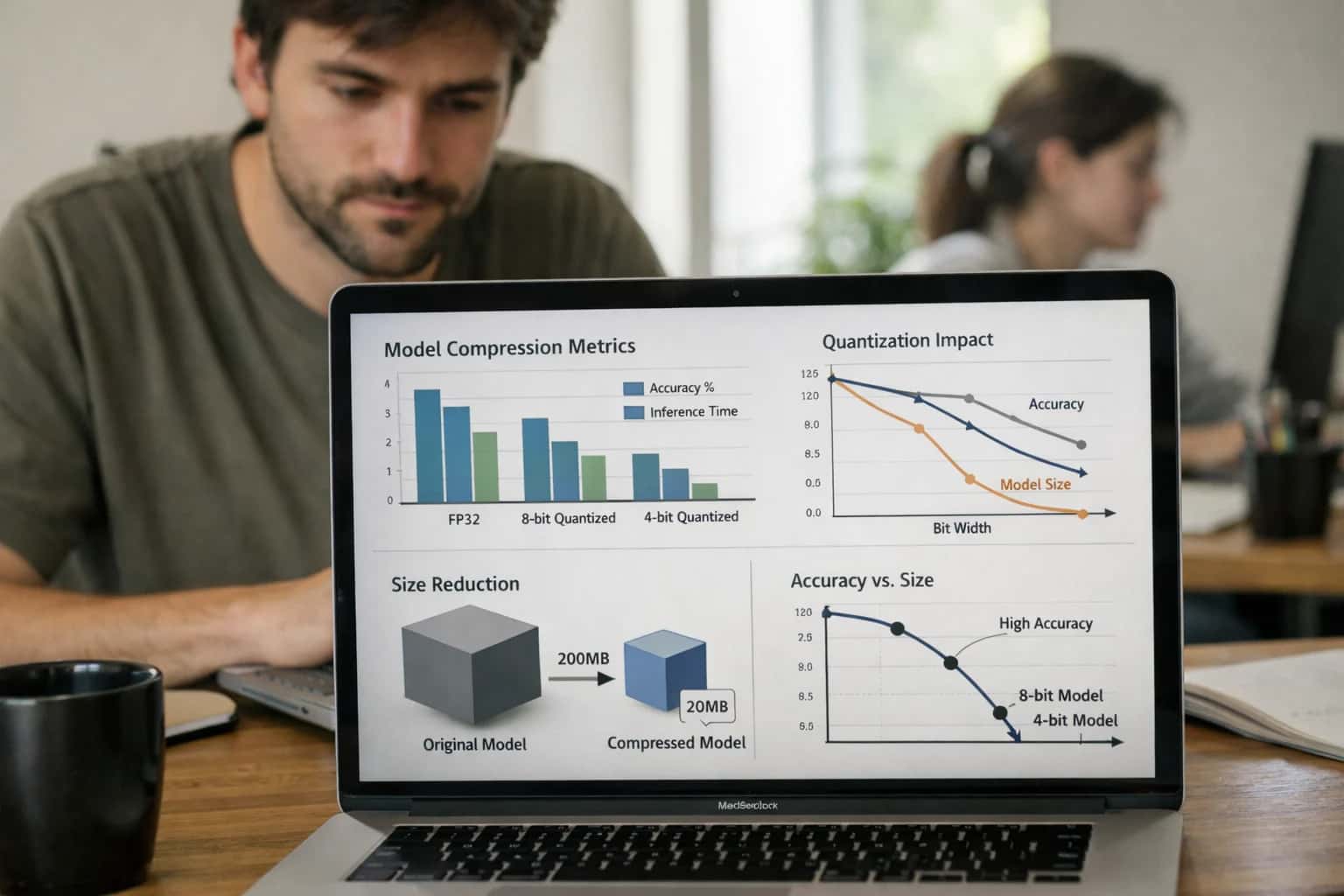
Quantization is the process of converting a neural network's parameters and activations from high-precision floating-point numbers (like 32-bit FP32) to lower-bit integer representations (like 8-bit INT8). This model compression technique dramatically reduces the computational and memory footprint of a model, enabling faster inference and deployment on resource-constrained devices like mobile phones, NPUs, and edge hardware. The core mechanism involves mapping a continuous range of values to a discrete, finite set defined by quantization parameters.

Glossary
Quantization
Quantization is a model compression technique that maps high-precision floating-point numbers (e.g., FP32) to lower-bit integer representations (e.g., INT8) to reduce neural network size, memory footprint, and computational cost for faster inference.
MIXED-PRECISION COMPUTATION
What is Quantization?
Quantization is a foundational technique in machine learning for deploying efficient models on specialized hardware.
The process introduces quantization error, managed through methods like post-training quantization (PTQ) and quantization-aware training (QAT). Key concepts include the scale and zero-point for affine mapping, and granularity choices like per-tensor or per-channel quantization. The ultimate goal is integer-only inference, where all operations use efficient integer math, eliminating costly floating-point computation and maximizing hardware acceleration.
METHODS
Key Quantization Techniques
Quantization encompasses several distinct methodologies for converting high-precision neural network parameters to lower-bit representations. Each technique offers a different trade-off between accuracy, computational efficiency, and implementation complexity.
03
Dynamic Quantization
Dynamic quantization is a post-training method where the scaling factor for converting activations to integers is calculated on-the-fly at runtime for each individual input. Weights are typically quantized statically ahead of time. This approach is flexible and handles inputs with varying ranges effectively.
- Primary Use: Models with activation ranges that vary significantly per input (e.g., LSTMs, transformers for variable-length sequences).
- Runtime Overhead: Includes the cost of computing scaling factors for each inference.
- Advantage: No requirement for a representative calibration dataset; adapts to real input distribution.
- Trade-off: Less efficient than static quantization due to per-inference calculations.
04
Static Quantization
Static quantization is a post-training method where the scaling factors for converting both weights and activations to integers are predetermined using a calibration dataset and then fixed for all inference runs. This enables integer-only inference, where the entire computational graph can be executed with pure integer arithmetic.
- Primary Use: High-performance, low-latency deployment on edge devices and NPUs with dedicated integer units.
- Requirement: A representative calibration dataset to capture activation statistics.
- Advantage: Maximum inference efficiency by eliminating floating-point operations.
- Challenge: Accuracy can degrade if the calibration data is not representative of runtime inputs.
05
Per-Channel vs. Per-Tensor Quantization
This refers to the quantization granularity—the scope over which a single set of quantization parameters is shared.
- Per-Tensor Quantization: A single scale and zero-point is applied to an entire tensor. This is simple but can be suboptimal if the tensor's values have a wide or uneven distribution.
- Per-Channel Quantization: A unique set of parameters is applied to each output channel of a weight tensor (common for convolutional and fully connected layers). This finer granularity accounts for varying distributions across channels, typically leading to higher accuracy.
Example: Quantizing a convolutional layer's 4D weight tensor [OC, IC, KH, KW] per-channel applies different parameters to each of the OC output channels.
06
Symmetric vs. Asymmetric Quantization
These are two schemes for defining the mapping range between floating-point and integer values.
-
Symmetric Quantization: The quantization range is symmetric around zero. The zero-point is typically forced to 0. This simplifies the integer arithmetic (no zero-point offset needed in some operations) but can waste precision if the actual data range is not symmetric.
Integer_Value = round(Float_Value / Scale) -
Asymmetric Quantization: The quantization range is offset to match the min/max of the data. It uses a non-zero zero-point to represent the real value zero. This better utilizes the integer range for skewed data (e.g., ReLU activations that are all non-negative) but requires more complex arithmetic involving the zero-point.
Integer_Value = round(Float_Value / Scale) + Zero-Point
Weights are often quantized symmetrically, while activations may use asymmetric quantization for better accuracy.
MECHANISM
How Quantization Works: The Core Mechanism
Quantization is a model compression technique that reduces the numerical precision of a neural network's parameters and activations to shrink its memory footprint and accelerate computation.
Quantization works by mapping a continuous range of high-precision floating-point values (e.g., FP32) to a discrete, finite set of lower-bit integers (e.g., INT8). This is governed by an affine transformation defined by a scale factor and a zero-point. The scale determines the resolution of the mapping, while the zero-point aligns the integer range with the floating-point distribution, enabling efficient integer arithmetic during inference.
The process introduces quantization error, comprising rounding error from the discrete mapping and clipping error from values outside the representable range. Calibration on a representative dataset determines optimal scaling parameters to minimize this distortion. For execution, specialized quantization backends like TensorRT or TFLite leverage hardware-accelerated integer units, enabling integer-only inference that eliminates costly floating-point operations entirely.
METHOD OVERVIEW
Quantization Methods Compared
A comparison of core quantization techniques used to convert neural networks from floating-point to lower-bit integer formats for efficient inference.
| Feature / Metric | Post-Training Quantization (PTQ) | Quantization-Aware Training (QAT) | Dynamic Quantization |
|---|---|---|---|
Primary Goal | Compress a trained model without retraining | Train or fine-tune a model to be robust to quantization | Apply quantization with runtime flexibility for activations |
Requires Retraining | |||
Calibration Dataset Required | |||
Typical Accuracy vs. FP32 | Slight degradation (0.5-2% drop) | Near-lossless (<0.5% drop) | Variable degradation (depends on input variance) |
Inference Speed | Fastest (static graph, integer-only ops) | Fast (static graph, integer-only ops) | Moderate (runtime scaling calculation) |
Hardware Compatibility | Wide (NPUs, GPUs, CPUs with INT8) | Wide (NPUs, GPUs, CPUs with INT8) | Limited (requires runtime scaling support) |
Model Size Reduction | 4x (FP32 to INT8) | 4x (FP32 to INT8) | 4x for weights, dynamic for activations |
Best For | Rapid deployment, batch inference | Production models where accuracy is critical | Models with highly variable activation ranges (e.g., NLP) |
QUANTIZATION
Framework & Hardware Support
Quantization's effectiveness is tightly coupled with the underlying hardware and the software frameworks that orchestrate it. This section details the key platforms and tools that enable efficient quantized model execution.
QUANTIZATION
Frequently Asked Questions
Quantization is a core technique for deploying efficient neural networks. These questions address its mechanisms, trade-offs, and practical implementation.
Quantization is a model compression technique that maps a continuous set of high-precision values, typically 32-bit floating-point (FP32) numbers, to a discrete, finite set of lower-bit integer representations (e.g., INT8) to reduce the computational and memory footprint of a neural network. The process involves determining a linear mapping defined by a scale factor and a zero-point integer. This allows weights and activations to be stored and operated on using efficient integer arithmetic, drastically decreasing model size, memory bandwidth requirements, and latency, especially on hardware with dedicated integer units like NPUs and TPUs. The primary trade-off is the introduction of quantization error, which must be managed to preserve model accuracy.
Enabling Efficiency, Speed & Accuracy
Intelligent Analysis, Decision & Execution
We build AI systems for teams that need search across company data, workflow automation across tools, or AI features inside products and internal software.
Talk to Us
Search across company data
Give teams answers from docs, tickets, runbooks, and product data with sources and permissions.
Useful when people spend too long searching or get different answers from different systems.
Enterprise searchRAGPermissions
Read more
Automate internal workflows
Use AI to route work, draft outputs, trigger actions, and keep approvals and logs in place.
Useful when repetitive work moves across multiple tools and teams.
AI agentsWorkflow automationGovernance
Read more
Add AI to products and internal tools
Build assistants, guided actions, or decision support into the software your team or customers already use.
Useful when AI needs to be part of the product, not a separate tool.
AI integrationDecision supportModel routing
Read more
About the author
Prasad Kumkar
CEO & MD, Inference Systems
Prasad Kumkar is the CEO & MD of Inference Systems and writes about AI systems architecture, LLM infrastructure, model serving, evaluation, and production deployment. Over 5+ years, he has worked across computer vision models, L5 autonomous vehicle systems, and LLM research, with a focus on taking complex AI ideas into real-world engineering systems.
His work and writing cover AI systems, large language models, AI agents, multimodal systems, autonomous systems, inference optimization, RAG, evaluation, and production AI engineering.
LinkedIn
Limited slotsGet a Free AI Consultation
Partnered with leading AI, data, and software stack.





How We Work
Custom AI workflows for your Business
One-fit-all AI don't work for modern businesses. At Inferensys, we aim to understand your business & custom requirements; which we use to define most efficient agentic workflows, the data, and the tools for your business.
01
Review the use case
We understand the task, the users, and where AI can actually help.
Read more02
Pick the right approach
We define what needs search, automation, or product integration.
Read more03
Build the first useful version
We implement the part that proves the value first.
Read more04
Improve from there
We add the checks and visibility needed to keep it useful.
Read moreThe first call is a practical review of your use case and the right next step.
Talk to Us