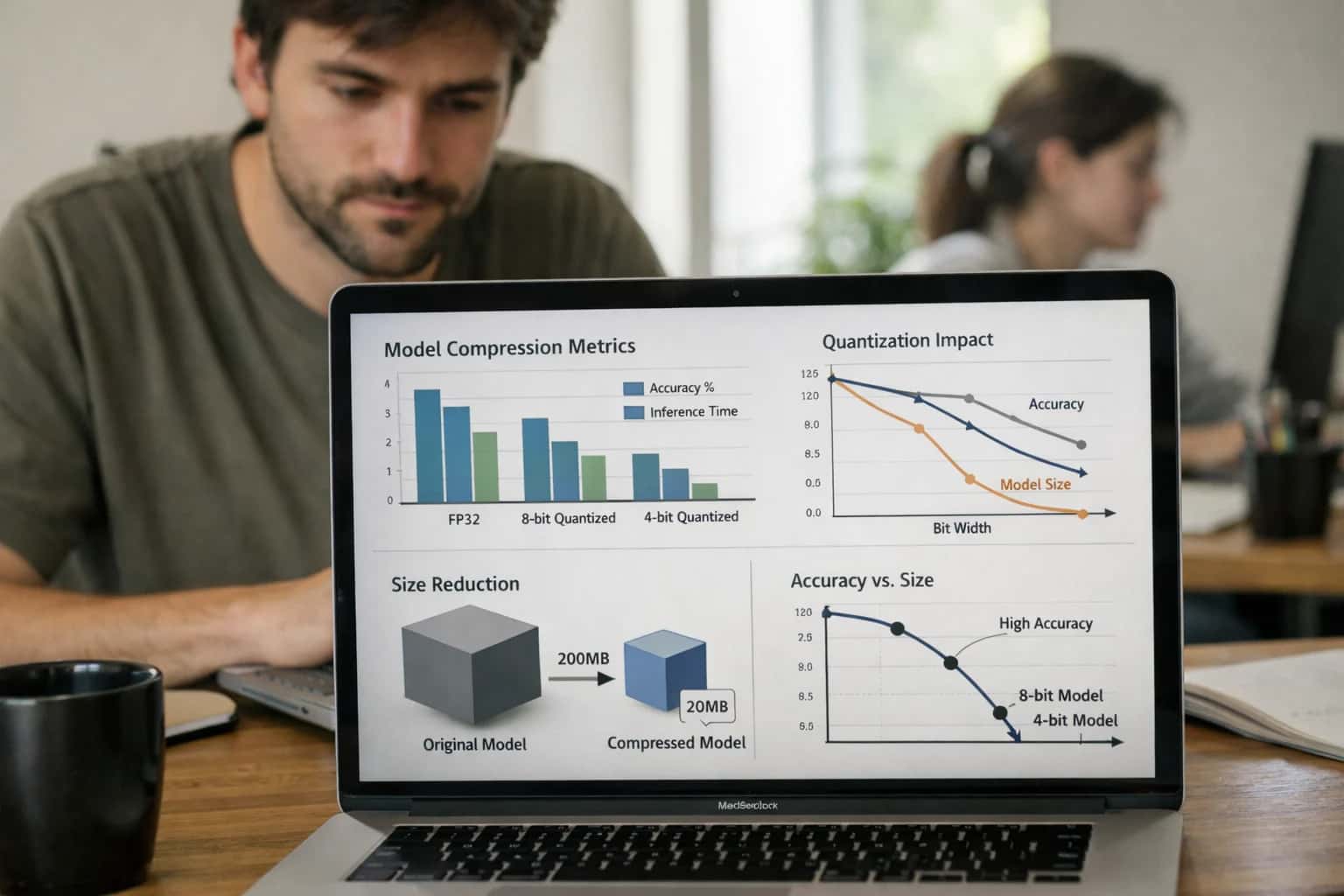
INT8 quantization is a model compression technique that converts a neural network's 32-bit floating-point (FP32) weights and activations into 8-bit integer representations. This transformation uses a linear mapping defined by a scale factor and a zero-point, drastically reducing the model's memory footprint and enabling faster computation on hardware with dedicated integer arithmetic units, such as Neural Processing Units (NPUs) and many edge AI chips. The primary trade-off is a potential, manageable reduction in model accuracy.

Glossary
INT8 Quantization
INT8 quantization is a model compression technique that represents neural network weights and activations using 8-bit integers, reducing model size and accelerating inference on hardware with dedicated integer units.
MIXED-PRECISION COMPUTATION
What is INT8 Quantization?
INT8 quantization is a cornerstone technique for deploying efficient neural networks on modern hardware accelerators.
The process is typically performed via Post-Training Quantization (PTQ), using a small calibration dataset to determine optimal scaling parameters. For higher accuracy, Quantization-Aware Training (QAT) simulates quantization during training. On supported hardware, this enables integer-only inference, where all operations use efficient 8-bit math, eliminating costly floating-point calculations. This is a key method within mixed-precision computation strategies for optimizing performance and power efficiency in production AI systems.
MIXED-PRECISION COMPUTATION
Key Characteristics of INT8 Quantization
INT8 quantization is a model compression technique that maps 32-bit floating-point weights and activations to 8-bit integers. Its primary characteristics define the trade-offs between efficiency, accuracy, and hardware compatibility.
01
Affine Quantization Scheme
INT8 quantization typically uses an affine (linear) mapping defined by a scale factor (S) and a zero-point (Z). The formula q = round(r / S) + Z converts a real value r to an integer q. The zero-point allows the integer range to align with the real value distribution, which is crucial for accurately representing asymmetric data like ReLU activations. This scheme enables lossy but controlled compression.
02
Symmetric vs. Asymmetric Modes
A key design choice is the quantization range.
- Symmetric Quantization: Sets the zero-point to 0 and uses a range symmetric around zero (e.g.,
[-127, 127]). This simplifies arithmetic by eliminating zero-point addition in matrix multiplication but can be inefficient if the data distribution is not symmetric. - Asymmetric Quantization: Allows the zero-point to shift, fitting the range
[min, max]of the actual data. This better utilizes the 8-bit dynamic range for skewed distributions (common in activations) but adds computational overhead for the zero-point correction.
03
Per-Tensor vs. Per-Channel Granularity
Quantization parameters can be shared at different granularities, affecting accuracy and hardware support.
- Per-Tensor: A single scale and zero-point for an entire tensor. This is simple and widely supported but can lead to higher error if the tensor's values have wide variance.
- Per-Channel: Applies unique scale/zero-point to each output channel of a weight tensor (common for convolutional and linear layers). This finer granularity preserves accuracy much better, as it accounts for varying weight distributions across channels. It is the default for weight quantization in frameworks like TensorRT and TFLite.
04
Integer-Only Arithmetic
A core goal of INT8 quantization is to enable integer-only inference. After quantization, the core operation of a layer (e.g., matrix multiplication, convolution) can be performed using 8-bit integer inputs and 32-bit integer accumulators. The output is then re-quantized to 8-bit. This eliminates floating-point units from the compute path, enabling deployment on low-power edge devices, NPUs, and DSPs that have dedicated integer arithmetic logic units (ALUs), yielding significant latency and power benefits.
05
Calibration for Static Ranges
For static quantization, optimal scale and zero-point values must be determined before deployment via a calibration process. A small, representative calibration dataset is passed through the model in FP32 to collect the statistical distribution (min/max, histogram) of activation tensors. Algorithms like Entropy Minimization or Mean Squared Error Minimization then analyze these histograms to select quantization parameters that minimize the information loss or distortion, balancing clipping and rounding error.
06
Accuracy-Recovery Techniques
Pure post-training quantization (PTQ) to INT8 often causes accuracy drops. Two primary techniques mitigate this:
- Quantization-Aware Training (QAT): During fine-tuning, fake quantization nodes simulate INT8 rounding and clipping in the forward pass, while gradients flow in FP32. This allows the model to adapt its weights to the quantization error.
- Advanced PTQ Algorithms: Methods like Layer-Wise Equalization and Bias Correction adjust weights and activations post-training to reduce quantization-induced bias, often recovering most accuracy loss without retraining.
MIXED-PRECISION COMPUTATION
How INT8 Quantization Works
INT8 quantization is a model compression technique that converts neural network parameters from high-precision floating-point formats to 8-bit integers, enabling efficient execution on hardware with dedicated integer arithmetic units.
INT8 quantization is a post-training or quantization-aware training process that maps a continuous range of 32-bit floating-point (FP32) values to a discrete set of 256 possible 8-bit integer values. This is achieved through an affine transformation defined by a scale factor and a zero-point. The scale determines the resolution of the mapping, while the zero-point aligns the integer range with the floating-point distribution, enabling accurate representation of both positive and negative values. This transformation drastically reduces the memory footprint and bandwidth requirements of a model.
During inference, the quantized INT8 weights and activations are processed using efficient integer arithmetic, bypassing slower floating-point units. The core computation, such as a convolution or matrix multiplication, is performed entirely with integers. The integer outputs are then dequantized back to floating-point using the inverse transformation for subsequent layers or final output. This integer-only inference pipeline is critical for deployment on neural processing units (NPUs) and mobile devices, where it delivers significant latency reduction and power efficiency gains with minimal accuracy loss when properly calibrated.
COMPARISON
INT8 vs. Other Quantization Methods
A technical comparison of INT8 quantization against other common numerical formats used for model compression and acceleration, highlighting key trade-offs for NPU deployment.
| Feature / Metric | INT8 (8-bit Integer) | FP16 (16-bit Float) | FP32 (32-bit Float) | INT4 (4-bit Integer) |
|---|---|---|---|---|
Bit Width | 8 bits | 16 bits | 32 bits | 4 bits |
Primary Use Case | Inference acceleration | Mixed-precision training & inference | Full-precision training & baseline | Extreme compression for edge inference |
Theoretical Size Reduction (vs. FP32) | 4x | 2x | 1x (baseline) | 8x |
Arithmetic Type | Integer-only | Floating-point | Floating-point | Integer-only |
Typical Accuracy Drop (Post-Training) | 1-2% | < 0.5% | 0% | 2-10% (requires QAT) |
Hardware Support | Universal on NPUs/GPUs (dedicated INT8 units) | Common on modern NPUs/GPUs (Tensor Cores) | Universal (baseline) | Emerging, vendor-specific |
Requires Calibration | ||||
Enables Integer-Only Inference | ||||
Dynamic Range | Limited (256 discrete levels) | High (5 orders of magnitude) | Very High (7 orders of magnitude) | Very Limited (16 discrete levels) |
Common Quantization Scheme | Symmetric or Asymmetric | Not applicable (native format) | Not applicable (native format) | Usually asymmetric, group-wise |
Typical Latency Speedup (vs. FP32 on NPU) | 2-4x | 1.5-3x | 1x | Potential 5x+ (hardware dependent) |
Power Efficiency | Highest | High | Low | Potentially highest (data-dependent) |
Requires Quantization-Aware Training (QAT) for best accuracy |
ECOSYSTEM OVERVIEW
Frameworks and Hardware Supporting INT8
The practical deployment of INT8 quantization relies on a mature ecosystem of software frameworks that implement the technique and hardware accelerators that execute integer operations with high efficiency.
04
Hardware: NVIDIA GPUs with Tensor Cores
Modern NVIDIA GPUs (Ampere, Hopper architectures) feature Tensor Cores that perform mixed-precision matrix operations. For INT8, these cores execute integer matrix multiply-accumulate (IMMA) operations, providing a 4x theoretical throughput increase over FP16 on the same hardware. This makes data center GPUs like the A100 and H100, as well as edge GPUs like the Jetson Orin, highly effective platforms for INT8 inference, especially when paired with TensorRT.
4x
FP16 Throughput (theoretical)
05
Hardware: Neural Processing Units (NPUs)
Neural Processing Units (NPUs) and AI accelerators (e.g., Google TPU, Apple Neural Engine, Qualcomm Hexagon) are designed with native integer arithmetic logic units (ALUs). These specialized cores execute 8-bit integer operations with extreme power efficiency, making them ideal for mobile and edge devices. Their instruction sets and memory hierarchies are optimized for the predictable dataflow of quantized neural networks, enabling integer-only inference without any floating-point units.
INT8 QUANTIZATION
Frequently Asked Questions
INT8 quantization is a cornerstone technique for deploying neural networks on resource-constrained hardware. These questions address its core mechanisms, trade-offs, and implementation.
INT8 quantization is a model compression technique that converts a neural network's weights and activations from 32-bit floating-point (FP32) values into 8-bit integer representations. It works by mapping the continuous range of floating-point values to a discrete set of 256 integer values (from -128 to 127 for signed INT8) using a linear transformation defined by a scale factor and a zero-point. The scale determines the resolution of the mapping, and the zero-point aligns the integer value of 0 with a specific floating-point value, allowing for efficient integer-only arithmetic during inference.
Enabling Efficiency, Speed & Accuracy
Intelligent Analysis, Decision & Execution
We build AI systems for teams that need search across company data, workflow automation across tools, or AI features inside products and internal software.
Talk to Us
Search across company data
Give teams answers from docs, tickets, runbooks, and product data with sources and permissions.
Useful when people spend too long searching or get different answers from different systems.
Enterprise searchRAGPermissions
Read more
Automate internal workflows
Use AI to route work, draft outputs, trigger actions, and keep approvals and logs in place.
Useful when repetitive work moves across multiple tools and teams.
AI agentsWorkflow automationGovernance
Read more
Add AI to products and internal tools
Build assistants, guided actions, or decision support into the software your team or customers already use.
Useful when AI needs to be part of the product, not a separate tool.
AI integrationDecision supportModel routing
Read more
About the author
Prasad Kumkar
CEO & MD, Inference Systems
Prasad Kumkar is the CEO & MD of Inference Systems and writes about AI systems architecture, LLM infrastructure, model serving, evaluation, and production deployment. Over 5+ years, he has worked across computer vision models, L5 autonomous vehicle systems, and LLM research, with a focus on taking complex AI ideas into real-world engineering systems.
His work and writing cover AI systems, large language models, AI agents, multimodal systems, autonomous systems, inference optimization, RAG, evaluation, and production AI engineering.
LinkedIn
Limited slotsGet a Free AI Consultation
Partnered with leading AI, data, and software stack.





How We Work
Custom AI workflows for your Business
One-fit-all AI don't work for modern businesses. At Inferensys, we aim to understand your business & custom requirements; which we use to define most efficient agentic workflows, the data, and the tools for your business.
01
Review the use case
We understand the task, the users, and where AI can actually help.
Read more02
Pick the right approach
We define what needs search, automation, or product integration.
Read more03
Build the first useful version
We implement the part that proves the value first.
Read more04
Improve from there
We add the checks and visibility needed to keep it useful.
Read moreThe first call is a practical review of your use case and the right next step.
Talk to Us