A temporal contradiction is a logical inconsistency where two or more temporal statements in a contract cannot be simultaneously true, such as an obligation being due both before and after a specified temporal trigger. This creates a paradox that renders the contract's timeline logically impossible to execute, as no valid point in time can satisfy the conflicting constraints.

Glossary
Temporal Contradiction
A logical inconsistency between two or more temporal statements in a contract, such as an obligation being due both before and after a specified triggering event.
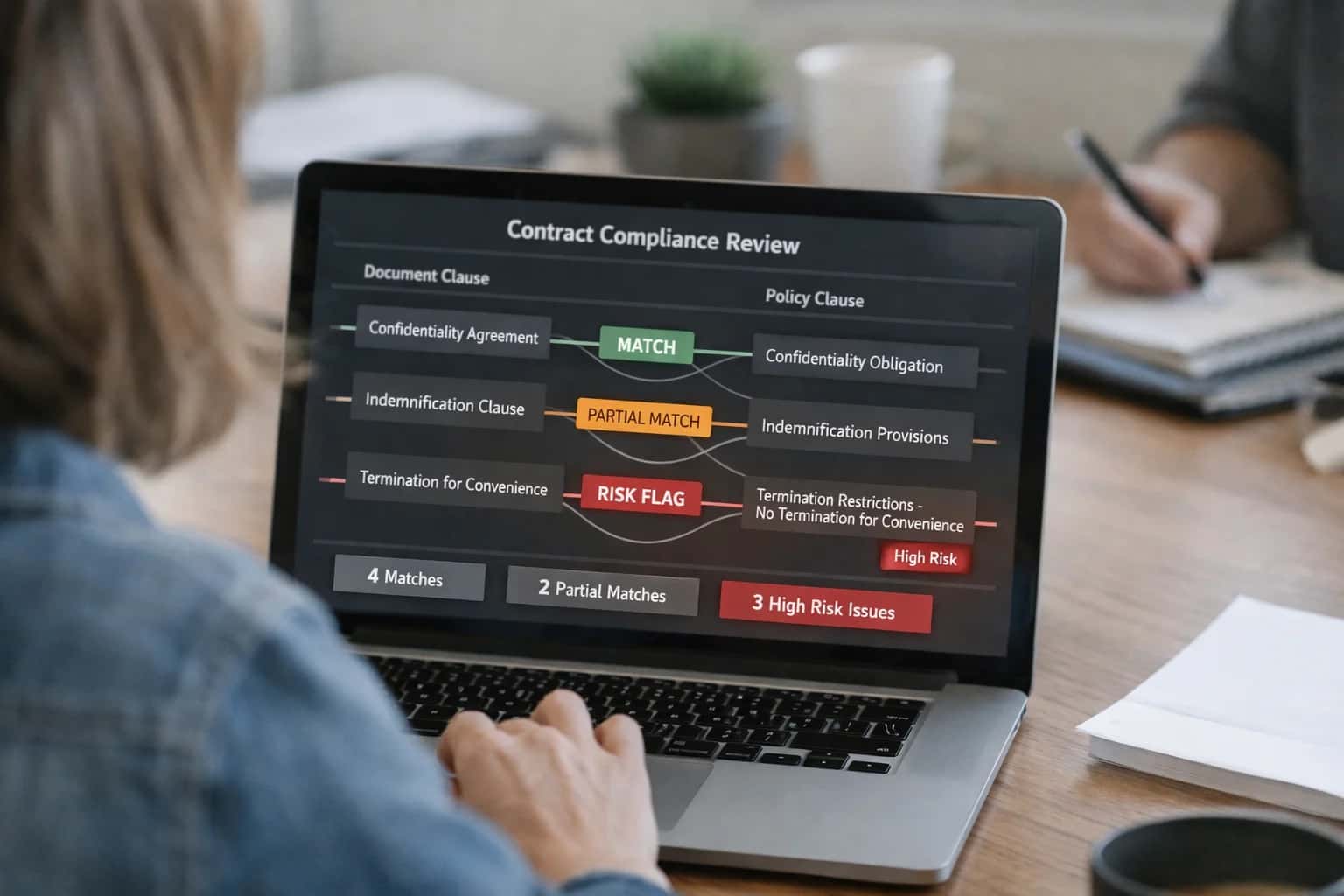
DEFINITION
What is Temporal Contradiction?
A temporal contradiction is a logical inconsistency between two or more time-bound statements in a contract, creating an impossible or ambiguous obligation.
Resolving a temporal contradiction requires formal reasoning systems like temporal constraint satisfaction to detect the conflict and apply legal canons of construction to determine which clause prevails. In automated contract analysis, these contradictions are flagged as critical exceptions that prevent the generation of a valid temporal dependency graph until a human operator or predefined precedence rule resolves the inconsistency.
DIAGNOSTIC FRAMEWORK
Key Characteristics of Temporal Contradictions
A temporal contradiction is a logical inconsistency between two or more time-bound statements in a contract, creating an impossible or ambiguous obligation timeline. Identifying these conflicts is a core challenge for automated contract analysis systems.
01
Logical Structure of a Conflict
A temporal contradiction occurs when two clauses impose mutually exclusive constraints on the same obligation. This typically manifests as a cycle in a temporal dependency graph where event A must precede event B, and event B must precede event A. Formally, this violates the irreflexivity and asymmetry axioms of temporal order. For example, a payment obligation cannot be triggered both 'upon execution' and '30 days prior to execution' of the same agreement.
02
Common Root Causes
Contradictions arise from specific drafting failures:
- Amendment Stacking: A new amendment changes a deadline without explicitly superseding the original clause, leaving both active.
- Cross-Referencing Errors: Clause 2.1 references the 'Closing Date' as defined in Section 1.1, but a side letter redefines 'Closing Date' for a subset of obligations.
- Conditional Precedence Loops: Obligation A is contingent on the completion of Obligation B, which is itself contingent on the completion of Obligation A.
- Undefined Temporal Granularity: A clause states an action is due 'within 5 business days of notice,' while another states it is due 'by the end of the calendar month.'
03
Detection via Allen's Interval Algebra
Allen's Interval Algebra provides a formal framework for detecting contradictions. By mapping each obligation to a time interval, a contradiction is identified when the asserted relation between two intervals is logically impossible. For instance, if Clause A asserts interval X meets interval Y, but Clause B asserts interval X contains interval Y, the system flags a relation inconsistency. A constraint satisfaction solver then attempts to find a valid timeline; failure confirms an unresolvable contradiction.
04
Resolution Strategies for Automation
Automated systems cannot resolve legal ambiguity but can triage it:
- Rule-Based Hierarchy: Apply a hard-coded precedence rule, such as 'specific clause overrides general clause' or 'later-dated amendment supersedes earlier.'
- Flag for Human Review: The most common strategy. The system generates a contradiction report pinpointing the conflicting clauses and the specific temporal predicates in conflict.
- Normative Defaulting: If a contradiction involves a statutory right, the system defaults to the legally mandated minimum or maximum timeframe as a safe harbor, while still raising an alert.
05
Impact on Obligation Lifecycle State Machines
An unresolved temporal contradiction causes a fatal error in an obligation lifecycle state machine. The machine cannot transition from a 'pending' state because the triggering condition is logically indeterminate. This results in a deadlocked obligation that is neither active nor terminated. In a multi-party workflow, this can cascade, blocking downstream dependent obligations and corrupting the critical path analysis for an entire transaction.
06
Bitemporal Modeling as a Mitigation
A bitemporal data model can contain and contextualize a contradiction without system failure. By recording both the valid time (when the drafter intended the obligation to be true) and the transaction time (when the contradictory clause was recorded in the system), the database preserves a full history. A query can then show that at transaction time T1, the deadline was X, and at T2, it was modified to Y, explicitly surfacing the conflict as a data artifact rather than a logical crash.
TEMPORAL CONTRADICTION
Frequently Asked Questions
Explore common questions about identifying, classifying, and resolving logical inconsistencies between time-bound statements in legal agreements.
A temporal contradiction is a logical inconsistency between two or more time-bound statements in a legal agreement that makes simultaneous compliance impossible. For example, a clause stating a payment is due 'within 30 days of closing' while another clause specifies the same payment is due 'on or before the closing date' creates a direct temporal conflict. These contradictions arise from drafting errors, inconsistent amendments, or the complex interplay of effective date anchors and temporal triggers. In computational contract analysis, a temporal contradiction is formally detected when a temporal constraint satisfaction solver finds no valid timeline that satisfies all extracted constraints. The presence of such contradictions can render a contract voidable or lead to litigation over the intended meaning.
Enabling Efficiency, Speed & Accuracy
Intelligent Analysis, Decision & Execution
We build AI systems for teams that need search across company data, workflow automation across tools, or AI features inside products and internal software.
Talk to Us
Search across company data
Give teams answers from docs, tickets, runbooks, and product data with sources and permissions.
Useful when people spend too long searching or get different answers from different systems.
Enterprise searchRAGPermissions
Read more
Automate internal workflows
Use AI to route work, draft outputs, trigger actions, and keep approvals and logs in place.
Useful when repetitive work moves across multiple tools and teams.
AI agentsWorkflow automationGovernance
Read more
Add AI to products and internal tools
Build assistants, guided actions, or decision support into the software your team or customers already use.
Useful when AI needs to be part of the product, not a separate tool.
AI integrationDecision supportModel routing
Read more
About the author
Prasad Kumkar
CEO & MD, Inference Systems
Prasad Kumkar is the CEO & MD of Inference Systems and writes about AI systems architecture, LLM infrastructure, model serving, evaluation, and production deployment. Over 5+ years, he has worked across computer vision models, L5 autonomous vehicle systems, and LLM research, with a focus on taking complex AI ideas into real-world engineering systems.
His work and writing cover AI systems, large language models, AI agents, multimodal systems, autonomous systems, inference optimization, RAG, evaluation, and production AI engineering.
LinkedIn
Limited slotsGet a Free AI Consultation
Partnered with leading AI, data, and software stack.





How We Work
Custom AI workflows for your Business
One-fit-all AI don't work for modern businesses. At Inferensys, we aim to understand your business & custom requirements; which we use to define most efficient agentic workflows, the data, and the tools for your business.
01
Review the use case
We understand the task, the users, and where AI can actually help.
Read more02
Pick the right approach
We define what needs search, automation, or product integration.
Read more03
Build the first useful version
We implement the part that proves the value first.
Read more04
Improve from there
We add the checks and visibility needed to keep it useful.
Read moreThe first call is a practical review of your use case and the right next step.
Talk to Us