Temporal Constraint Satisfaction is the computational process of determining a consistent assignment of dates and times to a set of contractual events such that all specified temporal constraints—like deadlines, durations, and precedence rules—are simultaneously satisfied. It frames contract analysis as a constraint satisfaction problem (CSP), where variables are event timestamps and constraints are the temporal relationships extracted from legal text.

Glossary
Temporal Constraint Satisfaction
The algorithmic process of finding a valid timeline of events that satisfies all specified temporal constraints and precedence rules extracted from a set of contracts.
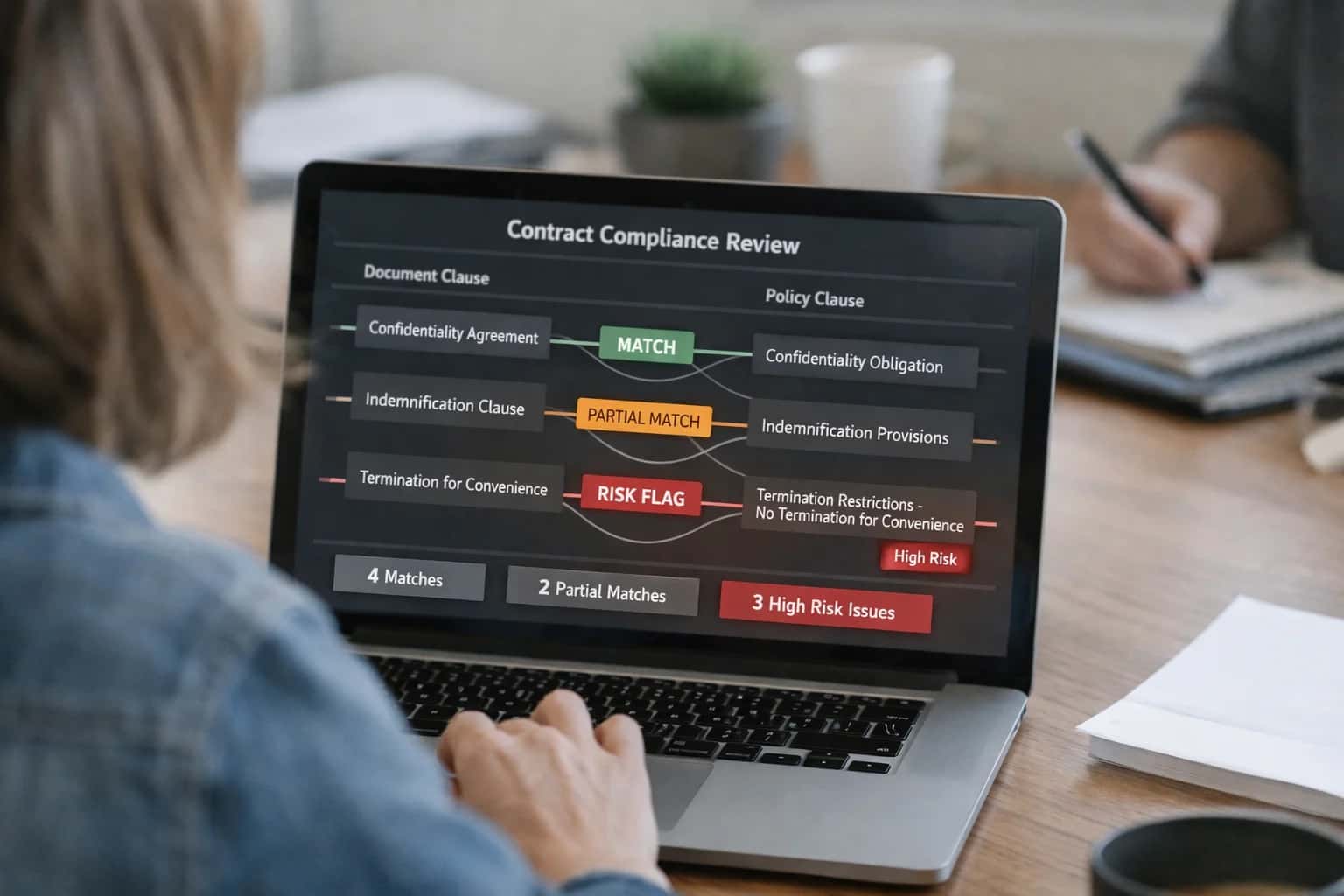
DEFINITION
What is Temporal Constraint Satisfaction?
The algorithmic process of finding a valid timeline of events that satisfies all specified temporal constraints and precedence rules extracted from a set of contracts.
The solver must resolve complex interactions between effective date anchors, temporal triggers, and business day conventions to detect hidden contradictions or generate a valid execution schedule. This technique is foundational for building obligation management systems that can automatically verify the logical consistency of a multi-document transaction timeline before any real-world deadline is missed.
TEMPORAL CONSTRAINT SATISFACTION
Core Characteristics of TCS Engines
A Temporal Constraint Satisfaction (TCS) engine algorithmically finds a valid timeline of events that satisfies all specified temporal constraints and precedence rules extracted from a set of contracts. It is the core solver for ensuring that a proposed schedule of obligations contains no logical contradictions.
01
Constraint Propagation
The foundational inference mechanism that reduces the search space by deducing new, tighter bounds from existing constraints. When a TCS engine processes a rule like 'Event A must occur before Event B' and 'Event B must occur before Day 30', it propagates this information to infer that Event A must occur before Day 30. This is typically implemented using path consistency algorithms on a Temporal Dependency Graph, ensuring that a local change to a deadline immediately updates all logically connected obligations.
02
Qualitative & Quantitative Reasoning
A robust TCS engine must simultaneously solve two classes of temporal data. Qualitative reasoning handles relative relationships defined by formalisms like Allen's Interval Algebra, such as 'during', 'overlaps', or 'meets'. Quantitative reasoning manages precise metric durations and deadlines, like '15 business days'. The engine unifies these by translating qualitative relations into quantitative bounds on start and end times, allowing a single solver to manage both a 'Sunset Clause' and a specific 'Effective Date Anchor'.
03
Inconsistency Detection
A critical function is identifying Temporal Contradictions that render a contract impossible to execute. The engine detects negative cycles in the constraint graph, which mathematically prove an inconsistency. For example, if a Temporal Dependency Graph contains a loop where Event A must precede Event B, Event B must precede Event C, and Event C must precede Event A, the system flags this as an unsatisfiable deadlock. This provides an automated 'red-flag' review for logically flawed contract drafting.
04
Disjunctive Constraint Resolution
Real-world contracts often contain choices, modeled as disjunctive constraints (e.g., 'deliver to New York or London within 10 days'). A TCS engine resolves these by systematically exploring alternative timelines. It may employ a Truth Maintenance System (TMS) to backtrack and test different combinations of disjuncts. When a choice leads to a contradiction, the engine retracts that assumption and its propagated consequences, efficiently searching for a globally consistent schedule that satisfies all non-negotiable obligations.
05
Preference-Based Scheduling
Beyond finding any valid timeline, advanced TCS engines optimize for a preferred one. They incorporate soft constraints with associated cost functions, such as 'minimize total contract lifecycle' or 'avoid scheduling payments on Q4 end'. The engine uses a branch-and-bound search to find the solution that not only satisfies all hard temporal constraints but also minimizes the total penalty of violated preferences. This transforms the engine from a simple validator into a tool for Critical Path Analysis and strategic obligation management.
06
Dynamic Temporal Network Management
Contractual timelines are not static; they evolve through amendments, breaches, and Temporal Triggers. A production TCS engine maintains a Simple Temporal Network (STN) that can be efficiently updated. When a new event, like a force majeure notice, is added, the engine does not re-solve from scratch. It incrementally propagates the new constraint through the existing network to instantly determine if the new fact violates any existing deadline or creates a new feasible window for a dependent obligation.
TEMPORAL REASONING
Frequently Asked Questions
Clear, technical answers to the most common questions about modeling and solving time-based constraints in legal agreements.
Temporal Constraint Satisfaction (TCS) is the algorithmic process of finding a valid timeline of events that satisfies all specified temporal constraints and precedence rules extracted from a set of contracts. It works by first parsing legal text to extract a network of temporal variables (e.g., deadlines, effective dates) and binary constraints (e.g., 'Event A must occur before Event B'). A solver then systematically assigns valid date-time values to each variable such that no constraint is violated. The underlying formalism often relies on Allen's Interval Algebra to express qualitative relations like 'overlaps' or 'meets', and Simple Temporal Networks (STNs) for quantitative bounds like 'delivery must occur 10 to 30 days after payment'. When a contract contains contradictory temporal statements—such as an obligation being due both before and after a triggering event—the solver detects a temporal contradiction, flagging the inconsistency for human review. This is the core engine behind automated obligation management systems that must ensure a proposed schedule of performance is logically coherent and contractually compliant.
Enabling Efficiency, Speed & Accuracy
Intelligent Analysis, Decision & Execution
We build AI systems for teams that need search across company data, workflow automation across tools, or AI features inside products and internal software.
Talk to Us
Search across company data
Give teams answers from docs, tickets, runbooks, and product data with sources and permissions.
Useful when people spend too long searching or get different answers from different systems.
Enterprise searchRAGPermissions
Read more
Automate internal workflows
Use AI to route work, draft outputs, trigger actions, and keep approvals and logs in place.
Useful when repetitive work moves across multiple tools and teams.
AI agentsWorkflow automationGovernance
Read more
Add AI to products and internal tools
Build assistants, guided actions, or decision support into the software your team or customers already use.
Useful when AI needs to be part of the product, not a separate tool.
AI integrationDecision supportModel routing
Read more
About the author
Prasad Kumkar
CEO & MD, Inference Systems
Prasad Kumkar is the CEO & MD of Inference Systems and writes about AI systems architecture, LLM infrastructure, model serving, evaluation, and production deployment. Over 5+ years, he has worked across computer vision models, L5 autonomous vehicle systems, and LLM research, with a focus on taking complex AI ideas into real-world engineering systems.
His work and writing cover AI systems, large language models, AI agents, multimodal systems, autonomous systems, inference optimization, RAG, evaluation, and production AI engineering.
LinkedIn
Limited slotsGet a Free AI Consultation
Partnered with leading AI, data, and software stack.





How We Work
Custom AI workflows for your Business
One-fit-all AI don't work for modern businesses. At Inferensys, we aim to understand your business & custom requirements; which we use to define most efficient agentic workflows, the data, and the tools for your business.
01
Review the use case
We understand the task, the users, and where AI can actually help.
Read more02
Pick the right approach
We define what needs search, automation, or product integration.
Read more03
Build the first useful version
We implement the part that proves the value first.
Read more04
Improve from there
We add the checks and visibility needed to keep it useful.
Read moreThe first call is a practical review of your use case and the right next step.
Talk to Us