Entire Agreement Clause Parsing is a specialized contract clause extraction task that locates the provision designed to prevent parties from relying on pre-contractual statements. The parser must identify the clause's core declaration that the executed document constitutes the entire agreement, explicitly nullifying all prior representations, warranties, and understandings.

Glossary
Entire Agreement Clause Parsing
The automated NLP process of identifying the 'integration' or 'merger' clause that declares a written contract to be the complete and final agreement, superseding all prior negotiations and representations.
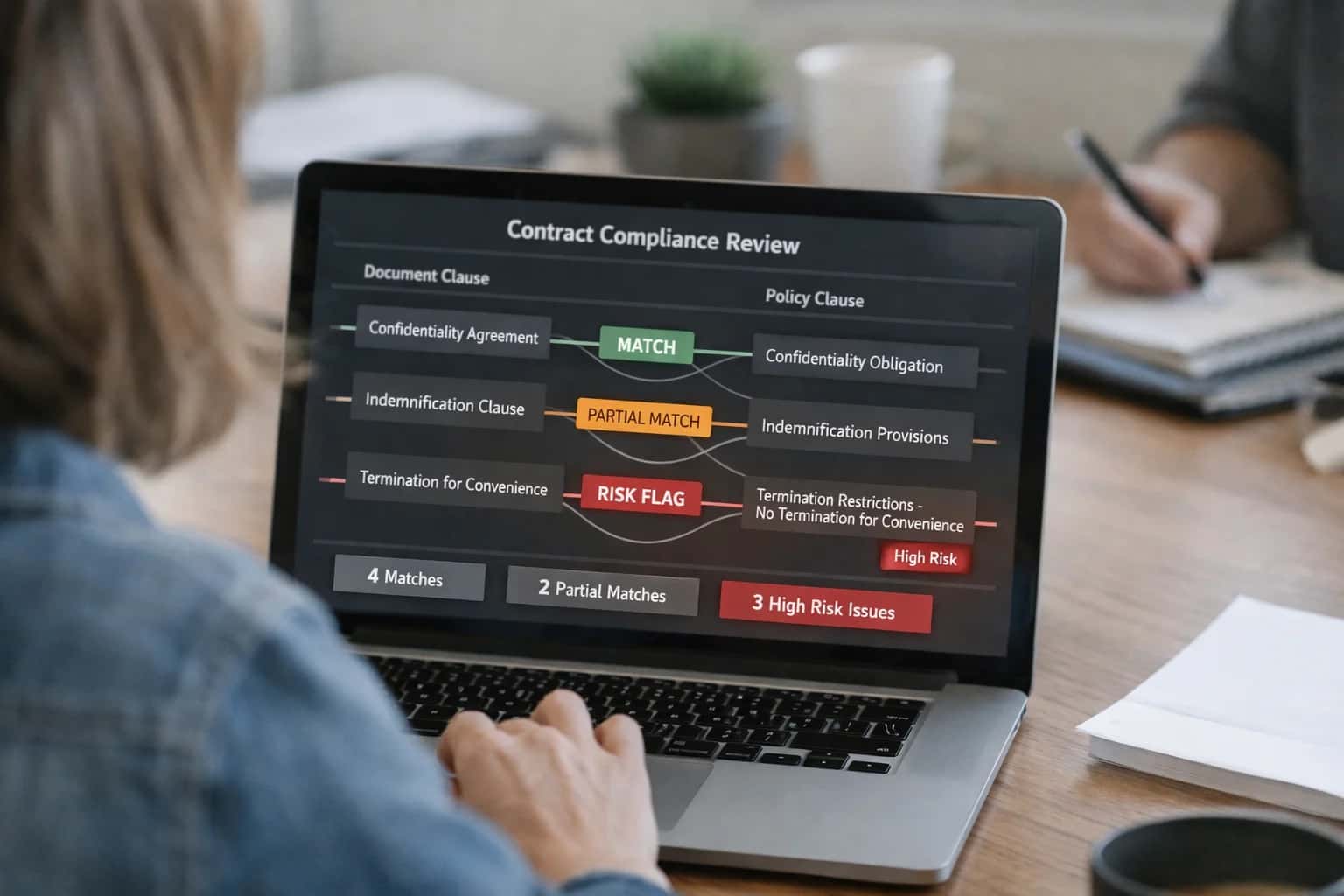
What is Entire Agreement Clause Parsing?
Entire Agreement Clause Parsing is the automated NLP task of identifying and extracting the 'integration' or 'merger' clause that declares a written contract to be the complete and final agreement, superseding all prior negotiations.
Effective parsing requires distinguishing this clause from related boilerplate provisions like amendments or severability. The model must extract the scope of the superseded materials—whether it covers oral discussions, draft agreements, or marketing materials—and identify any standard carve-outs for fraud or implied terms that survive the integration.
ENTIRE AGREEMENT CLAUSE PARSING
Frequently Asked Questions
Clear, technical answers to common questions about the automated identification and analysis of integration clauses in legal documents.
An entire agreement clause (also known as a merger clause or integration clause) is a contractual provision that declares the written document to be the complete and final expression of the parties' agreement, explicitly superseding all prior negotiations, representations, and understandings. Its primary function is to prevent parties from later claiming that additional terms were agreed upon outside the written instrument. By channeling all obligations into a single document, it creates contractual certainty and limits litigation risk. In automated parsing, the model must identify the clause's trigger language (e.g., 'This Agreement constitutes the entire understanding...') and distinguish it from related but distinct provisions like amendment clauses or no-reliance clauses.
Enabling Efficiency, Speed & Accuracy
Intelligent Analysis, Decision & Execution
We build AI systems for teams that need search across company data, workflow automation across tools, or AI features inside products and internal software.
Talk to Us
Search across company data
Give teams answers from docs, tickets, runbooks, and product data with sources and permissions.
Useful when people spend too long searching or get different answers from different systems.
Enterprise searchRAGPermissions
Read more
Automate internal workflows
Use AI to route work, draft outputs, trigger actions, and keep approvals and logs in place.
Useful when repetitive work moves across multiple tools and teams.
AI agentsWorkflow automationGovernance
Read more
Add AI to products and internal tools
Build assistants, guided actions, or decision support into the software your team or customers already use.
Useful when AI needs to be part of the product, not a separate tool.
AI integrationDecision supportModel routing
Read moreANATOMY OF AN INTEGRATION CLAUSE
Key Characteristics for Parsing
Parsing the Entire Agreement clause requires identifying specific linguistic markers and structural patterns that distinguish this 'super-integration' provision from other contract terms.
01
Canonical Header Triggers
The model must identify the clause by its standardized headings, which are highly predictable in commercial contracts. Key triggers include:
- Exact matches: 'Entire Agreement', 'Complete Agreement', 'Merger Clause'
- Variants: 'Sole Understanding', 'Integration Clause', 'Final Agreement'
- Negation: Distinguishing it from 'Partial Integration' or 'Amendment' clauses The parser uses a weighted header classifier that prioritizes these headings over body-text keyword matches to prevent false positives from cross-references.
02
Supersession Language
The core semantic payload is the declaration of supersession—the explicit statement that the written contract extinguishes all prior agreements. The parser extracts:
- Active verbs: 'supersedes', 'extinguishes', 'merges', 'replaces', 'cancels'
- Object of supersession: 'all prior negotiations', 'representations', 'agreements', 'understandings'
- Temporal scope: 'oral or written', 'prior to the Effective Date', 'contemporaneous'
This extraction creates a structured tuple:
{action, scope, temporal_boundary}for downstream obligation analysis.
03
Carve-Out and Exception Detection
A critical parsing challenge is identifying exceptions to the integration. The model must detect carve-outs that survive the merger:
- Fraud carve-out: 'except in the case of fraud' or 'nothing herein shall exclude liability for fraudulent misrepresentation'
- Surviving obligations: Specific clauses like 'Confidentiality Agreement dated X shall survive'
- Ancillary documents: 'the Schedules and Exhibits attached hereto' The parser uses dependency tree analysis to link exception phrases to the main supersession verb, preventing the erroneous classification of a clause as a complete integration when it contains material carve-outs.
04
Reliance Disclaimers
Entire Agreement clauses frequently contain a non-reliance statement where parties acknowledge they are not relying on extra-contractual representations. Key extraction targets:
- Acknowledgment language: 'each party acknowledges that...', 'the parties confirm that...'
- Disclaimed reliance: 'it has not relied on any representation', 'no reliance on any warranty'
- Contractual estoppel markers: 'shall be estopped from claiming', 'waives any claims based on' The parser classifies these as evidentiary provisions distinct from the integration function, enabling separate risk scoring for litigation exposure.
05
Multi-Jurisdictional Variance
The legal effect of an Entire Agreement clause varies significantly by governing law, and the parser must flag jurisdictional signals:
- English law: Broad effect; strong presumption that the clause excludes implied terms and collateral warranties
- New York law: Enforced but subject to parol evidence rule exceptions for ambiguity
- Civil law jurisdictions: May be treated as a rebuttable evidentiary presumption rather than a substantive bar
- CISG (International Sales): Article 8 and Article 11 interact with merger clauses differently than common law The parser cross-references the Governing Law extraction to tag the clause with a jurisdiction-specific enforceability profile.
06
Negative Scope Definition
The parser must also identify what the clause explicitly does not cover to define its operational boundary:
- Future amendments: Distinguishing the integration clause from the 'Amendment' clause that governs future modifications
- Statutory rights: 'nothing in this clause excludes liability for...' followed by non-waivable statutory protections
- Implied terms: Whether the clause purports to exclude terms implied by statute (e.g., UK Sale of Goods Act 1979) This boundary detection prevents the over-application of the integration label to unrelated contractual mechanisms and ensures accurate clause classification within the document taxonomy.

About the author
Prasad Kumkar
CEO & MD, Inference Systems
Prasad Kumkar is the CEO & MD of Inference Systems and writes about AI systems architecture, LLM infrastructure, model serving, evaluation, and production deployment. Over 5+ years, he has worked across computer vision models, L5 autonomous vehicle systems, and LLM research, with a focus on taking complex AI ideas into real-world engineering systems.
His work and writing cover AI systems, large language models, AI agents, multimodal systems, autonomous systems, inference optimization, RAG, evaluation, and production AI engineering.
LinkedIn
Limited slotsGet a Free AI Consultation
Partnered with leading AI, data, and software stack.





How We Work
Custom AI workflows for your Business
One-fit-all AI don't work for modern businesses. At Inferensys, we aim to understand your business & custom requirements; which we use to define most efficient agentic workflows, the data, and the tools for your business.
01
Review the use case
We understand the task, the users, and where AI can actually help.
Read more02
Pick the right approach
We define what needs search, automation, or product integration.
Read more03
Build the first useful version
We implement the part that proves the value first.
Read more04
Improve from there
We add the checks and visibility needed to keep it useful.
Read moreThe first call is a practical review of your use case and the right next step.
Talk to Us