Assignment clause parsing is the automated analysis of provisions that govern the transferability of contractual rights and obligations. It involves using natural language processing to identify whether a contract permits, restricts, or prohibits assignment, and to extract the specific conditions, consent requirements, and carve-outs that define the scope of transferability.

Glossary
Assignment Clause Parsing
The automated analysis of provisions that govern the ability of a party to transfer its contractual rights or obligations to a third party.
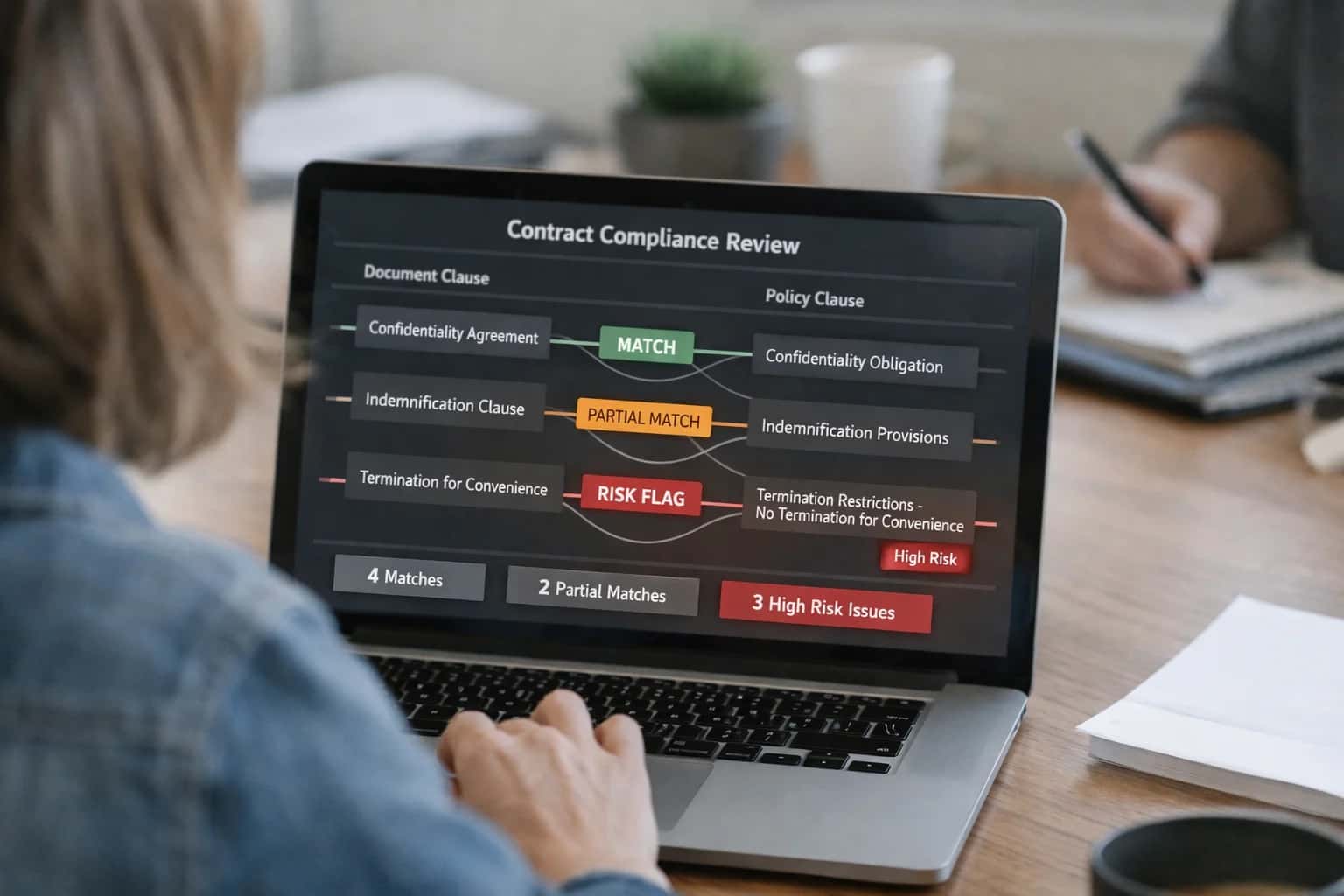
CONTRACT ANALYSIS
What is Assignment Clause Parsing?
Assignment clause parsing is the automated process of identifying, extracting, and structuring the semantic components of contractual provisions that govern a party's ability to transfer its rights or delegate its duties to a third party.
This task requires the model to distinguish between the assignment of rights and the delegation of duties, recognize exceptions for corporate reorganizations or affiliate transfers, and identify anti-assignment language that may be buried in boilerplate. Accurate parsing is critical for M&A due diligence, where the assignability of key contracts directly impacts deal structure and valuation.
ASSIGNMENT CLAUSE INTELLIGENCE
Core Parsing Capabilities
The automated analysis of provisions that govern the ability of a party to transfer its contractual rights or obligations to a third party.
01
Consent Structure Classification
Identifies the permission regime governing assignment. The system classifies clauses into three categories: absolute prohibition (no assignment permitted), qualified consent (not to be unreasonably withheld, conditioned, or delayed), and sole discretion (consent may be withheld for any reason or no reason). It further detects deemed consent triggers, where consent is automatically granted if the counterparty fails to respond within a specified notice period.
02
Change of Control Carve-Out Detection
Distinguishes between direct assignment and indirect transfers via corporate restructuring. The parser identifies whether a merger, acquisition, or sale of equity constitutes a prohibited assignment. It extracts specific carve-out language that exempts transactions with affiliates or internal reorganizations, and flags anti-assignment triggers tied to changes in majority ownership or voting control.
03
Permitted Transferee Extraction
Extracts the enumerated list of entities to which assignment is pre-authorized without counterparty consent. Common categories include:
- Affiliates and subsidiaries
- Successors and assigns
- Financing parties and collateral assignees
- Acquirers of substantially all assets or business lines The system also detects conditional permissions, such as requiring the assignor to remain secondarily liable or guaranteeing the assignee's creditworthiness.
04
Anti-Assignment Override Logic
Parses statutory and equitable exceptions that override contractual prohibitions. The model recognizes that certain rights—such as payment streams, receivables, and security interests—may be assignable by operation of law under UCC Article 9 or equivalent statutes. It distinguishes between the assignment of rights (generally freely transferable unless materially altering the obligor's duty) and the delegation of performance obligations (often restricted).
05
Void vs. Voidable Distinction
Classifies the legal consequence of a prohibited assignment. The parser differentiates between clauses rendering an unauthorized assignment void ab initio (a legal nullity with no effect) versus voidable (effective until challenged, giving the non-assigning party an election right). It also detects breach-only provisions, where an unauthorized assignment constitutes a breach but the transfer itself remains legally effective between assignor and assignee.
06
Novation vs. Assignment Detection
Disambiguates between a true assignment (transferring rights while the original party remains liable) and a novation (substituting a new party and releasing the original obligor). The system identifies language requiring express written consent from all parties for novation, and detects clauses where assignment operates as an automatic novation upon counterparty approval, extinguishing the assignor's obligations entirely.
ASSIGNMENT CLAUSE INTELLIGENCE
Frequently Asked Questions
Clear answers to the most common technical and legal questions about the automated parsing and analysis of assignment and anti-assignment provisions in commercial contracts.
Assignment clause parsing is the automated process of using natural language processing (NLP) models to identify, extract, and structure the semantic components of a contractual provision that governs the transfer of rights or obligations to a third party. The process works by first locating the clause using a semantic clause classification model trained on labeled legal corpora. Once identified, a sequence of token-level classifiers and span detectors extracts key entities: the assigning party, the restriction type (prohibition, consent-required, or freely assignable), carve-outs (e.g., affiliate transfers, change of control), and conditions precedent to a valid assignment. Modern systems use legal embedding models fine-tuned on M&A and commercial agreements to distinguish between the assignment of rights versus the delegation of duties, a critical legal distinction often conflated in standard NLP pipelines.
Enabling Efficiency, Speed & Accuracy
Intelligent Analysis, Decision & Execution
We build AI systems for teams that need search across company data, workflow automation across tools, or AI features inside products and internal software.
Talk to Us
Search across company data
Give teams answers from docs, tickets, runbooks, and product data with sources and permissions.
Useful when people spend too long searching or get different answers from different systems.
Enterprise searchRAGPermissions
Read more
Automate internal workflows
Use AI to route work, draft outputs, trigger actions, and keep approvals and logs in place.
Useful when repetitive work moves across multiple tools and teams.
AI agentsWorkflow automationGovernance
Read more
Add AI to products and internal tools
Build assistants, guided actions, or decision support into the software your team or customers already use.
Useful when AI needs to be part of the product, not a separate tool.
AI integrationDecision supportModel routing
Read more
About the author
Prasad Kumkar
CEO & MD, Inference Systems
Prasad Kumkar is the CEO & MD of Inference Systems and writes about AI systems architecture, LLM infrastructure, model serving, evaluation, and production deployment. Over 5+ years, he has worked across computer vision models, L5 autonomous vehicle systems, and LLM research, with a focus on taking complex AI ideas into real-world engineering systems.
His work and writing cover AI systems, large language models, AI agents, multimodal systems, autonomous systems, inference optimization, RAG, evaluation, and production AI engineering.
LinkedIn
Limited slotsGet a Free AI Consultation
Partnered with leading AI, data, and software stack.





How We Work
Custom AI workflows for your Business
One-fit-all AI don't work for modern businesses. At Inferensys, we aim to understand your business & custom requirements; which we use to define most efficient agentic workflows, the data, and the tools for your business.
01
Review the use case
We understand the task, the users, and where AI can actually help.
Read more02
Pick the right approach
We define what needs search, automation, or product integration.
Read more03
Build the first useful version
We implement the part that proves the value first.
Read more04
Improve from there
We add the checks and visibility needed to keep it useful.
Read moreThe first call is a practical review of your use case and the right next step.
Talk to Us