Contract Taxonomy Alignment is the algorithmic process of normalizing extracted clauses—such as indemnities or termination triggers—into a predefined, hierarchical legal classification scheme. This mapping resolves semantic variance, where two contracts use different language for the same legal concept, by anchoring every provision to a canonical node in a master legal ontology. The alignment ensures that a 'Limitation of Liability' clause in one document is computationally recognized as identical to a 'Liability Cap' in another, enabling reliable portfolio-wide analytics.

Glossary
Contract Taxonomy Alignment
The process of mapping extracted contractual clauses to a standardized legal ontology or classification scheme to enable consistent cross-document analysis.
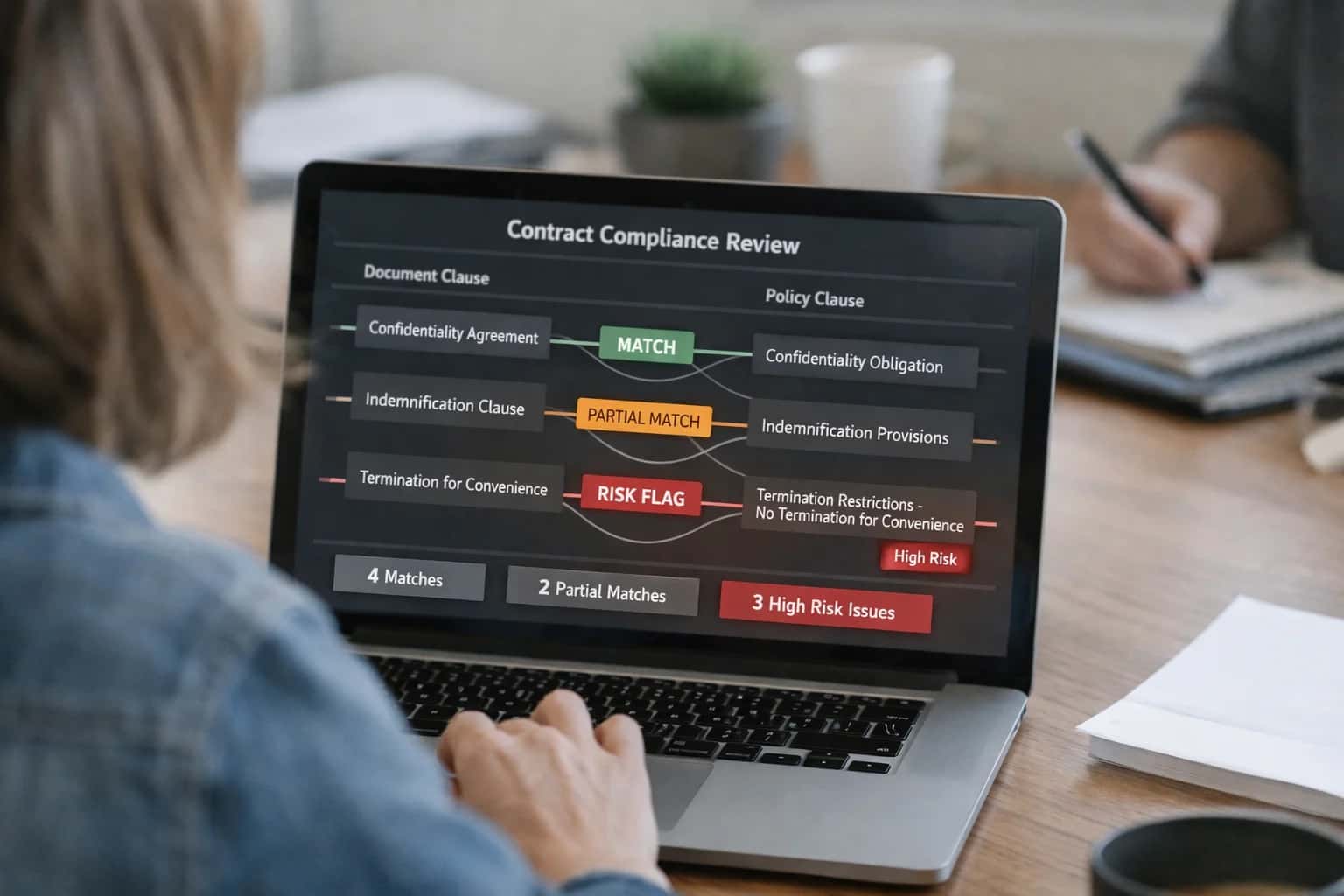
LEGAL ONTOLOGY MAPPING
What is Contract Taxonomy Alignment?
The computational process of mapping extracted contractual clauses to a standardized legal ontology or classification scheme, enabling consistent cross-document analysis and automated contract intelligence.
The alignment engine typically employs a hybrid architecture combining transformer-based semantic similarity with deterministic rule-based logic. The model measures the vector distance between an extracted clause embedding and the centroid of each taxonomy class, while rules enforce structural constraints like the presence of a deontic trigger. This process transforms unstructured text into structured, queryable metadata, forming the foundational layer for downstream tasks such as obligation extraction, cross-jurisdictional harmonization, and automated regulatory compliance checks.
CONTRACT TAXONOMY ALIGNMENT
Key Characteristics of Effective Alignment
Effective contract taxonomy alignment transforms unstructured legal text into a structured, queryable asset. The following characteristics define a robust alignment strategy that enables consistent cross-document analysis and downstream reasoning.
01
Ontological Granularity
The taxonomy must balance specificity with usability. Overly broad categories (e.g., 'Liability') fail to distinguish between a consequential damages waiver and an indemnification clause, collapsing distinct legal concepts. Conversely, excessive granularity creates a sparse, unmanageable schema. Effective alignment targets a functional resolution—deep enough to isolate commercially significant variations like sole remedy vs. cumulative remedies—while maintaining high inter-annotator agreement.
02
Semantic Normalization
Identical legal concepts appear with radically different surface forms. A single taxonomy node for Governing Law must absorb 'This Agreement shall be governed by...', 'The laws of the State of...', and 'Choice of Law.' Alignment requires semantic normalization that maps these lexical variants to a canonical concept identifier, often using a combination of few-shot classification and embedding similarity thresholds against a curated set of positive and negative exemplars.
03
Hierarchical Inheritance
A flat list of clause types is insufficient. A robust taxonomy uses hierarchical inheritance where specific clauses inherit the properties of their parents. For example, Non-Compete and Non-Solicitation are both children of Restrictive Covenants. This structure enables both precise extraction ('Find all non-solicitation clauses') and aggregate analysis ('Show me all restrictive covenants across this portfolio'), supporting multi-level legal reasoning.
04
Cross-Jurisdictional Mapping
Legal concepts are jurisdictionally bound. A Limitation of Liability clause operates differently under Delaware law versus English common law. Effective alignment incorporates a jurisdictional layer that maps local clause types to a universal abstract concept, enabling harmonized analysis across multi-jurisdictional contract portfolios. This prevents false equivalence where identically labeled clauses carry materially different legal weight.
05
Temporal Versioning
Legal taxonomies are not static. Regulatory changes, such as the shift from Safe Harbor to Standard Contractual Clauses for data transfers, require taxonomy evolution. A production alignment system must support temporal versioning of the ontology, allowing historical contracts to be re-indexed against updated schemas without losing the original classification context. This ensures auditability and backward compatibility.
06
Confidence Scoring and Ambiguity Handling
Not all clauses map cleanly to a single node. A paragraph may blend Indemnification with Limitation of Liability. Effective alignment systems output a probability distribution over candidate taxonomy nodes rather than a hard label. This confidence scoring enables downstream systems to route ambiguous clauses for human review, maintaining high precision on clear cases while transparently flagging edge cases for escalation.
CONTRACT TAXONOMY
Frequently Asked Questions
Addressing common questions about the alignment of extracted contract clauses to standardized legal classification schemes for consistent cross-document analysis.
Contract taxonomy alignment is the computational process of mapping extracted contractual clauses to a predefined, standardized legal ontology or classification scheme. It is critical because raw text extraction produces unstructured data; alignment normalizes this data into a consistent, machine-readable hierarchy. Without alignment, an indemnification clause in one contract and a hold harmless agreement in another are treated as distinct entities, breaking cross-document analysis. This process ensures that semantic equivalents are unified under a single canonical label, enabling reliable portfolio-wide risk assessment, obligation tracking, and regulatory compliance verification. The alignment layer acts as the semantic glue between raw NLP output and actionable legal intelligence, transforming a collection of parsed documents into a queryable, structured knowledge base.
Enabling Efficiency, Speed & Accuracy
Intelligent Analysis, Decision & Execution
We build AI systems for teams that need search across company data, workflow automation across tools, or AI features inside products and internal software.
Talk to Us
Search across company data
Give teams answers from docs, tickets, runbooks, and product data with sources and permissions.
Useful when people spend too long searching or get different answers from different systems.
Enterprise searchRAGPermissions
Read more
Automate internal workflows
Use AI to route work, draft outputs, trigger actions, and keep approvals and logs in place.
Useful when repetitive work moves across multiple tools and teams.
AI agentsWorkflow automationGovernance
Read more
Add AI to products and internal tools
Build assistants, guided actions, or decision support into the software your team or customers already use.
Useful when AI needs to be part of the product, not a separate tool.
AI integrationDecision supportModel routing
Read more
About the author
Prasad Kumkar
CEO & MD, Inference Systems
Prasad Kumkar is the CEO & MD of Inference Systems and writes about AI systems architecture, LLM infrastructure, model serving, evaluation, and production deployment. Over 5+ years, he has worked across computer vision models, L5 autonomous vehicle systems, and LLM research, with a focus on taking complex AI ideas into real-world engineering systems.
His work and writing cover AI systems, large language models, AI agents, multimodal systems, autonomous systems, inference optimization, RAG, evaluation, and production AI engineering.
LinkedIn
Limited slotsGet a Free AI Consultation
Partnered with leading AI, data, and software stack.





How We Work
Custom AI workflows for your Business
One-fit-all AI don't work for modern businesses. At Inferensys, we aim to understand your business & custom requirements; which we use to define most efficient agentic workflows, the data, and the tools for your business.
01
Review the use case
We understand the task, the users, and where AI can actually help.
Read more02
Pick the right approach
We define what needs search, automation, or product integration.
Read more03
Build the first useful version
We implement the part that proves the value first.
Read more04
Improve from there
We add the checks and visibility needed to keep it useful.
Read moreThe first call is a practical review of your use case and the right next step.
Talk to Us