Boilerplate clause filtering is the computational process of automatically identifying and segregating standardized, non-negotiable legal provisions—such as severability, entire agreement, and governing law clauses—from the bespoke, commercially negotiated terms that define the specific economic deal. This technique leverages semantic clause classification models to distinguish between high-variance, risk-bearing language and low-variance, templated text, enabling legal teams to focus review resources exclusively on the provisions that materially impact liability and consideration.

Glossary
Boilerplate Clause Filtering
The automated classification and separation of standardized, non-negotiable legal language from commercially significant, bespoke contract terms using natural language processing.
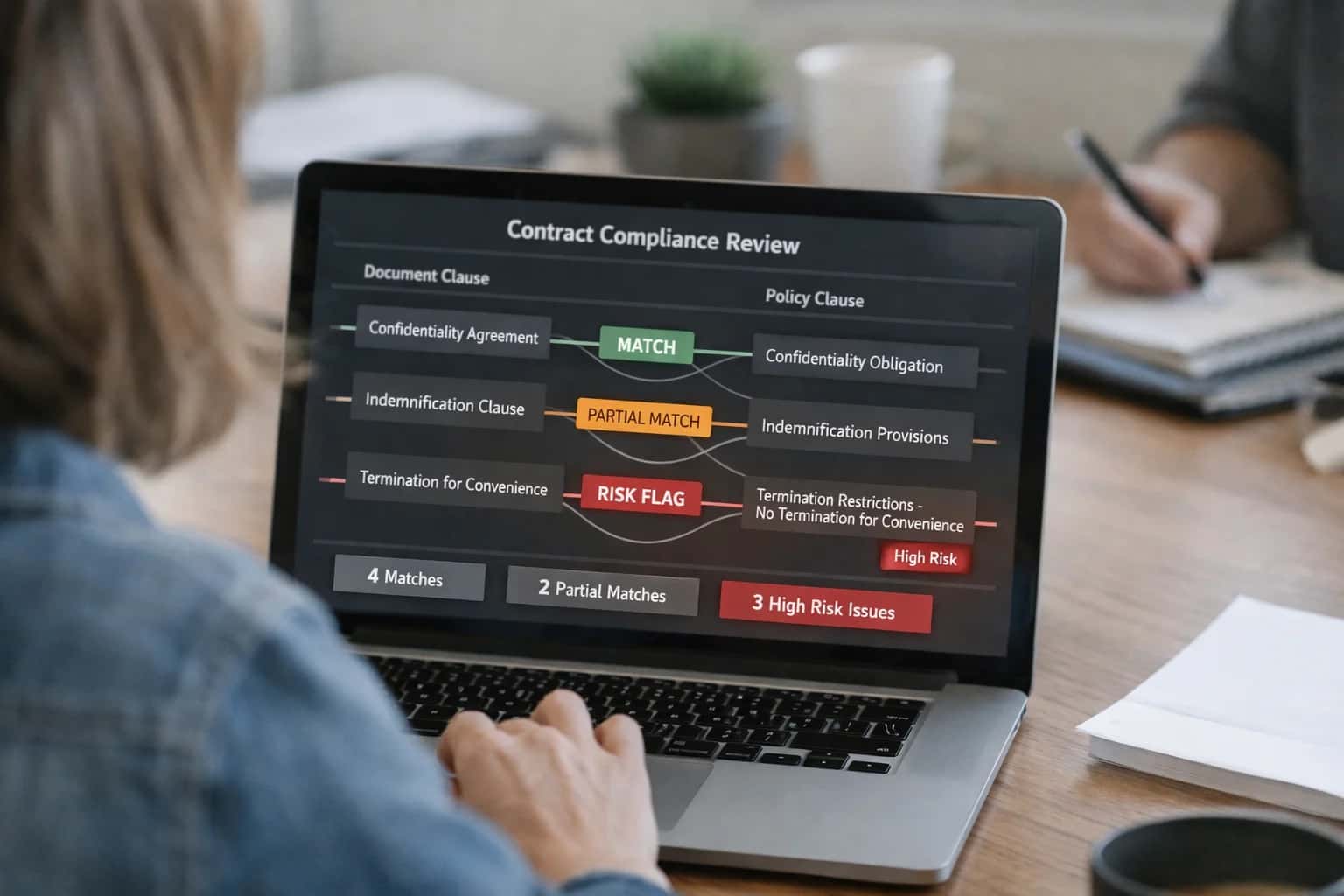
CONTRACT ANALYSIS
What is Boilerplate Clause Filtering?
The automated classification and separation of standardized, non-negotiable legal language from commercially significant, bespoke contract terms.
The filtering mechanism typically operates as a pre-processing stage in a contract analysis pipeline, applying a pre-defined taxonomy of standard clauses to suppress them from the review queue. By removing the noise of uniform 'miscellaneous' provisions, the system dramatically reduces the document surface area requiring expert human review, allowing for the rapid triage of high-volume contract portfolios and ensuring that obligation extraction and risk analysis are performed only on the substantive, deal-specific language.
MECHANISMS OF STANDARD LANGUAGE DETECTION
Core Characteristics of Boilerplate Filtering Systems
The technical architecture and operational logic enabling the automated separation of standardized, non-negotiable legal language from commercially significant, bespoke contract terms.
01
Statistical Frequency Analysis
Leverages term frequency-inverse document frequency (TF-IDF) and n-gram probability distributions across massive contract corpora. Clauses appearing with high frequency and low variance across thousands of agreements are statistically flagged as boilerplate. This method identifies standardized language patterns without requiring pre-labeled training data, making it effective for initial corpus exploration and identifying previously uncatalogued standard clauses.
02
Embedding Similarity Clustering
Converts clause text into high-dimensional vector embeddings using domain-specific legal language models. Boilerplate clauses form dense, tight clusters in vector space due to their semantic homogeneity. Bespoke clauses, by contrast, exhibit high cosine distance from these centroids. This technique excels at identifying near-duplicate standard language even when surface-level wording varies slightly across different law firms or practice areas.
03
Syntactic Structure Fingerprinting
Parses clauses into abstract syntax trees (ASTs) or dependency graphs to compare structural blueprints rather than surface text. Boilerplate clauses share nearly identical syntactic architectures—the same branching patterns, clause nesting, and modifier placement. This method is robust against lexical substitution attacks where synonyms are swapped to evade keyword-based filters, as the underlying grammatical skeleton remains unchanged.
04
Negotiation History Heuristics
Incorporates redline and version history metadata from contract lifecycle management systems. Clauses that have never been modified across multiple negotiation rounds or counterparties receive a high boilerplate probability score. Conversely, clauses with frequent tracked changes, strikethroughs, and comment threads are classified as commercially significant. This temporal signal provides a powerful real-world negotiation behavior ground truth.
05
Entropy-Based Novelty Scoring
Calculates Shannon entropy and perplexity scores at the token level. Boilerplate text exhibits low entropy—highly predictable word sequences with minimal information density. Bespoke, negotiated language contains higher entropy due to unique phrasing, specific dollar amounts, and tailored legal logic. This information-theoretic approach provides a language-model-native signal that requires no external knowledge bases or ontologies.
06
Ontological Role Classification
Maps extracted clauses to a standardized legal taxonomy (e.g., indemnification, termination, governing law) and cross-references against known boilerplate templates for each category. A governing law clause matching the standard New York or Delaware template with zero deviation is classified as boilerplate. This method combines semantic classification with template matching to achieve high precision in regulated contexts where standard language is explicitly prescribed.
Enabling Efficiency, Speed & Accuracy
Intelligent Analysis, Decision & Execution
We build AI systems for teams that need search across company data, workflow automation across tools, or AI features inside products and internal software.
Talk to Us
Search across company data
Give teams answers from docs, tickets, runbooks, and product data with sources and permissions.
Useful when people spend too long searching or get different answers from different systems.
Enterprise searchRAGPermissions
Read more
Automate internal workflows
Use AI to route work, draft outputs, trigger actions, and keep approvals and logs in place.
Useful when repetitive work moves across multiple tools and teams.
AI agentsWorkflow automationGovernance
Read more
Add AI to products and internal tools
Build assistants, guided actions, or decision support into the software your team or customers already use.
Useful when AI needs to be part of the product, not a separate tool.
AI integrationDecision supportModel routing
Read moreBOILERPLATE CLAUSE FILTERING
Frequently Asked Questions
Clear answers to common questions about the automated identification and separation of standardized legal language from commercially significant contract terms.
Boilerplate clause filtering is the automated classification and separation of standardized, non-negotiable legal language from commercially significant, bespoke contract terms using natural language processing models. The process distinguishes miscellaneous provisions—such as entire agreement clauses, severability, notices, and counterparts—from deal-specific terms like pricing, liability caps, indemnification scopes, and termination rights. Modern filtering systems employ semantic clause classification models fine-tuned on legal corpora to recognize the linguistic patterns and structural markers that differentiate boilerplate from operative language. This enables legal teams to focus review efforts on high-risk, high-value provisions rather than expending time on language that rarely changes across agreements. Effective filtering requires understanding that some clauses occupy a gray zone—an assignment clause may be boilerplate in one contract type but heavily negotiated in another, necessitating configurable taxonomies rather than rigid binary classification.

About the author
Prasad Kumkar
CEO & MD, Inference Systems
Prasad Kumkar is the CEO & MD of Inference Systems and writes about AI systems architecture, LLM infrastructure, model serving, evaluation, and production deployment. Over 5+ years, he has worked across computer vision models, L5 autonomous vehicle systems, and LLM research, with a focus on taking complex AI ideas into real-world engineering systems.
His work and writing cover AI systems, large language models, AI agents, multimodal systems, autonomous systems, inference optimization, RAG, evaluation, and production AI engineering.
LinkedIn
Limited slotsGet a Free AI Consultation
Partnered with leading AI, data, and software stack.





How We Work
Custom AI workflows for your Business
One-fit-all AI don't work for modern businesses. At Inferensys, we aim to understand your business & custom requirements; which we use to define most efficient agentic workflows, the data, and the tools for your business.
01
Review the use case
We understand the task, the users, and where AI can actually help.
Read more02
Pick the right approach
We define what needs search, automation, or product integration.
Read more03
Build the first useful version
We implement the part that proves the value first.
Read more04
Improve from there
We add the checks and visibility needed to keep it useful.
Read moreThe first call is a practical review of your use case and the right next step.
Talk to Us