Workflow-as-Code is a software development practice where the definition, logic, and dependencies of a business or technical process are authored, versioned, and managed as code (e.g., in Python, YAML, or a domain-specific language) within a standard development lifecycle. This approach treats the workflow definition as a first-class, testable software artifact, enabling practices like version control, code review, CI/CD integration, and automated testing. It is foundational to declarative orchestration platforms like Apache Airflow, Temporal, and AWS Step Functions, which execute these code-defined workflows.

Glossary
Workflow-as-Code
Workflow-as-Code is a development practice where workflow definitions are authored, versioned, and managed as code (e.g., in Python, YAML) within a standard software development lifecycle.
ORCHESTRATION WORKFLOW ENGINES
What is Workflow-as-Code?
A core practice in modern multi-agent system orchestration where complex processes are defined, managed, and executed as software artifacts.
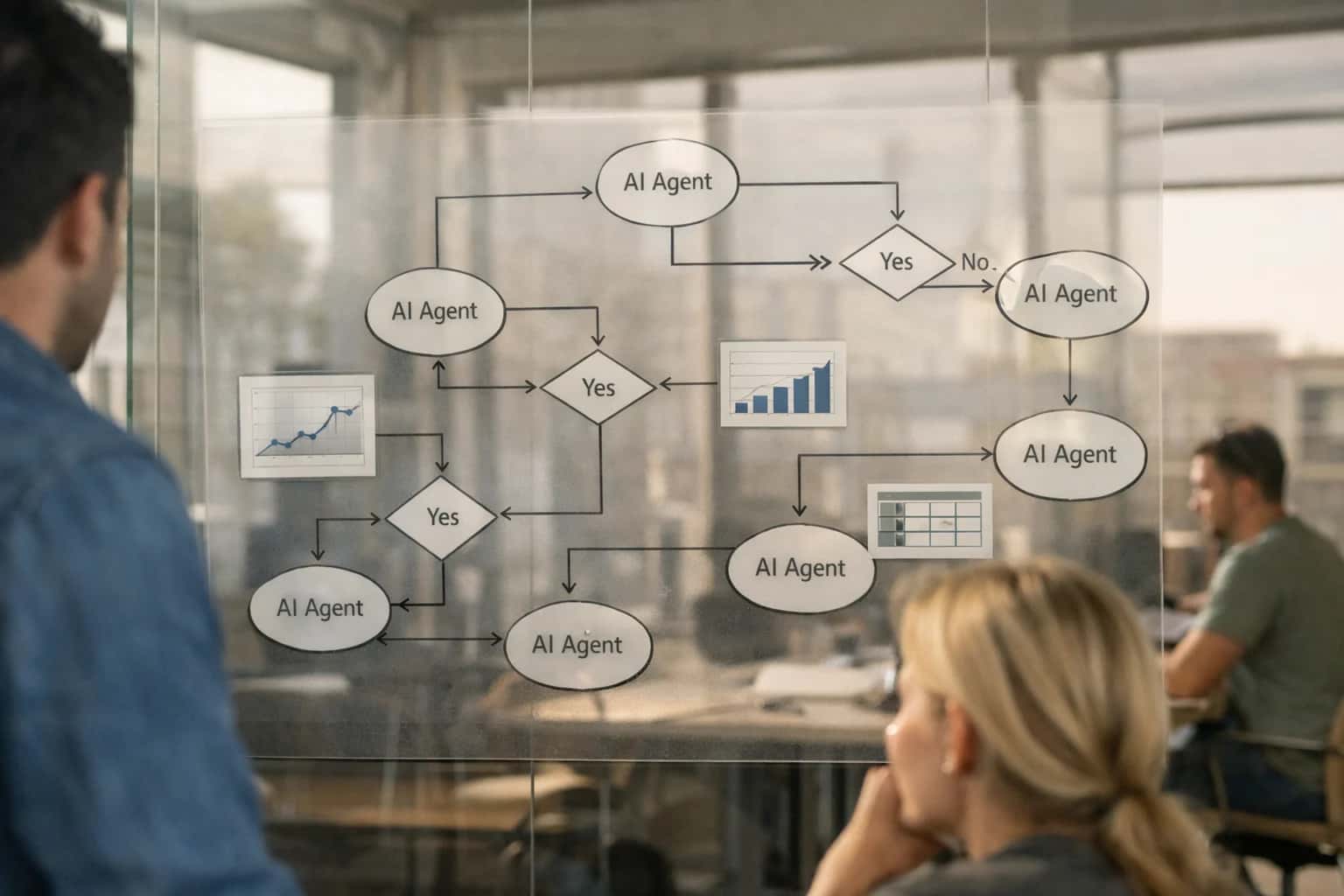
By codifying workflows, engineering teams gain deterministic execution, reproducibility, and auditability, which are critical for multi-agent system orchestration. The code explicitly models tasks as activities, their sequence as a Directed Acyclic Graph (DAG), and control flow with conditional branching and parallel execution. This shifts orchestration from manual, GUI-based configuration to a programmable, scalable engineering discipline, directly supporting the agent lifecycle management and state synchronization required for complex, autonomous systems.
ORCHESTRATION WORKFLOW ENGINES
Core Characteristics of Workflow-as-Code
Workflow-as-Code is a development practice where workflow definitions are authored, versioned, and managed as code within a standard software development lifecycle. This approach transforms orchestration logic from a configuration artifact into a first-class, testable software component.
01
Declarative & Imperative Definitions
Workflow-as-Code supports both declarative and imperative programming models. A declarative definition (e.g., in YAML, CUE) specifies the desired end state and dependencies, letting the engine determine execution order. An imperative definition (e.g., in Python, TypeScript) uses standard programming constructs like loops and conditionals to explicitly define step-by-step control flow. This dual model allows engineers to choose the right abstraction for the task's complexity.
- Example: Apache Airflow uses imperative Python code to define DAGs, while AWS Step Functions uses the declarative Amazon States Language (ASL).
- Benefit: Combines the flexibility of general-purpose code with the simplicity of declarative intent for common patterns.
02
Version Control & CI/CD Integration
The primary advantage of Workflow-as-Code is that workflow definitions are stored in version control systems (e.g., Git). This enables:
- Collaborative Development: Multiple engineers can propose changes via pull requests, with code reviews ensuring quality.
- Change Auditing: Every modification is tracked with an author, timestamp, and commit message, creating a full audit trail.
- CI/CD Pipelines: Workflows can be linted, unit-tested, and integration-tested automatically before deployment, just like application code. Deployment becomes part of the standard release process, eliminating manual uploads to a UI.
This integration brings software engineering rigor to orchestration, reducing configuration drift and deployment errors.
03
Programmatic Abstraction & Reusability
Treating workflows as code enables powerful software engineering principles. Engineers can create abstractions like functions, classes, and libraries to encapsulate common patterns.
- Reusable Components: A complex data validation task can be defined once as a function and invoked across dozens of different workflows.
- Parameterization: Workflows accept input parameters, making them generic templates for different use cases (e.g.,
process_dataset(dataset_id)). - Modularity: Large workflows can be decomposed into smaller, independently testable sub-workflows or modules.
This shifts orchestration from monolithic, copy-paste configuration to a modular, maintainable codebase, dramatically improving developer productivity and system reliability.
04
Local Testing & Deterministic Execution
A core tenet of Workflow-as-Code is the ability to test workflows locally before deployment. Developers can run a workflow definition in a simulated or mocked environment on their laptop.
- Unit Testing: Individual tasks or branches can be tested in isolation.
- Integration Testing: The full workflow logic, including conditional branching and error handling, can be validated against test data.
- Deterministic Replay: Advanced engines (e.g., Temporal) use event sourcing to record all decisions. This history allows the exact same workflow instance to be deterministically replayed from any point, which is invaluable for debugging and ensuring state recovery after failures.
This testability is critical for building reliable, production-grade automation.
05
Dynamic Control Flow & Error Handling
Because workflows are expressed in code, control flow can be dynamic and context-aware, going beyond static diagrams. This includes:
- Complex Branching: Using
if/elseandswitchstatements based on runtime data. - Loops: Iterating over items in a list (e.g.,
for file in file_list). - Sophisticated Error Handling: Implementing retry logic with exponential backoff, defining compensating transactions for the Saga pattern, or using the circuit breaker pattern to halt calls to failing services.
These constructs allow workflows to model complex, real-world business processes with resilience, moving beyond simple linear sequences.
06
Tight Integration with Development Tooling
Workflow-as-Code fits seamlessly into a developer's existing toolkit, reducing cognitive load and friction.
- IDEs & Linters: Developers write workflows in their preferred IDE (VS Code, PyCharm) with access to syntax highlighting, autocomplete, and static analysis.
- Dependency Management: Workflow dependencies (like Python packages or Docker images) are declared in standard files (
requirements.txt,Dockerfile) and managed by existing systems. - Observability: Since workflows are code, they can be instrumented with standard logging and metrics libraries, and their execution can be traced using OpenTelemetry, providing deep orchestration observability.
This tooling integration is essential for adoption at scale within engineering organizations.
WORKFLOW-AS-CODE
Frequently Asked Questions
Workflow-as-Code is a development practice where workflow definitions are authored, versioned, and managed as code within a standard software development lifecycle. This FAQ addresses its core principles, implementation, and benefits for platform engineers and CTOs.
Workflow-as-Code is a software development practice where the definition, logic, and dependencies of a business or technical process are authored, versioned, and managed as executable code (e.g., in Python, YAML, or a Domain-Specific Language) rather than configured through a graphical user interface. It treats workflow specifications as first-class software artifacts, enabling them to be integrated into standard development workflows including version control (Git), code review, CI/CD pipelines, and automated testing. This approach is foundational to modern multi-agent system orchestration, where complex sequences of agent interactions must be defined with precision and reliability.
Enabling Efficiency, Speed & Accuracy
Intelligent Analysis, Decision & Execution
We build AI systems for teams that need search across company data, workflow automation across tools, or AI features inside products and internal software.
Talk to Us
Search across company data
Give teams answers from docs, tickets, runbooks, and product data with sources and permissions.
Useful when people spend too long searching or get different answers from different systems.
Enterprise searchRAGPermissions
Read more
Automate internal workflows
Use AI to route work, draft outputs, trigger actions, and keep approvals and logs in place.
Useful when repetitive work moves across multiple tools and teams.
AI agentsWorkflow automationGovernance
Read more
Add AI to products and internal tools
Build assistants, guided actions, or decision support into the software your team or customers already use.
Useful when AI needs to be part of the product, not a separate tool.
AI integrationDecision supportModel routing
Read more
About the author
Prasad Kumkar
CEO & MD, Inference Systems
Prasad Kumkar is the CEO & MD of Inference Systems and writes about AI systems architecture, LLM infrastructure, model serving, evaluation, and production deployment. Over 5+ years, he has worked across computer vision models, L5 autonomous vehicle systems, and LLM research, with a focus on taking complex AI ideas into real-world engineering systems.
His work and writing cover AI systems, large language models, AI agents, multimodal systems, autonomous systems, inference optimization, RAG, evaluation, and production AI engineering.
LinkedIn
Limited slotsGet a Free AI Consultation
Partnered with leading AI, data, and software stack.





How We Work
Custom AI workflows for your Business
One-fit-all AI don't work for modern businesses. At Inferensys, we aim to understand your business & custom requirements; which we use to define most efficient agentic workflows, the data, and the tools for your business.
01
Review the use case
We understand the task, the users, and where AI can actually help.
Read more02
Pick the right approach
We define what needs search, automation, or product integration.
Read more03
Build the first useful version
We implement the part that proves the value first.
Read more04
Improve from there
We add the checks and visibility needed to keep it useful.
Read moreThe first call is a practical review of your use case and the right next step.
Talk to Us