Declarative orchestration is a paradigm for defining automated workflows where the developer specifies the desired end state and the dependencies between tasks, leaving the underlying workflow engine to determine the optimal execution sequence and handle failures. This contrasts with imperative orchestration, which requires explicitly coding the control flow (e.g., loops, conditionals, and error handling). The engine uses the declarative workflow definition—often expressed as a Directed Acyclic Graph (DAG) or in a Workflow Definition Language (WDL)—to generate and manage the execution plan, automatically handling scheduling, retries, and state persistence.

Glossary
Declarative Orchestration
Declarative orchestration is a workflow definition approach where you specify the desired end state and dependencies, and the engine determines the optimal execution sequence.
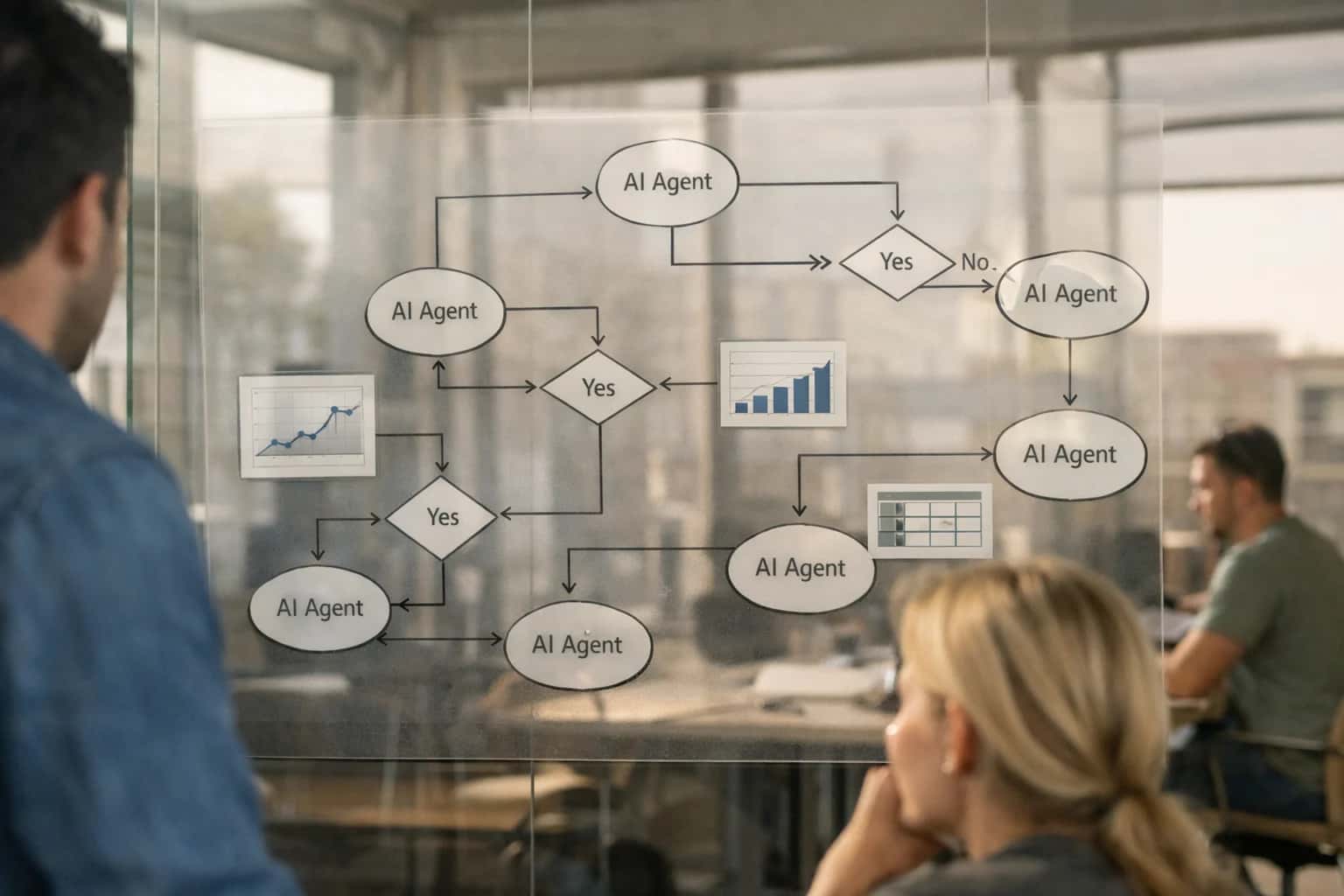
WORKFLOW ENGINE
What is Declarative Orchestration?
Declarative orchestration is a paradigm for defining automated workflows by specifying the desired end state and component relationships, rather than writing imperative step-by-step instructions.
This approach abstracts away operational complexity, promoting idempotent execution and fault tolerance through built-in mechanisms like checkpointing and compensating transactions. It is foundational to platforms like Apache Airflow (with its DAGs) and AWS Step Functions (using Amazon States Language). By focusing on the 'what' rather than the 'how', declarative orchestration increases developer productivity, ensures consistent deterministic replay for debugging, and enhances system reliability by making the workflow's intent explicit and engine-managed.
ARCHITECTURAL PRINCIPLES
Key Characteristics of Declarative Orchestration
Declarative orchestration defines workflows by specifying the desired end state and dependencies, allowing the engine to determine the optimal execution sequence. This contrasts with imperative orchestration, which requires explicit step-by-step instructions.
01
End-State Specification
The core principle of declarative orchestration is defining the desired outcome rather than the procedure to achieve it. A developer specifies the final data state, service configuration, or business goal, and the orchestration engine's scheduler determines the necessary actions. For example, a workflow could declare, "Ensure database schema X exists with tables A, B, and C," and the engine would run the required migration scripts in the correct order, idempotently. This shifts the developer's focus from control flow logic to business intent.
02
Implicit Dependency Resolution
The orchestration engine automatically infers and manages task dependencies from the declared end state. Dependencies are derived from data flow (the output of Task A is the input for Task B) or resource constraints. The engine constructs an internal Directed Acyclic Graph (DAG) to model these relationships, ensuring tasks execute only when their prerequisites are satisfied. This eliminates manual dependency wiring and reduces errors from incorrect sequencing, as the engine calculates a valid topological order for execution.
03
Idempotent & Convergent Execution
Declarative systems are designed to be idempotent and convergent. The engine continuously compares the current system state against the declared desired state. If a deviation is detected (e.g., a task failed, a resource was deleted), the engine executes only the minimal set of operations needed to converge the system back to the desired state. This provides built-in fault tolerance and self-healing, as re-running the same declaration multiple times safely leads to the same consistent outcome without side effects.
04
Separation of Concerns
This approach enforces a clean architectural separation between business logic (the 'what') and execution logic (the 'how').
- Declarative Layer: The developer defines goals, constraints, and dependencies in a Workflow Definition Language (WDL) like YAML, CUE, or HCL.
- Imperative Layer: The orchestration engine (e.g., Kubernetes controllers, Terraform, Apache Airflow) contains the complex, reusable logic for scheduling, retries, and state management. This separation simplifies the definition, enhances portability across different runtimes, and allows platform engineers to optimize the engine independently.
05
Parallelization & Optimization
By understanding the complete dependency graph upfront, the orchestration engine can aggressively optimize for performance. It identifies independent tasks that can be executed in parallel, maximizing resource utilization and minimizing end-to-end latency. The engine can also reorder non-dependent tasks for efficiency, such as grouping similar operations or prioritizing critical path items. This is a key advantage over imperative scripts, where parallel execution must be explicitly and often rigidly coded by the developer.
06
Primary Use Cases & Examples
Declarative orchestration excels in environments requiring consistency, resilience, and complex dependency management.
- Infrastructure as Code (IaC): Tools like Terraform and AWS CloudFormation declare the desired cloud resource state.
- Container Orchestration: Kubernetes manifests declare the desired state of pods, services, and deployments.
- Data Pipeline Orchestration: Apache Airflow and Prefect allow declarative definition of data pipeline DAGs.
- Configuration Management: Ansible (in its declarative mode) and Puppet ensure system configurations match a defined spec. These systems continuously reconcile observed state with declared state, providing autonomous operation.
ARCHITECTURAL PARADIGM COMPARISON
Declarative vs. Imperative Orchestration
A comparison of the two fundamental approaches for defining and executing workflows in multi-agent systems and general software orchestration.
| Core Feature / Characteristic | Declarative Orchestration | Imperative Orchestration |
|---|---|---|
Definition Paradigm | Specifies the desired end state and constraints. | Specifies the exact sequence of step-by-step commands. |
Control Flow Responsibility | The orchestration engine. | The workflow author/developer. |
Primary Abstraction | Desired state, dependencies, and constraints. | Procedural instructions and explicit order. |
Execution Flexibility | High. Engine can optimize order and parallelization. | Low. Execution follows the prescribed sequence. |
Fault Tolerance & Recovery | Built-in. Engine manages retries and state reconciliation. | Manual. Requires explicit error handling in the code. |
State Management | Implicit. Engine infers and manages state from declarations. | Explicit. Developer must track and pass state between steps. |
Complexity for Long-Running Processes | Low. Engine handles durability, checkpoints, and resumes. | High. Developer must implement persistence and recovery logic. |
Example Technologies / Patterns | Kubernetes manifests, AWS Step Functions, Temporal Workflows, DAG-based engines. | Custom scripts, traditional procedural code, basic cron jobs, explicit service calls. |
DECLARATIVE ORCHESTRATION
Frequently Asked Questions
Declarative orchestration defines workflows by specifying the desired end state and dependencies, allowing the engine to determine the optimal execution sequence. This contrasts with imperative orchestration, which requires explicit step-by-step instructions.
Declarative orchestration is a paradigm for defining automated workflows by specifying the desired end state and the dependencies between tasks, rather than writing a rigid, step-by-step procedural script. The workflow engine analyzes this declaration to automatically generate and execute an optimal execution plan. It works by interpreting a workflow definition—often written in a Workflow Definition Language (WDL) like YAML or a domain-specific language—that describes the tasks, their inputs/outputs, and their dependencies, typically modeled as a Directed Acyclic Graph (DAG). The engine's scheduler then resolves dependencies, manages concurrency, handles retries, and ensures the final state is achieved, even if the path to get there changes due to runtime conditions.
Enabling Efficiency, Speed & Accuracy
Intelligent Analysis, Decision & Execution
We build AI systems for teams that need search across company data, workflow automation across tools, or AI features inside products and internal software.
Talk to Us
Search across company data
Give teams answers from docs, tickets, runbooks, and product data with sources and permissions.
Useful when people spend too long searching or get different answers from different systems.
Enterprise searchRAGPermissions
Read more
Automate internal workflows
Use AI to route work, draft outputs, trigger actions, and keep approvals and logs in place.
Useful when repetitive work moves across multiple tools and teams.
AI agentsWorkflow automationGovernance
Read more
Add AI to products and internal tools
Build assistants, guided actions, or decision support into the software your team or customers already use.
Useful when AI needs to be part of the product, not a separate tool.
AI integrationDecision supportModel routing
Read more
About the author
Prasad Kumkar
CEO & MD, Inference Systems
Prasad Kumkar is the CEO & MD of Inference Systems and writes about AI systems architecture, LLM infrastructure, model serving, evaluation, and production deployment. Over 5+ years, he has worked across computer vision models, L5 autonomous vehicle systems, and LLM research, with a focus on taking complex AI ideas into real-world engineering systems.
His work and writing cover AI systems, large language models, AI agents, multimodal systems, autonomous systems, inference optimization, RAG, evaluation, and production AI engineering.
LinkedIn
Limited slotsGet a Free AI Consultation
Partnered with leading AI, data, and software stack.





How We Work
Custom AI workflows for your Business
One-fit-all AI don't work for modern businesses. At Inferensys, we aim to understand your business & custom requirements; which we use to define most efficient agentic workflows, the data, and the tools for your business.
01
Review the use case
We understand the task, the users, and where AI can actually help.
Read more02
Pick the right approach
We define what needs search, automation, or product integration.
Read more03
Build the first useful version
We implement the part that proves the value first.
Read more04
Improve from there
We add the checks and visibility needed to keep it useful.
Read moreThe first call is a practical review of your use case and the right next step.
Talk to Us