Data provenance is the verifiable record of the origins, custody, and sequence of transformations applied to a data asset, creating an immutable audit trail. In multi-agent system orchestration, it provides a tamper-evident lineage for every piece of information exchanged, processed, or generated by autonomous agents. This traceability is foundational for security auditing, debugging cascading errors, and verifying the integrity of collaborative outputs, ensuring that decisions can be traced back to trusted sources.

Glossary
Data Provenance
Data provenance is the complete historical record of a data asset's origins, custody, and transformations, providing an auditable trail for security and integrity verification.
ORCHESTRATION SECURITY
What is Data Provenance?
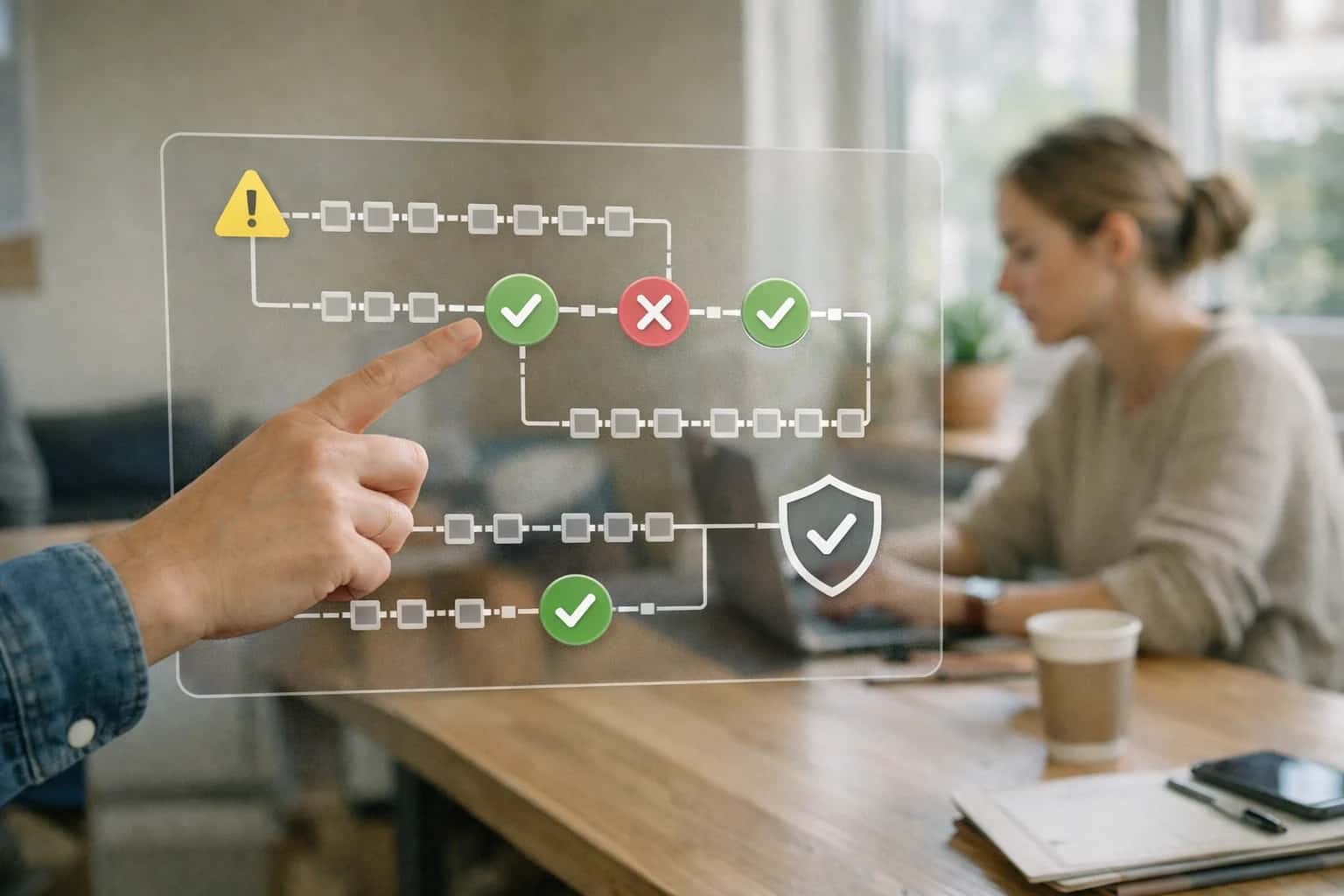
Data provenance is a critical security and governance concept for multi-agent systems, providing a verifiable historical record of data's origin, custody, and transformations.
For orchestration security, provenance acts as a core observability and compliance mechanism. It enables the detection of data poisoning attempts by logging the source of training data, supports regulatory compliance (like GDPR's right to explanation) by documenting decision-making inputs, and facilitates conflict resolution by providing agents with a shared, authoritative history. Techniques like cryptographic hashing and immutable logs are used to create provenance records that are resistant to agent manipulation or system faults.
ORCHESTRATION SECURITY
Core Components of Data Provenance
Data provenance is the verifiable record of a data object's origins, custody, and transformations. In multi-agent systems, it is a critical security control for auditing, debugging, and ensuring data integrity across autonomous workflows.
01
Data Lineage
Data lineage is the specific subset of provenance that tracks the flow and transformation of data from its source to its current state. It maps the complete journey, including:
- Source systems (e.g., databases, APIs, sensors)
- Processing agents and the operations they performed
- Intermediate data artifacts created
- Dependencies between datasets In orchestration, lineage enables impact analysis (e.g., identifying all agents affected by a corrupted source) and debugging complex data errors.
02
Provenance Metadata
Provenance metadata is the structured information attached to a data object that constitutes its provenance record. This metadata typically includes:
- Temporal data: Timestamps for creation and modification.
- Agentic data: Identity of the creating/transforming agent (e.g., agent ID, public key).
- Operational data: The specific action performed (e.g.,
filter,aggregate,enrich). - Contextual data: Input parameters, code version, or the hash of the parent data. Standards like the W3C PROV (PROVenance) Data Model (https://www.w3.org/TR/prov-overview/) provide an ontology for structuring this metadata interoperably.
03
Cryptographic Attestation
Cryptographic attestation is the mechanism that makes provenance records tamper-evident and verifiable. It involves creating a cryptographic hash (e.g., SHA-256) of the data and its provenance metadata, which is then digitally signed by the responsible agent using its private key.
- Immutable Proof: Any alteration to the data or its history changes the hash, breaking the signature.
- Non-Repudiation: The signature proves a specific agent created or transformed the data.
- Chain of Custody: Signatures can be chained, creating an auditable sequence from source to consumer.
04
Provenance Graph
A provenance graph is a directed acyclic graph (DAG) that visually and computationally represents the relationships between data entities, agents, and activities. Nodes represent:
- Entities: Data objects, files, or models.
- Agents: Software agents, users, or organizations.
- Activities: Processes or transformations.
Edges represent relationships like
wasGeneratedBy,used, orwasDerivedFrom. This graph structure is essential for complex queries, such as tracing all contributors to a final decision or identifying the root cause of anomalous data.
05
Provenance Storage & Query
Provenance storage and query refers to the specialized infrastructure for persisting and retrieving provenance records at scale. Requirements include:
- High Write Throughput: To log events from thousands of concurrent agents.
- Immutable Backend: Often implemented via immutable logs or blockchain-inspired ledgers.
- Efficient Graph Traversal: Support for graph query languages (e.g., SPARQL, Cypher) to navigate lineage.
- Long-Term Retention: For compliance with regulations like GDPR's 'right to explanation'. Systems may use a combination of time-series databases, graph databases, and content-addressable storage.
06
Policy-Based Provenance Validation
Policy-based provenance validation is the automated enforcement of security and compliance rules by inspecting provenance records. Orchestration engines can validate data before it is consumed by an agent. Example policies include:
- Source Whitelisting: "Agent X can only use data originating from approved source Y."
- Transformation Integrity: "Model training data must have been cleaned by the 'DataSanitizer' agent."
- Freshness Requirements: "Inference data must be less than 5 minutes old." This turns provenance from a passive audit trail into an active security control, enforcing the Principle of Least Privilege at the data level.
ORCHESTRATION SECURITY
How Data Provenance Works in Multi-Agent Systems
In multi-agent systems, data provenance is the critical mechanism for tracking the origin, transformations, and custody of data as it flows between autonomous agents, enabling security, auditability, and trust.
Data provenance in a multi-agent system is the cryptographically verifiable record of a data artifact's complete lineage, including its original source, every agent that processed it, and the specific operations applied. This immutable audit trail is essential for debugging complex, distributed workflows, verifying the integrity of collaborative outputs, and meeting stringent regulatory compliance requirements in enterprise environments. It transforms opaque agent interactions into a transparent, accountable process.
Effective implementation requires each autonomous agent to attest to its actions, embedding signed metadata about data receipt, processing logic, and output generation into a tamper-evident chain. This enables post-hoc analysis for root cause diagnosis during failures, provides verifiable evidence for outputs in high-stakes decisions, and supports dynamic policy enforcement by allowing the system to evaluate an agent's trustworthiness based on its historical data handling before granting access to sensitive resources.
DATA PROVENANCE
Frequently Asked Questions
Data provenance is a critical security and governance concept for multi-agent systems, providing a verifiable audit trail of data's origin, custody, and transformations. This FAQ addresses key questions for security architects and CTOs implementing robust data lineage and integrity controls.
Data provenance is the verifiable record of the origins, custody, and sequence of transformations applied to a piece of data throughout its lifecycle. In AI security, it is critical for establishing data integrity, enabling forensic auditing of model decisions, detecting data poisoning attacks, and ensuring compliance with regulations like GDPR and the EU AI Act by providing a tamper-evident lineage. Without provenance, it is impossible to trust the inputs to a multi-agent system or verify the authenticity of its outputs.
Enabling Efficiency, Speed & Accuracy
Intelligent Analysis, Decision & Execution
We build AI systems for teams that need search across company data, workflow automation across tools, or AI features inside products and internal software.
Talk to Us
Search across company data
Give teams answers from docs, tickets, runbooks, and product data with sources and permissions.
Useful when people spend too long searching or get different answers from different systems.
Enterprise searchRAGPermissions
Read more
Automate internal workflows
Use AI to route work, draft outputs, trigger actions, and keep approvals and logs in place.
Useful when repetitive work moves across multiple tools and teams.
AI agentsWorkflow automationGovernance
Read more
Add AI to products and internal tools
Build assistants, guided actions, or decision support into the software your team or customers already use.
Useful when AI needs to be part of the product, not a separate tool.
AI integrationDecision supportModel routing
Read more
About the author
Prasad Kumkar
CEO & MD, Inference Systems
Prasad Kumkar is the CEO & MD of Inference Systems and writes about AI systems architecture, LLM infrastructure, model serving, evaluation, and production deployment. Over 5+ years, he has worked across computer vision models, L5 autonomous vehicle systems, and LLM research, with a focus on taking complex AI ideas into real-world engineering systems.
His work and writing cover AI systems, large language models, AI agents, multimodal systems, autonomous systems, inference optimization, RAG, evaluation, and production AI engineering.
LinkedIn
Limited slotsGet a Free AI Consultation
Partnered with leading AI, data, and software stack.





How We Work
Custom AI workflows for your Business
One-fit-all AI don't work for modern businesses. At Inferensys, we aim to understand your business & custom requirements; which we use to define most efficient agentic workflows, the data, and the tools for your business.
01
Review the use case
We understand the task, the users, and where AI can actually help.
Read more02
Pick the right approach
We define what needs search, automation, or product integration.
Read more03
Build the first useful version
We implement the part that proves the value first.
Read more04
Improve from there
We add the checks and visibility needed to keep it useful.
Read moreThe first call is a practical review of your use case and the right next step.
Talk to Us