A Holonic Multi-Agent System is a recursive organizational structure where autonomous agents, called holons, can be members of larger super-holons and simultaneously contain smaller sub-holons. This creates a flexible hierarchy where control and coordination are distributed. Each holon maintains its autonomy while cooperating to achieve the goals of the super-holon, enabling systems to balance global coherence with local reactivity and robustness against failure.

Glossary
Holonic Multi-Agent System
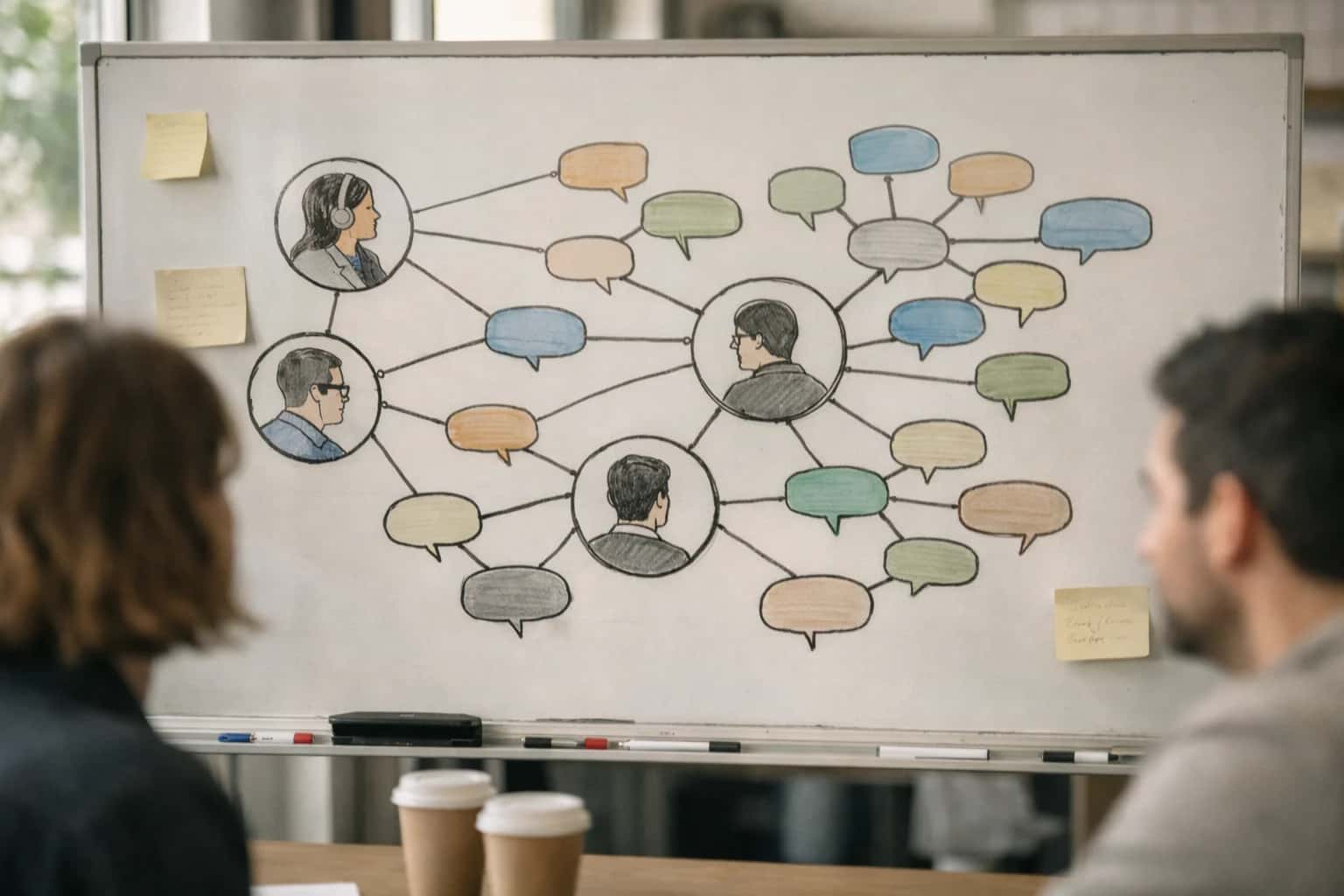
A Holonic Multi-Agent System (HMAS) is a recursive agent architecture where agents (holons) can simultaneously be part of larger super-holons and contain smaller sub-holons, enabling flexible, scalable coordination.
AGENT COORDINATION PATTERNS
What is a Holonic Multi-Agent System?
A Holonic Multi-Agent System (HMAS) is an organizational architecture for agent coordination inspired by the concept of a holarchy, where each component (a holon) is simultaneously a self-contained whole and a part of a larger system.
The architecture is fundamental for modeling complex enterprise systems like smart manufacturing or supply chains, where entities (e.g., a factory, a workstation, a robot) naturally exhibit this part-whole relationship. Key design challenges include managing recursive communication, emergent behavior from holon interactions, and dynamic holon formation and dissolution. This pattern provides a formal model for building scalable, modular, and resilient multi-agent applications.
ARCHITECTURAL PRINCIPLES
Key Characteristics of Holonic Systems
Holonic Multi-Agent Systems are defined by a set of core architectural principles derived from Arthur Koestler's concept of the 'holon.' These principles enable the construction of systems that are simultaneously robust, flexible, and scalable.
01
Recursive Self-Similarity (Holarchy)
The foundational principle where a holon (an agent) is simultaneously a whole and a part. A holon can be an autonomous entity itself (whole) while also being a component of a larger, more complex holon (part). This creates a holarchy—a hierarchy of holons—where the structure is self-similar at different scales. For example:
- A manufacturing robot (holon) is part of a production cell (super-holon).
- That production cell is part of an assembly line.
- The assembly line is part of the entire factory system. This recursion allows for modeling complex systems with manageable, modular components.
02
Autonomy & Cooperation
Each holon maintains a degree of operational autonomy, controlling its own internal functions and decision-making. However, holons are designed to cooperate with others to achieve the objectives of the super-holon they belong to. This balance is governed by a set of rules or constraints. Key aspects include:
- Local Control: A holon manages its resources and executes its plans.
- Global Objective Alignment: Through cooperation, local actions contribute to the super-holon's goal.
- Negotiation Protocols: Holons use standardized interactions (e.g., based on Contract Net Protocol) to coordinate tasks and resolve conflicts, ensuring the system is neither purely centralized nor anarchic.
03
Stability & Adaptability (Janus Effect)
Inspired by the two-faced Roman god Janus, this characteristic describes the dual nature of holonic systems. They exhibit stability because the super-holon can maintain its overall function even if a sub-holon fails or changes (the whole is resilient). Simultaneously, they possess adaptability because sub-holons can be reconfigured, replaced, or upgraded with minimal disruption to the larger system (the parts are flexible). This makes holarchies ideal for:
- Fault-tolerant systems where components can fail without catastrophic collapse.
- Evolvable systems that can be upgraded incrementally.
- Dynamic environments requiring rapid re-organization.
04
Goal-Directed Behavior & Emergence
Holons are inherently goal-directed. A sub-holon's goals are derived from and subordinate to the goals of its super-holon. This nested goal structure leads to emergent system behavior. The global behavior and intelligence of the system arise from the local interactions and cooperation of the holons, without being explicitly programmed into a central controller. This is critical for solving complex, non-linear problems. Examples include:
- A logistics holarchy where local route optimizations by vehicle holons emerge into a globally efficient delivery network.
- A smart grid where holonic control of local energy producers and consumers stabilizes the entire grid's load.
05
Standardized Interfaces & Communication
For holons to effectively cooperate within a holarchy, they require well-defined, standardized interfaces. This ensures that holons can be developed independently and still interoperate. Communication is typically based on agent communication languages (like FIPA ACL) and interaction protocols. Key interface elements include:
- Capability Advertisement: Holons publish what services they offer.
- Message Templates: Standard formats for requests, bids, inform messages, etc.
- Ontologies: Shared vocabularies to ensure semantic understanding. This standardization enables plug-and-play functionality, where holons can be dynamically added or removed from the system.
06
Applications & Industry Use Cases
The holonic paradigm is particularly suited for complex, distributed, and rapidly changing domains. Major application areas include:
- Manufacturing (Holonic Manufacturing Systems - HMS): For flexible production lines that can dynamically reconfigure to handle different product types. A machine holon, transporter holon, and order holon cooperate to fulfill a production goal.
- Supply Chain & Logistics: Holons representing warehouses, trucks, and orders coordinate to optimize routing and inventory in real-time.
- Smart Grids & Energy Management: Holons for generators, storage units, and consumers cooperate to balance load and integrate renewable sources.
- Traffic Management: Vehicle and intersection holons coordinate to optimize flow and reduce congestion.
- Healthcare Coordination: Patient, doctor, and equipment holons can coordinate for optimized treatment scheduling and resource allocation.
AGENT COORDINATION PATTERNS
How Holonic Multi-Agent Systems Work
A Holonic Multi-Agent System (HMAS) is a recursive organizational architecture for agent coordination, inspired by the concept of a holarchy from systems theory.
A Holonic Multi-Agent System is a coordination architecture where individual software agents, called holons, can recursively aggregate to form larger super-holons and simultaneously contain smaller sub-holons. This creates a flexible, hierarchical structure where each holon acts as an autonomous entity while also being an integrated component of a larger whole. The system enables complex problem-solving through the self-organization of these nested units, balancing local autonomy with global goal alignment.
The architecture operates on principles of recursive containment and dynamic reorganization. A holon communicates with its internal sub-holons and external peer or parent holons using standardized Agent Communication Languages. This structure provides inherent scalability and fault tolerance, as the failure of one holon does not necessarily collapse the entire system. HMAS is particularly suited for modeling complex, modular systems like smart grids, supply chains, and flexible manufacturing, where entities naturally form part-whole relationships.
PRACTICAL DOMAINS
Applications of Holonic Multi-Agent Systems
Holonic Multi-Agent Systems (HMAS) provide a recursive, hierarchical organizational model for complex coordination. Their unique structure—where agents (holons) are simultaneously autonomous wholes and parts of larger super-holons—makes them exceptionally suited for domains requiring flexibility, scalability, and resilience. This architecture is applied to solve intricate problems across various industries.
01
Smart Manufacturing & Industry 4.0
HMAS are foundational to software-defined manufacturing and cyber-physical production systems. In a smart factory, each physical resource (a robot, machine tool, conveyor) or logical unit (a production cell, assembly line) is modeled as a holon. These holons recursively organize into a production holarchy.
- Dynamic Scheduling: Holons representing orders, products, and resources negotiate in real-time to adapt schedules to machine failures or rush orders.
- Plug-and-Produce Integration: New machines (sub-holons) can join a production cell (super-holon) by adhering to communication protocols, enabling flexible reconfiguration.
- Resilience: If a robot holon fails, its super-holon (the work cell) can reallocate tasks to other member holons, maintaining overall production flow.
This architecture moves beyond rigid, centralized Manufacturing Execution Systems (MES) to create adaptive, resilient production networks.
02
Autonomous Fleet & Logistics Orchestration
In heterogeneous fleet orchestration, HMAS manage mixed fleets of autonomous mobile robots (AMRs), automated guided vehicles (AGVs), and human-operated equipment in warehouses, ports, and airports. Each vehicle is a holon with its own navigation and task execution capabilities.
- Hierarchical Control: Individual vehicles are sub-holons within zone controllers (e.g., a picking zone), which are sub-holons within the warehouse-wide orchestration system.
- Conflict Resolution: Holons at intersection points negotiate right-of-way using local protocols, preventing deadlocks without global intervention.
- Scalable Coordination: Adding a new delivery zone involves creating a new super-holon that integrates with the existing logistics holarchy, allowing seamless expansion.
This application demonstrates HMAS's strength in managing large-scale, real-time spatial coordination under uncertainty.
03
Smart Grid & Energy Management
Modern smart grids are decentralized networks of producers (solar farms, wind turbines), consumers, prosumers, and storage units. HMAS model these entities as holons that form dynamic virtual power plants or microgrids.
- Recursive Aggregation: A home's appliances are sub-holons of a home energy manager holon. Multiple homes form a neighborhood holon, which can participate in grid-level demand-response programs.
- Decentralized Optimization: Holons negotiate energy buy/sell contracts to balance local supply and demand, stabilizing the grid without a single point of control.
- Fault Isolation: If a transformer fails, its sub-holon network can be reconfigured by its super-holon to isolate the fault and reroute power, enhancing grid resilience.
This application highlights HMAS's capability for multi-level, market-based coordination in critical infrastructure.
04
Healthcare Process Coordination
HMAS coordinate complex, patient-centric workflows across hospitals, clinics, and labs. A patient's journey is managed by a care plan holon, which contains and coordinates sub-holons for diagnostics, treatment, and monitoring.
- Adaptive Care Pathways: The care plan holon can dynamically reconfigure its sub-holon sequence based on diagnostic results (e.g., escalating from a GP holon to a specialist holon).
- Resource Coordination: MRI machine holons, pharmacist holons, and surgeon holons negotiate schedules through their departmental super-holons to minimize patient wait times.
- Privacy-Aware Federation: Under healthcare federated learning paradigms, hospital holons can collaborate as peers in a research super-holon, sharing model updates without exposing raw patient data.
This showcases HMAS in managing highly dynamic, privacy-sensitive, and life-critical processes.
05
Supply Chain Resilience
Global supply chains are inherently distributed and prone to disruptions. HMAS model each entity—supplier, manufacturer, distributor, retailer—as an autonomous holon that is part of larger logistical holons (e.g., a regional distribution network).
- Dynamic Reconfiguration: If a port closure disrupts a shipping route, affected logistics holons can autonomously negotiate with alternative carrier and warehouse holons to reroute goods.
- Propagation of Constraints: A delay at a parts supplier holon triggers re-negotiation with its downstream manufacturer holon, which may then adjust its orders with other supplier holons, localizing the impact.
- End-to-End Visibility: Each holon maintains its local state, which can be aggregated upward through the holarchy to provide executives with a coherent, real-time view of supply chain health without a monolithic tracking system.
This application leverages HMAS for building anti-fragile, self-adapting business networks.
06
Multi-Domain Robotic Swarms
HMAS provide a structured alternative to purely emergent swarm intelligence for coordinating large numbers of robots in missions like environmental monitoring, search & rescue, or precision agriculture. Robots are holons grouped into squads (super-holons), which are part of the full mission team.
- Balanced Autonomy: Individual robot holons handle low-level perception and obstacle avoidance, while squad-level super-holons execute area coverage patterns, and the mission-level holon oversees goal achievement.
- Graceful Degradation: The loss of a scout robot holon leads its squad super-holon to reassign the scouting role, while the mission holon may adjust the overall search pattern based on reduced capacity.
- Heterogeneous Integration: Different robot types (aerial, ground, aquatic) can form cross-domain super-holons for specific sub-tasks, leveraging their complementary capabilities through the holonic interface.
This demonstrates how HMAS inject hierarchical organization into swarm-based systems for more predictable, mission-critical coordination.
HOLONIC MULTI-AGENT SYSTEM
Frequently Asked Questions
A Holonic Multi-Agent System (HMAS) is a recursive organizational model for agent coordination, inspired by the concept of holarchy. These FAQs address its core principles, architectural benefits, and practical applications in enterprise systems.
A Holonic Multi-Agent System is a multi-agent system architecture where each agent, called a holon, is simultaneously a self-contained, autonomous whole and a constituent part of a larger super-holon, forming a recursive hierarchy known as a holarchy. This structure enables agents to dynamically form groups to solve complex problems, where a super-holon coordinates its member sub-holons while presenting a unified interface to the outside world. The term originates from Arthur Koestler's concept of a holon, which captures the dual nature of being both a part and a whole. In software engineering, this model provides a powerful abstraction for building scalable, flexible, and resilient systems where coordination can occur at multiple levels of granularity.
Enabling Efficiency, Speed & Accuracy
Intelligent Analysis, Decision & Execution
We build AI systems for teams that need search across company data, workflow automation across tools, or AI features inside products and internal software.
Talk to Us
Search across company data
Give teams answers from docs, tickets, runbooks, and product data with sources and permissions.
Useful when people spend too long searching or get different answers from different systems.
Enterprise searchRAGPermissions
Read more
Automate internal workflows
Use AI to route work, draft outputs, trigger actions, and keep approvals and logs in place.
Useful when repetitive work moves across multiple tools and teams.
AI agentsWorkflow automationGovernance
Read more
Add AI to products and internal tools
Build assistants, guided actions, or decision support into the software your team or customers already use.
Useful when AI needs to be part of the product, not a separate tool.
AI integrationDecision supportModel routing
Read more
About the author
Prasad Kumkar
CEO & MD, Inference Systems
Prasad Kumkar is the CEO & MD of Inference Systems and writes about AI systems architecture, LLM infrastructure, model serving, evaluation, and production deployment. Over 5+ years, he has worked across computer vision models, L5 autonomous vehicle systems, and LLM research, with a focus on taking complex AI ideas into real-world engineering systems.
His work and writing cover AI systems, large language models, AI agents, multimodal systems, autonomous systems, inference optimization, RAG, evaluation, and production AI engineering.
LinkedIn
Limited slotsGet a Free AI Consultation
Partnered with leading AI, data, and software stack.





How We Work
Custom AI workflows for your Business
One-fit-all AI don't work for modern businesses. At Inferensys, we aim to understand your business & custom requirements; which we use to define most efficient agentic workflows, the data, and the tools for your business.
01
Review the use case
We understand the task, the users, and where AI can actually help.
Read more02
Pick the right approach
We define what needs search, automation, or product integration.
Read more03
Build the first useful version
We implement the part that proves the value first.
Read more04
Improve from there
We add the checks and visibility needed to keep it useful.
Read moreThe first call is a practical review of your use case and the right next step.
Talk to Us