An Electronic Institution is a formal, computational framework that defines the norms, rules, and structured interaction spaces governing the behavior of autonomous agents to ensure orderly, predictable, and goal-directed societal interactions. It provides a virtual environment with explicit conventions, protocols, and sanctions, analogous to physical institutions like markets or courts, which agents must adhere to when communicating, trading, or collaborating. This framework creates a predictable ecosystem where heterogeneous agents, potentially with competing goals, can interact reliably.

Glossary
Electronic Institutions
Electronic Institutions are computational frameworks that define norms, rules, and structured interaction spaces to govern autonomous agent behavior for orderly societal interactions.
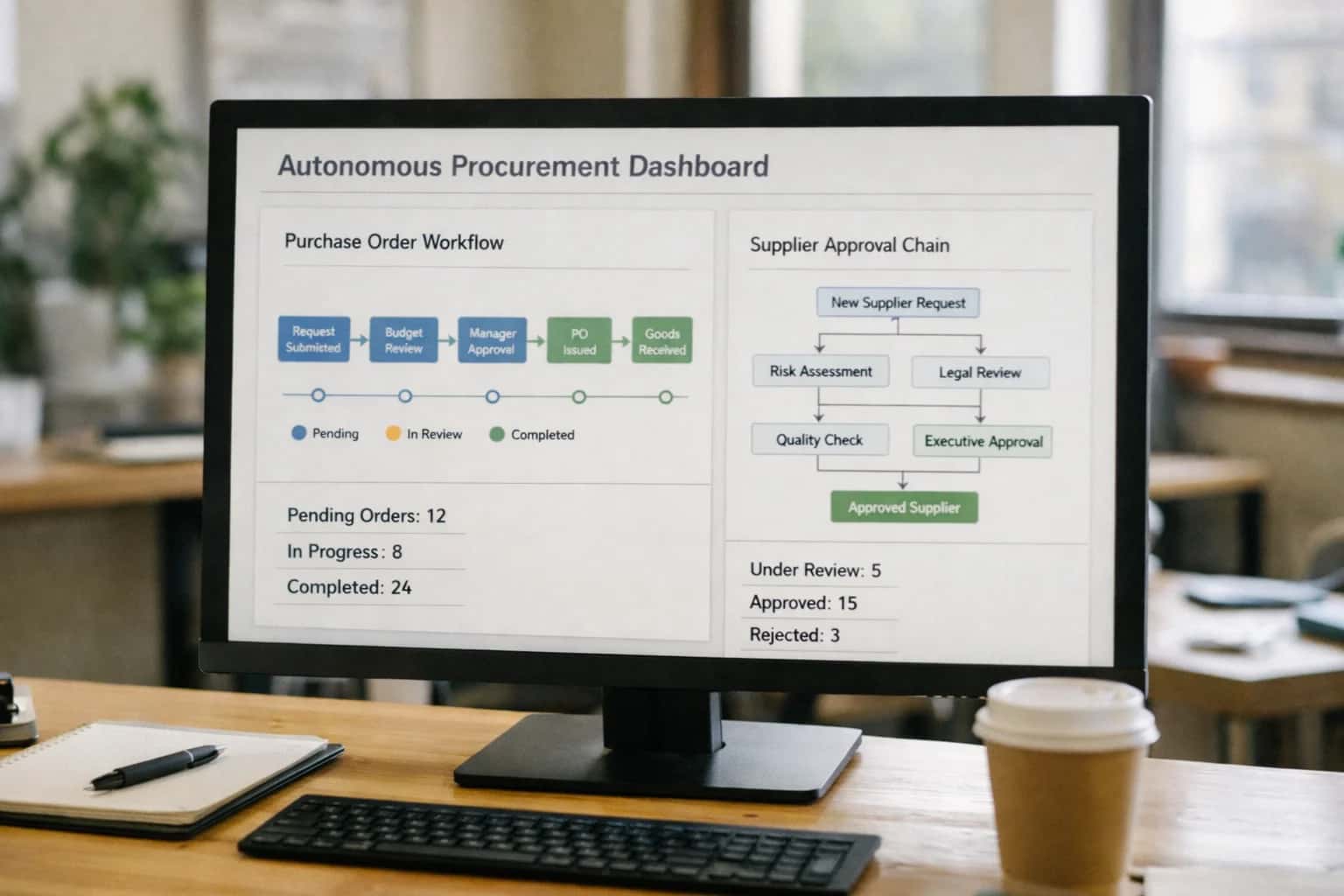
AGENT COORDINATION PATTERN
What is Electronic Institutions?
Electronic Institutions are computational frameworks that define the norms, rules, and structured interaction spaces governing the behavior of autonomous agents to ensure orderly and goal-directed societal interactions.
The architecture typically models the institution as a collection of scenes (virtual rooms for specific interactions, like a bidding floor) and transitions between them, forming a performative structure that agents navigate. Normative rules are enforced by institutional agents, such as governors or monitors, which verify compliance and manage sanctions. This approach is foundational for building trustworthy, scalable multi-agent systems in domains like supply chain automation, financial trading, and smart grids, where structured, rule-based interaction is non-negotiable.
ELECTRONIC INSTITUTIONS
Core Architectural Components
Electronic Institutions are computational frameworks that define the norms, rules, and structured interaction spaces governing autonomous agents to ensure orderly and goal-directed societal interactions. Their architecture is built from specific, formal components that create a predictable environment for agent coordination.
01
Normative Framework
The normative framework is the rule system that defines the permissions, obligations, and prohibitions for agents within the institution. It encodes the social laws and deontic constraints (what agents may, must, or must not do) that govern acceptable behavior.
- Constitutive Rules: Define the institutional facts and the meaning of actions within the context of the institution (e.g., 'submitting a bid counts as making an offer').
- Regulative Rules: Directly constrain agent behavior to maintain order (e.g., 'an agent must pay within 24 hours of winning an auction').
- Sanctioning Mechanisms: Specify the consequences for norm violations, which can range from fines to expulsion from the institution.
02
Scene & Workflow Protocols
Scenes are the fundamental interaction spaces within an electronic institution, analogous to rooms in a building. Each scene has a specific purpose and a well-defined interaction protocol that dictates the possible sequences of speech acts between roles.
- Finite-State Representation: A scene's protocol is often formally specified as a finite-state machine or a Petri net, outlining all legal dialogue states and transitions.
- Role Participation: Agents enter a scene by taking on a specific role (e.g., Auctioneer, Bidder, Mediator) which defines their permissible actions.
- Workflow Composition: Complex institution-wide activities are created by linking multiple scenes together via transitions, forming a global workflow that agents navigate to achieve their goals.
03
Performative Structure
The performative structure is the formal specification of the institution's overall connectivity and agent mobility. It defines the network of scenes and the allowed paths agents can take between them, creating the macroscopic framework for institutional processes.
- Graph-Based Model: Typically modeled as a directed graph where nodes are scenes and edges are possible role-based transitions.
- Concurrency & Choice: The structure defines where agents can be in multiple scenes simultaneously and where they must choose between alternative paths.
- Orchestration Layer: This component acts as the institution's 'floor plan,' ensuring agents move through the correct sequence of interactions to complete complex tasks like a supply chain negotiation or a multi-stage tender process.
04
Dialogical Framework
The dialogical framework establishes the common language and semantics for all communication within the institution. It ensures that messages between heterogeneous agents are unambiguous and interpretable, based on formal speech act theory.
- Agent Communication Language (ACL): Defines the syntax and performatives (e.g.,
cfp(call-for-proposals),propose,accept,reject) for messages. - Ontology: Provides a shared vocabulary and meaning for the concepts discussed within the institution (e.g., defining 'Price,' 'DeliveryDate,' 'QualityTier').
- Content Language: Specifies the format (e.g., SL, KIF, XML) for expressing the actual content of a message, such as the details of a bid or a service description.
05
Governance Agents
Governance agents are specialized, trusted agents that embody the institution's authority. They are responsible for enforcing norms, managing scenes, and ensuring the integrity of the interaction processes.
- Governor Agent: Often acts as a 'gatekeeper' for a scene, verifying an agent's credentials and role eligibility before permitting entry, and monitoring compliance with the scene's protocol.
- Arbiter Agent: Resolves disputes between participants by interpreting the normative framework, potentially applying sanctions.
- Notary Agent: Provides trusted third-party services like timestamping transactions or certifying the outcome of an interaction, creating a verifiable audit trail.
06
Institutional Facts & State
Institutional facts are elements of reality that exist only by collective agreement within the institution, such as 'ownership,' 'a contract,' or 'the winning bid.' The institutional state is the dynamic, shared representation of all such facts at a given time.
- Shared Memory: Often implemented as a tuple space or a specialized database that agents can query to understand the current institutional context.
- State Transition Rules: Define how agent actions (speech acts) update the institutional facts (e.g., an
acceptmessage changes a contract's state from 'offered' to 'active'). - Common Ground: This component is critical for coordination, as it provides all participants with a consistent, authoritative view of what has been declared, committed, and accomplished within the institution.
AGENT COORDINATION PATTERNS
How Electronic Institutions Function
Electronic Institutions are computational frameworks that define the norms, rules, and structured interaction spaces governing autonomous agents to ensure orderly societal interactions.
An Electronic Institution functions by establishing a formal, machine-readable specification of the norms, roles, and protocols that govern agent interactions within a defined virtual society. It creates structured interaction spaces, often conceptualized as virtual rooms or scenes, where agents can enter, perform specific communicative acts, and transition based on institutional rules. This framework ensures that the autonomous, and potentially self-interested, behaviors of heterogeneous agents result in predictable, goal-directed societal outcomes without requiring centralized, moment-to-moment control.
The core operational mechanism involves a normative layer that defines permissions, obligations, and prohibitions, which are enforced through monitoring and sanctioning subsystems. Agents interact via a standardized Agent Communication Language (ACL) within dialogical frameworks or interaction protocols, such as auctions or negotiations. By providing this scaffolded environment, Electronic Institutions enable open multi-agent systems, where agents designed by different parties can interoperate reliably, facilitating complex coordination patterns like coalition formation and distributed problem-solving within a governed digital ecosystem.
ELECTRONIC INSTITUTIONS
Frequently Asked Questions
Electronic Institutions are formal computational frameworks that govern multi-agent societies. They provide the 'rules of the game'—norms, protocols, and structured interaction spaces—to ensure orderly, predictable, and goal-directed collaboration between autonomous agents.
An Electronic Institution is a computational framework that defines the norms, rules, and structured interaction spaces governing the behavior of autonomous agents to ensure orderly and goal-directed societal interactions. It functions as a virtual regulatory environment, analogous to a physical institution like a stock exchange or courtroom, but for software agents.
It works by providing three core components:
- Interaction Protocols: Formal specifications (e.g., as finite state machines) that dictate the permissible sequences of communicative acts (speech acts) between agents.
- Normative Rules: Deontic constraints (obligations, permissions, prohibitions) that define acceptable behavior and the consequences for violations.
- Structured Environments: A topology of virtual scenes or rooms (e.g., a registration room, a trading floor, a contract room) where specific types of interactions occur. Agents move between scenes by fulfilling institutional roles and following defined transition rules.
For example, in an electronic auction institution, agents must first enter a 'registration' scene to acquire a bidder role, then move to the 'auction floor' scene where they can only utter bids according to a defined protocol, and finally to a 'settlement' scene to fulfill payment obligations.
Enabling Efficiency, Speed & Accuracy
Intelligent Analysis, Decision & Execution
We build AI systems for teams that need search across company data, workflow automation across tools, or AI features inside products and internal software.
Talk to Us
Search across company data
Give teams answers from docs, tickets, runbooks, and product data with sources and permissions.
Useful when people spend too long searching or get different answers from different systems.
Enterprise searchRAGPermissions
Read more
Automate internal workflows
Use AI to route work, draft outputs, trigger actions, and keep approvals and logs in place.
Useful when repetitive work moves across multiple tools and teams.
AI agentsWorkflow automationGovernance
Read more
Add AI to products and internal tools
Build assistants, guided actions, or decision support into the software your team or customers already use.
Useful when AI needs to be part of the product, not a separate tool.
AI integrationDecision supportModel routing
Read more
About the author
Prasad Kumkar
CEO & MD, Inference Systems
Prasad Kumkar is the CEO & MD of Inference Systems and writes about AI systems architecture, LLM infrastructure, model serving, evaluation, and production deployment. Over 5+ years, he has worked across computer vision models, L5 autonomous vehicle systems, and LLM research, with a focus on taking complex AI ideas into real-world engineering systems.
His work and writing cover AI systems, large language models, AI agents, multimodal systems, autonomous systems, inference optimization, RAG, evaluation, and production AI engineering.
LinkedIn
Limited slotsGet a Free AI Consultation
Partnered with leading AI, data, and software stack.





How We Work
Custom AI workflows for your Business
One-fit-all AI don't work for modern businesses. At Inferensys, we aim to understand your business & custom requirements; which we use to define most efficient agentic workflows, the data, and the tools for your business.
01
Review the use case
We understand the task, the users, and where AI can actually help.
Read more02
Pick the right approach
We define what needs search, automation, or product integration.
Read more03
Build the first useful version
We implement the part that proves the value first.
Read more04
Improve from there
We add the checks and visibility needed to keep it useful.
Read moreThe first call is a practical review of your use case and the right next step.
Talk to Us