TensorFlow Lite is a lightweight, cross-platform inference engine developed by Google for executing trained machine learning models on resource-constrained devices. It consists of a compact interpreter and a suite of tools for model conversion and optimization, such as quantization and pruning. The framework provides hardware acceleration APIs to leverage on-device Neural Processing Units (NPUs) and GPUs, enabling low-latency, privacy-preserving inference without a constant cloud connection.

Glossary
TensorFlow Lite
TensorFlow Lite is an open-source deep learning framework developed by Google for deploying machine learning models on mobile, embedded, and edge devices, providing a lightweight interpreter and hardware acceleration APIs.
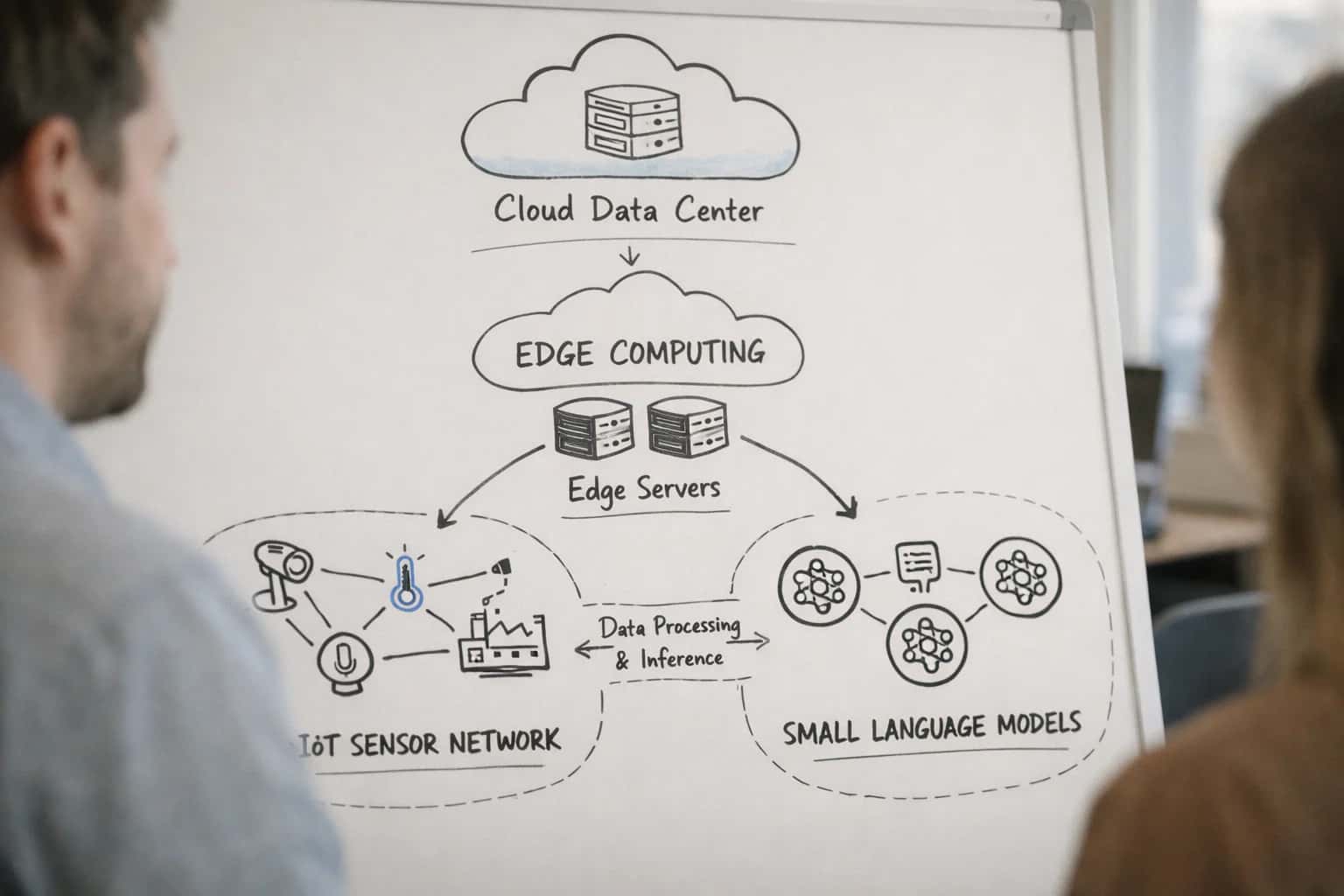
ON-DEVICE AND EDGE INFERENCE
What is TensorFlow Lite?
TensorFlow Lite is an open-source deep learning framework for deploying models on mobile, embedded, and edge devices.
The workflow involves converting a standard TensorFlow or Keras model into the efficient .tflite format using the TensorFlow Lite Converter. This format is optimized for size and speed, making it suitable for Android, iOS, Linux-based microcontrollers, and other edge environments. TensorFlow Lite is a cornerstone of on-device AI, powering applications from mobile camera features to industrial IoT predictive maintenance, by balancing performance with the severe memory and power constraints of edge hardware.
ON-DEVICE AND EDGE INFERENCE
Key Features of TensorFlow Lite
TensorFlow Lite is an open-source framework for deploying machine learning models on mobile, embedded, and IoT devices. Its architecture is designed to address the core constraints of edge environments: limited memory, compute, power, and connectivity.
01
Lightweight Interpreter
The core of TensorFlow Lite is a highly optimized interpreter designed for minimal binary size and fast startup on resource-constrained devices. It loads models from the FlatBuffer format—a serialization protocol chosen for its efficiency—which allows for direct memory mapping without an expensive parsing step. This design enables:
- Low memory footprint: The interpreter core adds minimal overhead to the model itself.
- Fast initialization: Models can be loaded and made ready for inference with minimal latency.
- Cross-platform support: A single, consistent API across Android, iOS, Linux-based embedded systems, and microcontrollers.
02
Hardware Acceleration Delegates
To leverage specialized silicon, TensorFlow Lite uses a delegate system. Delegates are modular components that hand off compute-intensive portions of a model to dedicated hardware accelerators like NPUs (Neural Processing Units), GPUs, or DSPs (Digital Signal Processors). This is critical for achieving real-time performance and energy efficiency.
- GPU Delegate: Optimizes for parallelizable operations (e.g., convolutions) on mobile GPUs.
- NNAPI Delegate (Android): Provides a unified interface to all available accelerators (NPU, GPU, DSP) via Android's Neural Networks API.
- Hexagon Delegate: Targets Qualcomm Hexagon DSPs for power-efficient inference.
- Core ML Delegate (iOS): Utilizes Apple's Core ML framework for optimal performance on Apple Silicon.
- XNNPACK Delegate: A highly optimized CPU delegate for floating-point and quantized models, using advanced kernel libraries.
03
Model Optimization Toolkit
TensorFlow Lite is tightly integrated with a suite of post-training and training-time optimization techniques to shrink models and accelerate inference without proportional accuracy loss. These are essential for fitting models into the tight memory budgets of edge devices.
- Quantization: Reduces the numerical precision of weights and activations. Post-training quantization (PTQ) converts a trained FP32 model to INT8, typically reducing size by 75% and speeding up inference. Quantization-aware training (QAT) simulates quantization during training for higher accuracy.
- Pruning: Systematically removes less important weights from a model, creating a sparse network that can be compressed.
- Weight Clustering: Groups similar weights together, sharing a single value, to enable more efficient compression. These optimizations often work in combination, and the TensorFlow Model Optimization Toolkit provides the APIs to apply them.
04
Microcontroller Support (TFLite Micro)
TensorFlow Lite for Microcontrollers is a variant designed to run on bare-metal microcontroller units (MCUs) with only kilobytes of memory. It strips away dynamic memory allocation and standard C/C++ libraries for maximum portability.
- Kernel-Only Library: Developers include only the operators needed for their specific model, minimizing binary size.
- No Operating System Required: Runs directly on RTOS (Real-Time Operating Systems) or in a simple super-loop.
- Targets Ultra-Low Power: Enables always-on ML applications like keyword spotting or anomaly detection on sensors, running for months on a coin-cell battery. It supports a subset of operators and is a foundational technology for the TinyML ecosystem.
05
On-Device Training (Experimental)
While primarily an inference engine, TensorFlow Lite includes experimental support for on-device fine-tuning and federated learning tasks. This allows models to adapt to new data or user behavior locally, enhancing personalization and privacy.
- Fine-Tuning: A pre-deployed model can be updated with new, locally generated data (e.g., improving a photo style model based on a user's preferences).
- Federated Learning Client: The framework can act as the client-side component in a federated learning pipeline, computing gradient updates on local data and sending only the encrypted updates to a central server for aggregation. This feature moves the edge device from a passive inference node to an active participant in the model lifecycle, crucial for applications requiring data privacy or continuous adaptation.
06
Cross-Platform Tooling & Conversion
TensorFlow Lite provides a comprehensive toolchain to transition models from training to deployment. The TensorFlow Lite Converter is the central tool that transforms a TensorFlow model (SavedModel, Keras, Concrete Functions) into the optimized .tflite format, applying optimizations during the conversion process.
- Selective Operator Registration: The converter can warn about or exclude operators not supported by the target runtime (e.g., TFLite Micro).
- Metadata Integration: Allows embedding labels, normalization parameters, and other metadata directly into the model file, simplifying the integration code on the device.
- Benchmarking Tools: The
benchmark_modeltool profiles model performance (latency, memory) on a target device, and the Android/iOS benchmark apps provide real-world measurement. - Code Generation: For microcontrollers, a utility can generate a C source file containing the model as a byte array, ready for compilation.
ON-DEVICE AND EDGE INFERENCE
How TensorFlow Lite Works
TensorFlow Lite is an open-source framework for deploying machine learning models on mobile, embedded, and IoT devices, enabling low-latency, private, and offline-capable inference.
TensorFlow Lite is a lightweight inference engine that converts standard TensorFlow or Keras models into an efficient, flat buffer format (.tflite) for deployment. Its core is an interpreter that executes these models using a set of optimized kernels, which can leverage device-specific hardware accelerators like NPUs, GPUs, or the Android Neural Networks API (NNAPI) via delegates. This architecture prioritizes minimal binary size, low memory usage, and fast startup to run on resource-constrained hardware.
The workflow involves model conversion with the TensorFlow Lite Converter, which applies optimizations like post-training quantization and pruning. Developers then integrate the interpreter into their mobile or embedded application, handling tasks like input preprocessing and output parsing. For advanced use cases, the framework supports selective operator registration, custom operations, and on-device training via TensorFlow Lite Micro for microcontroller deployment, ensuring flexibility across the edge computing spectrum from phones to microcontrollers.
ON-DEVICE & EDGE INFERENCE
TensorFlow Lite Use Cases
TensorFlow Lite enables efficient machine learning on resource-constrained devices. Its primary use cases span mobile applications, IoT, microcontrollers, and specialized hardware, focusing on low latency, privacy, and offline operation.
FEATURE COMPARISON
TensorFlow Lite vs. Other Edge Frameworks
A technical comparison of key features and deployment characteristics for major frameworks used to run machine learning models on mobile, embedded, and edge devices.
| Feature / Metric | TensorFlow Lite | PyTorch Mobile | ONNX Runtime |
|---|---|---|---|
Primary Developer | Meta (PyTorch) | Microsoft | |
Core Model Format | .tflite (FlatBuffer) | TorchScript / Mobile-optimized .pt | .onnx (Open Neural Network Exchange) |
Runtime Interpreter | TFLite Interpreter (C++) | LibTorch (C++) | ONNX Runtime (C++, C) |
Hardware Acceleration Delegates | NNAPI, GPU, Hexagon, XNNPACK, Core ML | Metal (iOS), Vulkan (Android) | Execution Providers: NNAPI, Core ML, CUDA, TensorRT, OpenVINO |
Quantization Support | Post-Training (PTQ) & Quantization-Aware Training (QAT) for INT8, FP16 | Dynamic Quantization, QAT for INT8 | Static & Dynamic Quantization for INT8, QLinearOps |
Model Optimization Toolkit | TFLite Converter (pruning, clustering, quantization) | Torch.quantization, Mobile Optimizer | ONNX Runtime Quantization Tools |
Cross-Platform Support | Android, iOS, Linux, Microcontrollers | Android, iOS, Linux | Windows, Linux, Android, iOS, WebAssembly |
Microcontroller (MCU) Target | Yes (TensorFlow Lite for Microcontrollers) | No (Requires full OS) | No (Requires full OS) |
Model Size Overhead | < 100 KB (interpreter only) | ~3-4 MB (LibTorch core) | ~10-15 MB (full runtime) |
Language Bindings (Primary) | Java, C++, Python, Swift | Java (Android), Objective-C (iOS), C++ | C, C++, C#, Java, Python, JavaScript |
Benchmark Suite | TFLite Benchmark Tool | PyTorch Mobile Benchmark App | ONNX Runtime Performance Tool |
Commercial Use License | Apache 2.0 | BSD-3 | MIT License |
TENSORFLOW LITE
Frequently Asked Questions
TensorFlow Lite is Google's open-source framework for deploying machine learning models on mobile, embedded, and edge devices. This FAQ addresses common technical questions from developers and engineers implementing on-device inference.
TensorFlow Lite is an open-source deep learning framework for deploying models on resource-constrained devices like smartphones, microcontrollers, and IoT sensors. It works by converting a standard TensorFlow model into a compact .tflite format using the TensorFlow Lite Converter, which applies optimizations like quantization and pruning. The core component is the TensorFlow Lite Interpreter, a lightweight runtime written in C++ that loads the .tflite file and executes it efficiently on the target hardware, optionally leveraging hardware acceleration APIs like Android Neural Networks API (NNAPI) or GPU delegates. This architecture enables on-device inference, processing data locally without a constant cloud connection, which reduces latency, preserves bandwidth, and enhances user privacy.
Enabling Efficiency, Speed & Accuracy
Intelligent Analysis, Decision & Execution
We build AI systems for teams that need search across company data, workflow automation across tools, or AI features inside products and internal software.
Talk to Us
Search across company data
Give teams answers from docs, tickets, runbooks, and product data with sources and permissions.
Useful when people spend too long searching or get different answers from different systems.
Enterprise searchRAGPermissions
Read more
Automate internal workflows
Use AI to route work, draft outputs, trigger actions, and keep approvals and logs in place.
Useful when repetitive work moves across multiple tools and teams.
AI agentsWorkflow automationGovernance
Read more
Add AI to products and internal tools
Build assistants, guided actions, or decision support into the software your team or customers already use.
Useful when AI needs to be part of the product, not a separate tool.
AI integrationDecision supportModel routing
Read more
About the author
Prasad Kumkar
CEO & MD, Inference Systems
Prasad Kumkar is the CEO & MD of Inference Systems and writes about AI systems architecture, LLM infrastructure, model serving, evaluation, and production deployment. Over 5+ years, he has worked across computer vision models, L5 autonomous vehicle systems, and LLM research, with a focus on taking complex AI ideas into real-world engineering systems.
His work and writing cover AI systems, large language models, AI agents, multimodal systems, autonomous systems, inference optimization, RAG, evaluation, and production AI engineering.
LinkedIn
Limited slotsGet a Free AI Consultation
Partnered with leading AI, data, and software stack.





How We Work
Custom AI workflows for your Business
One-fit-all AI don't work for modern businesses. At Inferensys, we aim to understand your business & custom requirements; which we use to define most efficient agentic workflows, the data, and the tools for your business.
01
Review the use case
We understand the task, the users, and where AI can actually help.
Read more02
Pick the right approach
We define what needs search, automation, or product integration.
Read more03
Build the first useful version
We implement the part that proves the value first.
Read more04
Improve from there
We add the checks and visibility needed to keep it useful.
Read moreThe first call is a practical review of your use case and the right next step.
Talk to Us