Knowledge distillation is a model compression technique where a smaller, more efficient student model is trained to mimic the behavior of a larger, more accurate teacher model. The student learns not just from the original training data's hard labels, but primarily from the teacher's softened output probabilities, known as the soft target distribution. This distribution contains richer information about class similarities, enabling the student to achieve higher accuracy than if trained on the data alone.

Glossary
Knowledge Distillation
Knowledge distillation is a model compression technique where a smaller, efficient student model is trained to replicate the predictions or internal representations of a larger, more accurate teacher model.
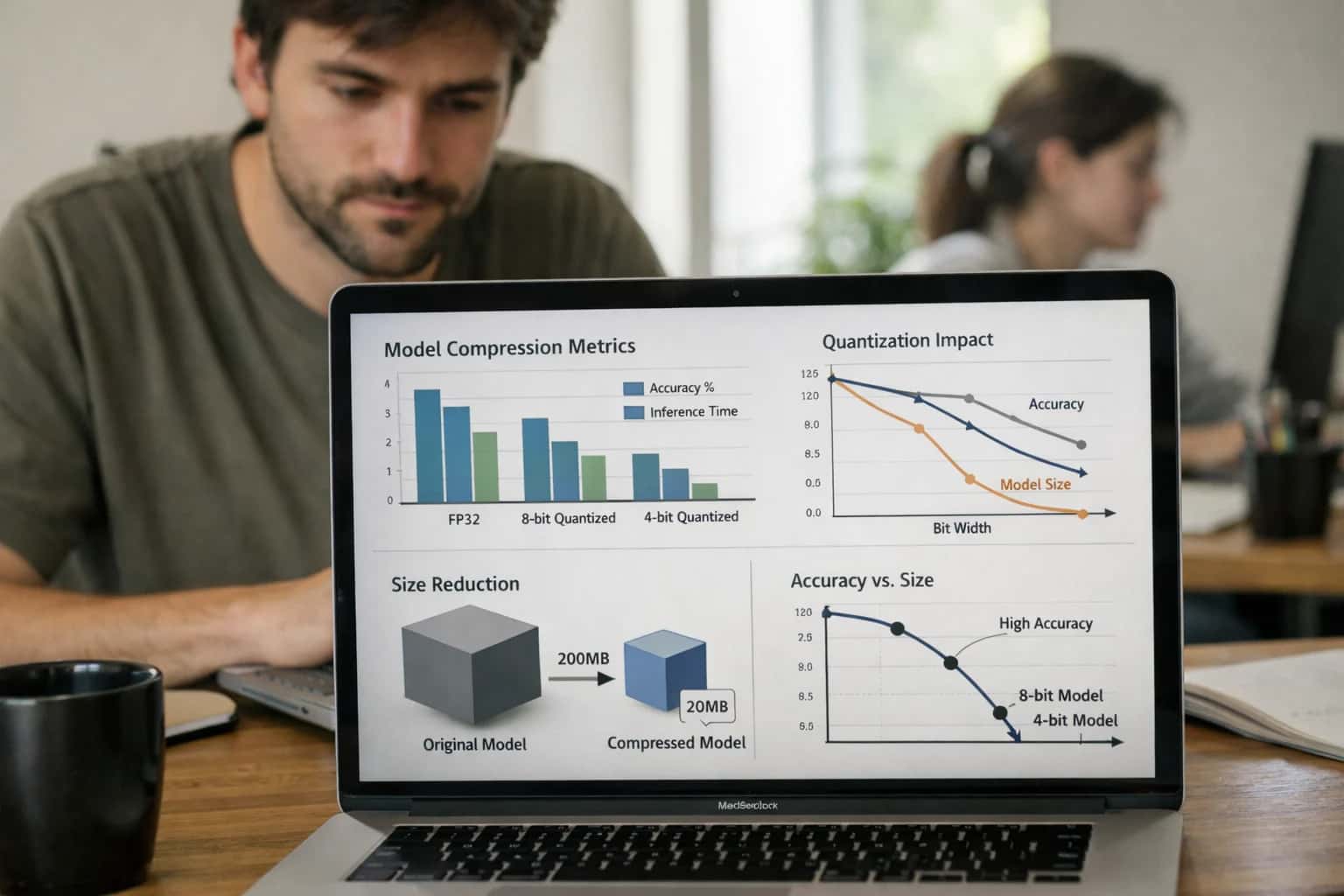
MODEL COMPRESSION
What is Knowledge Distillation?
A technique for creating smaller, faster models by transferring knowledge from a larger, more accurate model.
The process is central to on-device and edge inference, where deploying large models is infeasible due to memory, compute, and latency constraints. By distilling knowledge into a compact student, performance is preserved while enabling deployment on resource-constrained hardware like phones and IoT devices. The technique is often combined with other optimization methods like quantization and pruning to create highly efficient production models.
KNOWLEDGE DISTILLATION
Key Variants and Techniques
Knowledge distillation is not a monolithic technique. It encompasses a family of methods for transferring knowledge, each with distinct mechanisms and optimization targets for the student model.
01
Response Distillation
The foundational and most common form of knowledge distillation. The student model is trained to mimic the final output probabilities (logits) of the teacher model, not just the hard class labels.
- Soft Targets: Instead of a one-hot encoded label (e.g.,
[0, 0, 1, 0]), the student learns from the teacher's softened probability distribution (e.g.,[0.01, 0.04, 0.90, 0.05]) using a high temperature parameter in the softmax function. - Loss Function: Combines a standard cross-entropy loss with the ground truth (hard labels) and a distillation loss (e.g., Kullback-Leibler divergence) that measures the difference between the student's and teacher's softened outputs.
- Primary Goal: Teaches the student the relative relationships between classes as perceived by the more nuanced teacher.
02
Feature Distillation
Also known as hint-based training or intermediate representation distillation. This technique transfers knowledge from the teacher's internal feature maps or activations, not just its final predictions.
- Mechanism: A projection layer (or 'hint' and 'guide' layers) is added to align the dimensions of the student's and teacher's intermediate feature tensors. The student is trained to minimize the difference (e.g., using Mean Squared Error) between its transformed features and the teacher's.
- Rationale: The teacher's internal representations contain rich, structured information about the data that is lost by the final classification layer. Mimicking these features can lead to faster convergence and better generalization in the student.
- Common Use: Particularly effective for compressing convolutional neural networks (CNNs) in computer vision, where features from middle layers are highly informative.
03
Attention Distillation
A specialized technique for Transformer-based models (e.g., BERT, GPT). It transfers the attention patterns learned by the teacher model, which encode how the model focuses on different parts of the input sequence.
- Process: The student's multi-head attention matrices are trained to match the teacher's corresponding attention matrices. This can be done by minimizing the Mean Squared Error or a divergence measure between the attention distributions.
- Benefit: Attention maps capture linguistic relationships and dependencies. By mimicking them, the student learns a similar structural understanding of language, which is crucial for tasks like translation, summarization, and question answering.
- Variants: Can be applied to both self-attention and cross-attention mechanisms in encoder-decoder architectures.
04
Self-Distillation
A variant where the teacher and student are the same model architecture, or where a model distills knowledge into itself. This paradox can improve a model's own performance or create a more efficient version.
- Same-Architecture Self-Distillation: A model is trained normally, then used as a teacher to train another instance of the same architecture from scratch. This iterative process can often boost the final student's accuracy.
- Progressive Self-Distillation: A single model is trained, and its knowledge at earlier training checkpoints is used to guide its own later training via a distillation loss, acting as a form of regularization.
- Primary Advantage: Does not require a separate, larger teacher model. It leverages the idea that a model's own predictions contain richer information than one-hot labels.
05
Online Distillation
A dynamic, single-stage training process where the teacher and student models are co-trained simultaneously, rather than using a fixed, pre-trained teacher.
- Mechanism: An ensemble of models (the 'peers') are trained in parallel. The knowledge distilled into any one student model is an aggregate of the outputs from all other models in the ensemble at that training step.
- Benefits:
- Eliminates the need for a costly, two-stage training pipeline.
- The teaching signal evolves and improves alongside the student models.
- Can be more efficient and lead to better final performance than offline distillation with a static teacher.
- Common Framework: Deep Mutual Learning is a prominent example, where a cohort of models teach each other throughout training.
06
Data-Free Distillation
An advanced technique where the student model is trained without access to the original training data, using only the pre-trained teacher model. This is critical for privacy-sensitive or proprietary data scenarios.
- Core Challenge: Generating synthetic data that elicits a useful teaching signal from the teacher.
- Methods:
- Generator-Based: A generative model (e.g., a GAN) is trained to produce inputs that maximize the disagreement or information gain from the teacher, which are then used to train the student.
- Optimization-Based: Synthetic data samples are directly optimized via gradient ascent to match statistics (e.g., batch normalization layer statistics) of the teacher's activations recorded during its original training.
- Use Case: Essential for compressing models where the training data is no longer available or cannot be shared due to regulations like GDPR.
COMPARISON
Knowledge Distillation vs. Other Compression Techniques
A feature comparison of Knowledge Distillation against other primary methods for reducing model size and computational cost for on-device and edge inference.
| Feature / Metric | Knowledge Distillation | Quantization | Pruning | Neural Architecture Search (NAS) |
|---|---|---|---|---|
Primary Mechanism | Mimics teacher model's output/logits | Reduces numerical precision of weights/activations | Removes redundant model parameters (weights) | Automated search for optimal model structure |
Typical Size Reduction | 2x - 10x (via smaller student arch.) | 4x (FP32 -> INT8) | 2x - 10x (sparse model) | Defined by search constraints (e.g., FLOPs) |
Accuracy Preservation | High (learns softened teacher distribution) | Moderate-High (with QAT) | Moderate (requires fine-tuning) | High (accuracy is a direct search objective) |
Retraining Required | Yes (train student from scratch) | Optional (PTQ) / Yes (QAT) | Yes (iterative pruning & fine-tuning) | Yes (training final discovered architecture) |
Inference Speedup | Moderate (smaller, faster model) | High (low-precision arithmetic) | Moderate (sparsity requires specialized hardware) | High (architecture is hardware-optimized) |
Hardware Support | Universal (standard ops) | Requires INT8/FP16 support | Requires sparse kernel support | Hardware-aware search targets specific silicon |
Compounds With Other Techniques | ||||
Typical Use Case | Creating compact, general-purpose models | Maximizing throughput on supported accelerators | Maximizing compression for storage/transmission | Designing optimal models for a specific chip |
KNOWLEDGE DISTILLATION
Frequently Asked Questions
Knowledge distillation is a core technique for model compression, enabling the transfer of capabilities from a large, complex model to a smaller, more efficient one. This FAQ addresses common technical questions about its mechanisms, applications, and relationship to other optimization methods.
Knowledge distillation is a model compression technique where a smaller, more efficient student model is trained to mimic the predictions or internal representations of a larger, more accurate teacher model. The process works by using the teacher's output logits (pre-softmax activations) or intermediate feature maps as a 'soft target' training signal for the student, in addition to or instead of the standard hard labels from the original dataset. A temperature parameter (T) is applied to the teacher's softmax output, creating a smoother probability distribution that contains richer relational information (e.g., 'a cat is more like a dog than a truck'), which the student learns to match. This transfer of 'dark knowledge' often allows the student to achieve higher accuracy than if it were trained on the hard labels alone.
Key Steps:
- Train or select a high-performance teacher model.
- Generate soft targets by running the teacher on a (often unlabeled) transfer dataset.
- Train the student model using a combined loss function: Distillation Loss (e.g., Kullback-Leibler divergence between student and teacher outputs) + Task Loss (e.g., cross-entropy with true labels).
- Deploy the compact student model for efficient inference.
Enabling Efficiency, Speed & Accuracy
Intelligent Analysis, Decision & Execution
We build AI systems for teams that need search across company data, workflow automation across tools, or AI features inside products and internal software.
Talk to Us
Search across company data
Give teams answers from docs, tickets, runbooks, and product data with sources and permissions.
Useful when people spend too long searching or get different answers from different systems.
Enterprise searchRAGPermissions
Read more
Automate internal workflows
Use AI to route work, draft outputs, trigger actions, and keep approvals and logs in place.
Useful when repetitive work moves across multiple tools and teams.
AI agentsWorkflow automationGovernance
Read more
Add AI to products and internal tools
Build assistants, guided actions, or decision support into the software your team or customers already use.
Useful when AI needs to be part of the product, not a separate tool.
AI integrationDecision supportModel routing
Read more
About the author
Prasad Kumkar
CEO & MD, Inference Systems
Prasad Kumkar is the CEO & MD of Inference Systems and writes about AI systems architecture, LLM infrastructure, model serving, evaluation, and production deployment. Over 5+ years, he has worked across computer vision models, L5 autonomous vehicle systems, and LLM research, with a focus on taking complex AI ideas into real-world engineering systems.
His work and writing cover AI systems, large language models, AI agents, multimodal systems, autonomous systems, inference optimization, RAG, evaluation, and production AI engineering.
LinkedIn
Limited slotsGet a Free AI Consultation
Partnered with leading AI, data, and software stack.





How We Work
Custom AI workflows for your Business
One-fit-all AI don't work for modern businesses. At Inferensys, we aim to understand your business & custom requirements; which we use to define most efficient agentic workflows, the data, and the tools for your business.
01
Review the use case
We understand the task, the users, and where AI can actually help.
Read more02
Pick the right approach
We define what needs search, automation, or product integration.
Read more03
Build the first useful version
We implement the part that proves the value first.
Read more04
Improve from there
We add the checks and visibility needed to keep it useful.
Read moreThe first call is a practical review of your use case and the right next step.
Talk to Us