Real-Time Zone Monitoring is the continuous, automated observation of defined geographic areas within a workspace using sensor data, agent telemetry, and system state to enforce access control policies and maintain operational integrity. It provides the Policy Enforcement Point (PEP) with the situational awareness needed to authorize or deny entry, tracks occupancy against zone capacity limits, and immediately flags boundary violations or unauthorized transitions for corrective action.

Glossary
Real-Time Zone Monitoring
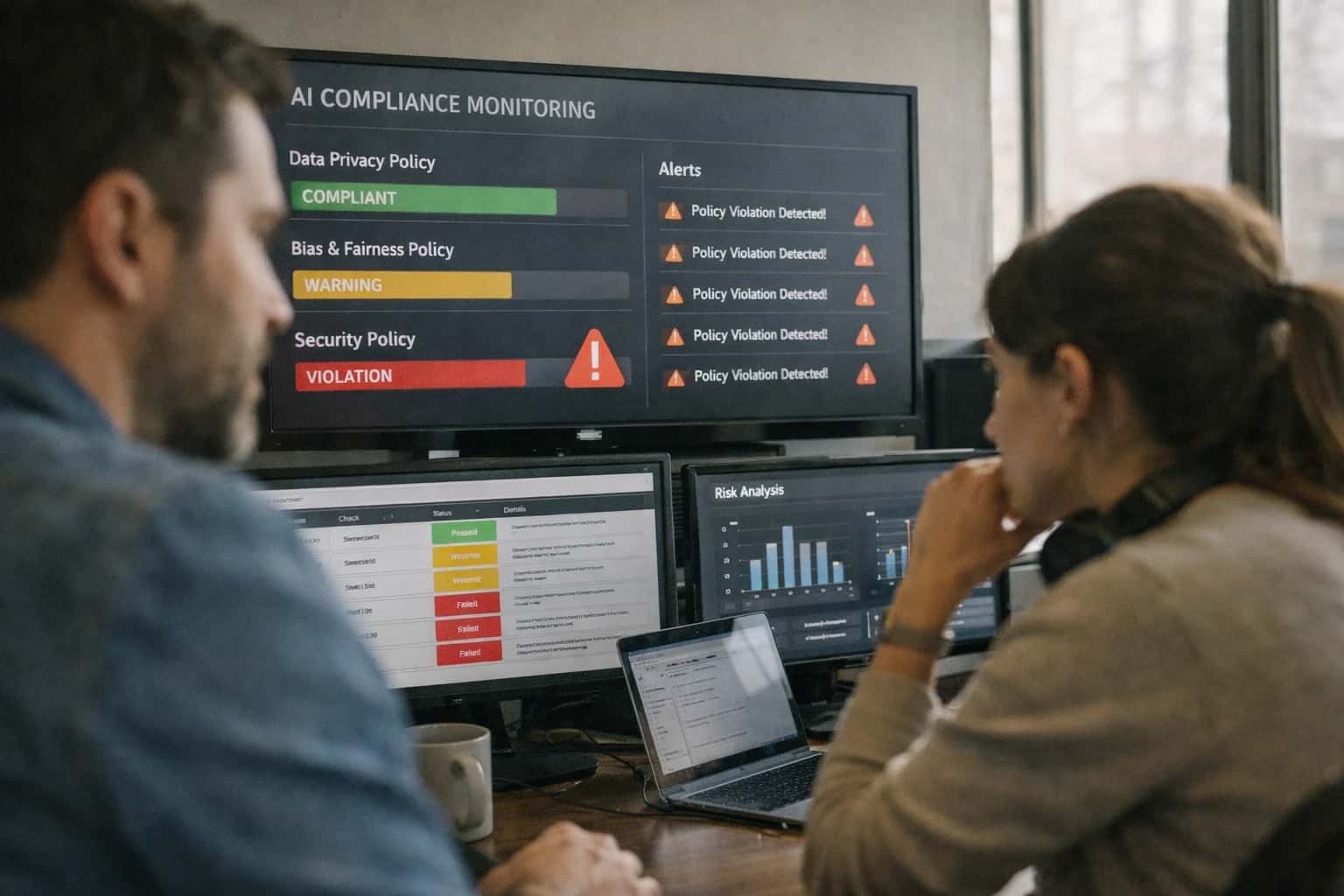
Real-Time Zone Monitoring is the continuous observation of zone states, agent occupancy, and boundary integrity using sensor data and telemetry to ensure policy enforcement and system health.
ZONE MANAGEMENT PROTOCOLS
What is Real-Time Zone Monitoring?
The continuous observation of zone states, agent occupancy, and boundary integrity using sensor data and telemetry to ensure policy enforcement and system health.
This monitoring function is foundational to heterogeneous fleet orchestration, ensuring that mutual exclusion zones are respected and dynamic zone allocations are executed safely. By maintaining a live fleet state estimation, it feeds critical data into the zone orchestration engine and spatial-temporal scheduling algorithms, enabling proactive deadlock detection and supporting comprehensive zone audit logging for security and compliance analysis.
ZONE MANAGEMENT PROTOCOLS
Key Features of Real-Time Zone Monitoring
Real-Time Zone Monitoring is the continuous observation of zone states, agent occupancy, and boundary integrity using sensor data and telemetry to ensure policy enforcement and system health. These are its core operational features.
01
Continuous State Tracking
The system maintains a unified, real-time view of all managed zones. This involves tracking:
- Zone State: The current operational mode (e.g., AVAILABLE, OCCUPIED, LOCKED, QUARANTINE) as defined by a Zone State Machine.
- Agent Occupancy: Precise knowledge of which agents are within each zone, their identities, and their current activities.
- Boundary Integrity: Verification that virtual perimeters are intact and没有被 compromised by environmental changes or sensor drift. This state forms the ground truth for the entire Fleet State Estimation system.
02
Policy Enforcement Point (PEP) Integration
The monitoring system acts as the sensory input for the Zone Policy Enforcement Point (PEP). When an agent requests zone entry, the PEP:
- Intercepts the request.
- Queries the monitoring system for real-time zone state (occupancy, capacity).
- Sends this context, along with the agent's attributes, to the Policy Decision Point (PDP).
- Executes the PDP's decision (Allow/Deny) by physically controlling access via barriers, signals, or direct agent commands. This creates a closed-loop control system where monitoring directly enables enforcement.
03
Boundary Violation Detection
A critical safety function that uses sensor fusion to identify unauthorized entries or exits. The system:
- Continuously compares agent positions (from GPS, UWB, LiDAR) against defined zone geofences.
- Implements algorithms to filter out sensor noise and prevent false positives from momentary GPS drift.
- Triggers immediate alerts to the Human-in-the-Loop Interface and the Exception Handling Framework upon a confirmed violation.
- Initiates protocols such as Emergency Zone Clearance or agent emergency stop commands to mitigate risk.
04
Telemetry & Audit Logging
Every interaction and state change is recorded to create an immutable audit trail for security, compliance, and system optimization. Logs typically include:
- Access Requests: Timestamp, agent ID, requested zone, agent attributes.
- Policy Decisions: The Allow/Deny outcome and the specific rule that triggered it.
- Zone Entries/Exits: Precise timestamps and agent identifiers.
- State Transitions: When a zone changes from OCCUPIED to AVAILABLE, or to LOCKED.
- Violation Events: Full context of any Boundary Violation Detection. This data feeds into Zone Audit Logging systems and is crucial for Fleet Health Monitoring and post-incident analysis.
05
Dynamic Capacity Monitoring
Enforces Zone Capacity Limits in real-time, preventing congestion that can lead to deadlocks or reduced efficiency. The system:
- Tracks the count of agents within each zone against its predefined maximum capacity.
- Integrates with the Zone Reservation System to account for future bookings when calculating available slots.
- Provides live data to Spatial-Temporal Scheduling and Dynamic Task Allocation systems, which can reroute agents to less congested zones.
- May work in concert with a Zone Load Balancer to automatically distribute traffic across multiple similar zones.
06
Exception & Health Reporting
Proactively identifies and reports anomalies beyond simple violations, serving as a frontline for system reliability. This includes:
- Sensor Health: Monitoring the status of cameras, LiDAR units, and positioning anchors that provide zone data.
- Protocol Failures: Detecting failures in the Zone Handshake Protocol or missed acknowledgments.
- Zone State Anomalies: Flagging illogical states, such as a zone showing OCCUPIED with no agent telemetry.
- Integration with Fleet Health Monitoring: Correlating zone access issues with individual agent diagnostic codes (e.g., a robot failing to exit may have a motor fault). These reports are critical for maintaining high system availability and informing maintenance schedules.
ZONE MANAGEMENT PROTOCOLS
How Real-Time Zone Monitoring Works
Real-Time Zone Monitoring is the continuous observation of zone states, agent occupancy, and boundary integrity using sensor data and telemetry to ensure policy enforcement and system health.
Real-Time Zone Monitoring is a continuous feedback loop that uses sensor fusion and telemetry streams to maintain a live, authoritative view of all managed geographic areas within a workspace. It tracks which agents occupy each zone, verifies their authorized presence, and monitors for boundary violations or unexpected state changes. This data is fed to the Zone Orchestration Engine and Policy Enforcement Points (PEPs) to enable immediate, deterministic responses to any deviation from the defined spatial authorization policies.
The system operates by correlating agent-reported positions (via GPS, UWB, or LiDAR) with fixed environmental sensors to perform state estimation and integrity checking. It continuously evaluates zone occupancy against capacity limits and temporal access windows, updating a shared zone state machine. This real-time awareness is critical for dynamic zone allocation, deadlock detection, and triggering emergency clearance protocols, forming the observational backbone for safe, multi-agent spatial coordination.
REAL-TIME ZONE MONITORING
Real-World Applications and Examples
Real-Time Zone Monitoring is the continuous observation of zone states, agent occupancy, and boundary integrity using sensor data and telemetry to ensure policy enforcement and system health. These examples illustrate its critical role in modern logistics, manufacturing, and safety-critical environments.
01
Automated Warehouse Safety
In high-density fulfillment centers, Real-Time Zone Monitoring prevents collisions between Autonomous Mobile Robots (AMRs) and human workers. Mutual Exclusion Zones around packing stations are monitored via LiDAR and cameras. The system enforces spatial-temporal scheduling, ensuring only one agent occupies a high-risk area at a time, while dynamic zone allocation reroutes robots around congested aisles. This directly supports collision avoidance systems and fleet health monitoring.
>99.9%
Collision-Free Operation
< 1 sec
Violation Detection Latency
02
Dynamic Manufacturing Cell Control
In flexible assembly lines, zones around robotic workcells are monitored to enforce role-based access control (RBAC). A zone state machine tracks states like SETUP, ACTIVE, and MAINTENANCE. AGVs delivering parts are granted access via an authorization token only when the cell is in SETUP state. Boundary violation detection triggers if a manual forklift enters an active robotic zone, executing an emergency zone clearance protocol. This integrates with fleet state estimation and exception handling frameworks.
30%
Increase in Cell Utilization
03
Airport Baggage Handling System Orchestration
Baggage sorting areas are divided into zones with strict capacity limits. Real-time monitoring of RFID and vision data tracks bag carts (Unit Load Devices). The zone orchestration engine uses this data for load balancing, directing carts to underutilized induction points. Temporal access windows control when maintenance crews can enter high-speed conveyor zones. Zone audit logging provides a complete trace for security and operational analysis, linking to multi-agent path planning.
99.5%
Sortation Accuracy
04
Hospital Logistics & Infection Control
Hospitals use zone monitoring to manage Autonomous Delivery Robots transporting supplies and sensitive materials. Zone quarantine protocols are activated via monitoring if a biohazard spill is detected, creating dynamic virtual perimeters. Attribute-based access control (ABAC) evaluates robot type, cargo, and sterilization status before granting zone entry. Cross-zone transition protocols ensure sterile corridors are not compromised, integrating with the broader heterogeneous fleet orchestration platform.
50%
Reduction in Manual Transport
05
Port Container Yard Management
Monitoring Straddle Carriers and Autonomous Stacking Cranes in dense container yards. Geofencing defines stacking lanes and transfer points. The system detects deadlock scenarios where equipment is mutually blocked and triggers real-time replanning. Zone priority override allows a crane with a critical export container to preempt a lane. Data feeds into spatial-temporal scheduling algorithms to optimize vessel loading sequences. This is a core component of autonomous supply chain intelligence.
20%
Improved Yard Throughput
06
Cross-Docking Facility Optimization
In time-sensitive cross-docks, zones at dock doors and staging areas are monitored to minimize trailer turn-time. Zone load balancers distribute AMRs pulling pallets to avoid congestion. Zone affinity rules keep pallets for the same outbound door grouped together. Monitoring data feeds dynamic task allocation systems to reassign forklifts in real-time. Zone reservation systems integrate with appointment schedules to pre-allocate door zones, demonstrating software-defined manufacturing automation principles.
15%
Faster Trailer Turnaround
ZONE MANAGEMENT PROTOCOLS
Frequently Asked Questions
Common technical questions about Real-Time Zone Monitoring, the continuous sensor-based observation system that ensures policy enforcement and safety in dynamic multi-agent environments.
Real-Time Zone Monitoring is the continuous, sensor-driven observation of defined geographic areas within a workspace to track occupancy, enforce access policies, and ensure system integrity. It works by integrating data streams from multiple sources—including LiDAR, ultra-wideband (UWB) tags, onboard agent telemetry, and camera feeds—into a central orchestration engine. This engine maintains a unified situational awareness model, comparing real-time agent positions and states against a zone permission matrix and spatial authorization policies. The system continuously evaluates for boundary violations, updates zone state machines (e.g., from AVAILABLE to OCCUPIED), and triggers automated responses or alerts through the Policy Enforcement Point (PEP).
Enabling Efficiency, Speed & Accuracy
Intelligent Analysis, Decision & Execution
We build AI systems for teams that need search across company data, workflow automation across tools, or AI features inside products and internal software.
Talk to Us
Search across company data
Give teams answers from docs, tickets, runbooks, and product data with sources and permissions.
Useful when people spend too long searching or get different answers from different systems.
Enterprise searchRAGPermissions
Read more
Automate internal workflows
Use AI to route work, draft outputs, trigger actions, and keep approvals and logs in place.
Useful when repetitive work moves across multiple tools and teams.
AI agentsWorkflow automationGovernance
Read more
Add AI to products and internal tools
Build assistants, guided actions, or decision support into the software your team or customers already use.
Useful when AI needs to be part of the product, not a separate tool.
AI integrationDecision supportModel routing
Read more
About the author
Prasad Kumkar
CEO & MD, Inference Systems
Prasad Kumkar is the CEO & MD of Inference Systems and writes about AI systems architecture, LLM infrastructure, model serving, evaluation, and production deployment. Over 5+ years, he has worked across computer vision models, L5 autonomous vehicle systems, and LLM research, with a focus on taking complex AI ideas into real-world engineering systems.
His work and writing cover AI systems, large language models, AI agents, multimodal systems, autonomous systems, inference optimization, RAG, evaluation, and production AI engineering.
LinkedIn
Limited slotsGet a Free AI Consultation
Partnered with leading AI, data, and software stack.





How We Work
Custom AI workflows for your Business
One-fit-all AI don't work for modern businesses. At Inferensys, we aim to understand your business & custom requirements; which we use to define most efficient agentic workflows, the data, and the tools for your business.
01
Review the use case
We understand the task, the users, and where AI can actually help.
Read more02
Pick the right approach
We define what needs search, automation, or product integration.
Read more03
Build the first useful version
We implement the part that proves the value first.
Read more04
Improve from there
We add the checks and visibility needed to keep it useful.
Read moreThe first call is a practical review of your use case and the right next step.
Talk to Us