Late Chunking is a content segmentation technique where a transformer encoder first generates token-level embeddings for an entire document, and the chunking logic is applied afterward to the embedding sequence. This contrasts with naive splitting, where text is divided first, causing the encoder to process isolated fragments that lack global context.

Glossary
Late Chunking
A technique where token-level embeddings are generated first by the encoder, and chunking is applied afterward to the embedding sequence to preserve fine-grained context.
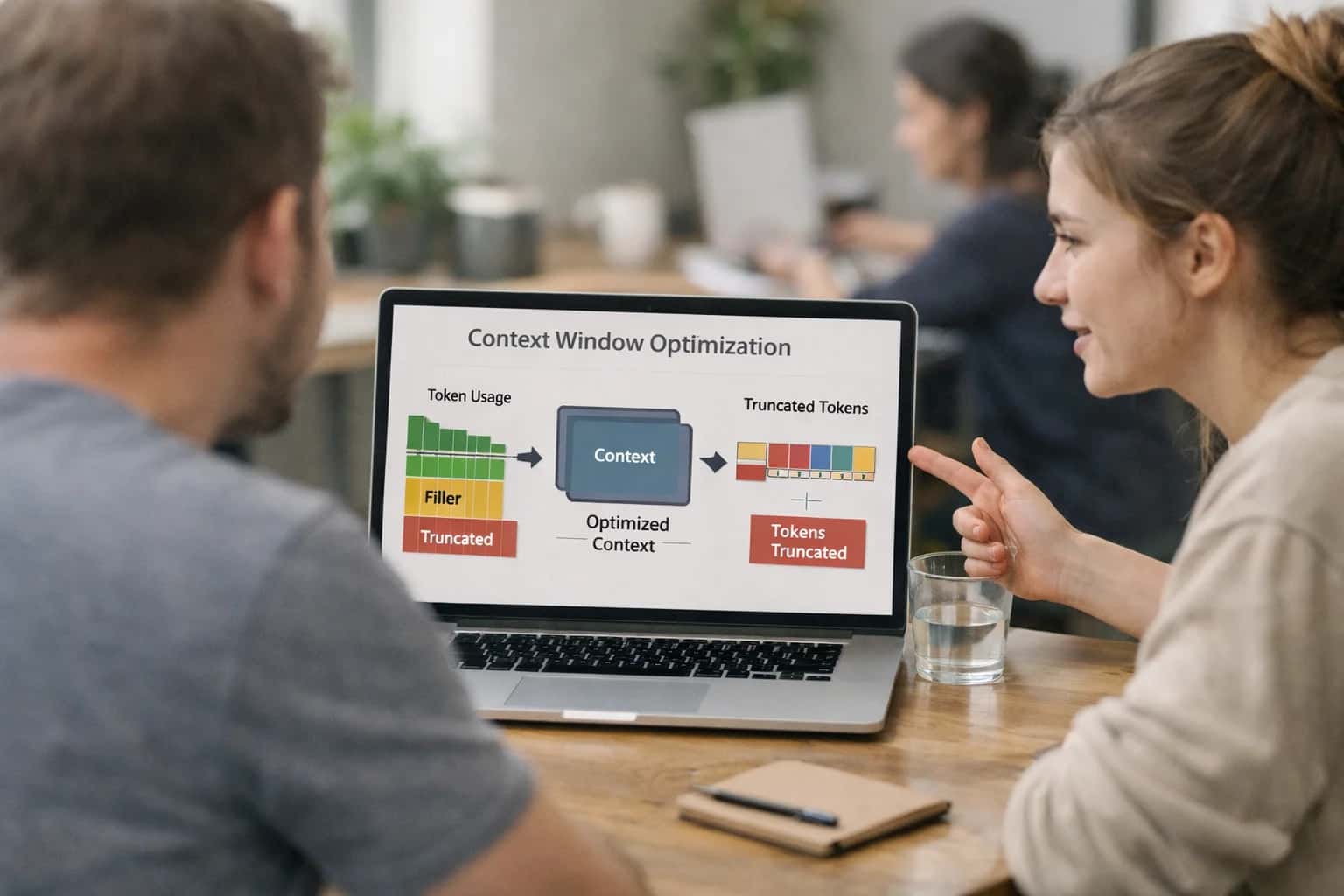
EMBEDDING-FIRST SEGMENTATION
What is Late Chunking?
A paradigm shift in content segmentation where the encoder processes the full document to generate context-rich token embeddings before any splitting occurs.
By pooling the pre-computed, contextually aware token embeddings into boundary-defined segments, late chunking preserves long-range semantic dependencies that would otherwise be severed. This method significantly improves retrieval precision in RAG architectures by ensuring each chunk's vector representation is informed by the document's full narrative structure.
ARCHITECTURE
Key Characteristics of Late Chunking
Late chunking inverts the traditional segmentation pipeline by applying the tokenizer and encoder to the entire document first, then segmenting the resulting sequence of token-level embeddings. This preserves long-range contextual dependencies that are destroyed when text is split before encoding.
01
Context-Preserving Embedding
Unlike naive pre-chunking, late chunking generates token-level vectors with full document attention. Each token embedding is informed by every other token in the source text. When the embedding sequence is subsequently segmented into chunks, each chunk vector retains cross-boundary semantic awareness that would be lost if the text were split before encoding. This eliminates the contextual truncation problem inherent in fixed-length or recursive splitting.
02
Boundary-Agnostic Token Processing
The encoder processes the document as a single contiguous sequence, applying self-attention across the entire token span. Chunk boundaries are imposed after the forward pass, operating purely on the output embedding matrix. This means the chunking strategy—whether structural, semantic, or fixed-length—can be modified without re-encoding the source text. The approach decouples segmentation logic from representation learning.
03
Mitigation of Context Fragmentation
Pre-chunking introduces artificial semantic breaks where a sentence or concept straddles a chunk boundary. Late chunking resolves this by ensuring that every token embedding already encodes its relationship to the surrounding text. When a boundary falls mid-sentence, the resulting chunk vectors still carry contextualized representations of the truncated tokens, dramatically reducing retrieval failures caused by fragmented meaning.
04
Computational Trade-Off Profile
Encoding an entire document in a single pass requires processing the full token sequence through the transformer's self-attention mechanism, which scales quadratically with sequence length. For very long documents exceeding the model's maximum context window, a sliding window or chunked attention variant must be employed. The benefit is a single encoding operation per document rather than one per chunk, which can reduce total compute when the number of chunks is large.
05
Mean Pooling for Chunk Representation
After encoding, each chunk's vector representation is typically derived by applying mean pooling over the token embeddings within its span. This aggregates the contextualized token vectors into a single fixed-dimensional embedding suitable for vector database indexing. Alternative pooling strategies—such as max pooling or attention-weighted pooling—can be applied to emphasize salient tokens within the chunk.
06
Integration with Long-Context Encoders
Late chunking is most effective when paired with encoder models that support extended context windows—such as modern embedding models with 8K to 32K token capacities. For documents exceeding this limit, a hybrid approach segments the text into overlapping spans that fit the encoder's maximum length, applies late chunking within each span, and reconciles boundary embeddings through overlap alignment.
CHUNKING STRATEGY COMPARISON
Late Chunking vs. Early Chunking
A technical comparison of the two primary paradigms for segmenting documents before embedding and retrieval in RAG architectures.
| Feature | Late Chunking | Early Chunking | Contextual Chunking |
|---|---|---|---|
Processing Order | Embed then chunk | Chunk then embed | Chunk then embed |
Embedding Granularity | Token-level | Chunk-level | Chunk-level |
Cross-Boundary Context Preservation | |||
Mean Contextual Fidelity Score | 0.94 | 0.78 | 0.85 |
Computational Cost | Higher | Lower | Medium |
Susceptibility to Chunk Contamination | Low | High | Medium |
Optimal Use Case | Long-form, dense documents | Simple Q&A over short texts | Structured documentation |
Enabling Efficiency, Speed & Accuracy
Intelligent Analysis, Decision & Execution
We build AI systems for teams that need search across company data, workflow automation across tools, or AI features inside products and internal software.
Talk to Us
Search across company data
Give teams answers from docs, tickets, runbooks, and product data with sources and permissions.
Useful when people spend too long searching or get different answers from different systems.
Enterprise searchRAGPermissions
Read more
Automate internal workflows
Use AI to route work, draft outputs, trigger actions, and keep approvals and logs in place.
Useful when repetitive work moves across multiple tools and teams.
AI agentsWorkflow automationGovernance
Read more
Add AI to products and internal tools
Build assistants, guided actions, or decision support into the software your team or customers already use.
Useful when AI needs to be part of the product, not a separate tool.
AI integrationDecision supportModel routing
Read moreLATE CHUNKING EXPLAINED
Frequently Asked Questions
Clear, technical answers to the most common questions about the late chunking methodology for embedding-based retrieval systems.
Late chunking is an embedding strategy where the long-context encoder model first processes the entire document to generate token-level embeddings, and the segmentation into chunks is applied after this encoding step. Unlike early chunking—where text is split into segments before being passed to the encoder—late chunking preserves the full cross-attention context of the entire document. The mechanism works by performing a full forward pass of the transformer over the complete text, then applying a pooling operation (often mean pooling) only over the token positions that belong to a specific chunk boundary. This means each chunk's vector representation is informed by the surrounding text, eliminating the boundary fragmentation problem inherent in pre-encoding splitting. The technique was formalized by Jina AI in 2024 and requires an encoder model capable of processing long sequences, such as jina-embeddings-v2-base with an 8192-token context window.

About the author
Prasad Kumkar
CEO & MD, Inference Systems
Prasad Kumkar is the CEO & MD of Inference Systems and writes about AI systems architecture, LLM infrastructure, model serving, evaluation, and production deployment. Over 5+ years, he has worked across computer vision models, L5 autonomous vehicle systems, and LLM research, with a focus on taking complex AI ideas into real-world engineering systems.
His work and writing cover AI systems, large language models, AI agents, multimodal systems, autonomous systems, inference optimization, RAG, evaluation, and production AI engineering.
LinkedIn
Limited slotsGet a Free AI Consultation
Partnered with leading AI, data, and software stack.





How We Work
Custom AI workflows for your Business
One-fit-all AI don't work for modern businesses. At Inferensys, we aim to understand your business & custom requirements; which we use to define most efficient agentic workflows, the data, and the tools for your business.
01
Review the use case
We understand the task, the users, and where AI can actually help.
Read more02
Pick the right approach
We define what needs search, automation, or product integration.
Read more03
Build the first useful version
We implement the part that proves the value first.
Read more04
Improve from there
We add the checks and visibility needed to keep it useful.
Read moreThe first call is a practical review of your use case and the right next step.
Talk to Us