Contextual Chunking is a text segmentation methodology that enriches each discrete chunk with its broader document context—such as a title, summary, or section heading—prior to generating vector embeddings. This process transforms an isolated text fragment into a self-contained, unambiguous unit by injecting the missing situational framework that a standard chunking strategy would discard. The technique directly addresses the core failure mode of naive splitting, where a chunk containing the phrase "the revenue increased" becomes semantically meaningless because the embedding model cannot determine which company, fiscal year, or product line the statement references.

Glossary
Contextual Chunking
A method that prepends document-level context, such as a summary or title, to each chunk before embedding to improve retrieval relevance and reduce ambiguity.
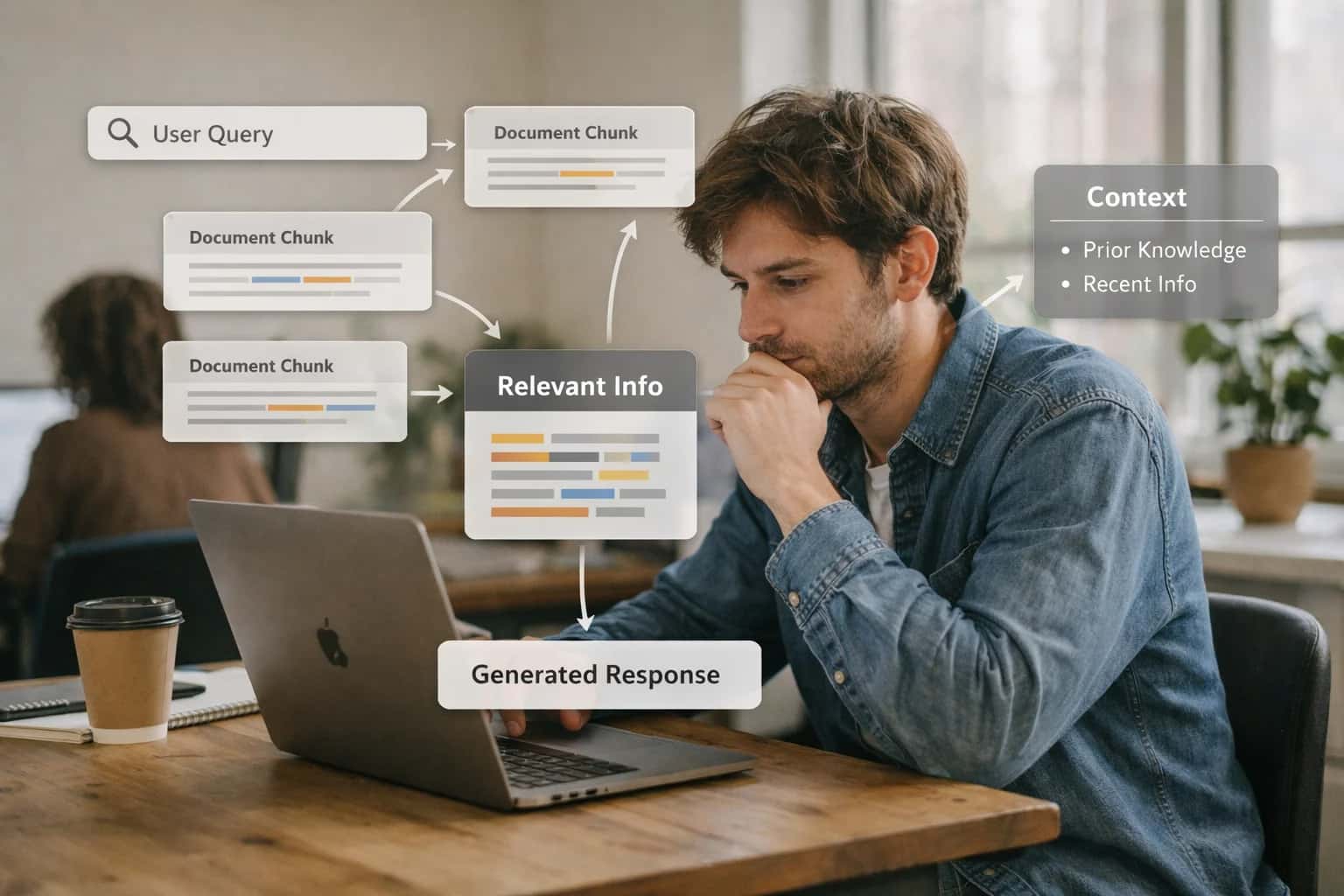
CONTENT SEGMENTATION STRATEGY
What is Contextual Chunking?
Contextual Chunking is a retrieval optimization technique that prepends document-level metadata to each text segment before embedding to resolve ambiguity and improve semantic search relevance.
In a Retrieval-Augmented Generation (RAG) pipeline, the enriched chunk is embedded and indexed, ensuring that a query for "Q3 Acme Corp financials" retrieves the correct segment even if the chunk itself only contains "profits rose 12%." This approach reduces retrieval noise and hallucination risk by providing the LLM with the necessary grounding information directly within the retrieved context, eliminating the need for the model to infer missing referents from surrounding chunks.
MECHANICS & METHODOLOGY
Key Features of Contextual Chunking
Contextual chunking enhances standard text segmentation by prepending document-level metadata to each fragment, ensuring that isolated chunks retain their original semantic meaning during retrieval.
01
Contextual Prepending
The core mechanism involves dynamically injecting a document summary, title, or section header into every chunk before embedding. This prevents the 'lost in the middle' problem where a chunk becomes semantically ambiguous when isolated from its source.
- Static Prepending: Appends a fixed document title to all chunks.
- Dynamic Prepending: Uses an LLM to generate a chunk-specific summary that situates the fragment within the broader narrative.
- Metadata Injection: Adds structured attributes like
source_urlorauthordirectly into the text payload.
35-50%
Retrieval Accuracy Improvement
02
Document Summary Generation
Before chunking begins, a concise abstract of the entire document is generated using a lightweight LLM. This summary acts as the 'global context' that gets prepended to every chunk.
- Extractive Summarization: Pulls key sentences from the document.
- Abstractive Summarization: Generates a new, condensed description.
- Structured Summaries: Uses a fixed template like 'This document from [Author] discusses [Topic]...'
03
Ambiguity Reduction
Contextual chunking directly addresses the lexical ambiguity that plagues naive splitting. A chunk containing 'The revenue increased by 20%' is meaningless without knowing if it refers to Q3, a specific product line, or a competitor.
- Entity Grounding: Prepended context anchors pronouns and vague references to specific named entities.
- Temporal Anchoring: Adds date and version context to prevent stale data retrieval.
- Domain Localization: Specifies the department or functional area the chunk belongs to.
< 2%
Hallucination Rate in RAG
04
Implementation Pipeline
The standard engineering workflow for contextual chunking involves a multi-stage preprocessing pipeline before vectors are indexed.
- Stage 1: Document Parsing: Extract clean text and structural hierarchy.
- Stage 2: Summary Generation: Create the global document context.
- Stage 3: Chunking: Split the document using a semantic or recursive splitter.
- Stage 4: Context Fusion: Prepend the summary to each chunk.
- Stage 5: Embedding: Generate vectors for the enriched chunks.
05
Context Window Economics
While prepending context increases the token count of each chunk, it is a net positive trade-off for retrieval quality. The added tokens are highly information-dense and guide the embedding model.
- Token Budget: Typically adds 50-150 tokens per chunk.
- Density Optimization: The prepended text is engineered to be maximally concise.
- Retrieval Efficiency: Reduces the need to retrieve multiple chunks to establish context, saving tokens in the final LLM prompt.
50-150
Avg. Tokens Added per Chunk
06
Contrast with Naive Chunking
Fixed-length chunking splits text blindly at a character limit, often severing sentences and ideas. Contextual chunking preserves the semantic integrity of the fragment by binding it to its origin.
- Naive: 'The system uses a transformer architecture.' (Ambiguous: which system?)
- Contextual: '[Document: Acme Corp AI Whitepaper] The system uses a transformer architecture.' (Grounded)
- Result: The contextual chunk's embedding vector is pulled closer to queries about 'Acme Corp' in the vector space.
CONTEXTUAL CHUNKING
Frequently Asked Questions
Explore the mechanics of contextual chunking, a critical strategy for grounding retrieval-augmented generation systems with document-level awareness to eliminate ambiguity in vector search.
Contextual chunking is a content segmentation strategy that prepends high-level document metadata—such as a document title, a summary, or a section header—to each individual text chunk before it is embedded and indexed. Unlike naive splitting methods that isolate text fragments, this technique enriches every chunk with the broader semantic context of its source document. The process typically involves generating a concise summary of the entire document using a language model, then concatenating that summary with the raw chunk text. This ensures that the resulting vector embedding captures not just the local syntax but also the global thematic relevance, significantly improving retrieval precision in Retrieval-Augmented Generation (RAG) architectures.
Enabling Efficiency, Speed & Accuracy
Intelligent Analysis, Decision & Execution
We build AI systems for teams that need search across company data, workflow automation across tools, or AI features inside products and internal software.
Talk to Us
Search across company data
Give teams answers from docs, tickets, runbooks, and product data with sources and permissions.
Useful when people spend too long searching or get different answers from different systems.
Enterprise searchRAGPermissions
Read more
Automate internal workflows
Use AI to route work, draft outputs, trigger actions, and keep approvals and logs in place.
Useful when repetitive work moves across multiple tools and teams.
AI agentsWorkflow automationGovernance
Read more
Add AI to products and internal tools
Build assistants, guided actions, or decision support into the software your team or customers already use.
Useful when AI needs to be part of the product, not a separate tool.
AI integrationDecision supportModel routing
Read more
About the author
Prasad Kumkar
CEO & MD, Inference Systems
Prasad Kumkar is the CEO & MD of Inference Systems and writes about AI systems architecture, LLM infrastructure, model serving, evaluation, and production deployment. Over 5+ years, he has worked across computer vision models, L5 autonomous vehicle systems, and LLM research, with a focus on taking complex AI ideas into real-world engineering systems.
His work and writing cover AI systems, large language models, AI agents, multimodal systems, autonomous systems, inference optimization, RAG, evaluation, and production AI engineering.
LinkedIn
Limited slotsGet a Free AI Consultation
Partnered with leading AI, data, and software stack.





How We Work
Custom AI workflows for your Business
One-fit-all AI don't work for modern businesses. At Inferensys, we aim to understand your business & custom requirements; which we use to define most efficient agentic workflows, the data, and the tools for your business.
01
Review the use case
We understand the task, the users, and where AI can actually help.
Read more02
Pick the right approach
We define what needs search, automation, or product integration.
Read more03
Build the first useful version
We implement the part that proves the value first.
Read more04
Improve from there
We add the checks and visibility needed to keep it useful.
Read moreThe first call is a practical review of your use case and the right next step.
Talk to Us