Token allocation is the engineering discipline of apportioning a finite context window budget among competing inputs—system prompts, conversation history, retrieved documents, and instructions—to optimize an LLM's output quality. It directly addresses the hard constraint that a model can only attend to a fixed number of tokens at once, requiring developers to prioritize high-signal information and truncate or summarize low-value content to prevent context window saturation.

Glossary
Token Allocation
The strategic distribution of a limited token budget within an LLM's context window to maximize the relevance and completeness of retrieved information.
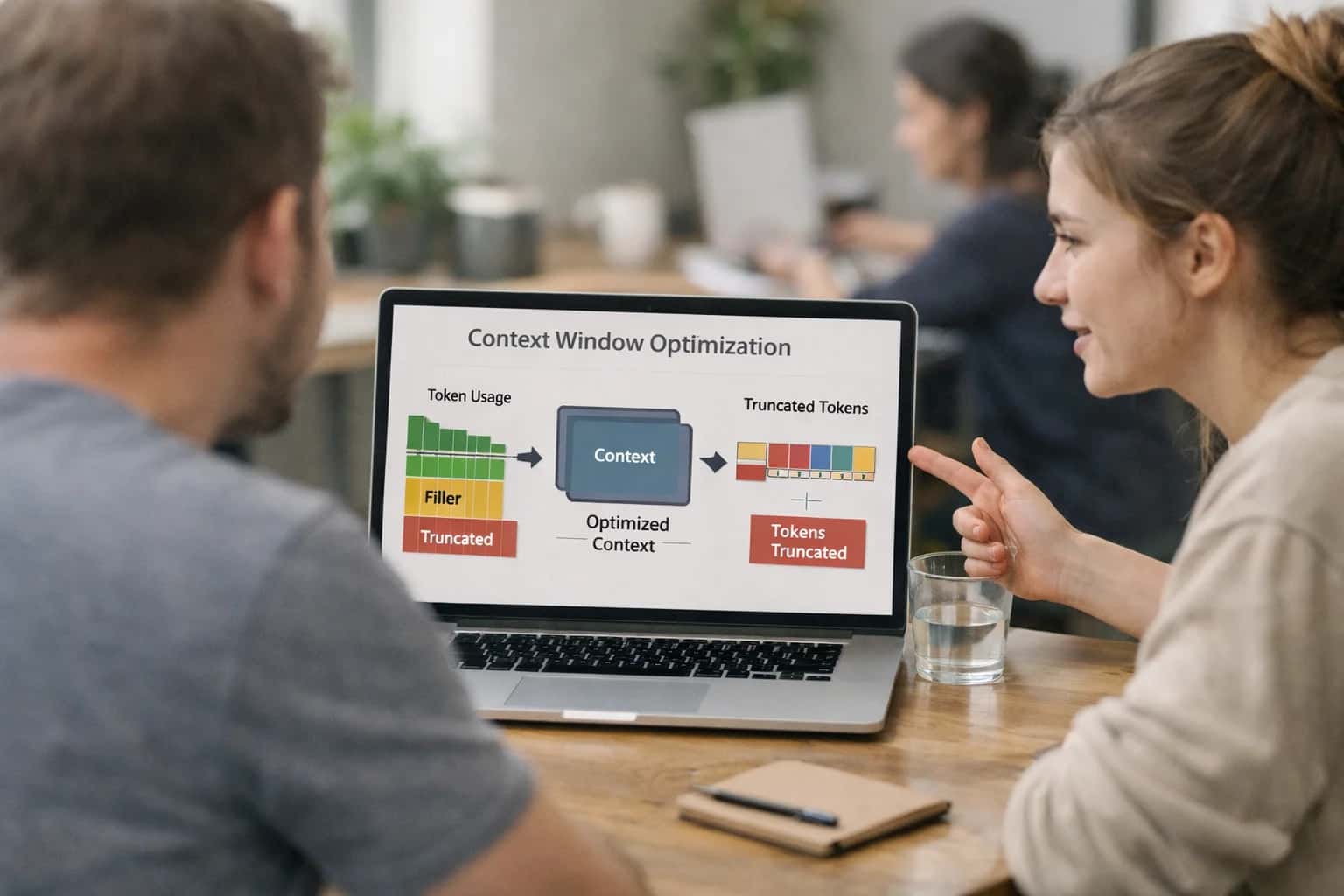
CONTEXT WINDOW STRATEGY
What is Token Allocation?
Token allocation is the strategic distribution of a limited token budget within an LLM's context window to maximize the relevance and completeness of retrieved information for a specific generation task.
Effective allocation strategies are critical for Retrieval-Augmented Generation (RAG) architectures, where the volume of retrieved documents often exceeds the available token budget. Techniques include re-ranking to place the most semantically relevant chunks at the top of the prompt, summarization of lower-priority passages, and dynamic budget partitioning that reserves a fixed percentage of the window for instructions and conversation memory, ensuring the model never loses its core directive.
CONTEXT BUDGETING
Key Characteristics of Token Allocation
Token allocation is the strategic distribution of a finite context window budget to maximize retrieval relevance and response completeness. The following characteristics define effective allocation strategies.
01
Context Window as a Scarce Resource
Every LLM has a finite context window—a maximum number of tokens it can process in a single request. This window must accommodate the system prompt, retrieved documents, conversation history, and the generated response. Token allocation treats this capacity as a zero-sum budget: every token spent on one element is unavailable for another. Poor allocation leads to context window saturation, where critical information is truncated or ignored due to the lost-in-the-middle phenomenon. Effective allocation requires understanding that model attention is not uniform across the window—information at the beginning and end receives disproportionate focus.
128K–1M
Typical Context Window (Tokens)
~$0.01/1K
Avg. Input Token Cost (GPT-4o)
02
Token Budgeting by Content Role
Allocation is not uniform—different content categories receive different budget priorities:
- System Prompt: Fixed overhead (500–2K tokens) defining behavior, constraints, and output format
- Retrieval Context: The largest variable allocation, containing chunks from vector search or knowledge graph queries
- Conversation History: Rolling buffer of prior turns, often managed with sliding window or summary compression techniques
- Generation Reserve: Tokens explicitly reserved for the model's output, preventing truncation mid-response
- Metadata & Citations: Structured fields for source attribution, confidence scores, and entity linking Strategic allocation often involves dynamic repartitioning based on query complexity—simple factual queries need less retrieval context, while multi-hop reasoning demands more.
500–2K
System Prompt Overhead
60–80%
Typical Retrieval Context Share
03
Chunk-Level Token Prioritization
Not all retrieved passages deserve equal token allocation. Prioritization strategies include:
- Relevance Scoring: Chunks with higher cosine similarity or reciprocal rank fusion (RRF) scores receive fuller allocation
- Information Density Filtering: Passages with higher entity-to-token ratios are prioritized over verbose, low-signal text
- Deduplication: Near-duplicate chunks are collapsed to prevent wasted tokens on redundant information
- Hierarchical Truncation: Within each chunk, the most salient sentences are preserved using extractive summarization before insertion
- Source Authority Weighting: Content from high-confidence, verified sources may receive allocation preference over lower-authority matches This transforms allocation from a simple FIFO insertion into a rank-aware budgeting process.
30–50%
Token Waste from Redundancy
3–5
Optimal Chunks per Query
04
Dynamic Allocation & Query-Adaptive Budgeting
Static allocation policies fail under diverse query loads. Query-adaptive budgeting adjusts allocation in real-time based on:
- Query Classification: Factoid queries receive narrow, high-precision allocation; exploratory queries receive broader, lower-precision context
- Multi-Hop Detection: Queries requiring chained reasoning across documents trigger expanded retrieval allocation with explicit relationship markers
- Uncertainty Triggers: When initial retrieval confidence is low, the system can reallocate tokens to a secondary retrieval pass or expanded chunk neighborhood
- Latency Budget Integration: Token allocation is balanced against time-to-first-token (TTFT) constraints—larger contexts increase prefill latency This dynamic approach treats allocation as a runtime optimization problem rather than a fixed configuration.
2–5x
Latency Increase from Overallocation
< 200ms
Target TTFT for Interactive Use
05
Citation & Provenance Token Overhead
For Retrieval-Augmented Generation (RAG) systems requiring verifiable outputs, a portion of the token budget must be reserved for citation signals and data provenance metadata. This includes:
- Inline Citation Markers: Numeric or symbolic references linking claims to source chunks
- Source Metadata: Document titles, dates, authors, and confidence scores appended to each chunk
- Attribution Instructions: System prompt directives requiring the model to cite sources for factual claims
- Grounding Tokens: Explicit markers that anchor generated statements to specific retrieval offsets While citation overhead can consume 10–20% of the context window, it is essential for hallucination mitigation and establishing algorithmic trust. The trade-off between completeness and verifiability is a core allocation decision.
10–20%
Citation Token Overhead
40–60%
Hallucination Reduction with Citations
06
Cross-Turn Memory & Conversation Compression
In multi-turn conversational AI, token allocation must account for conversation history without exhausting the window. Techniques include:
- Sliding Window: Retaining only the most recent N turns, discarding older exchanges
- Incremental Summarization: Periodically compressing prior turns into a concise running summary, freeing tokens for new exchanges
- Selective Memory: Retaining only turns containing entity mentions, decisions, or user preferences relevant to future queries
- Checkpoint Compression: At defined intervals, the entire history is compressed into a structured state object These strategies treat conversation history as a compressible asset rather than a linear accumulation, enabling long-running sessions within fixed token budgets.
5–10
Turns Before Compression Trigger
70–90%
Compression Ratio Achievable
TOKEN ALLOCATION
Frequently Asked Questions
Explore the strategic mechanics of distributing a limited token budget within an LLM's context window to maximize the relevance and completeness of retrieved information.
Token allocation is the strategic distribution of a limited token budget within a large language model's (LLM) context window to maximize the relevance, completeness, and factual accuracy of retrieved information. Since every LLM interaction—comprising the system prompt, user query, retrieved documents, and conversation history—consumes tokens from a finite capacity, allocation defines the priority and proportion of space given to each component. Effective allocation ensures that high-signal, entity-rich content occupies the most attention-dense regions of the context window, while low-value or redundant text is pruned. This process directly impacts information gain, hallucination mitigation, and the model's ability to perform complex, multi-hop reasoning without losing track of earlier instructions due to context window saturation.
CONTEXT WINDOW STRATEGIES
Token Allocation vs. Related Concepts
How token allocation differs from adjacent context engineering and retrieval optimization techniques
| Feature | Token Allocation | Context Engineering | Content Chunking |
|---|---|---|---|
Primary objective | Maximize relevance per token within fixed context budget | Design prompt structure to steer model behavior | Segment content for precise vector retrieval |
Operates at | Inference time (within active context window) | Prompt design time (before inference) | Indexing time (before retrieval) |
Key constraint | Context window token limit | Model instruction-following capability | Embedding model dimensionality |
Directly addresses context window saturation | |||
Uses semantic chunk boundaries | |||
Primary metric | Information density per token | Output accuracy and format compliance | Retrieval precision@k |
Typical token budget awareness | Explicit (counts tokens) | Implicit (estimates length) | None (operates on characters/words) |
Related to RAG architecture |
Enabling Efficiency, Speed & Accuracy
Intelligent Analysis, Decision & Execution
We build AI systems for teams that need search across company data, workflow automation across tools, or AI features inside products and internal software.
Talk to Us
Search across company data
Give teams answers from docs, tickets, runbooks, and product data with sources and permissions.
Useful when people spend too long searching or get different answers from different systems.
Enterprise searchRAGPermissions
Read more
Automate internal workflows
Use AI to route work, draft outputs, trigger actions, and keep approvals and logs in place.
Useful when repetitive work moves across multiple tools and teams.
AI agentsWorkflow automationGovernance
Read more
Add AI to products and internal tools
Build assistants, guided actions, or decision support into the software your team or customers already use.
Useful when AI needs to be part of the product, not a separate tool.
AI integrationDecision supportModel routing
Read more
About the author
Prasad Kumkar
CEO & MD, Inference Systems
Prasad Kumkar is the CEO & MD of Inference Systems and writes about AI systems architecture, LLM infrastructure, model serving, evaluation, and production deployment. Over 5+ years, he has worked across computer vision models, L5 autonomous vehicle systems, and LLM research, with a focus on taking complex AI ideas into real-world engineering systems.
His work and writing cover AI systems, large language models, AI agents, multimodal systems, autonomous systems, inference optimization, RAG, evaluation, and production AI engineering.
LinkedIn
Limited slotsGet a Free AI Consultation
Partnered with leading AI, data, and software stack.





How We Work
Custom AI workflows for your Business
One-fit-all AI don't work for modern businesses. At Inferensys, we aim to understand your business & custom requirements; which we use to define most efficient agentic workflows, the data, and the tools for your business.
01
Review the use case
We understand the task, the users, and where AI can actually help.
Read more02
Pick the right approach
We define what needs search, automation, or product integration.
Read more03
Build the first useful version
We implement the part that proves the value first.
Read more04
Improve from there
We add the checks and visibility needed to keep it useful.
Read moreThe first call is a practical review of your use case and the right next step.
Talk to Us