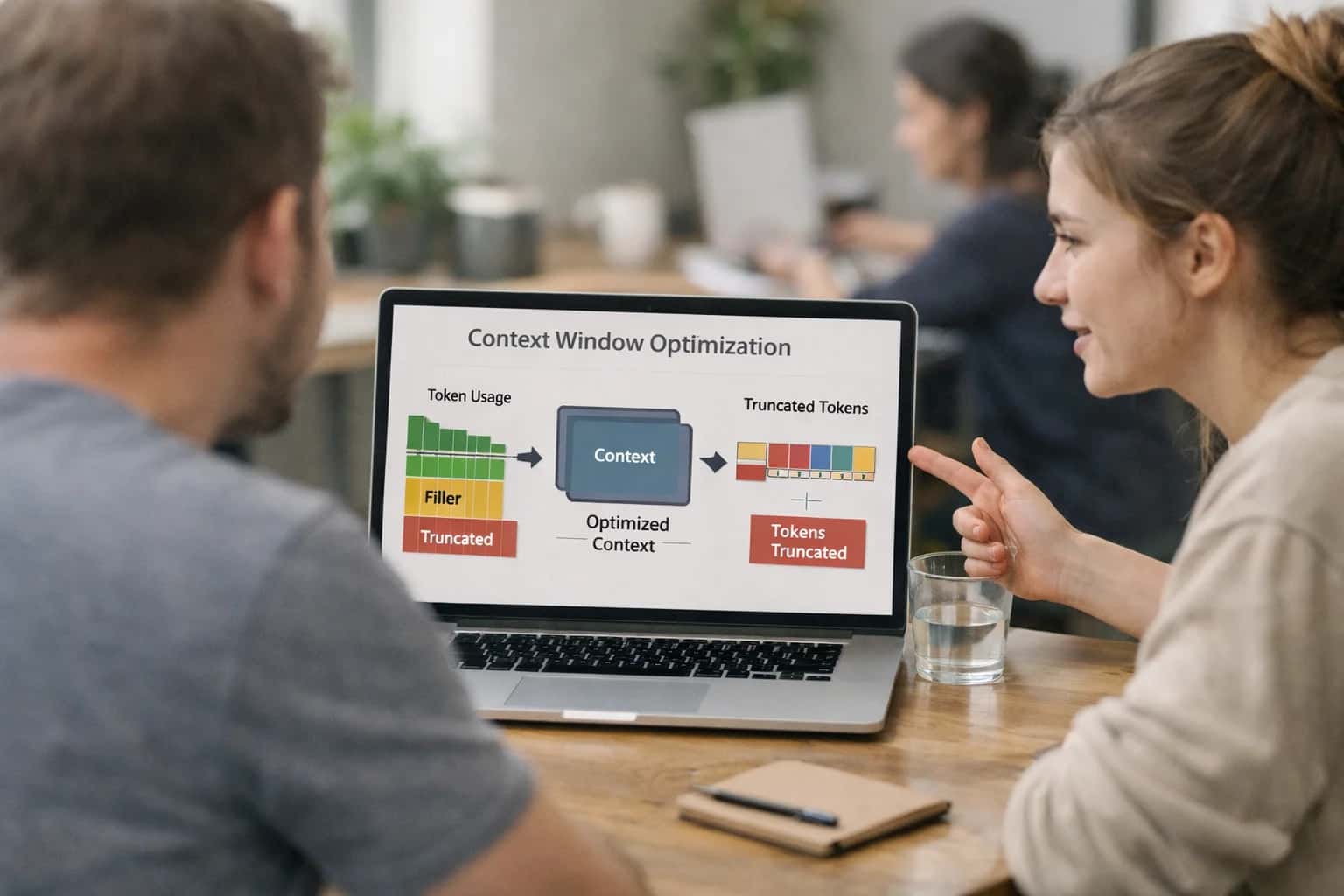
Context window saturation is the state where the total token count of a prompt, conversation history, and retrieved documents equals the model's maximum context length, preventing the ingestion of additional information. At this limit, the model's attention mechanism can no longer process new input without truncation, forcing a trade-off between recency and relevance.

Glossary
Context Window Saturation
The point at which a large language model's fixed token capacity is exceeded, causing the model to lose access to or fail to attend to information positioned at the beginning of the input sequence.
TOKEN CAPACITY LIMIT
What is Context Window Saturation?
The operational threshold at which a large language model's fixed input buffer reaches its maximum token capacity, triggering attention degradation and potential information loss.
Saturation triggers the "lost-in-the-middle" phenomenon, where the model's recall accuracy for information in the central portion of the context degrades significantly. Mitigation strategies include token allocation budgeting, aggressive content chunking for retrieval-augmented generation, and sliding window architectures that summarize or evict stale context to preserve functional capacity.
Context Window Saturation
Core Characteristics
The defining attributes and operational boundaries of an LLM's finite attention span, where exceeding the token limit triggers catastrophic forgetting and performance degradation.
01
The Recency Bias Problem
When saturation occurs, models exhibit a strong recency bias, overweighting information at the end of the context window while catastrophically forgetting instructions or data placed at the beginning. This is often described as the 'lost-in-the-middle' phenomenon, where the model's attention mechanism fails to retrieve centrally located facts. For enterprise RAG applications, this means critical system prompts or early grounding documents can be silently ignored, leading to hallucination or policy violations.
02
Token Counting Mechanics
Saturation is a function of the tokenizer, not raw word count. A token is roughly 0.75 words in English, but can be a single character or a whole word.
- Input Tokens: The sum of the system prompt, user query, and all retrieved context.
- Output Tokens: The model's generated response.
- Total Limit: The model's maximum context window (e.g., 128k for GPT-4 Turbo, 200k for Claude 3). Exceeding the limit typically results in an API error or silent truncation of the oldest tokens.
03
Attention Dilution
Even before hitting the hard token limit, performance degrades due to attention dilution. As the context grows, the model's quadratic attention mechanism must compute relationships between all token pairs, spreading its 'focus' thin. This means that in a 100k-token context, a specific fact may receive a vanishingly small attention weight, making it effectively invisible to the generation process. This is a soft form of saturation that impacts factual recall accuracy.
04
Mitigation Strategies
Engineers combat saturation through several architectural and content strategies:
- Context Compression: Using a secondary LLM to summarize long documents before insertion.
- Reranking: Placing the most semantically relevant chunks at the beginning and end of the prompt to exploit primacy and recency biases.
- Streaming & Chunking: Processing documents in sequential, overlapping windows rather than stuffing a single massive prompt.
- Infinite Context Architectures: Emerging designs using external memory stores (vector DBs) to simulate unbounded context without overloading the attention mechanism.
05
The 'Needle in a Haystack' Benchmark
The standard test for context window saturation is the Needle-in-a-Haystack (NIAH) evaluation. A specific fact (the 'needle') is placed at varying depths within a long, irrelevant document (the 'haystack'). The model is then queried for that fact. Results typically show a U-shaped curve: high accuracy at the very beginning and very end of the context, with a significant drop in the middle. This benchmark directly visualizes the 'lost-in-the-middle' effect and is a key metric for comparing long-context model performance.
06
Cost Implications of Saturation
Saturation has a direct financial impact on API-based LLM usage. Since pricing is per-token, filling the context window with low-value text drastically increases latency and cost without improving output quality. This creates a diminishing returns curve for RAG retrieval. The optimal strategy is often to retrieve fewer, higher-quality chunks rather than maximizing token usage. Prompt caching can mitigate costs for static system prompts, but dynamic context still incurs full compute charges.
CONTEXT WINDOW SATURATION
Frequently Asked Questions
Explore the critical boundary where an LLM's working memory fills to capacity, causing performance degradation through recency bias and the 'lost-in-the-middle' phenomenon.
Context window saturation is the point at which the total volume of input tokens—including the system prompt, conversation history, and retrieved documents—fills an LLM's maximum context capacity, forcing the model to rely on its internal compression mechanisms and often leading to information loss. When saturation occurs, the model's attention mechanism becomes diluted across too many tokens, causing it to disproportionately weight information at the beginning (primacy bias) and end (recency bias) of the context while ignoring or forgetting details in the middle. This 'lost-in-the-middle' phenomenon is a well-documented failure mode in models like GPT-4 and Claude, where retrieval accuracy for facts placed between 25% and 75% of the context depth can drop by over 20% compared to facts at the edges. Saturation is not a binary state but a gradient—performance degrades progressively as the context fills, with sharp drop-offs occurring when the model must perform complex reasoning over densely packed information.
Enabling Efficiency, Speed & Accuracy
Intelligent Analysis, Decision & Execution
We build AI systems for teams that need search across company data, workflow automation across tools, or AI features inside products and internal software.
Talk to Us
Search across company data
Give teams answers from docs, tickets, runbooks, and product data with sources and permissions.
Useful when people spend too long searching or get different answers from different systems.
Enterprise searchRAGPermissions
Read more
Automate internal workflows
Use AI to route work, draft outputs, trigger actions, and keep approvals and logs in place.
Useful when repetitive work moves across multiple tools and teams.
AI agentsWorkflow automationGovernance
Read more
Add AI to products and internal tools
Build assistants, guided actions, or decision support into the software your team or customers already use.
Useful when AI needs to be part of the product, not a separate tool.
AI integrationDecision supportModel routing
Read more
About the author
Prasad Kumkar
CEO & MD, Inference Systems
Prasad Kumkar is the CEO & MD of Inference Systems and writes about AI systems architecture, LLM infrastructure, model serving, evaluation, and production deployment. Over 5+ years, he has worked across computer vision models, L5 autonomous vehicle systems, and LLM research, with a focus on taking complex AI ideas into real-world engineering systems.
His work and writing cover AI systems, large language models, AI agents, multimodal systems, autonomous systems, inference optimization, RAG, evaluation, and production AI engineering.
LinkedIn
Limited slotsGet a Free AI Consultation
Partnered with leading AI, data, and software stack.





How We Work
Custom AI workflows for your Business
One-fit-all AI don't work for modern businesses. At Inferensys, we aim to understand your business & custom requirements; which we use to define most efficient agentic workflows, the data, and the tools for your business.
01
Review the use case
We understand the task, the users, and where AI can actually help.
Read more02
Pick the right approach
We define what needs search, automation, or product integration.
Read more03
Build the first useful version
We implement the part that proves the value first.
Read more04
Improve from there
We add the checks and visibility needed to keep it useful.
Read moreThe first call is a practical review of your use case and the right next step.
Talk to Us