Continuous evaluation is the systematic, automated comparison of a production model's live inference outputs against a ground truth ingestion pipeline. Unlike static validation, it calculates metrics like Expected Calibration Error (ECE) and precision-recall on live traffic, immediately flagging discrepancies caused by data drift or concept drift before they impact business outcomes.

Glossary
Continuous Evaluation
An automated MLOps process that persistently monitors a deployed model's performance metrics against a validation baseline to detect degradation in real-time.
MLOps
What is Continuous Evaluation?
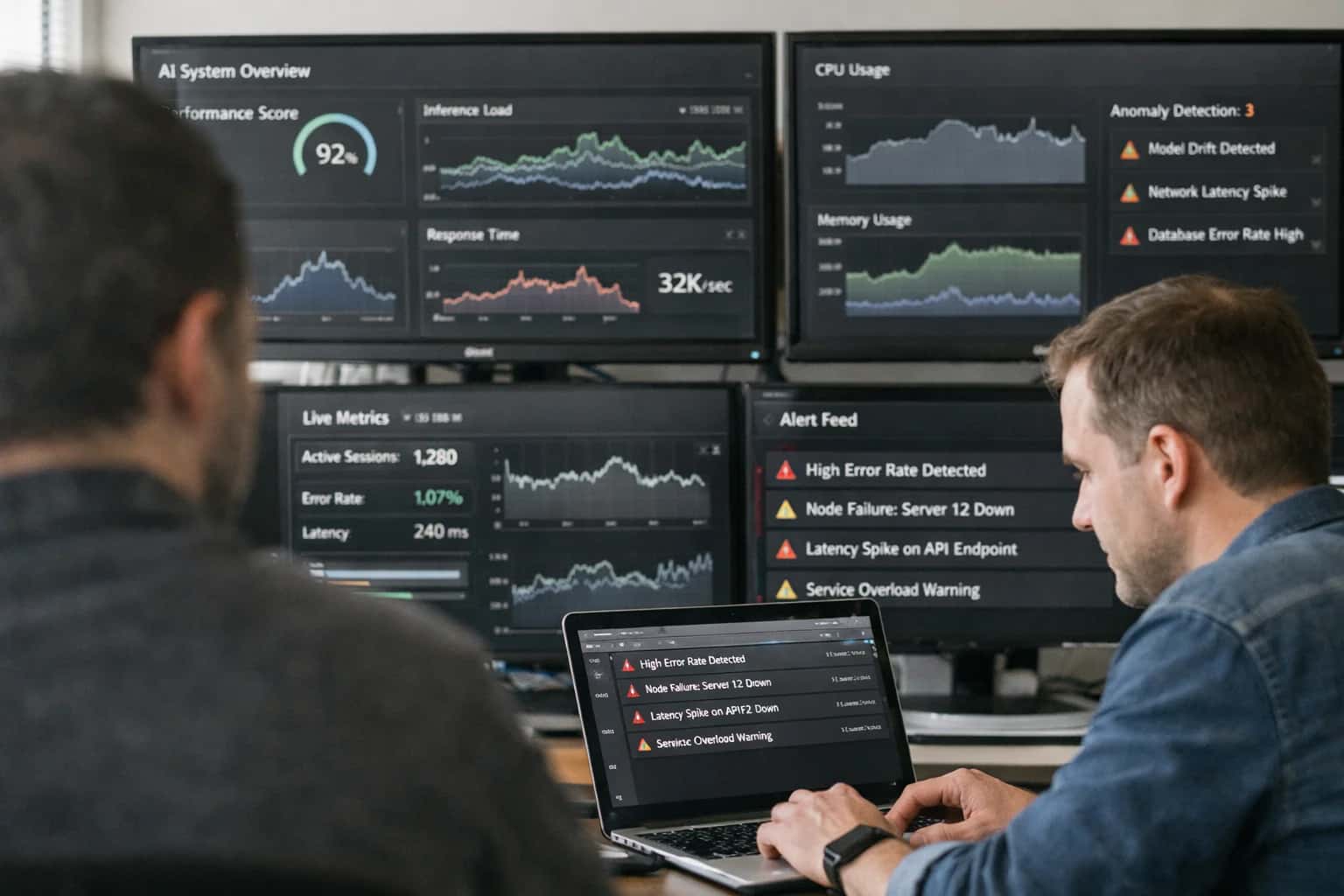
Continuous evaluation is an automated MLOps process that persistently monitors a deployed model's performance metrics against a validation baseline to detect degradation in real-time.
This framework relies on a champion-challenger framework or shadow deployment to safely benchmark new candidates against the incumbent model. By integrating with a model registry and utilizing statistical process control (SPC) charts, continuous evaluation enables triggered retraining and instant model rollback, ensuring sustained efficacy in dynamic environments.
Automated Model Surveillance
Key Characteristics of Continuous Evaluation
Continuous evaluation is not a periodic audit but an automated, persistent MLOps process that monitors a deployed model's performance against a validation baseline to detect degradation in real-time.
01
Automated Metric Computation
The core engine of continuous evaluation automatically calculates performance metrics on live traffic without manual intervention. This involves:
- Streaming metric pipelines that compute precision, recall, and F1-score on prediction windows
- Statistical distance measures like Population Stability Index (PSI) and Kullback-Leibler Divergence to quantify drift magnitude
- Expected Calibration Error (ECE) tracking to detect overconfident probability estimates
- Automated comparison against a static validation baseline established during model certification
02
Ground Truth Integration
Continuous evaluation requires a robust ground truth ingestion pipeline to compare predictions against real-world outcomes. In fraud detection, this is complicated by feedback loop delay—chargebacks and confirmed fraud labels may arrive weeks after the transaction. The system must:
- Join delayed labels back to historical prediction logs using transaction IDs
- Handle partial ground truth where only a subset of transactions are ever investigated
- Account for confirmation bias where only high-scoring transactions are reviewed by analysts
- Maintain a holdout set of low-scored transactions that are randomly reviewed to estimate true prevalence
03
Slice-Based Drift Detection
Aggregate metrics can mask critical failures in specific segments. Continuous evaluation implements slice-based evaluation to monitor performance across granular cohorts:
- Geographic slices: Detect if the model fails for transactions from a specific country or region
- Merchant category slices: Identify degradation in specific MCC codes like luxury goods or digital services
- Transaction amount bands: Catch drift in micro-transactions or high-value wire transfers
- Channel slices: Compare performance on mobile, web, and in-person transactions This prevents silent failures where a catastrophic drop in one segment is hidden by stable overall averages.
04
Statistical Process Control Integration
Continuous evaluation borrows from manufacturing quality control by applying Statistical Process Control (SPC) to model metrics. This establishes:
- Control charts with upper and lower bounds calculated from historical metric variance
- Western Electric rules to distinguish normal statistical variation from genuine degradation signals
- Exponentially weighted moving averages (EWMA) to smooth noisy metric streams and detect subtle trends
- Automated alerts triggered when metrics breach three-sigma limits or exhibit sustained directional drift over consecutive windows
05
Champion-Challenger Integration
Continuous evaluation is tightly coupled with the champion-challenger framework. While the champion model serves live traffic, challenger models receive a split of production data for evaluation:
- Shadow deployment allows challengers to process live data without affecting users
- Evaluation metrics from the challenger are compared against the champion in real-time dashboards
- Statistical significance tests determine when a challenger has definitively outperformed the incumbent
- Automated triggered retraining pipelines are initiated when a challenger demonstrates sustained superiority, enabling seamless model rotation
06
Alerting and Automated Response
The output of continuous evaluation feeds into operational response systems. When degradation is detected, the system can trigger:
- Model rollback to a previously validated version stored in the model registry
- Automatic scaling of manual review queues to compensate for reduced model precision
- Triggered retraining pipelines that ingest recent labeled data to adapt to the new distribution
- Graduated alerting: informational warnings for minor drift, critical alerts for performance drops below business-defined thresholds
- Integration with incident management platforms like PagerDuty for on-call MLOps engineer notification
Enabling Efficiency, Speed & Accuracy
Intelligent Analysis, Decision & Execution
We build AI systems for teams that need search across company data, workflow automation across tools, or AI features inside products and internal software.
Talk to Us
Search across company data
Give teams answers from docs, tickets, runbooks, and product data with sources and permissions.
Useful when people spend too long searching or get different answers from different systems.
Enterprise searchRAGPermissions
Read more
Automate internal workflows
Use AI to route work, draft outputs, trigger actions, and keep approvals and logs in place.
Useful when repetitive work moves across multiple tools and teams.
AI agentsWorkflow automationGovernance
Read more
Add AI to products and internal tools
Build assistants, guided actions, or decision support into the software your team or customers already use.
Useful when AI needs to be part of the product, not a separate tool.
AI integrationDecision supportModel routing
Read moreCONTINUOUS EVALUATION
Frequently Asked Questions
Clear, technical answers to the most common questions about automated model monitoring, drift detection, and maintaining fraud detection efficacy in production.
Continuous evaluation is an automated MLOps process that persistently monitors a deployed model's performance metrics against a validation baseline to detect degradation in real-time. Unlike static, one-off validation, it establishes a persistent feedback loop that compares live inference data and delayed ground truth labels against the model's expected behavior. The core mechanism involves streaming production data through a champion-challenger framework or shadow deployment, calculating metrics like precision, recall, and Expected Calibration Error (ECE), and triggering alerts when these metrics breach Statistical Process Control (SPC) limits. This ensures that a fraud model that was accurate at deployment remains accurate as transaction patterns evolve.

About the author
Prasad Kumkar
CEO & MD, Inference Systems
Prasad Kumkar is the CEO & MD of Inference Systems and writes about AI systems architecture, LLM infrastructure, model serving, evaluation, and production deployment. Over 5+ years, he has worked across computer vision models, L5 autonomous vehicle systems, and LLM research, with a focus on taking complex AI ideas into real-world engineering systems.
His work and writing cover AI systems, large language models, AI agents, multimodal systems, autonomous systems, inference optimization, RAG, evaluation, and production AI engineering.
LinkedIn
Limited slotsGet a Free AI Consultation
Partnered with leading AI, data, and software stack.





How We Work
Custom AI workflows for your Business
One-fit-all AI don't work for modern businesses. At Inferensys, we aim to understand your business & custom requirements; which we use to define most efficient agentic workflows, the data, and the tools for your business.
01
Review the use case
We understand the task, the users, and where AI can actually help.
Read more02
Pick the right approach
We define what needs search, automation, or product integration.
Read more03
Build the first useful version
We implement the part that proves the value first.
Read more04
Improve from there
We add the checks and visibility needed to keep it useful.
Read moreThe first call is a practical review of your use case and the right next step.
Talk to Us