Traffic mirroring (also called shadow deployment) is a release strategy where live production requests are duplicated and sent to a parallel, non-serving instance of a service—such as a new machine learning model—for analysis, validation, or performance testing without affecting the user-facing response. This technique allows for zero-risk evaluation of new versions against real-world data and load, enabling teams to compare outputs, measure latency, and detect errors before any user traffic is routed to the new system.

Glossary
Traffic Mirroring
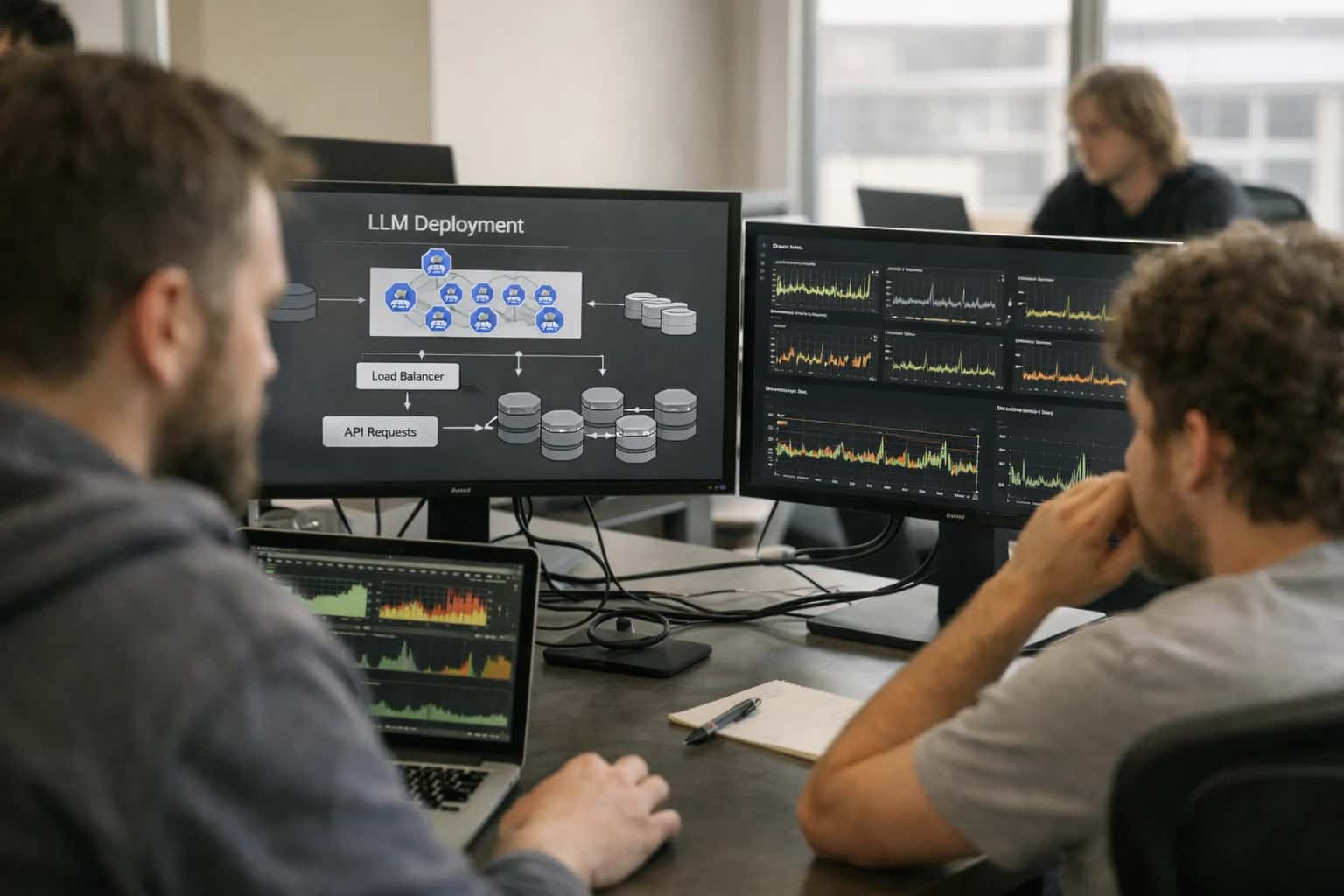
Traffic mirroring is a deployment technique where live production requests are duplicated and sent to a parallel, non-serving instance for analysis without affecting user responses.
PRODUCTION CANARY ANALYSIS
What is Traffic Mirroring?
Traffic mirroring is a critical technique in MLOps for safely evaluating new AI models in production.
In the context of Evaluation-Driven Development, traffic mirroring is foundational for production canary analysis. It provides the raw observational data needed to perform rigorous, quantitative comparisons between a stable champion model and a new challenger model. By analyzing mirrored traffic, engineers can validate performance against Service Level Objectives (SLOs), detect prediction drift, and gather evidence for a deployment verdict—promote or rollback—based on concrete metrics rather than simulated tests.
PRODUCTION CANARY ANALYSIS
Key Characteristics of Traffic Mirroring
Traffic mirroring is a non-disruptive deployment technique where live production requests are duplicated and sent to a parallel, non-serving instance of a service for analysis, validation, or performance testing without affecting the user-facing response.
01
Non-Disruptive Validation
The core characteristic of traffic mirroring is its zero-impact on live users. The primary production service handles all requests and returns responses to users normally. A duplicate (or 'mirrored') copy of each request is sent asynchronously to a separate, isolated environment. This allows for real-world testing using actual production traffic patterns and data distributions without any risk of degraded user experience, failed requests, or data corruption.
02
Architecture & Data Flow
Traffic mirroring is typically implemented at the infrastructure layer, often using a service mesh (e.g., Istio, Linkerd) or an API gateway. The key components are:
- Traffic Duplication Rule: A configuration that defines which requests to copy and where to send them.
- Shadow Instance: A full, non-serving deployment of the new service version (e.g., a new ML model) that receives the mirrored traffic.
- Asynchronous Processing: The mirrored traffic is sent on a best-effort basis; latency or failures in the shadow path do not affect the primary response.
- Dual Data Sinks: Outputs from both the primary and shadow services are logged to separate systems for comparative analysis.
03
Primary Use Cases in MLOps
In machine learning operations, traffic mirroring is critical for production canary analysis. Its main applications include:
- Model Performance Validation: Comparing the predictions, confidence scores, and business logic outputs of a new model (shadow) against the currently serving model (primary) under identical real-world conditions.
- Integration & Load Testing: Verifying that a new model service correctly integrates with downstream dependencies and can handle production-scale load without being in the critical path.
- Latency Profiling: Measuring the real inference latency of a new model architecture or hardware configuration.
- Data Distribution Analysis: Capturing the statistical properties of live inference requests to check for data drift or to create representative datasets for future training.
04
Comparison with Canary & Blue-Green
Traffic mirroring is often confused with related deployment strategies, but it serves a distinct purpose:
- vs. Canary Deployment: A canary serves live traffic to a subset of users. Traffic mirroring never serves user traffic; it only observes. Canary is for risk-limited release; mirroring is for pre-release validation.
- vs. Blue-Green Deployment: Blue-green involves two full-capacity, live environments with instant traffic switching. Mirroring involves a primary live environment and a passive shadow. Blue-green eliminates downtime; mirroring eliminates risk during testing.
- vs. Dark Launch: A dark launch activates new backend logic for a subset of users invisibly. Mirroring duplicates all logic execution but discards the shadow's outputs. Both are invisible, but a dark launch's code path affects some user transactions, while mirroring's does not.
05
Implementation Considerations
Successfully deploying traffic mirroring requires addressing several engineering challenges:
- Resource Cost: Running a full parallel service doubles compute resource consumption during the test period.
- Data Consistency: The shadow environment must have access to the same feature stores, databases, and caches as the primary to ensure valid comparisons. Write operations (e.g., database updates) triggered by mirrored requests must be suppressed or mocked to prevent duplicate side effects.
- Analysis Overhead: The system must log, correlate, and compare outputs from both paths. This requires robust experiment tracking and metric collection pipelines.
- Tooling: Often implemented using service mesh resources like Istio's
Mirrorfield in a VirtualService, or through specialized progressive delivery tools like Flagger or Argo Rollouts which automate the mirroring and analysis lifecycle.
06
Metrics & Evaluation
The value of traffic mirroring is realized through the analysis of comparative metrics. Key evaluation categories include:
- Functional Correctness: Do the shadow model's predictions align with the primary's within an expected tolerance? Are there new error types?
- Performance Metrics: What is the differential in p95/p99 latency, throughput, and resource utilization (CPU/GPU memory)?
- Business Logic Outputs: For a recommendation model, do the shadow's recommendations have a similar click-through rate when evaluated retrospectively?
- Statistical Drift: Does the distribution of the shadow model's input features or output scores significantly differ from the primary's, indicating a potential integration issue? The outcome of this analysis informs the deployment verdict for a subsequent canary or blue-green release.
PRODUCTION CANARY ANALYSIS
How Traffic Mirroring Works
Traffic mirroring is a foundational technique in Evaluation-Driven Development, enabling rigorous, zero-risk validation of new AI models in a live production environment.
Traffic mirroring is a deployment technique where live production requests are duplicated and sent to a parallel, non-serving instance of a service—such as a new AI model—for analysis without affecting the user-facing response. This creates a shadow environment where the new version processes real-world data in lockstep with the stable production system. The primary goal is to collect canary metrics—like prediction accuracy, latency, and error rates—for a comprehensive performance comparison against the baseline, all while maintaining a zero blast radius for end-users.
The mirrored traffic is analyzed using Automated Canary Analysis (ACA) frameworks that statistically compare the new version's outputs against the champion model. This validation is critical for hallucination detection, latency benchmarking, and ensuring instruction following accuracy before any user traffic is routed to the new system. Successful analysis leads to a deployment verdict to promote the model via a controlled canary deployment or traffic splitting, forming a core component of a robust production canary analysis strategy.
PRODUCTION CANARY ANALYSIS
Traffic Mirroring vs. Related Deployment Strategies
A comparison of key characteristics for deployment strategies used to validate new AI models and services in production environments.
| Feature / Characteristic | Traffic Mirroring (Shadow Deployment) | Canary Deployment | Blue-Green Deployment | A/B/n Testing |
|---|---|---|---|---|
Primary Objective | Validate performance & correctness with zero user impact | Assess stability & health on a small user subset | Enable zero-downtime releases & instant rollbacks | Statistically compare variants against a business metric |
User Traffic Impact | None (traffic is duplicated, not diverted) | Small, controlled percentage (e.g., 1-5%) | 100% (all traffic switches at once) | Split between variants (e.g., 50%/50%) |
Risk Exposure (Blast Radius) | Zero | Low | High (but reversible) | Controlled (based on split) |
Evaluation Method | Offline comparison of outputs/logs | Real-time metric analysis (Automated Canary Analysis) | Health checks & synthetic monitoring post-cutover | Hypothesis testing for statistical significance |
Typical Use Case in AI/ML | Testing new model inference accuracy & latency | Validating a new model's stability & error rate | Rolling out a major model version or infrastructure change | Comparing champion vs. challenger models on a business KPI |
Requires Parallel Infrastructure | ||||
Allows Direct User Feedback Collection | ||||
Enables Instant Rollback | ||||
Common Tooling Integration | Service meshes (Istio, Linkerd), Flagger | Argo Rollouts, Kayenta, Flagger, Spinnaker | Kubernetes, cloud load balancers, Spinnaker | Feature flag platforms, Optimizely, Statsig |
PRODUCTION CANARY ANALYSIS
Common Use Cases for Traffic Mirroring
Traffic mirroring is a foundational technique for safely evaluating new AI models and infrastructure in production. By duplicating live requests to a non-serving instance, teams can perform rigorous validation without user impact.
01
Model Performance Benchmarking
Traffic mirroring enables apples-to-apples comparison of a new model (challenger) against the current production model (champion) using identical, real-world inputs. This is critical for A/B testing and champion-challenger evaluations.
- Measure real-world metrics: Compare latency, throughput, and computational cost under actual load patterns.
- Validate quality improvements: Assess changes in output accuracy, relevance, or instruction-following without risking user-facing regressions.
- Establish statistical significance: Use mirrored traffic to power long-running experiments, gathering sufficient data for confident promotion decisions.
02
Hallucination & Safety Detection
Mirrored traffic allows for the deployment of specialized detector models and rule-based validators that scrutinize generative AI outputs for critical failures before a new model serves users.
- Identify factual inaccuracies: Run outputs through fact-checking pipelines or against knowledge graphs to flag potential hallucinations.
- Monitor for policy violations: Detect toxic, biased, or unsafe content using dedicated classifiers.
- Test adversarial robustness: Proactively evaluate model responses to prompt injection attempts or other adversarial inputs in a safe, isolated environment.
03
Infrastructure & Scaling Validation
Before a full cutover, traffic mirroring tests whether new hardware, orchestration platforms, or optimized inference engines can handle production-scale load. This is a form of dark launch or shadow testing.
- Load testing under real traffic: Validate autoscaling policies, GPU utilization, and memory management without affecting SLOs.
- Benchmark inference engines: Compare the performance of different serving stacks (e.g., vLLM, TensorRT-LLM, TGI) using identical request streams.
- Profile resource consumption: Accurately measure the CPU, memory, and I/O footprint of a new model version to right-size infrastructure.
04
Data Drift & Input Validation
By processing mirrored requests, teams can monitor the live data distribution flowing to the model, enabling proactive detection of data drift and validation of input schemas for new features.
- Establish a statistical baseline: Continuously compute summary statistics (means, variances, embeddings) on live inputs to detect shifts from the training distribution.
- Validate new feature encodings: Ensure new data pipelines or pre-processing logic function correctly before they affect user-facing predictions.
- Trigger retraining pipelines: Use drift detection on mirrored traffic as a signal to initiate model refresh cycles before performance degrades.
05
Downstream Integration Testing
Traffic mirroring validates how a new model's outputs integrate with and affect dependent downstream systems, such as databases, caching layers, and business logic, in a production-like context.
- Test API contracts: Verify that the new model's output schema is compatible with all consuming services and applications.
- Assess business logic impact: Run mirrored outputs through post-processing rules and decision engines to check for unintended consequences.
- Warm caches and indexes: Populate vector databases, recommendation indices, or other caches with outputs from the new model before it goes live.
06
Training Data Collection & Enrichment
Mirrored traffic serves as a high-fidelity source of production data for continuous model improvement. This data is invaluable for creating fine-tuning datasets and synthetic data generation.
- Gather hard examples: Identify and log queries where the current model performs poorly, creating a targeted dataset for retraining.
- Generate preference data: Use mirrored inputs to collect pairs of candidate outputs for reinforcement learning from human feedback (RLHF) or automated ranking.
- Create evaluation suites: Build a continuously updated test set that reflects the evolving distribution of real user requests.
PRODUCTION CANARY ANALYSIS
Frequently Asked Questions
Essential questions about traffic mirroring, a critical technique for safely evaluating new AI models and services in production without impacting end-users.
Traffic mirroring is a deployment and evaluation technique where live production requests are duplicated and sent to a parallel, non-serving instance of a service for analysis without affecting the user-facing response. It works by intercepting incoming traffic at the load balancer or service mesh level (e.g., using an Istio VirtualService), creating an exact copy of each request, and routing that copy to a shadow or mirror environment. The mirrored service processes the request, but its output is discarded or logged for analysis; the user receives the response only from the stable, primary service. This allows for zero-risk validation of new model versions, infrastructure changes, or code under real-world load and data conditions.
Enabling Efficiency, Speed & Accuracy
Intelligent Analysis, Decision & Execution
We build AI systems for teams that need search across company data, workflow automation across tools, or AI features inside products and internal software.
Talk to Us
Search across company data
Give teams answers from docs, tickets, runbooks, and product data with sources and permissions.
Useful when people spend too long searching or get different answers from different systems.
Enterprise searchRAGPermissions
Read more
Automate internal workflows
Use AI to route work, draft outputs, trigger actions, and keep approvals and logs in place.
Useful when repetitive work moves across multiple tools and teams.
AI agentsWorkflow automationGovernance
Read more
Add AI to products and internal tools
Build assistants, guided actions, or decision support into the software your team or customers already use.
Useful when AI needs to be part of the product, not a separate tool.
AI integrationDecision supportModel routing
Read more
About the author
Prasad Kumkar
CEO & MD, Inference Systems
Prasad Kumkar is the CEO & MD of Inference Systems and writes about AI systems architecture, LLM infrastructure, model serving, evaluation, and production deployment. Over 5+ years, he has worked across computer vision models, L5 autonomous vehicle systems, and LLM research, with a focus on taking complex AI ideas into real-world engineering systems.
His work and writing cover AI systems, large language models, AI agents, multimodal systems, autonomous systems, inference optimization, RAG, evaluation, and production AI engineering.
LinkedIn
Limited slotsGet a Free AI Consultation
Partnered with leading AI, data, and software stack.





How We Work
Custom AI workflows for your Business
One-fit-all AI don't work for modern businesses. At Inferensys, we aim to understand your business & custom requirements; which we use to define most efficient agentic workflows, the data, and the tools for your business.
01
Review the use case
We understand the task, the users, and where AI can actually help.
Read more02
Pick the right approach
We define what needs search, automation, or product integration.
Read more03
Build the first useful version
We implement the part that proves the value first.
Read more04
Improve from there
We add the checks and visibility needed to keep it useful.
Read moreThe first call is a practical review of your use case and the right next step.
Talk to Us