A dark launch is a deployment strategy where new backend functionality is released and activated for a subset of users or internal systems without any visible changes to the user interface. This allows for real-world load testing and validation under actual production conditions, enabling teams to monitor system performance, catch bugs, and verify data integrity before a full, user-facing release. It is a core technique within Evaluation-Driven Development for mitigating risk.

Glossary
Dark Launch
A dark launch is a deployment strategy where new backend functionality is released and activated for a subset of users or internal systems without any visible changes to the user interface.
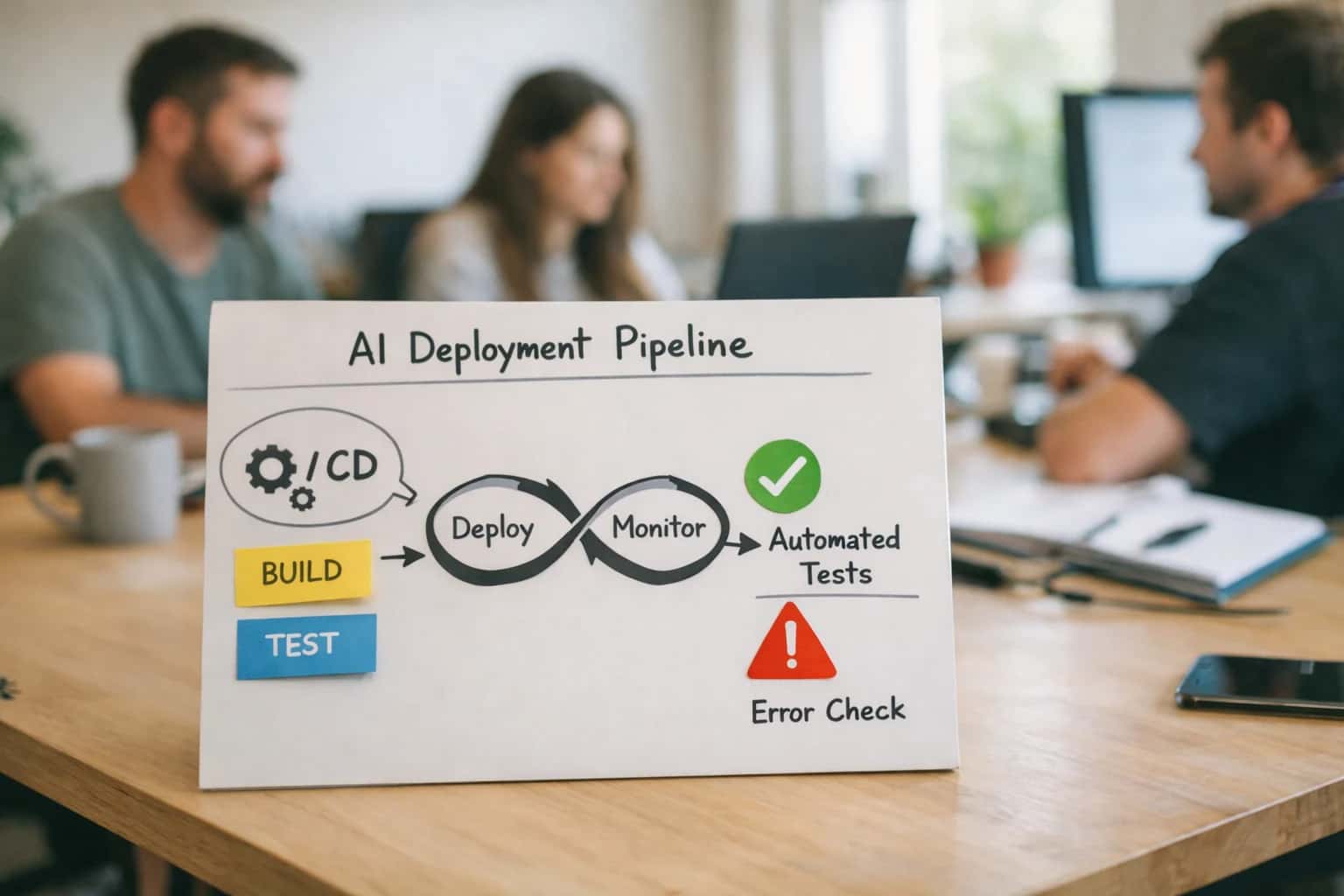
PRODUCTION CANARY ANALYSIS
What is Dark Launch?
A deployment strategy for validating new backend functionality with live traffic before a user-facing release.
The process involves deploying the new code path alongside the existing system and using mechanisms like feature flags or traffic splitting to silently route a controlled percentage of requests to it. Key metrics such as latency, error rates, and resource utilization are closely monitored. This strategy is foundational for production canary analysis, providing empirical evidence of a change's stability and performance impact without exposing end-users to potential failures.
PRODUCTION CANARY ANALYSIS
Key Characteristics of Dark Launches
A dark launch is a deployment strategy where new backend functionality is released and activated for a subset of users or internal systems without any visible changes to the user interface, allowing for real-world load testing and validation. Its key characteristics distinguish it from other progressive delivery techniques.
01
Zero User Interface Changes
The defining feature of a dark launch is the complete absence of visible changes to the end-user's frontend experience. The new functionality runs silently in the background, often triggered by the same user actions that call the existing service. This allows engineering teams to:
- Validate performance under real production load without user awareness.
- Test integration with downstream systems using live data flows.
- Gather operational metrics (e.g., latency, error rates, resource consumption) for the new code path before committing to a user-facing release.
02
Internal or Subset Activation
Activation is strictly controlled and limited, never exposing all users simultaneously. Common activation scopes include:
- Internal user cohorts: Engineers, QA teams, or beta testers.
- Percentage-based traffic splitting: A small, randomized percentage of all requests (e.g., 1%, 5%).
- Specific request headers or cookies: Traffic from particular geographic regions or user segments.
- Shadow mode: All traffic is duplicated to the new service, but its responses are discarded and only used for comparison. This granular control minimizes blast radius and allows for isolated observation.
03
Real-World Load & Integration Testing
Unlike staging environments, dark launches test systems under authentic production conditions. This surfaces issues impossible to simulate, such as:
- Actual data volumes and shapes from live users.
- Integration points with third-party APIs and internal microservices at real scale.
- Resource contention and scaling behavior under true concurrent load.
- Edge cases and data permutations that exist only in the production dataset. This moves validation from hypothetical synthetic testing to empirical verification.
04
Dependency on Feature Flags
Dark launches are almost universally implemented using feature flags (feature toggles). These are conditional configuration switches that control code execution paths without requiring a new deployment. Key aspects:
- Dynamic toggling: Flags can be enabled/disabled in real-time via a management console, allowing instant rollback.
- Granular targeting: Flags support the activation scopes (user cohorts, percentages) essential for dark launches.
- Decoupling deployment from release: New code is deployed to production but remains unreleased until the flag is activated, separating technical delivery from business launch.
05
Focus on Operational Metrics, Not Business KPIs
The primary evaluation during a dark launch is on system health and performance, not user engagement or conversion. Core monitored metrics include:
- Infrastructure Metrics: CPU/memory utilization, garbage collection cycles, database query latency.
- Application Performance: P95/P99 latency, error rate (4xx/5xx), throughput (requests per second).
- Comparative Analysis: Metrics are compared side-by-side between the old (control) and new (canary) code paths. Success is defined by non-regression in these operational signals, not by an improvement in a business outcome, which cannot be measured without a UI change.
06
Precursor to Canary or Blue-Green Deployment
A dark launch is typically an earlier, more technical phase in a broader progressive delivery pipeline. Its role is to de-risk the subsequent user-facing release.
- Sequence: Dark Launch (backend validation) → Canary Deployment (UI exposed to small user group) → Progressive Rollout (increasing percentages) → Full Launch.
- Outcome: If the dark launch reveals critical performance bugs or integration failures, the issue is fixed without any user impact. Once the backend is proven stable, the feature flag can be used to activate the accompanying UI changes, transitioning the strategy into a standard canary release.
PRODUCTION CANARY ANALYSIS
How Dark Launch Works
A dark launch is a deployment strategy where new backend functionality is released and activated for a subset of users or internal systems without any visible changes to the user interface, allowing for real-world load testing and validation.
A dark launch is a deployment strategy where new backend functionality is released and activated for a subset of users or internal systems without any visible changes to the user interface. This allows for real-world load testing, performance validation, and failure detection using actual production traffic, but in a way that is completely invisible to the end-user. It is a form of progressive delivery that precedes a full public rollout.
The process is managed via feature flags or configuration toggles that silently route a percentage of traffic to the new service path. Engineers monitor canary metrics like latency, error rates, and system saturation to validate stability under real conditions. This approach minimizes blast radius by confining potential failures to internal systems, providing a critical safety layer before a canary deployment or full release to users.
COMPARISON
Dark Launch vs. Other Deployment Strategies
A technical comparison of deployment strategies used in MLOps and software engineering for controlled, low-risk releases.
| Feature / Characteristic | Dark Launch | Canary Deployment | Blue-Green Deployment | Shadow Deployment (Traffic Mirroring) |
|---|---|---|---|---|
Primary Objective | Real-world load testing & validation without user-facing changes | Stability & performance validation on a user subset | Zero-downtime releases & instant rollback | Behavioral comparison & validation without user impact |
User Visibility | None (backend-only activation) | Visible to a controlled user subset | Visible to all users after cutover | None (traffic is duplicated, not served) |
Traffic Routing | Internal or subset routing via feature flags; UI unchanged | Percentage-based splitting (e.g., 5% to new version) | Full, instantaneous switch between two complete environments | 100% duplication of live traffic to a parallel instance |
Impact on Live Users | None | Direct impact on the canary group | Direct impact on all users after switch | None |
Rollback Mechanism | Disable feature flag or internal routing | Reroute traffic back to stable version | Instant switch back to previous environment | Shut down shadow instance; no user traffic to reroute |
Validation Data Source | Real production load & infrastructure telemetry | Live user interactions & system metrics from canary group | Post-cutover live traffic & health checks | Comparative analysis of outputs (e.g., model predictions) between versions |
Typical Use Case in AI/ML | Load testing new model inference endpoints, validating data pipelines | Phased rollout of a new ML model to measure accuracy & latency | Major version upgrade of a model-serving API with zero downtime | Comparing a new model's predictions against the champion model's in real-time |
Complexity & Overhead | Moderate (requires feature flagging & internal plumbing) | Moderate (requires traffic routing & metric analysis) | High (requires duplicate infrastructure & precise cutover) | High (requires double compute resources & idempotent processing) |
Risk Profile (Blast Radius) | Very Low (no user-facing changes) | Low (limited to small user percentage) | Moderate (full cutover risk, but fast rollback) | Very Low (no live traffic served) |
EVALUATION-DRIVEN DEPLOYMENT
Dark Launch Use Cases in AI/ML
Dark launch is a deployment strategy where new backend functionality is activated for a subset of users or internal systems without visible UI changes, enabling real-world testing and validation. This section details its core applications in AI/ML systems.
01
Load & Scalability Testing for New Models
A dark launch allows a new, more complex model to be deployed into the production serving infrastructure and receive a copy of live inference traffic, without its outputs being served to end-users. This enables engineers to:
- Validate infrastructure scaling under real-world request patterns and concurrency.
- Profile actual inference latency and resource consumption (GPU memory, CPU) before user-facing cutover.
- Identify bottlenecks in pre/post-processing pipelines or model-serving frameworks that only appear at production scale.
- Example: A company launching a larger vision transformer can dark launch it to mirror traffic from its current ResNet, measuring if the new model's 2x latency increase will require autoscaling adjustments.
02
Champion-Challenger Model Evaluation
This is a primary use case where a new candidate model (the challenger) processes live requests in parallel with the current production model (the champion). The challenger's outputs are logged and compared offline. Key activities include:
- Collecting ground-truth labels for the challenger's predictions over time to calculate live accuracy, precision, and recall.
- Measuring business KPIs (e.g., conversion rate, user engagement) on the subset of traffic, though users see the champion's results.
- Detecting edge-case failures or regressions on real, evolving data that were not present in the static test set.
- This provides a statistically significant performance comparison in the true production environment, de-risking the eventual promotion.
03
Data Pipeline & Integration Validation
Before a new model is activated, its supporting data pipelines must be verified. A dark launch allows the full inference pipeline—from feature fetching to post-processing—to be executed with real requests. Engineers can:
- Verify feature consistency between training/serving, catching training-serving skew early.
- Test new data sources or feature stores integrated into the inference graph.
- Validate the end-to-end data lineage and logging for the new pipeline.
- Monitor for data quality issues (missing values, schema drift) on live data that the model will depend on.
- This ensures the operational data plumbing is robust before the model's predictions affect any business logic.
04
Shadow Deployment for Agentic Systems
For complex multi-agent systems or agentic workflows, a dark launch (often called a shadow deployment) is critical. The entire new agentic graph executes using mirrored user inputs, allowing observation of:
- End-to-end reasoning trace correctness and coherence over diverse real queries.
- Tool-calling reliability and external API integration success rates.
- Cascading failure modes and error handling between chained agents.
- Overall task completion latency for multi-step operations.
- The autonomous system's behavior can be fully evaluated, and its agentic memory interactions logged, without any risk of executing incorrect physical or digital actions.
05
Performance Baselining for RAG Systems
Deploying a new Retrieval-Augmented Generation (RAG) architecture involves multiple components: embedding models, vector databases, and the LLM. A dark launch enables holistic performance measurement:
- Measuring retrieval latency and recall@k for new embedding models or vector indexes against real user queries.
- Validating the quality of retrieved context and its relevance to the query before the LLM generates an answer.
- Baselining the final answer quality using human or model-based evaluation on live Q&A pairs.
- Testing cache hit rates and semantic search effectiveness under production load.
- This ensures the entire RAG pipeline meets latency SLOs and quality thresholds before serving answers to users.
06
Observability & Monitoring Ramp-Up
A dark launch provides a controlled environment to deploy and validate new observability tooling for the AI system. Teams can:
- Test new telemetry and logging without alert fatigue, ensuring metrics are correctly emitted.
- Calibrate anomaly detection and drift detection systems on the new model's predictions.
- Validate dashboard visualizations and alerting rules using real-time, dark-launched data.
- Practice incident response procedures using the dark launch's isolated failure modes.
- This creates a fully instrumented and monitored system before it becomes user-critical, supporting robust AI SLO/SLI definition.
DARK LAUNCH
Frequently Asked Questions
A dark launch is a deployment strategy for validating new backend functionality with live traffic before a user-facing release. This FAQ clarifies its purpose, mechanics, and role within modern MLOps and software delivery.
A dark launch is a deployment strategy where new backend functionality is released and activated for a subset of users or internal systems without any visible changes to the user interface, allowing for real-world load testing and validation. It works by deploying the new code or model alongside the existing production system and then using mechanisms like feature flags or traffic splitting to silently route a controlled percentage of live requests to the new version. The user-facing application continues to display results from the stable, original system, while the outputs and performance of the 'dark' system are monitored and compared in the background. This process validates scalability, performance under load, and functional correctness using real production data and traffic patterns, without exposing end-users to potential failures or incomplete features.
Enabling Efficiency, Speed & Accuracy
Intelligent Analysis, Decision & Execution
We build AI systems for teams that need search across company data, workflow automation across tools, or AI features inside products and internal software.
Talk to Us
Search across company data
Give teams answers from docs, tickets, runbooks, and product data with sources and permissions.
Useful when people spend too long searching or get different answers from different systems.
Enterprise searchRAGPermissions
Read more
Automate internal workflows
Use AI to route work, draft outputs, trigger actions, and keep approvals and logs in place.
Useful when repetitive work moves across multiple tools and teams.
AI agentsWorkflow automationGovernance
Read more
Add AI to products and internal tools
Build assistants, guided actions, or decision support into the software your team or customers already use.
Useful when AI needs to be part of the product, not a separate tool.
AI integrationDecision supportModel routing
Read more
About the author
Prasad Kumkar
CEO & MD, Inference Systems
Prasad Kumkar is the CEO & MD of Inference Systems and writes about AI systems architecture, LLM infrastructure, model serving, evaluation, and production deployment. Over 5+ years, he has worked across computer vision models, L5 autonomous vehicle systems, and LLM research, with a focus on taking complex AI ideas into real-world engineering systems.
His work and writing cover AI systems, large language models, AI agents, multimodal systems, autonomous systems, inference optimization, RAG, evaluation, and production AI engineering.
LinkedIn
Limited slotsGet a Free AI Consultation
Partnered with leading AI, data, and software stack.





How We Work
Custom AI workflows for your Business
One-fit-all AI don't work for modern businesses. At Inferensys, we aim to understand your business & custom requirements; which we use to define most efficient agentic workflows, the data, and the tools for your business.
01
Review the use case
We understand the task, the users, and where AI can actually help.
Read more02
Pick the right approach
We define what needs search, automation, or product integration.
Read more03
Build the first useful version
We implement the part that proves the value first.
Read more04
Improve from there
We add the checks and visibility needed to keep it useful.
Read moreThe first call is a practical review of your use case and the right next step.
Talk to Us