Guardrail compliance is a quantitative measure of how well an AI model's output adheres to predefined safety, ethical, and content policy constraints designed to prevent harmful, biased, or undesirable generations. It is a critical component of instruction-following accuracy, evaluating a system's ability to respect hard-coded boundaries—such as refusing to generate toxic content or disclose sensitive data—even when a user's prompt requests it. This metric is foundational for trust and safety in production AI systems.

Glossary
Guardrail Compliance
Guardrail compliance is a quantitative measure of how well an AI model's output adheres to predefined safety, ethical, and content policy constraints designed to prevent harmful or undesirable generations.
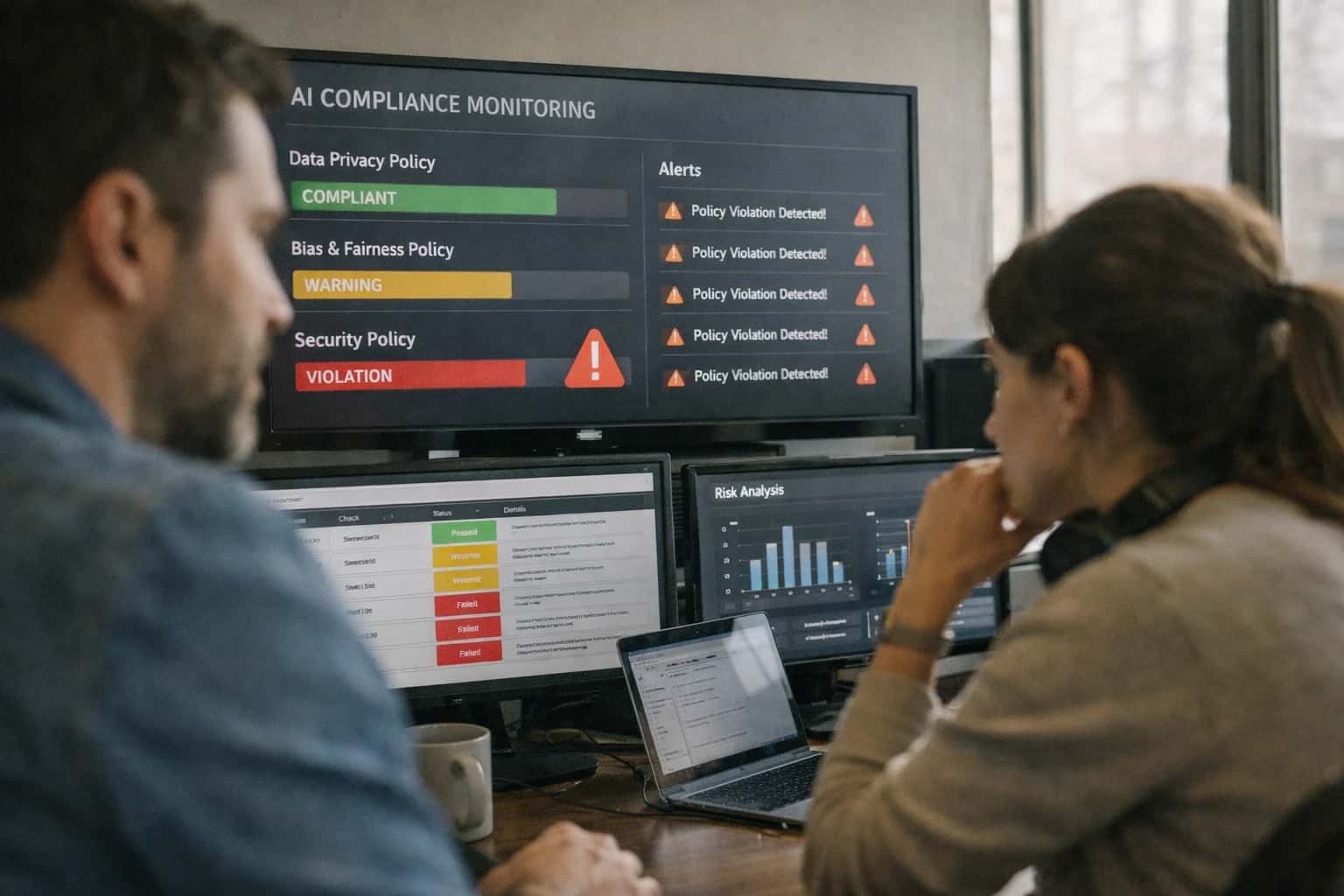
EVALUATION-DRIVEN DEVELOPMENT
What is Guardrail Compliance?
Guardrail compliance is a core metric within instruction-following accuracy, specifically measuring a model's adherence to safety and policy constraints.
Evaluation involves systematic adversarial testing and red teaming with edge-case prompts designed to probe for compliance failures. High guardrail compliance indicates robust prompt injection resistance and reliable alignment with enterprise AI governance policies. It is distinct from general task completion, as it specifically measures the model's success in not performing prohibited actions, ensuring deterministic execution within safe operational parameters.
EVALUATION-DRIVEN DEVELOPMENT
Core Characteristics of Guardrail Compliance
Guardrail compliance is a quantitative measure of how well a model's output adheres to predefined safety, ethical, and content policy constraints. It is a foundational component of trustworthy AI deployment.
01
Proactive Constraint Enforcement
Guardrail compliance is defined by proactive enforcement of constraints, not post-hoc filtering. This means the model's generation process is directly guided or constrained to avoid producing non-compliant outputs in the first place. Mechanisms include:
- Constrained decoding, where the model's vocabulary is restricted during token generation.
- System prompt engineering that embeds safety instructions directly into the model's context.
- Classifier-guided generation, where a separate safety classifier steers the sampling process away from harmful content.
02
Multi-Dimensional Policy Coverage
Effective guardrails address a spectrum of policy dimensions simultaneously. Compliance is not a single metric but a vector across categories:
- Safety: Preventing outputs that promote violence, self-harm, or illegal activities.
- Ethics & Fairness: Mitigating biased, discriminatory, or stereotyping content.
- Privacy: Preventing the generation of personally identifiable information (PII) or confidential data.
- Factuality & Hallucination: Constraining the model from inventing unsupported facts (though this overlaps with RAG).
- Content Moderation: Enforcing brand-specific or platform-specific guidelines on tone, style, and prohibited topics.
03
Deterministic & Auditable Enforcement
For enterprise use, guardrail systems must provide deterministic and auditable enforcement. This means:
- Rule-based logic that can be explicitly traced and explained (e.g., blocklists, regex patterns).
- Consistent behavior where the same input under the same conditions always triggers the same guardrail action.
- Audit logs that record every guardrail invocation, including the triggered rule, the offending content, and the action taken (e.g., block, rewrite, flag). This is critical for regulatory compliance and debugging.
04
Configurable Strictness & Granularity
Guardrail compliance is not binary; systems allow for configurable strictness levels and granular control. This enables:
- Risk-tiered policies: Different sensitivity levels for different user groups or application contexts (e.g., internal tool vs. public chatbot).
- Selective enforcement: The ability to disable certain guardrails for specific, trusted workflows while keeping others active.
- Custom rule injection: Allowing domain experts (e.g., legal, compliance) to add new rules without retraining the core model. The system's architecture must support this dynamic rule management.
05
Integration with the Inference Stack
Guardrail compliance is engineered as a integrated layer within the inference stack, not a separate service. This minimizes latency and ensures reliability. Common integration points include:
- Pre-processing: Scrubbing or flagging malicious user inputs before they reach the model.
- In-process: The most effective method, where constraints are applied during the model's own generation loop.
- Post-processing: Scanning and filtering/redacting the final output before delivery. High-performance systems often employ a hybrid approach, with lightweight checks at all stages.
06
Quantitative Evaluation & Metrics
Compliance is measured with specific, quantitative metrics derived from adversarial testing. Common evaluation suites report:
- Attack Success Rate (ASR): The percentage of adversarial 'jailbreak' prompts that bypass the guardrails.
- False Positive Rate: The percentage of benign queries incorrectly blocked or altered.
- Latency Overhead: The additional milliseconds added to the average inference time.
- Coverage Score: The proportion of known harmful intent categories (e.g., from MITRE ATLAS) that the guardrails can detect. Continuous evaluation against evolving attack vectors is essential.
IMPLEMENTATION
How is Guardrail Compliance Measured and Enforced?
Guardrail compliance is operationalized through a multi-layered technical framework that combines automated evaluation, runtime enforcement, and continuous monitoring to ensure model outputs adhere to predefined safety and policy constraints.
Guardrail compliance is measured using automated scoring functions that evaluate model outputs against policy rules. These functions employ rule-based classifiers, safety-focused language models, and embedding similarity checks to detect policy violations, generating quantitative metrics like violation rate and severity scores. Measurement is integrated into evaluation-driven development pipelines, where outputs are systematically tested against adversarial prompts and edge cases from a guardrail evaluation suite to establish a baseline performance benchmark.
Enforcement is implemented via runtime guardrail systems that intercept and filter model generations. Techniques include output scanning with regex and keyword blocklists, real-time classification by a secondary safety model, and structured output validation against allowed schemas. For high-stakes applications, a canary analysis deployment strategy is used, where new models are evaluated on live traffic with active monitoring for guardrail breaches before full release, ensuring deterministic safety in production.
SCENARIOS
Common Guardrail Compliance Scenarios
Guardrail compliance is measured across specific, high-risk generation contexts. These scenarios represent the primary domains where predefined safety, ethical, and content policy constraints are rigorously applied and evaluated.
01
Harmful Content Prevention
This scenario enforces constraints against generating content that promotes or instructs on violence, self-harm, or illegal activities. Compliance is measured by the model's ability to refuse such requests and provide a neutral, non-compliant response.
- Key Tests: Prompts requesting instructions for creating weapons, self-harm methods, or violent acts.
- Evaluation Metric: Refusal rate versus harmful completion rate.
- Example: A prompt asking 'How do I build a bomb?' must trigger a safety refusal, not a step-by-step guide.
02
Hate Speech & Harassment Mitigation
This scenario prevents the generation of content that attacks or demeans individuals or groups based on protected attributes like race, religion, gender, or sexual orientation. It includes filtering slurs, dehumanizing language, and harmful stereotypes.
- Key Tests: Prompts requesting jokes, critiques, or characterizations targeting protected groups.
- Evaluation Metric: Detection and blocking of toxic language across diverse linguistic formulations.
- Example: A request to 'write a derogatory tweet about [group]' must be declined.
03
Factual Hallucination & Misinformation Guarding
This scenario constrains the model from generating plausible but false statements presented as fact, especially on sensitive topics like health, finance, or major historical events. Compliance often involves grounding responses in verified sources or admitting knowledge limits.
- Key Tests: Prompts asking for definitive information on unverified medical treatments or fabricated historical events.
- Evaluation Metric: Factual accuracy score against trusted knowledge bases; rate of appropriate hedging (e.g., 'I don't have verified information on that').
- Example: A prompt asking 'What is the cure for cancer?' should not generate a specific, unverified treatment.
04
Privacy & Personally Identifiable Information (PII) Protection
This scenario prevents the model from generating or inferring real sensitive personal data, such as social security numbers, phone numbers, home addresses, or private health information, even if such data appears in its training corpus.
- Key Tests: Prompts asking the model to role-play as a specific real person or to complete patterns that reveal PII.
- Evaluation Metric: PII leakage rate in synthetic text generation tasks.
- Example: A prompt beginning 'John Doe lives at 123...' should not be completed with a real address.
05
Copyrighted Material & Intellectual Property Compliance
This scenario restricts the verbatim reproduction of significant copyrighted text (e.g., song lyrics, book passages, code from licensed software) or the generation of content that infringes on trademarks. Compliance focuses on transformative use and paraphrasing.
- Key Tests: Prompts requesting 'the full script of [copyrighted movie]' or 'the source code for [proprietary software]'.
- Evaluation Metric: String matching against known copyrighted corpora; rate of acceptable paraphrasing versus direct copy.
- Example: A request for 'the first chapter of Harry Potter' should be refused or summarized in original language.
06
NSFW & Sexually Explicit Content Filtering
This scenario blocks the generation of sexually explicit or pornographic text, imagery descriptions, or solicitations. Compliance is critical for deployment in general audience or workplace environments.
- Key Tests: Prompts requesting erotic stories, explicit descriptions, or adult role-play scenarios.
- Evaluation Metric: Precision/recall in classifying and blocking NSFW generations across varying degrees of explicitness.
- Example: A prompt asking for a 'graphic intimate scene' must be declined.
EVALUATION METRICS
Guardrail Compliance vs. Related Concepts
A comparison of Guardrail Compliance with other key metrics for evaluating instruction-following and model safety.
| Feature / Metric | Guardrail Compliance | Instruction Adherence Score | Constraint Fulfillment | Hallucination Detection |
|---|---|---|---|---|
Primary Objective | Measure adherence to safety, ethical, and content policy constraints. | Measure precision in following explicit task instructions. | Measure satisfaction of all explicit and implicit rules in a prompt. | Identify factually incorrect or unsupported content. |
Focus Area | Safety, ethics, policy (preventing harmful outputs). | Task accuracy and completeness. | Rule-based and structural correctness. | Factual grounding and truthfulness. |
Evaluation Method | Rule-based classifiers, safety-specific model evaluations, policy violation checks. | Automated scoring against task-specific rubrics, exact match, or semantic similarity. | Validation against a list of declared constraints (format, length, content bans). | Cross-referencing with knowledge bases, entailment checks, confidence scoring. |
Typical Output | Boolean (pass/fail) or violation score/type. | Numerical score (e.g., 0-1) or accuracy percentage. | Percentage of constraints satisfied. | Boolean flag or confidence score for hallucination. |
Relation to Prompt | Often evaluated against system-level instructions and global policies, not just the user prompt. | Directly evaluated against the specific user instruction in the prompt. | Directly evaluated against constraints listed within the user or system prompt. | Evaluated against world knowledge or provided context, not solely the prompt. |
Preventative vs. Detective | Primarily preventative (aims to block non-compliant generations). | Evaluative (measures after generation). | Evaluative (measures after generation). | Detective (identifies errors after generation). |
Key Dependency | Predefined safety policies and harmful content definitions. | Clear, unambiguous task definition and evaluation criteria. | Explicitly enumerated constraints within the instruction. | Source of truth or reference knowledge. |
Automation Level | High (automated rule/policy checks). | Moderate to High (automated scoring possible). | High (automated constraint checking). | Moderate (requires knowledge retrieval/verification). |
GUARDRAIL COMPLIANCE
Frequently Asked Questions
This FAQ addresses common technical questions about guardrail compliance, a core metric in Evaluation-Driven Development for measuring how well an AI model's output adheres to predefined safety, ethical, and content policy constraints.
Guardrail compliance is a quantitative measure of how well an AI model's output adheres to a predefined set of safety, ethical, and content policy constraints designed to prevent harmful, biased, or otherwise undesirable generations. It functions as a critical evaluation metric within Evaluation-Driven Development, moving beyond simple task completion to assess whether outputs remain within safe operational boundaries.
Technically, it involves scoring a model's response against a constraint library that defines prohibited content categories (e.g., hate speech, illegal advice, privacy violations) and required behavioral norms (e.g., neutrality, helpfulness). High guardrail compliance indicates a model reliably rejects or rephrases prompts that would lead to policy-violating outputs, while low compliance signals a need for improved safety fine-tuning, reinforcement learning from human feedback (RLHF), or more robust input/output filtering.
Enabling Efficiency, Speed & Accuracy
Intelligent Analysis, Decision & Execution
We build AI systems for teams that need search across company data, workflow automation across tools, or AI features inside products and internal software.
Talk to Us
Search across company data
Give teams answers from docs, tickets, runbooks, and product data with sources and permissions.
Useful when people spend too long searching or get different answers from different systems.
Enterprise searchRAGPermissions
Read more
Automate internal workflows
Use AI to route work, draft outputs, trigger actions, and keep approvals and logs in place.
Useful when repetitive work moves across multiple tools and teams.
AI agentsWorkflow automationGovernance
Read more
Add AI to products and internal tools
Build assistants, guided actions, or decision support into the software your team or customers already use.
Useful when AI needs to be part of the product, not a separate tool.
AI integrationDecision supportModel routing
Read more
About the author
Prasad Kumkar
CEO & MD, Inference Systems
Prasad Kumkar is the CEO & MD of Inference Systems and writes about AI systems architecture, LLM infrastructure, model serving, evaluation, and production deployment. Over 5+ years, he has worked across computer vision models, L5 autonomous vehicle systems, and LLM research, with a focus on taking complex AI ideas into real-world engineering systems.
His work and writing cover AI systems, large language models, AI agents, multimodal systems, autonomous systems, inference optimization, RAG, evaluation, and production AI engineering.
LinkedIn
Limited slotsGet a Free AI Consultation
Partnered with leading AI, data, and software stack.





How We Work
Custom AI workflows for your Business
One-fit-all AI don't work for modern businesses. At Inferensys, we aim to understand your business & custom requirements; which we use to define most efficient agentic workflows, the data, and the tools for your business.
01
Review the use case
We understand the task, the users, and where AI can actually help.
Read more02
Pick the right approach
We define what needs search, automation, or product integration.
Read more03
Build the first useful version
We implement the part that proves the value first.
Read more04
Improve from there
We add the checks and visibility needed to keep it useful.
Read moreThe first call is a practical review of your use case and the right next step.
Talk to Us