Compliance reporting is the systematic process of generating and submitting documented evidence to demonstrate an organization's adherence to internal policies and external regulatory requirements. In a semantic data governance framework, this evidence is derived from a knowledge graph, which provides a deterministic, interconnected view of data lineage, access controls, and policy enforcement. The report itself is a formal artifact that answers specific regulatory queries with verifiable facts.

Glossary
Compliance Reporting
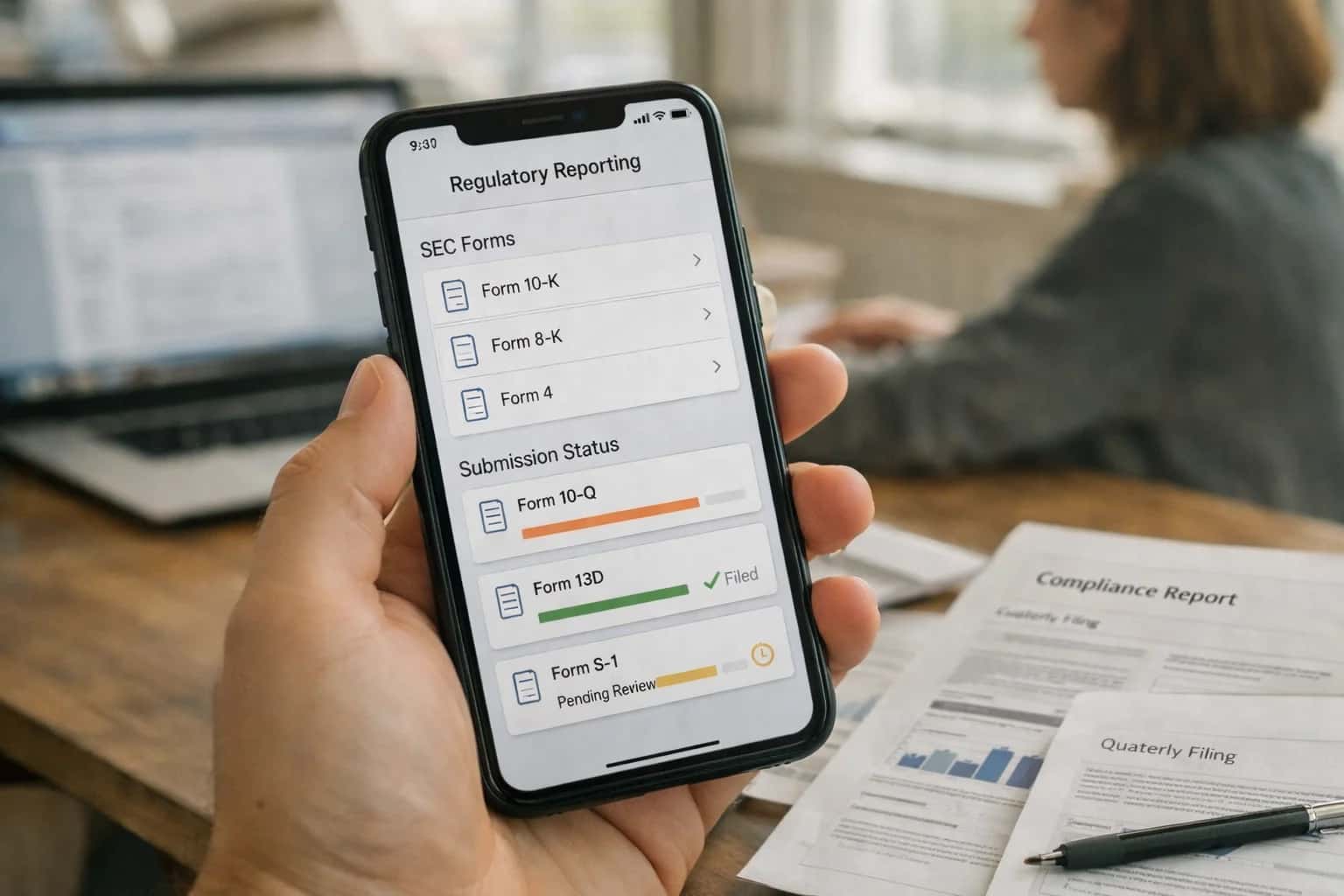
Compliance reporting is the process of generating and submitting documented evidence to demonstrate adherence to internal policies and external regulatory requirements.
SEMANTIC DATA GOVERNANCE
What is Compliance Reporting?
Compliance reporting is a core function of semantic data governance, transforming structured evidence into auditable documentation for regulators and internal stakeholders.
The process is automated by mapping regulatory obligations to data quality rules, access control policies, and audit logs stored within the governance system. This creates a continuous feedback loop where reporting requirements directly inform data classification and provenance capture standards. Effective compliance reporting reduces audit latency and provides a single source of truth for obligations under frameworks like GDPR or industry-specific mandates.
SEMANTIC DATA GOVERNANCE
Key Components of a Compliance Report
A compliance report is a structured artifact that documents evidence of adherence to regulations and policies. In a semantic data governance context, it leverages the deterministic relationships within a knowledge graph to automate evidence generation and trace lineage.
01
Executive Summary & Attestation
This section provides a high-level overview of the report's scope, period, and overall compliance posture, culminating in a formal attestation statement. It is generated by querying the knowledge graph for aggregated policy coverage and exception metrics.
- Attestation Statement: A legally binding declaration from a responsible officer (e.g., Chief Data Officer) confirming the accuracy of the report.
- Scope Definition: Explicitly lists the data domains, regulatory frameworks (e.g., GDPR, CCPA), and business processes covered.
- Summary Metrics: Presents key performance indicators like policy coverage percentage, data quality score, and count of open exceptions.
02
Policy-to-Control Mapping
The core of the report demonstrates how abstract regulatory articles and internal policies are implemented via specific technical and administrative controls. A knowledge graph explicitly models these relationships as semantic triples (e.g., GDPR-Article-17 <isImplementedBy> DataErasureProcedure).
- Regulatory Citations: Direct references to clauses from frameworks like the EU AI Act or HIPAA.
- Control Descriptions: Detailed specifications of the preventative, detective, and corrective controls in place.
- Implementation Evidence: Links to system configurations, access control lists (ACLs), and automated workflow logs that prove control operation.
03
Data Lineage & Provenance Evidence
This component provides verifiable traces of data origin, movement, and transformation, which is critical for regulations emphasizing data minimization and purpose limitation. The knowledge graph's inherent structure captures provenance as a first-class citizen.
- Source-to-Target Mapping: Visual or tabular representation of how data flows from source systems to reported metrics.
- Transformation Logic: Documentation of any data masking, tokenization, or aggregation applied.
- Provenance Records: Immutable audit logs showing the who, what, when, and why of data access and changes, often linked via W3C PROV ontology standards.
04
Access Governance & Entitlement Review
Documents who has access to what data and whether those permissions are appropriate. This is automated by querying the unified Role-Based Access Control (RBAC) or Attribute-Based Access Control (ABAC) policies modeled in the knowledge graph against actual user-role assignments.
- User Access Certifications: Lists of users with access to sensitive data assets (e.g., PII, PHI), requiring periodic manager review and sign-off.
- Privileged Account Audit: Review of accounts with elevated permissions, such as database administrators.
- Segregation of Duties (SoD) Analysis: Report on any conflicts where a single user holds incompatible roles, a key control for financial compliance like SOX.
05
Data Quality & Integrity Metrics
Quantifies the fitness of the governed data for its intended use, providing evidence for the accuracy principle of many regulations. Metrics are derived from the continuous execution of data quality rules defined as semantic constraints in the knowledge graph.
- Rule Violation Reports: Instances where data failed validation against defined business rules (e.g., "Customer Age must be > 18").
- Completeness & Timeliness Scores: Percentage of required fields populated and data freshness relative to service-level agreements.
- Trend Analysis: Shows improvement or degradation of quality metrics over the reporting period, informing corrective actions.
06
Exception & Remediation Log
A transparent record of any compliance violations, control failures, or policy deviations discovered during the period, along with their remediation status. In a semantic system, exceptions are raised as knowledge graph events linked to the affected data entities and controls.
- Exception Details: Description, severity, discovery date, and root cause analysis.
- Remediation Plan: Assigned owner, corrective actions, and target completion date.
- Closure Evidence: Proof that the issue was resolved, such as a updated configuration file or a completed data cleansing job log.
SEMANTIC DATA GOVERNANCE
How Compliance Reporting Works
Compliance reporting is the systematic process of generating and submitting documented evidence to demonstrate adherence to internal policies and external regulatory requirements.
The process begins with data collection and aggregation from disparate systems, including transactional databases, logs, and semantic knowledge graphs. This raw data is then transformed against a regulatory ontology—a formal model defining required evidence, control tests, and reporting formats. Automated validation rules and data quality checks are applied to ensure the evidence is complete, accurate, and temporally consistent, forming a verifiable audit trail. The structured evidence is mapped to specific regulatory articles, such as those in GDPR or SOX, using semantic tagging to create explicit linkages between organizational controls and legal obligations.
The final report is generated through templated document assembly, where validated evidence populates pre-defined narrative and quantitative sections. Dynamic lineage visualizations are often embedded to demonstrate the provenance of key data points. For submission, reports are packaged with digital signatures and cryptographic hashes to ensure immutability. In advanced systems, continuous compliance monitoring feeds into this process, enabling real-time exception reporting and reducing the manual burden of periodic audits. The entire workflow is governed by access control policies (ABAC/RBAC) and logged for its own audit, creating a closed-loop system of demonstrable accountability.
REPORTING MECHANISMS
Types of Compliance Reporting
A comparison of primary reporting methodologies used to demonstrate adherence to policies and regulations within a semantic data governance framework.
| Reporting Type | Operational Reporting | Regulatory Reporting | Audit Reporting |
|---|---|---|---|
Primary Objective | Monitor ongoing adherence to internal policies and SLAs | Submit mandated evidence to external authorities (e.g., GDPR, SOX) | Provide independent verification for internal or external auditors |
Trigger | Scheduled (e.g., daily, weekly) or event-driven | Legally mandated schedule (e.g., quarterly, annually) | Ad-hoc audit request or scheduled internal review cycle |
Automation Level | Fully automated via policy-as-code and continuous monitoring | Semi-automated; requires legal review and officer attestation | Manual evidence collection with automated verification tools |
Evidence Source | Real-time system logs, policy enforcement point (PEP) telemetry, data lineage | Aggregated audit logs, data processing records, consent management logs | Forensic data snapshots, interview records, process documentation |
Format & Standard | Internal dashboards, KPIs, executive summaries | Prescribed regulatory templates (e.g., XML, specific forms) | Detailed workpapers, findings reports, management letters |
Primary Audience | Data stewards, operational teams, domain owners | Regulatory bodies (e.g., ICO, SEC), data protection officers | Internal audit, external auditors, audit committees |
Semantic Governance Integration | Directly queries the knowledge graph for policy-to-data lineage mapping | Uses ontology to map data classes to regulatory articles (e.g., GDPR Art. 30) | Leverages provenance graphs to trace data origin and transformations for verification |
Retention Requirement | Short-term (e.g., 90 days) for operational review | Long-term (e.g., 7+ years) as defined by statute of limitations | Permanent record for the audit cycle duration, typically 5-7 years |
COMPLIANCE REPORTING
Frequently Asked Questions
Compliance reporting is the systematic process of generating and submitting documented evidence to demonstrate adherence to internal policies and external regulatory requirements. This FAQ addresses key technical and operational questions for data governance and engineering teams.
Compliance reporting is the formal process of generating and submitting documented evidence to demonstrate an organization's adherence to internal policies and external regulatory requirements. It works by systematically collecting, validating, and presenting data from across the enterprise's technology stack. Semantic data governance frameworks are critical, as they use ontologies and a knowledge graph to provide a unified, structured representation of data lineage, access controls, and processing activities. Automated pipelines pull logs from systems like Policy Enforcement Points (PEPs), audit logs, and data catalogs, map this information to regulatory control frameworks (e.g., GDPR Article 30, SOX 404), and generate reports that are both human-readable and machine-auditable. The process is continuous, not periodic, enabling real-time compliance posture monitoring.
Enabling Efficiency, Speed & Accuracy
Intelligent Analysis, Decision & Execution
We build AI systems for teams that need search across company data, workflow automation across tools, or AI features inside products and internal software.
Talk to Us
Search across company data
Give teams answers from docs, tickets, runbooks, and product data with sources and permissions.
Useful when people spend too long searching or get different answers from different systems.
Enterprise searchRAGPermissions
Read more
Automate internal workflows
Use AI to route work, draft outputs, trigger actions, and keep approvals and logs in place.
Useful when repetitive work moves across multiple tools and teams.
AI agentsWorkflow automationGovernance
Read more
Add AI to products and internal tools
Build assistants, guided actions, or decision support into the software your team or customers already use.
Useful when AI needs to be part of the product, not a separate tool.
AI integrationDecision supportModel routing
Read more
About the author
Prasad Kumkar
CEO & MD, Inference Systems
Prasad Kumkar is the CEO & MD of Inference Systems and writes about AI systems architecture, LLM infrastructure, model serving, evaluation, and production deployment. Over 5+ years, he has worked across computer vision models, L5 autonomous vehicle systems, and LLM research, with a focus on taking complex AI ideas into real-world engineering systems.
His work and writing cover AI systems, large language models, AI agents, multimodal systems, autonomous systems, inference optimization, RAG, evaluation, and production AI engineering.
LinkedIn
Limited slotsGet a Free AI Consultation
Partnered with leading AI, data, and software stack.





How We Work
Custom AI workflows for your Business
One-fit-all AI don't work for modern businesses. At Inferensys, we aim to understand your business & custom requirements; which we use to define most efficient agentic workflows, the data, and the tools for your business.
01
Review the use case
We understand the task, the users, and where AI can actually help.
Read more02
Pick the right approach
We define what needs search, automation, or product integration.
Read more03
Build the first useful version
We implement the part that proves the value first.
Read more04
Improve from there
We add the checks and visibility needed to keep it useful.
Read moreThe first call is a practical review of your use case and the right next step.
Talk to Us