Post-market monitoring is a mandatory, systematic process for collecting and analyzing real-world data on an AI system's performance, safety, and compliance after its deployment. It is a core requirement of the EU AI Act for high-risk systems, shifting the governance burden from a single pre-market conformity assessment to a continuous lifecycle obligation. The provider must proactively gather user feedback, log incidents, and detect concept drift or performance degradation that was not apparent during testing.

Glossary
Post-Market Monitoring
Post-market monitoring is the regulatory requirement for providers to continuously monitor the real-world performance and safety of an AI system after it has been placed on the market.
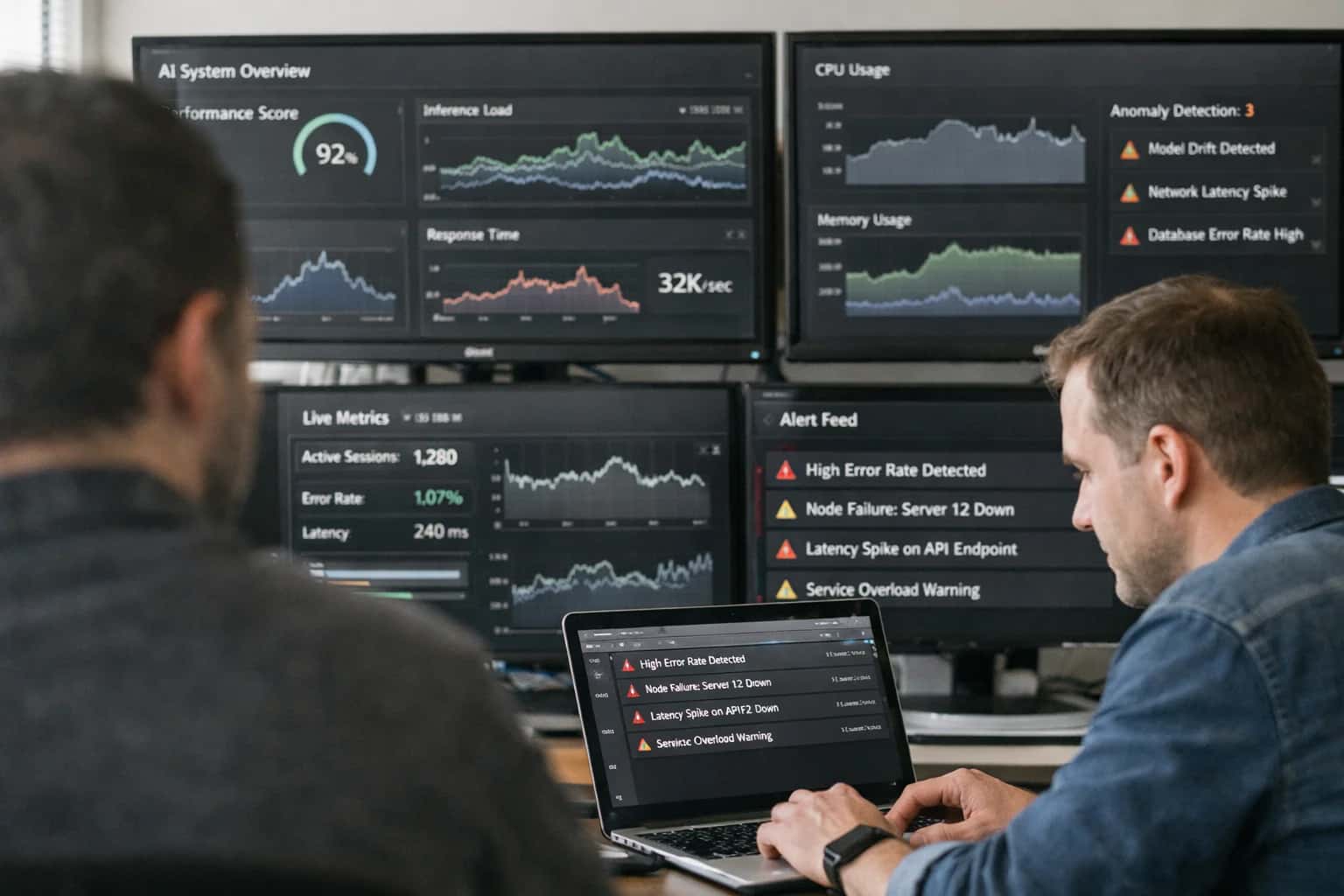
CONTINUOUS COMPLIANCE
What is Post-Market Monitoring?
Post-market monitoring is the regulatory requirement for providers to continuously monitor the real-world performance and safety of an AI system after it has been placed on the market.
The output of this monitoring directly feeds into the Algorithmic Impact Assessment lifecycle, triggering mandatory reporting to market surveillance authorities when serious incidents or safety risks are identified. Effective post-market monitoring requires a robust audit trail and automated telemetry to distinguish between acceptable operational variance and a systemic failure requiring model retraining or decommissioning.
CONTINUOUS COMPLIANCE
Core Components of Post-Market Monitoring
Post-market monitoring is a regulatory mandate requiring providers to systematically collect and analyze real-world performance data after deployment. These core components form the technical and procedural backbone of a compliant monitoring plan.
01
Real-World Performance Logging
The automated capture of all AI system inputs, inferences, and outcomes in a production environment. This is distinct from pre-deployment evaluation data and forms the basis for detecting concept drift and model degradation. Logs must capture the raw input, the model's output, any confidence scores, and the version of the model artifact that served the request. This data serves as the primary evidence for an audit trail.
02
Automated Drift Detection
A statistical subsystem that continuously compares the distribution of live production data against the baseline training data. It triggers an alert when a significant divergence is detected. Key metrics include:
- Data Drift: A change in the input feature distribution (e.g., a sudden shift in user demographics).
- Concept Drift: A change in the relationship between the inputs and the target variable (e.g., a fraud pattern that evolves to evade the model).
- Prediction Drift: A change in the model's output distribution, often a symptom of the first two.
03
Incident Reporting Pipeline
A formal, documented procedure for reporting serious incidents or malfunctions to market surveillance authorities. Under the EU AI Act, a 'serious incident' is any event that directly or indirectly leads to death, serious harm to health or property, or a serious disruption of critical infrastructure. The pipeline must define clear escalation paths, root-cause analysis protocols, and strict reporting timelines. This is a core component of the AI Incident Response framework.
04
Feedback Loop Integration
A technical mechanism that captures end-user feedback and operational outcomes to create a virtuous cycle of improvement. This includes:
- Explicit Feedback: A 'thumbs down' or 'report' button that captures a user's direct dissatisfaction.
- Implicit Feedback: Observing that a user immediately copied and pasted an AI-generated text into a different tool, signaling a failure.
- Outcome Feedback: A downstream system confirming the AI's prediction was correct (e.g., a predicted fraudulent transaction was confirmed as fraud by a human analyst).
05
Continuous Conformity Assessment
The ongoing verification that a high-risk AI system continues to meet its original compliance requirements after any modification or retraining. A substantial modification—such as a change to the model's intended purpose or a parameter-efficient fine-tuning update—may trigger a new conformity assessment. This process relies on automated policy-as-code checks to ensure that updated models do not violate pre-defined fairness or robustness thresholds before deployment.
06
Record-Keeping & Audit Trail Immutability
The generation and secure storage of tamper-proof logs that provide a complete, chronological record of the monitoring system's own operation. This is a meta-requirement proving that monitoring was active and effective. Techniques include cryptographic hashing of log entries and append-only storage architectures. These records are critical for demonstrating compliance to notified bodies and for fulfilling the right to explanation under GDPR.
POST-MARKET MONITORING
Frequently Asked Questions
Clear answers to the most common questions about the regulatory and technical requirements for continuously monitoring AI systems after deployment.
Post-market monitoring is a regulatory requirement mandating that providers of high-risk AI systems continuously and systematically collect, document, and analyze data on the real-world performance and safety of their systems after they have been placed on the market. This is not a one-time audit but a continuous lifecycle obligation under frameworks like the EU AI Act. The process involves tracking key performance indicators, detecting concept drift, identifying unforeseen risks, and logging incidents. The goal is to ensure that the system's residual risk remains acceptable and that any emerging hazards are promptly identified and mitigated, feeding back into the risk management system for corrective action.
Enabling Efficiency, Speed & Accuracy
Intelligent Analysis, Decision & Execution
We build AI systems for teams that need search across company data, workflow automation across tools, or AI features inside products and internal software.
Talk to Us
Search across company data
Give teams answers from docs, tickets, runbooks, and product data with sources and permissions.
Useful when people spend too long searching or get different answers from different systems.
Enterprise searchRAGPermissions
Read more
Automate internal workflows
Use AI to route work, draft outputs, trigger actions, and keep approvals and logs in place.
Useful when repetitive work moves across multiple tools and teams.
AI agentsWorkflow automationGovernance
Read more
Add AI to products and internal tools
Build assistants, guided actions, or decision support into the software your team or customers already use.
Useful when AI needs to be part of the product, not a separate tool.
AI integrationDecision supportModel routing
Read more
About the author
Prasad Kumkar
CEO & MD, Inference Systems
Prasad Kumkar is the CEO & MD of Inference Systems and writes about AI systems architecture, LLM infrastructure, model serving, evaluation, and production deployment. Over 5+ years, he has worked across computer vision models, L5 autonomous vehicle systems, and LLM research, with a focus on taking complex AI ideas into real-world engineering systems.
His work and writing cover AI systems, large language models, AI agents, multimodal systems, autonomous systems, inference optimization, RAG, evaluation, and production AI engineering.
LinkedIn
Limited slotsGet a Free AI Consultation
Partnered with leading AI, data, and software stack.





How We Work
Custom AI workflows for your Business
One-fit-all AI don't work for modern businesses. At Inferensys, we aim to understand your business & custom requirements; which we use to define most efficient agentic workflows, the data, and the tools for your business.
01
Review the use case
We understand the task, the users, and where AI can actually help.
Read more02
Pick the right approach
We define what needs search, automation, or product integration.
Read more03
Build the first useful version
We implement the part that proves the value first.
Read more04
Improve from there
We add the checks and visibility needed to keep it useful.
Read moreThe first call is a practical review of your use case and the right next step.
Talk to Us