An audit trail is a chronologically ordered, tamper-proof sequence of records that captures every discrete event within an AI system's lifecycle. Each entry typically includes a timestamp, the identity of the actor (human or automated process), the specific action performed, and the affected data object. This granular logging provides a verifiable reconstruction of system state, enabling forensic analysis and demonstrating adherence to governance policies.

Glossary
Audit Trail
A chronological, immutable record of system activities, data accesses, and decisions that provides verifiable evidence for compliance and forensic analysis.
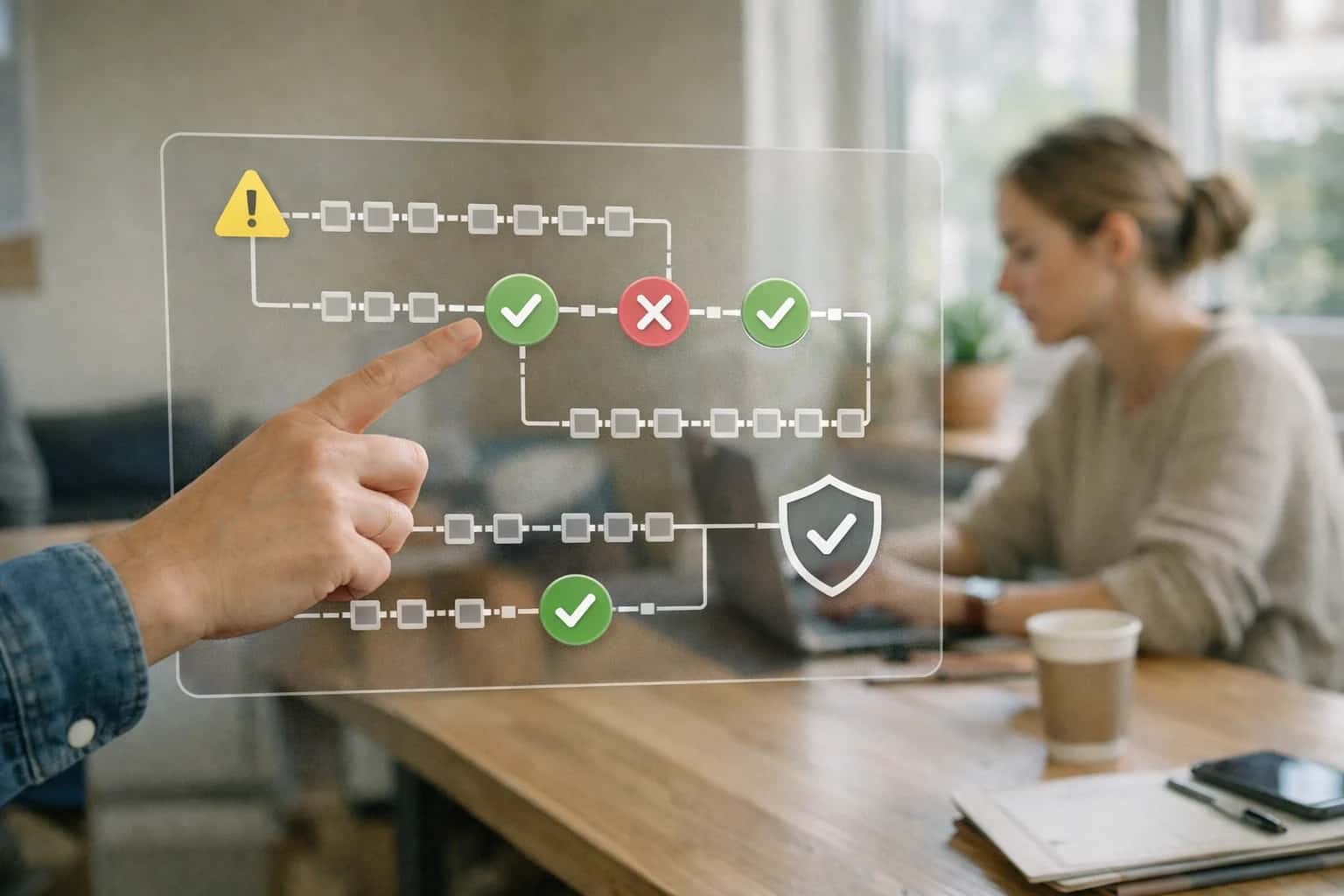
IMMUTABLE RECORD
What is an Audit Trail?
An audit trail is a chronological, immutable record of system activities, data accesses, and decisions that provides verifiable evidence for compliance and forensic analysis.
In the context of the EU AI Act and GDPR, a robust audit trail is the foundational mechanism for fulfilling the right to explanation and proving that a decision was not solely automated without meaningful human intervention. By ensuring data lineage and non-repudiation, the audit trail transforms opaque algorithmic processes into accountable, contestable records for regulators and end-users.
IMMUTABLE LOGGING
Core Properties of an AI Audit Trail
An AI audit trail is a chronological, tamper-proof record of system activities, data accesses, and decisions. These core properties ensure the log provides verifiable evidence for compliance, forensic analysis, and contesting automated outcomes.
01
Chronological Ordering
Every event in an audit trail must be recorded with a precise, synchronized timestamp to establish a definitive sequence of operations. This temporal ordering is critical for reconstructing the causal chain of events leading to a specific decision.
- NTP/PTP Synchronization: Clocks across distributed system components must be synchronized using Network Time Protocol or Precision Time Protocol to prevent clock skew from corrupting the event sequence.
- Lamport Timestamps: In highly concurrent, distributed agentic systems, logical clocks like Lamport timestamps may supplement physical timestamps to capture the happened-before relationship between causally linked events.
- Forensic Reconstruction: A correctly ordered log allows an auditor to replay the exact sequence of data fetches, model inferences, and tool calls that produced a specific output.
Microsecond
Typical Granularity
02
Immutability & Non-Repudiation
Once an audit record is written, it must be computationally infeasible to alter or delete it without detection. This property guarantees the integrity of the evidence and prevents a malicious actor from covering their tracks.
- Append-Only Logs: The storage medium must only support the creation of new entries, never the modification or deletion of existing ones.
- Cryptographic Hashing: Each log entry should contain a hash of the previous entry, forming a Merkle tree or hash chain. Any alteration to a past record would invalidate all subsequent hashes.
- Digital Signatures: Each entry should be signed by the originating service's private key to provide non-repudiation, proving which component generated the record.
03
Comprehensive Context
An audit record is useless if it only states what happened without explaining why. A complete trail captures the full input context, system state, and external triggers that led to a decision.
- Input Payloads: The raw, unprocessed input data (e.g., a user's prompt, an API call body, a sensor reading) must be logged verbatim.
- Model & Configuration Versioning: The specific version of the AI model, its weights, the prompt template, and any hyperparameters (e.g., temperature, top_p) must be recorded.
- Retrieval Context: For Retrieval-Augmented Generation systems, the exact text chunks fetched from a vector database and injected into the prompt must be included in the log.
- Tool Calls: The full request and response payloads for any external API or tool invoked by an agent must be captured.
04
Tamper-Evident Storage
The physical or logical storage layer must be architected to resist tampering, ensuring the immutability property holds under real-world threat models. This often involves write-once, read-many (WORM) compliant infrastructure.
- WORM Compliance: Storage solutions like AWS S3 Object Lock in Governance mode or specialized WORM drives prevent any user, including root administrators, from overwriting data before a defined retention date.
- Decentralized Verification: For the highest assurance, a hash of a batch of log entries can be anchored to a public blockchain. This provides a globally verifiable timestamp and an immutable proof of existence without relying on a single trusted party.
- Access Control: Strict Identity and Access Management policies must segregate duties, ensuring the entity writing logs cannot also modify the storage policy or delete the log bucket.
05
Verifiable Integrity
The system must provide a mechanism for an independent third-party auditor to cryptographically verify that a log has not been altered since it was created, without needing to trust the system's operators.
- Merkle Tree Proofs: By structuring the log as a Merkle tree, an auditor can verify the inclusion of a specific record by providing only a small, logarithmic-sized proof (the Merkle path) and the root hash.
- Zero-Knowledge Proofs: Advanced systems can use ZK-proofs to allow an auditor to verify that a log is compliant with a specific policy (e.g., "no PII was logged") without revealing the raw log data itself.
- Continuous Auditing: Automated scripts can continuously re-compute the hash chain and compare it against a trusted, independently stored root hash to detect any tampering in near real-time.
AUDIT TRAIL ESSENTIALS
Frequently Asked Questions
Clear, technical answers to the most common questions about establishing immutable, verifiable records of system activities for AI governance and compliance.
An audit trail is a chronological, immutable record of system activities, data accesses, and decisions that provides verifiable evidence for compliance and forensic analysis. It works by automatically capturing discrete events—such as user authentication, data queries, model inferences, and configuration changes—as timestamped log entries. Each entry typically includes a subject (who or what performed the action), an action (what was done), a resource (what was affected), and a result (the outcome). These logs are then secured using cryptographic hashing or append-only storage architectures to ensure non-repudiation, meaning no party can deny their actions. In AI systems, an audit trail captures the full decision lineage, including the input data, model version, hyperparameters, and the specific inference output, enabling downstream explainability and regulatory reporting.
Enabling Efficiency, Speed & Accuracy
Intelligent Analysis, Decision & Execution
We build AI systems for teams that need search across company data, workflow automation across tools, or AI features inside products and internal software.
Talk to Us
Search across company data
Give teams answers from docs, tickets, runbooks, and product data with sources and permissions.
Useful when people spend too long searching or get different answers from different systems.
Enterprise searchRAGPermissions
Read more
Automate internal workflows
Use AI to route work, draft outputs, trigger actions, and keep approvals and logs in place.
Useful when repetitive work moves across multiple tools and teams.
AI agentsWorkflow automationGovernance
Read more
Add AI to products and internal tools
Build assistants, guided actions, or decision support into the software your team or customers already use.
Useful when AI needs to be part of the product, not a separate tool.
AI integrationDecision supportModel routing
Read more
About the author
Prasad Kumkar
CEO & MD, Inference Systems
Prasad Kumkar is the CEO & MD of Inference Systems and writes about AI systems architecture, LLM infrastructure, model serving, evaluation, and production deployment. Over 5+ years, he has worked across computer vision models, L5 autonomous vehicle systems, and LLM research, with a focus on taking complex AI ideas into real-world engineering systems.
His work and writing cover AI systems, large language models, AI agents, multimodal systems, autonomous systems, inference optimization, RAG, evaluation, and production AI engineering.
LinkedIn
Limited slotsGet a Free AI Consultation
Partnered with leading AI, data, and software stack.





How We Work
Custom AI workflows for your Business
One-fit-all AI don't work for modern businesses. At Inferensys, we aim to understand your business & custom requirements; which we use to define most efficient agentic workflows, the data, and the tools for your business.
01
Review the use case
We understand the task, the users, and where AI can actually help.
Read more02
Pick the right approach
We define what needs search, automation, or product integration.
Read more03
Build the first useful version
We implement the part that proves the value first.
Read more04
Improve from there
We add the checks and visibility needed to keep it useful.
Read moreThe first call is a practical review of your use case and the right next step.
Talk to Us