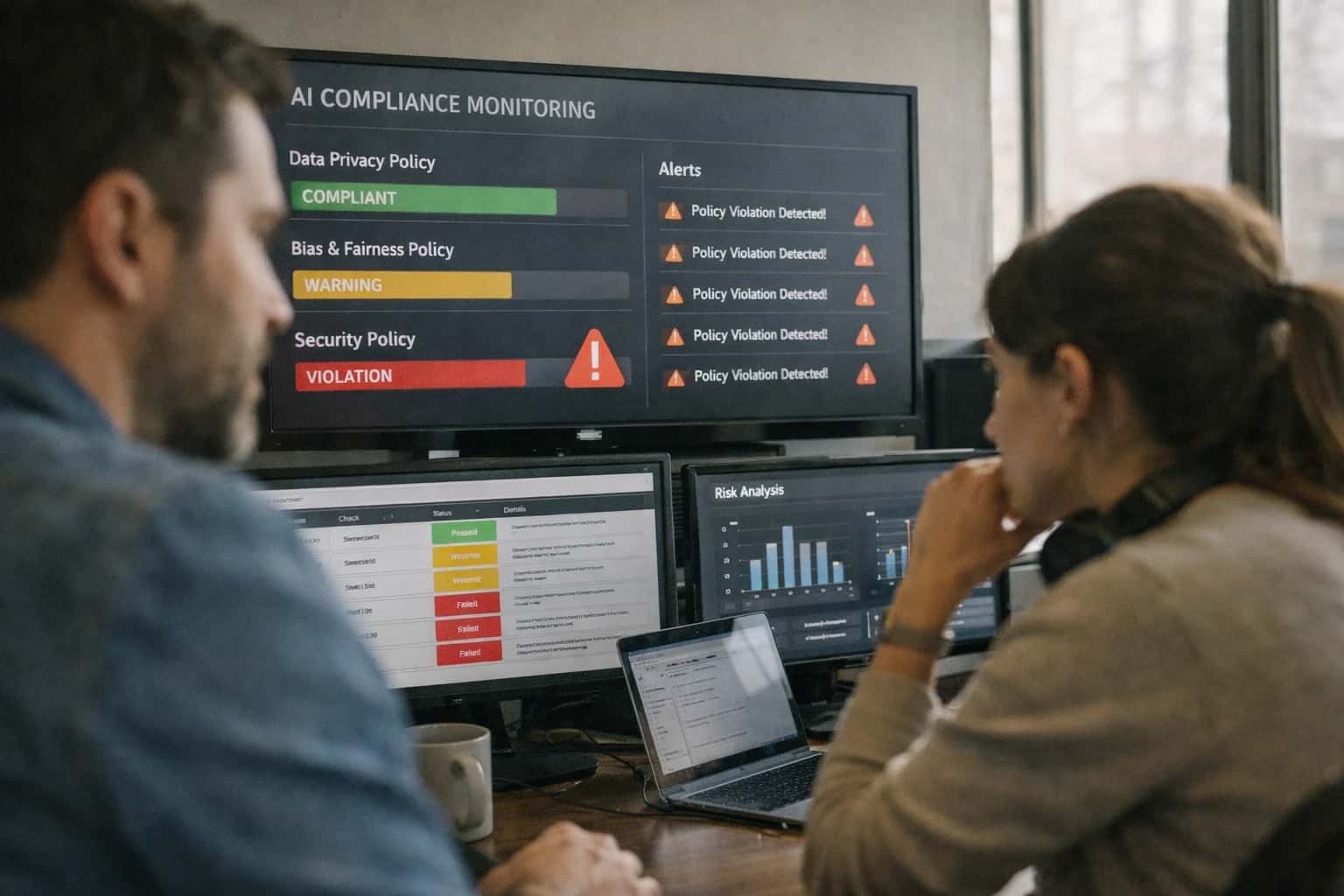
Post-market monitoring is a mandatory, provider-driven process defined in the EU AI Act requiring the continuous, systematic collection and analysis of data on a high-risk AI system's performance after market placement. This is not a one-time audit but a permanent feedback loop designed to identify emerging risks, novel failure modes, and unforeseen misuse that were not apparent during the pre-market conformity assessment. The process directly feeds the provider's risk management system, enabling iterative updates to risk mitigation measures based on real-world operational data rather than theoretical assumptions.

Glossary
Post-Market Monitoring
The continuous, systematic process by which a provider collects and analyzes real-world data on the performance of a deployed AI system to identify emerging risks and ensure ongoing compliance.
CONTINUOUS COMPLIANCE
What is Post-Market Monitoring?
Post-market monitoring is the systematic, lifecycle-long process of collecting and analyzing real-world performance data from a deployed AI system to detect emerging risks and verify ongoing regulatory compliance.
The monitoring plan must be documented in the technical documentation and is proportional to the system's risk profile. Providers are obligated to immediately report any serious incident—defined as a malfunction leading to death or serious harm—to the relevant market surveillance authority. This mechanism closes the gap between laboratory validation and complex, dynamic deployment environments, ensuring that a CE marking remains a valid indicator of safety and trustworthiness throughout the entire operational lifecycle of the artificial intelligence system.
CONTINUOUS COMPLIANCE
Core Characteristics of Post-Market Monitoring
Post-market monitoring (PMM) is a legally mandated, systematic process for collecting and analyzing real-world data on a deployed AI system's performance. It is the active, ongoing counterpart to the pre-market conformity assessment, designed to close the gap between anticipated risks and emergent reality.
01
Continuous Data Collection Plan
A documented, proactive strategy for gathering data from real-world use, not passive complaint waiting. This plan must define the specific metrics, collection methods, and feedback channels used to capture performance data.
- User Feedback Mechanisms: Embedded interfaces for deployers and end-users to report issues or unexpected outputs.
- Automated Telemetry: Direct collection of system logs, input/output pairs, and performance metrics from the live environment.
- Relevant Documentation: The plan itself is a critical part of the Technical Documentation required under the EU AI Act (Art. 11).
02
Emerging Risk Identification
The core objective of PMM is to detect novel risks that were not reasonably foreseeable during the initial Risk Management System analysis. This involves analyzing collected data for anomalies, drift, and failure modes.
- Data Drift Analysis: Statistically comparing live input data distributions against the original training and validation datasets to detect shifts.
- Model Decay Detection: Monitoring for degradation in key performance indicators (e.g., accuracy, precision) over time.
- Systemic Risk Triggers: For General Purpose AI (GPAI) models, identifying capabilities that could lead to large-scale harm.
03
Serious Incident Reporting
A non-negotiable legal obligation triggered when a malfunction or failure of the AI system directly or indirectly leads to a specific harm threshold. This is a reactive but critical component of the PMM framework.
- Reporting Deadline: Providers must notify the relevant Market Surveillance Authority immediately, typically within 15 days of becoming aware of the incident.
- Reportable Harm: Includes death, serious damage to health, or serious and irreversible damage to property.
- Investigation Protocol: The report must include a root cause analysis and a description of the immediate corrective actions taken.
04
Corrective Action & Feedback Loop
PMM is not just an observation exercise; it mandates a closed-loop system that feeds findings back into the AI lifecycle to trigger mandatory updates. This ensures the system remains compliant over time.
- Mandatory Provider Action: If a risk is identified, the provider must immediately take corrective measures, which may include withdrawing or recalling the system.
- Substantial Modification Trigger: A significant performance change identified through PMM may constitute a Substantial Modification, requiring a new Conformity Assessment.
- Risk Management Update: Findings must be systematically fed back to update the original risk assessment and mitigation strategies.
05
Deployer Monitoring Obligations
The responsibility for PMM is shared. Deployers of high-risk AI systems have a legal duty to monitor the system's operation and report any suspected risks to the provider, creating a collaborative surveillance network.
- Operational Monitoring: Deployers must ensure human oversight and monitor for signs of malfunction or unexpected behavior in their specific use context.
- Data Provision: Deployers are obligated to provide relevant data back to the provider to facilitate the provider's own PMM activities.
- Fundamental Rights Impact: Deployers must monitor for impacts on fundamental rights that were identified in their Fundamental Rights Impact Assessment.
06
Integration with Quality Management
PMM is a formal, auditable component of the provider's mandatory Quality Management System (QMS) . It must be a documented, controlled, and continuously improved process, not an ad-hoc activity.
- Audit Trail: All monitoring data, risk analyses, and corrective actions must be logged immutably for audit purposes.
- QMS Documentation: The PMM plan, procedures, and reports are key artifacts reviewed during a Conformity Assessment by a Notified Body.
- Continuous Improvement: The QMS must ensure that lessons learned from PMM are used to improve the design and development of future AI systems.
Enabling Efficiency, Speed & Accuracy
Intelligent Analysis, Decision & Execution
We build AI systems for teams that need search across company data, workflow automation across tools, or AI features inside products and internal software.
Talk to Us
Search across company data
Give teams answers from docs, tickets, runbooks, and product data with sources and permissions.
Useful when people spend too long searching or get different answers from different systems.
Enterprise searchRAGPermissions
Read more
Automate internal workflows
Use AI to route work, draft outputs, trigger actions, and keep approvals and logs in place.
Useful when repetitive work moves across multiple tools and teams.
AI agentsWorkflow automationGovernance
Read more
Add AI to products and internal tools
Build assistants, guided actions, or decision support into the software your team or customers already use.
Useful when AI needs to be part of the product, not a separate tool.
AI integrationDecision supportModel routing
Read morePOST-MARKET MONITORING
Frequently Asked Questions
Essential questions about the continuous, systematic process by which providers collect and analyze real-world data on deployed AI systems to identify emerging risks and ensure ongoing compliance.
Post-market monitoring (PMM) is the continuous, systematic process by which a provider collects and analyzes real-world data on the performance of a deployed AI system to identify emerging risks and ensure ongoing compliance with regulatory requirements. Unlike pre-market conformity assessments, PMM operates throughout the entire lifecycle of the system after it has been placed on the market. Under the EU AI Act, providers of high-risk AI systems are legally obligated to establish and document a post-market monitoring system that is proportionate to the nature of the AI technology and the risks it presents. This system must actively and systematically gather, document, and analyze relevant data provided by deployers or collected through other sources on the performance of high-risk AI systems throughout their lifetime. The core objective is to detect any unforeseen risks, serious incidents, or substantial modifications that may necessitate immediate corrective action, including market withdrawal or recall.

About the author
Prasad Kumkar
CEO & MD, Inference Systems
Prasad Kumkar is the CEO & MD of Inference Systems and writes about AI systems architecture, LLM infrastructure, model serving, evaluation, and production deployment. Over 5+ years, he has worked across computer vision models, L5 autonomous vehicle systems, and LLM research, with a focus on taking complex AI ideas into real-world engineering systems.
His work and writing cover AI systems, large language models, AI agents, multimodal systems, autonomous systems, inference optimization, RAG, evaluation, and production AI engineering.
LinkedIn
Limited slotsGet a Free AI Consultation
Partnered with leading AI, data, and software stack.





How We Work
Custom AI workflows for your Business
One-fit-all AI don't work for modern businesses. At Inferensys, we aim to understand your business & custom requirements; which we use to define most efficient agentic workflows, the data, and the tools for your business.
01
Review the use case
We understand the task, the users, and where AI can actually help.
Read more02
Pick the right approach
We define what needs search, automation, or product integration.
Read more03
Build the first useful version
We implement the part that proves the value first.
Read more04
Improve from there
We add the checks and visibility needed to keep it useful.
Read moreThe first call is a practical review of your use case and the right next step.
Talk to Us