Runbook Automation translates manual operational procedures into executable code, enabling systems to automatically triage and resolve known failure modes without human intervention. By codifying if-this-then-that logic for common incidents—such as model latency spikes or drift detection alerts—organizations reduce Mean Time To Resolve (MTTR) and eliminate the risk of operator error during high-stress outages.

Glossary
Runbook Automation
The execution of predefined diagnostic and remediation scripts by an automated system to reduce human toil and accelerate mean time to resolution during an AI incident response.
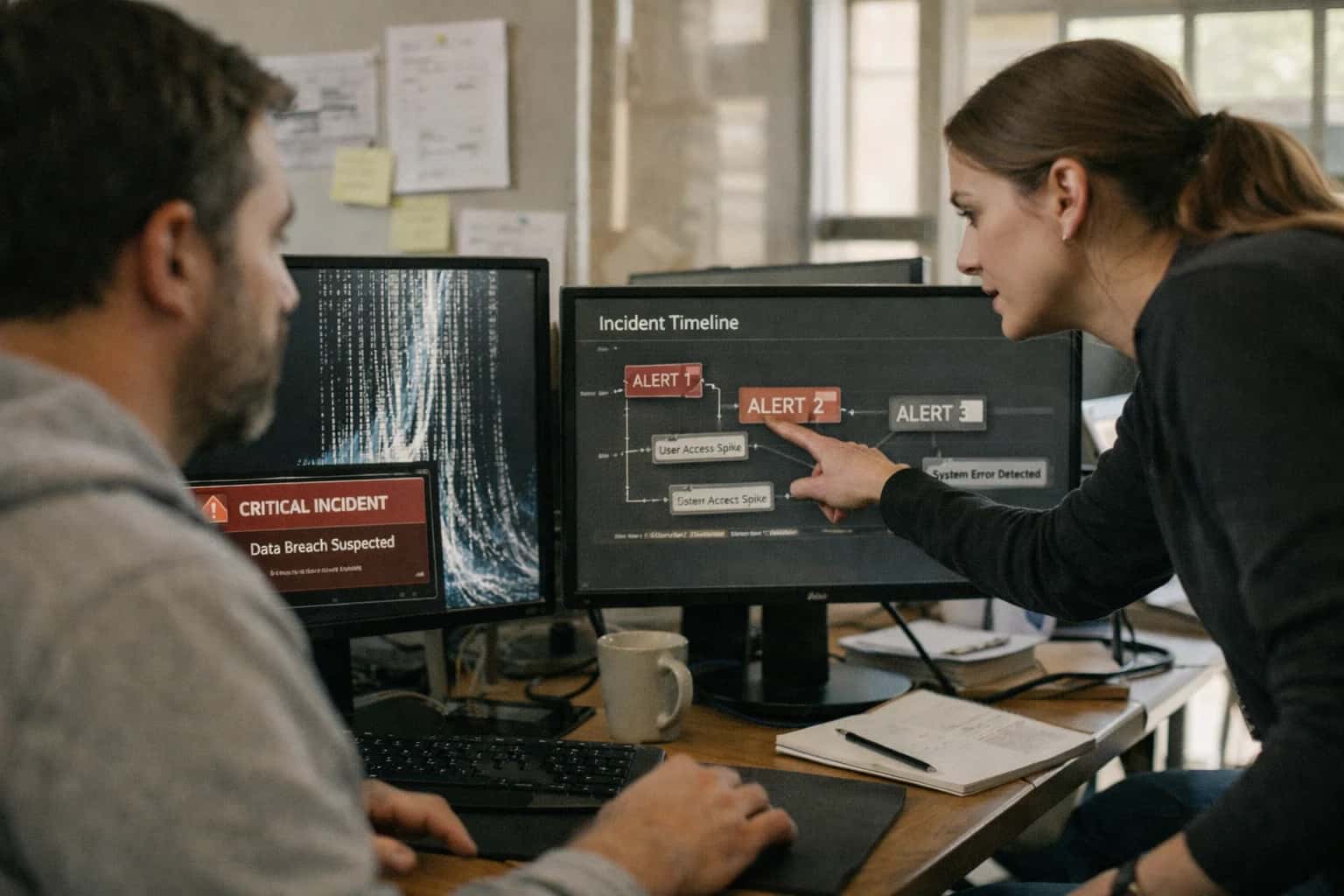
INCIDENT RESPONSE
What is Runbook Automation?
Runbook Automation is the execution of predefined diagnostic and remediation scripts by an automated system to reduce human toil during an AI incident response.
In AI governance, automated runbooks integrate with monitoring stacks to trigger circuit breaker patterns, initiate automated rollback to a stable model version, or quarantine toxic outputs. This ensures deterministic, auditable responses that enforce compliance policies while freeing Site Reliability Engineers to focus on novel failure modes rather than repetitive, manual diagnostics.
RUNBOOK AUTOMATION
Core Characteristics of Automated Runbooks
Automated runbooks replace manual, error-prone incident response checklists with executable code, ensuring consistent, auditable, and rapid remediation of AI system failures.
01
Declarative State Definition
Automated runbooks operate by defining the desired state of a system rather than a sequence of imperative commands. The automation engine continuously reconciles the current state against the target state.
- Idempotency: Scripts can be safely re-executed without side effects
- Self-healing: Drift from the defined state triggers automatic correction
- Example: A runbook declares 'model endpoint must serve version v2.1' and automatically rolls back if v2.2 fails a health check
02
Event-Driven Triggers
Runbooks are initiated by specific observability signals rather than human pager alerts. This eliminates the latency between detection and response.
- Alert webhooks: Prometheus Alertmanager fires a runbook on breach of SLO
- Log pattern matching: A specific error signature in Loki triggers a model rollback
- Metric thresholds: A spike in hallucination rate above 5% invokes a circuit breaker
- Example: A drift detection monitor observes a 3-sigma shift in input feature distribution and automatically triggers a shadow-mode deployment of the previous model version
03
Immutable Audit Trail
Every step executed by an automated runbook is cryptographically logged to provide decision provenance. This is critical for regulatory compliance under the EU AI Act.
- Records the exact model version, input parameters, and action taken
- Provides non-repudiation for post-incident analysis
- Integrates with blameless post-mortem workflows
- Example: An auditor queries the log to verify that a SEV-1 incident triggered a kill switch within the required Recovery Time Objective (RTO) of 5 minutes
04
Human-in-the-Loop Gates
Not all remediation steps are fully autonomous. Mature runbooks include manual approval gates for high-risk actions while automating the diagnostic and preparatory work.
- Auto-diagnosis: The runbook gathers logs, metrics, and stack traces automatically
- Approval step: A human operator reviews the diagnosis before authorizing a model decommissioning
- Escalation: If no approval is received within the deprecation window, the runbook escalates via the defined escalation policy
- Example: A runbook detects a potential data poisoning attack, quarantines the model, and presents evidence to a security engineer before executing a full rollback
05
Integration with Error Budgets
Automated runbooks are governed by error budget policies to balance reliability with feature velocity. Exhausting the error budget triggers a freeze on new deployments.
- Burn rate alerts: A high burn rate triggers a runbook that automatically scales back canary traffic
- Automatic freeze: When the error budget is fully consumed, the runbook blocks CI/CD pipelines from deploying new model versions
- Graceful degradation: Runbooks implement load shedding and bulkhead isolation to protect remaining budget
- Example: A runbook monitors the burn rate and, at 80% budget consumption, automatically reduces the traffic split for a canary deployment from 10% to 1%
06
Versioned and Tested as Code
Runbooks are stored in Git repositories alongside application code, enabling peer review, testing, and rollback of the automation logic itself.
- Infrastructure as Code (IaC): Runbooks are defined using tools like Terraform or Pulumi
- Chaos engineering: Runbooks are tested against injected failures in staging environments
- Continuous validation: Scheduled dry-runs verify runbook syntax and permissions without executing actions
- Example: A team practices a simulated cascading failure scenario where a model outage propagates to dependent services, validating that the runbook correctly isolates the fault domain
RUNBOOK AUTOMATION FAQ
Frequently Asked Questions
Clear answers to common questions about automating incident response with predefined diagnostic and remediation scripts.
Runbook automation is the execution of predefined diagnostic and remediation scripts by an automated system to reduce human toil during an AI incident response. It transforms manual operational procedures—traditionally documented in static runbooks—into executable code that a machine can trigger without human intervention. When a monitoring system detects an anomaly, such as a spike in hallucination rate or a drift detection alert, the automation engine executes a sequence of steps: it queries logs, checks model serving health endpoints, captures a sample of problematic inputs, and if conditions match a known failure pattern, initiates a model rollback or circuit breaker action. This eliminates the latency of paging a human operator at 3 a.m. and ensures a consistent, auditable response. The core components include an event trigger, a decision tree encoded in a workflow definition language, integration with infrastructure APIs, and a dead letter queue for unprocessable requests. By codifying the expertise of senior site reliability engineers, runbook automation ensures that junior responders and autonomous systems can resolve incidents with the same precision as a veteran, drastically reducing Mean Time To Resolve (MTTR).
Enabling Efficiency, Speed & Accuracy
Intelligent Analysis, Decision & Execution
We build AI systems for teams that need search across company data, workflow automation across tools, or AI features inside products and internal software.
Talk to Us
Search across company data
Give teams answers from docs, tickets, runbooks, and product data with sources and permissions.
Useful when people spend too long searching or get different answers from different systems.
Enterprise searchRAGPermissions
Read more
Automate internal workflows
Use AI to route work, draft outputs, trigger actions, and keep approvals and logs in place.
Useful when repetitive work moves across multiple tools and teams.
AI agentsWorkflow automationGovernance
Read more
Add AI to products and internal tools
Build assistants, guided actions, or decision support into the software your team or customers already use.
Useful when AI needs to be part of the product, not a separate tool.
AI integrationDecision supportModel routing
Read more
About the author
Prasad Kumkar
CEO & MD, Inference Systems
Prasad Kumkar is the CEO & MD of Inference Systems and writes about AI systems architecture, LLM infrastructure, model serving, evaluation, and production deployment. Over 5+ years, he has worked across computer vision models, L5 autonomous vehicle systems, and LLM research, with a focus on taking complex AI ideas into real-world engineering systems.
His work and writing cover AI systems, large language models, AI agents, multimodal systems, autonomous systems, inference optimization, RAG, evaluation, and production AI engineering.
LinkedIn
Limited slotsGet a Free AI Consultation
Partnered with leading AI, data, and software stack.





How We Work
Custom AI workflows for your Business
One-fit-all AI don't work for modern businesses. At Inferensys, we aim to understand your business & custom requirements; which we use to define most efficient agentic workflows, the data, and the tools for your business.
01
Review the use case
We understand the task, the users, and where AI can actually help.
Read more02
Pick the right approach
We define what needs search, automation, or product integration.
Read more03
Build the first useful version
We implement the part that proves the value first.
Read more04
Improve from there
We add the checks and visibility needed to keep it useful.
Read moreThe first call is a practical review of your use case and the right next step.
Talk to Us