An Incident Severity Level is a classification taxonomy, typically ranging from SEV-1 (critical) to SEV-5 (cosmetic), used to prioritize AI incident response based on the magnitude of business or societal harm. It provides a standardized framework for quantifying the impact of model degradation, safety violations, or system outages, ensuring that the most damaging events receive immediate engineering attention.

Glossary
Incident Severity Level
A classification taxonomy (e.g., SEV-1 to SEV-5) used to prioritize AI incident response based on the magnitude of business or societal harm.
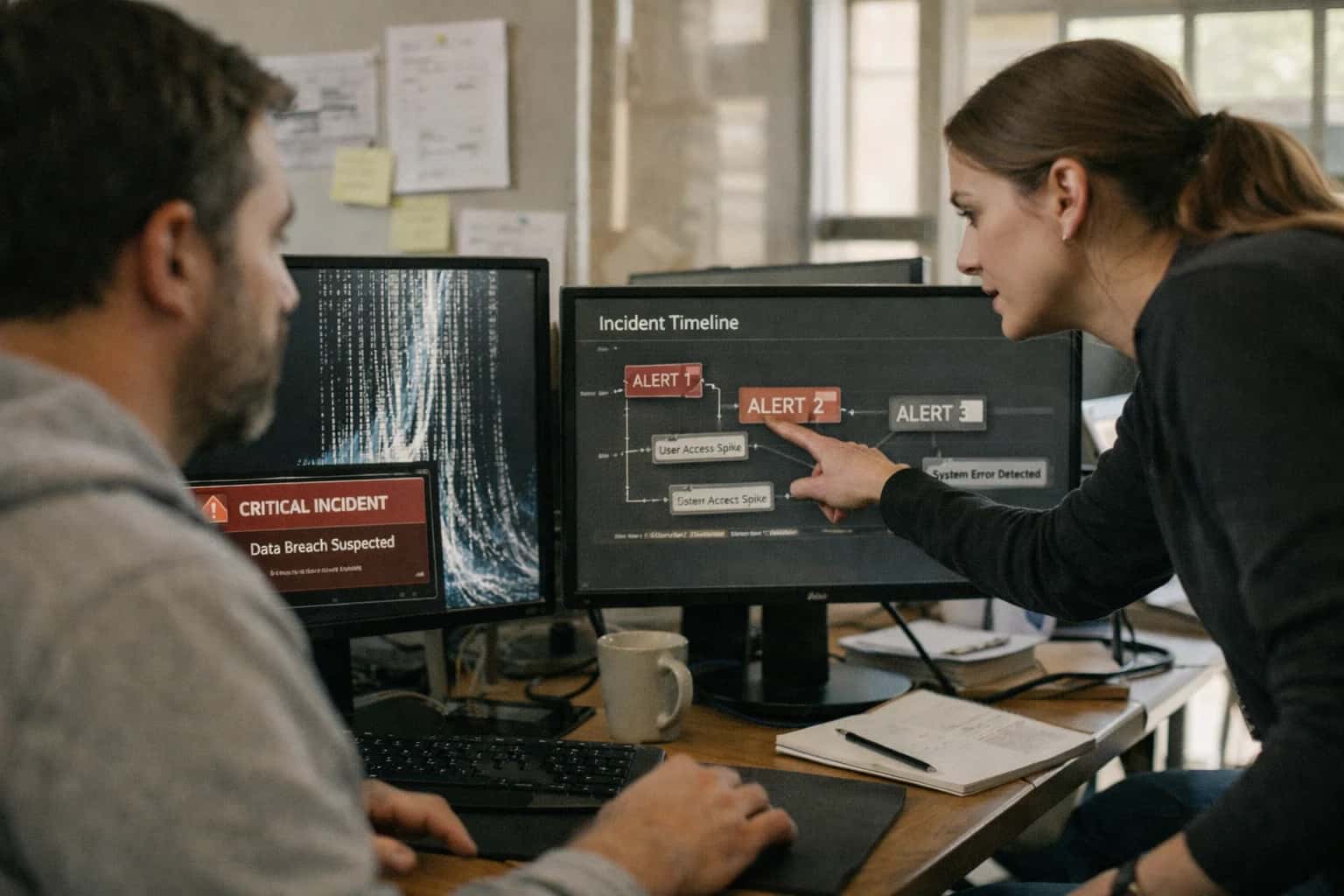
CLASSIFICATION TAXONOMY
What is Incident Severity Level?
A structured ranking system used to categorize AI incidents by the magnitude of harm, dictating response urgency and resource allocation.
Severity is determined by assessing the blast radius of the failure, including factors like financial loss, user safety risk, and regulatory non-compliance. This classification directly triggers specific escalation policies and Recovery Time Objectives (RTOs), linking operational response to predefined error budgets and service level objectives.
INCIDENT SEVERITY FRAMEWORKS
Core Characteristics of Severity Taxonomies
A robust severity taxonomy is the backbone of effective AI incident response, translating technical failures into business impact. These core characteristics define how incidents are classified, prioritized, and escalated.
01
Business Impact Alignment
Severity levels must be defined by business or societal harm, not the underlying technical cause. A SEV-1 incident is not a 'database outage'; it is a 'complete halt of customer transactions' or a 'safety-critical model outputting dangerous instructions.' This alignment ensures that response efforts are proportional to the actual damage, preventing engineering teams from over-prioritizing technically interesting but low-impact bugs. Effective taxonomies map directly to Service Level Objectives (SLOs) and revenue impact.
- SEV-1: Critical business function down, safety incident, or massive data breach.
- SEV-2: Major feature impaired with no workaround, significant user impact.
- SEV-3: Partial, non-critical feature loss with a viable workaround.
02
Clear, Actionable Definitions
Each severity level requires an unambiguous, binary-tested definition to eliminate subjective debate during an incident. A common framework uses a decision tree based on user impact scope and functional degradation. For example, a SEV-1 might be defined as '>50% of users receiving errors on a core transaction flow.' This prevents 'severity creep' where every issue is declared a top-priority emergency. The definition should be a simple checklist that an on-call engineer can apply in seconds.
- Scope: What percentage of users or requests are affected?
- Functionality: Is the system completely down, severely degraded, or slightly slow?
- Workaround: Does a manual bypass exist for the affected users?
03
Strict Response Triggers
A severity taxonomy is useless without automated and manual triggers that enforce it. Each level must be bound to specific response Service Level Agreements (SLAs) for acknowledgment and resolution. A SEV-1 incident typically triggers immediate paging of the on-call Incident Commander, a dedicated war room, and executive stakeholder notification within 15 minutes. These triggers are often linked to error budgets and burn rate alerts, automatically escalating an incident if the Mean Time To Acknowledge (MTTA) is breached.
- SEV-1: Page immediately, war room in 5 minutes, status update every 30 minutes.
- SEV-2: Page immediately, acknowledge in 30 minutes, status update every 2 hours.
- SEV-3: Auto-create ticket, triage during business hours.
04
Model-Specific Harm Criteria
AI systems introduce novel failure modes that traditional software taxonomies miss. A dedicated AI severity taxonomy must include criteria for algorithmic harm, such as biased outputs, model hallucination rates, or toxic content generation. A SEV-1 could be triggered by a model exhibiting a sudden spike in racial bias or generating dangerous medical advice, even if the API itself is technically 'healthy.' This requires integrating guardrail violation metrics and drift detection outputs directly into the severity classification logic.
- Safety Violation: Model outputs violating content safety policies.
- Fairness Degradation: A statistically significant increase in a bias metric.
- Factual Grounding Loss: Hallucination rate exceeding a critical threshold.
05
Escalation Path Clarity
The taxonomy must define not just the severity but the exact escalation path. A SEV-1 incident automatically pulls in a designated Incident Commander, a Scribe, and a Communications Lead. It also specifies which external stakeholders (e.g., legal, PR, customer support) must be engaged based on the incident's nature. For AI incidents, this often includes a dedicated AI Ethics Officer or a compliance lead if the failure involves a regulated decision. The policy removes ambiguity about who has the authority to declare an incident resolved.
06
Post-Incident Review Linkage
The final severity level assigned to an incident directly dictates the depth of the required post-mortem analysis. A SEV-1 incident mandates a formal, blameless post-mortem document with a rigorous root cause analysis and tracked remediation items within 5 business days. A SEV-3 might only require a lightweight retrospective note. This linkage ensures that the organization's learning and preventive investment are proportional to the incident's impact, creating a closed feedback loop from detection to systemic improvement.
INCIDENT CLASSIFICATION TAXONOMY
Common Severity Level Definitions
Standardized severity tiers used to prioritize AI incident response based on business impact, user harm, and regulatory exposure.
| Severity | Designation | Business Impact | Response SLA | Example AI Incident |
|---|---|---|---|---|
SEV-1 | Critical | Complete service outage, severe user harm, or regulatory breach in progress | < 15 min acknowledge, < 1 hr resolve | Model serving bias causing discriminatory loan denials at scale |
SEV-2 | High | Major feature degradation affecting >25% of users or significant revenue loss | < 30 min acknowledge, < 4 hr resolve | Hallucination rate spike to 12% in customer-facing chatbot |
SEV-3 | Medium | Partial degradation affecting <25% of users, no revenue impact | < 2 hr acknowledge, < 24 hr resolve | Drift detection alert on non-critical inference pipeline |
SEV-4 | Low | Minor cosmetic issue or single-user impact, no SLA breach | < 8 hr acknowledge, < 72 hr resolve | Model output formatting inconsistency in internal dashboard |
SEV-5 | Informational | No user impact, preemptive observation or improvement opportunity | Next business day acknowledge, no resolve SLA | Gradient anomaly detected during shadow mode evaluation |
INCIDENT SEVERITY CLASSIFICATION
Frequently Asked Questions
Clear answers to common questions about defining, assigning, and operationalizing severity levels for AI system failures.
An incident severity level is a classification taxonomy (typically ranging from SEV-1 to SEV-5) used to prioritize AI incident response based on the magnitude of business or societal harm. It provides a shared, objective framework for Site Reliability Engineers (SREs) and Risk Managers to triage failures. The level dictates the urgency of response, the escalation policy triggered, and the resources allocated. Unlike traditional software severity, AI severity incorporates unique dimensions such as hallucination rate, bias amplification, and safety policy violations. For example, a SEV-1 might be declared when a medical diagnostic model exhibits a statistically significant false-negative rate, while a SEV-5 might cover minor latency degradation in a non-critical recommendation engine.
Enabling Efficiency, Speed & Accuracy
Intelligent Analysis, Decision & Execution
We build AI systems for teams that need search across company data, workflow automation across tools, or AI features inside products and internal software.
Talk to Us
Search across company data
Give teams answers from docs, tickets, runbooks, and product data with sources and permissions.
Useful when people spend too long searching or get different answers from different systems.
Enterprise searchRAGPermissions
Read more
Automate internal workflows
Use AI to route work, draft outputs, trigger actions, and keep approvals and logs in place.
Useful when repetitive work moves across multiple tools and teams.
AI agentsWorkflow automationGovernance
Read more
Add AI to products and internal tools
Build assistants, guided actions, or decision support into the software your team or customers already use.
Useful when AI needs to be part of the product, not a separate tool.
AI integrationDecision supportModel routing
Read more
About the author
Prasad Kumkar
CEO & MD, Inference Systems
Prasad Kumkar is the CEO & MD of Inference Systems and writes about AI systems architecture, LLM infrastructure, model serving, evaluation, and production deployment. Over 5+ years, he has worked across computer vision models, L5 autonomous vehicle systems, and LLM research, with a focus on taking complex AI ideas into real-world engineering systems.
His work and writing cover AI systems, large language models, AI agents, multimodal systems, autonomous systems, inference optimization, RAG, evaluation, and production AI engineering.
LinkedIn
Limited slotsGet a Free AI Consultation
Partnered with leading AI, data, and software stack.





How We Work
Custom AI workflows for your Business
One-fit-all AI don't work for modern businesses. At Inferensys, we aim to understand your business & custom requirements; which we use to define most efficient agentic workflows, the data, and the tools for your business.
01
Review the use case
We understand the task, the users, and where AI can actually help.
Read more02
Pick the right approach
We define what needs search, automation, or product integration.
Read more03
Build the first useful version
We implement the part that proves the value first.
Read more04
Improve from there
We add the checks and visibility needed to keep it useful.
Read moreThe first call is a practical review of your use case and the right next step.
Talk to Us