Predictive maintenance (PdM) is a data-driven maintenance strategy that uses machine learning models to analyze real-time sensor data from equipment to predict the remaining useful life (RUL) of components and forecast imminent failures. Unlike reactive or scheduled maintenance, PdM enables condition-based maintenance, where repairs are performed only when a failure is predicted, maximizing asset uptime and reducing unnecessary costs. This approach relies on edge computing to process data locally on industrial machines, minimizing latency and ensuring operational continuity without constant cloud connectivity.

Glossary
Predictive Maintenance
Predictive maintenance is an edge AI application that uses sensor data and machine learning models to forecast equipment failures before they occur, enabling proactive repairs and minimizing downtime.
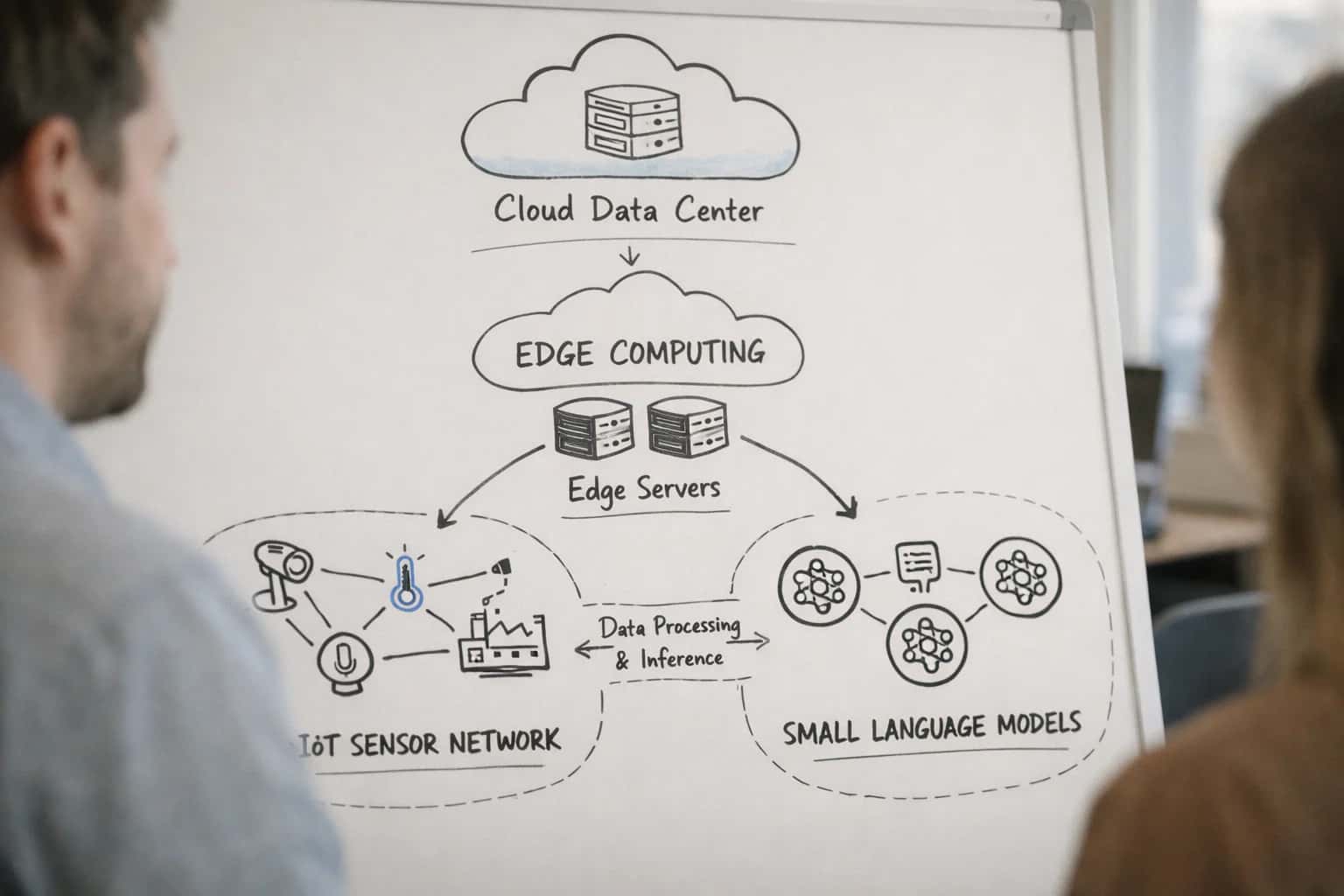
EDGE AI APPLICATION
What is Predictive Maintenance?
Predictive maintenance is an edge AI application that uses sensor data and machine learning models to forecast equipment failures before they occur, enabling proactive repairs and minimizing downtime.
The core technical workflow involves deploying anomaly detection and time-series forecasting models directly onto edge devices or industrial gateways. These models continuously ingest telemetry data—such as vibration, temperature, and acoustic emissions—to identify deviations from normal operational baselines. By predicting failures, organizations can schedule maintenance during planned downtime, avoid catastrophic breakdowns, and optimize spare parts inventory. This application is foundational to Industry 4.0 and smart manufacturing, transforming maintenance from a cost center into a strategic, data-driven operation.
EDGE AI APPLICATIONS
Key Features of Modern Predictive Maintenance
Modern predictive maintenance leverages edge AI to transform raw sensor data into actionable failure forecasts. This approach moves beyond simple threshold alerts to sophisticated, model-driven prognostics.
01
Real-Time Anomaly Detection
Anomaly detection algorithms continuously analyze sensor streams (e.g., vibration, temperature, acoustic) to identify deviations from normal operational baselines. Unlike scheduled checks, this provides immediate alerts for subtle, early-stage faults.
- Key Techniques: Isolation Forests, Autoencoders, One-Class SVMs.
- Edge Advantage: Detects issues in < 100 milliseconds, enabling immediate shutdown protocols to prevent catastrophic failure, without relying on cloud latency.
02
Remaining Useful Life (RUL) Estimation
RUL estimation uses regression models to predict the exact number of operational cycles or time until a component will fail. This transforms maintenance from a reactive or periodic task into a precisely scheduled, proactive operation.
- Core Models: Survival analysis models, LSTM networks, and Gradient Boosting Regressors trained on historical failure data.
- Business Impact: Enables just-in-time part ordering and maximizes asset utilization by scheduling downtime only when truly needed, reducing spare parts inventory by up to 30%.
03
Multi-Sensor Data Fusion
Sensor fusion combines data from heterogeneous sources—vibration sensors, thermal cameras, ultrasonic probes, and current sensors—to create a unified health signature. A single sensor may miss a fault, but fused data provides a high-confidence diagnosis.
- Example: Fusing vibration spectra with motor current signature analysis (MCSA) to distinguish between a bearing fault and an electrical imbalance with >95% accuracy.
- Edge Requirement: Requires local processing to handle high-bandwidth, multi-modal data streams without overwhelming network bandwidth.
04
Digital Twin Integration
An edge digital twin is a physics-informed or data-driven simulation model of the physical asset that runs locally. It uses real-time sensor data to simulate stress, wear, and future performance under various operational scenarios.
- Function: Provides a what-if analysis sandbox at the edge. Engineers can simulate the impact of increased load or different environmental conditions on RUL.
- Outcome: Enables root cause analysis and validates maintenance actions before physical intervention, reducing trial-and-error repairs.
05
Federated Learning for Model Improvement
Federated edge learning allows predictive maintenance models to improve across a fleet of machines without centralizing sensitive operational data. Each device trains a local model on its failure patterns, and only model weight updates are aggregated.
- Privacy Benefit: Original vibration, acoustic, and performance data never leaves the secure facility, crucial for defense and regulated industries.
- Scalability: A model deployed on 100 pumps can learn from rare failure modes experienced by only one, improving accuracy for the entire fleet while preserving data sovereignty.
06
Prescriptive Maintenance Recommendations
Advanced systems move beyond prediction to prescription. Using causal inference and optimization algorithms, the system recommends specific corrective actions—such as "replace bearing B-4," "rebalance rotor," or "reduce operating RPM by 10%"—to mitigate the predicted fault.
- Integration: Combines RUL estimates with maintenance logs, parts databases, and technician schedules.
- ROI Driver: Converts a data insight into a direct work order, closing the loop from detection to resolution and minimizing mean time to repair (MTTR).
MAINTENANCE PARADIGMS
Predictive Maintenance vs. Other Maintenance Strategies
A comparison of core operational characteristics, data requirements, and business impacts across the primary industrial maintenance methodologies.
| Feature / Metric | Reactive (Run-to-Failure) | Preventive (Time-Based) | Predictive (Condition-Based) |
|---|---|---|---|
Core Philosophy | Repair equipment only after a functional failure occurs. | Perform maintenance at fixed, calendar-based intervals. | Perform maintenance based on the actual condition of the asset, forecasted by data and AI. |
Primary Data Source | None (failure event triggers action). | Equipment manufacturer's recommended schedule and operating hours. | Real-time sensor data (vibration, temperature, acoustics, etc.) and historical failure logs. |
Analytical Method | None. | Statistical averages and manufacturer guidelines. | Machine learning models (e.g., anomaly detection, regression, survival analysis) for failure forecasting. |
Downtime Pattern | Unplanned, catastrophic, and often extended. | Planned, scheduled, but may be unnecessary. | Planned, minimized, and optimally timed just prior to predicted failure. |
Spare Parts Inventory | High (must stock for all potential failures). | Moderate (scheduled parts replacement). | Low (parts ordered just-in-time for predicted repairs). |
Maintenance Cost Efficiency | |||
Capital Expenditure (Initial Setup) | Low | Moderate | High (sensors, edge compute, data pipeline) |
Operational Expenditure (Long-term) | High (downtime costs, emergency repairs) | Moderate (scheduled labor, part replacement) | Low (optimized labor, reduced downtime, extended asset life) |
Edge AI & Compute Requirement | None | None | High (requires on-device inference for real-time analytics) |
Prevents Catastrophic Failure | |||
Avoids Unnecessary Maintenance | |||
Typical Implementation Complexity | Low | Medium | High |
PREDICTIVE MAINTENANCE
Frequently Asked Questions
Predictive maintenance is a core edge AI application that uses sensor data and machine learning to forecast equipment failures, enabling proactive repairs. These FAQs address its technical implementation, benefits, and integration within modern industrial systems.
Predictive maintenance is a data-driven maintenance strategy that uses machine learning models to analyze real-time sensor data from equipment to forecast potential failures before they occur, enabling proactive repairs. It works by deploying edge AI models directly on or near industrial assets to process streams of telemetry data (e.g., vibration, temperature, pressure, acoustic emissions). These models, often anomaly detection or time-series forecasting algorithms, learn the normal operational "health" signature of the machine. They continuously compare incoming sensor readings against this learned baseline. When the model detects patterns indicative of an impending fault—such as a gradual increase in vibration harmonics—it triggers an alert or work order, allowing maintenance to be scheduled during planned downtime, thus avoiding catastrophic failure and unplanned outages.
Enabling Efficiency, Speed & Accuracy
Intelligent Analysis, Decision & Execution
We build AI systems for teams that need search across company data, workflow automation across tools, or AI features inside products and internal software.
Talk to Us
Search across company data
Give teams answers from docs, tickets, runbooks, and product data with sources and permissions.
Useful when people spend too long searching or get different answers from different systems.
Enterprise searchRAGPermissions
Read more
Automate internal workflows
Use AI to route work, draft outputs, trigger actions, and keep approvals and logs in place.
Useful when repetitive work moves across multiple tools and teams.
AI agentsWorkflow automationGovernance
Read more
Add AI to products and internal tools
Build assistants, guided actions, or decision support into the software your team or customers already use.
Useful when AI needs to be part of the product, not a separate tool.
AI integrationDecision supportModel routing
Read more
About the author
Prasad Kumkar
CEO & MD, Inference Systems
Prasad Kumkar is the CEO & MD of Inference Systems and writes about AI systems architecture, LLM infrastructure, model serving, evaluation, and production deployment. Over 5+ years, he has worked across computer vision models, L5 autonomous vehicle systems, and LLM research, with a focus on taking complex AI ideas into real-world engineering systems.
His work and writing cover AI systems, large language models, AI agents, multimodal systems, autonomous systems, inference optimization, RAG, evaluation, and production AI engineering.
LinkedIn
Limited slotsGet a Free AI Consultation
Partnered with leading AI, data, and software stack.





How We Work
Custom AI workflows for your Business
One-fit-all AI don't work for modern businesses. At Inferensys, we aim to understand your business & custom requirements; which we use to define most efficient agentic workflows, the data, and the tools for your business.
01
Review the use case
We understand the task, the users, and where AI can actually help.
Read more02
Pick the right approach
We define what needs search, automation, or product integration.
Read more03
Build the first useful version
We implement the part that proves the value first.
Read more04
Improve from there
We add the checks and visibility needed to keep it useful.
Read moreThe first call is a practical review of your use case and the right next step.
Talk to Us